
I get this question from brand owners and wholesalers every quarter when they’re planning new bundle lines or updating wig textures. In my sourcing work across India, Southeast Asia, and LATAM, I’ve handled everything from raw Indian temple hair to “Brazilian-style” blends to lightweight Peruvian textures. I know the pressure: you need consistent hand-feel, curl memory, and longevity—without surprising your customers or overcomplicating aftercare.
Indian hair is fine-to-medium, silky, and naturally straight-to-wavy with strong longevity when cuticles are intact; Brazilian-style hair is medium-to-thick, full, and wavy-to-curly with excellent body and curl retention; Peruvian hair is soft, lightweight, fine-to-medium with straight-to-loose waves and needs gentler handling to maintain durability. Pick Brazilian-style bundles for fuller texture and volume; choose Indian temple hair for smooth blending and versatility; select Peruvian for airy comfort without heaviness—paired with lighter maintenance.
Below I break down what I advise buyers: how the three origins differ operationally, which to choose for fuller looks versus lighter installs, how to match them to specific wave patterns, and the maintenance protocols I recommend by origin to maximize service life.
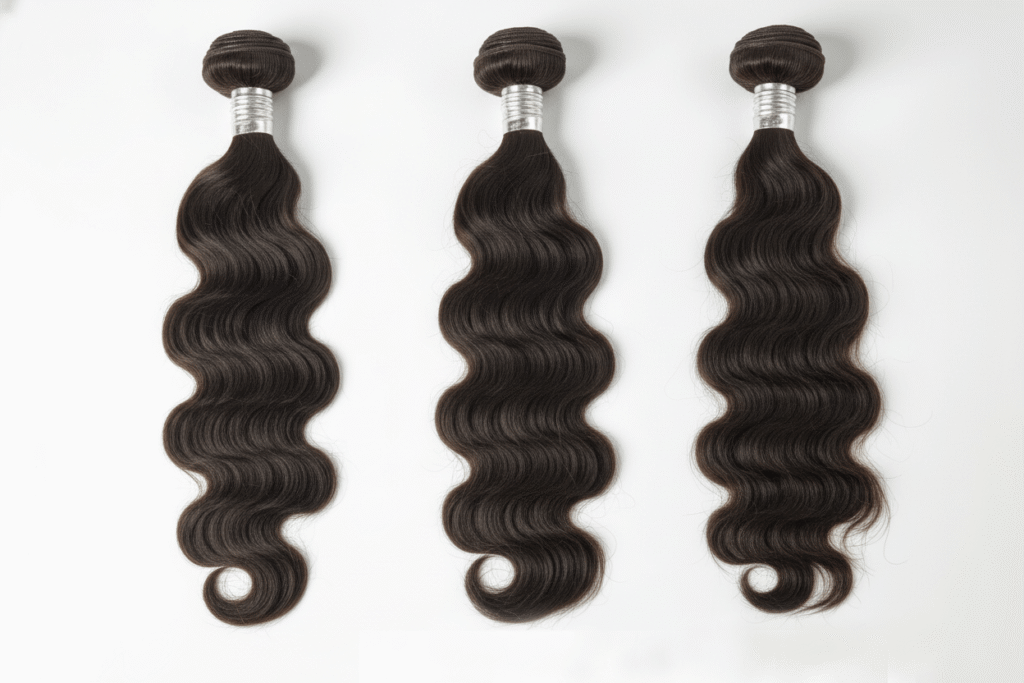
If my customers want fuller texture, should I pick Brazilian-style bundles or Indian temple hair?
The “fullness” decision in B2B terms
- When clients say “full,” they’re usually describing three variables: strand thickness (denier), bundle density (grams vs. usable volume), and curl/body retention after washing and wear.
- Brazilian-style hair typically uses medium-to-thick strands with a natural wavy-to-curly pattern, producing visible body and strong curl memory. It creates a fuller silhouette per bundle.
- Indian temple hair is fine-to-medium, naturally straight-to-wavy, and silky. It finishes sleeker unless steamed or set to higher-texture patterns.
My guidance for volume-led collections
- Choose Brazilian-style bundles when your customers want immediate volume, bouncy body wave, or defined curly looks that “read full” in photos and on the salon floor. Thicker fibers resist collapse and hold curls through humidity and restyling.
- Choose Indian temple hair when your customers want polish, easy blending across many hair types, and the option to wear bone-straight one week and soft waves the next. You can achieve fullness with higher bundle counts or higher-density wigs, but the core hand-feel remains smoother and silkier.
Quick comparison for “fullness vs. finish”
| Attribute | Brazilian-style | Indian temple |
|---|---|---|
| Strand thickness | Medium-to-thick | Fine-to-medium |
| Visual fullness | High at lower bundle counts | Moderate; scales with density |
| Curl/body retention | Strong | Moderate (improves with set/steam) |
| Finish | Voluminous, textured | Silky, smooth, blended |
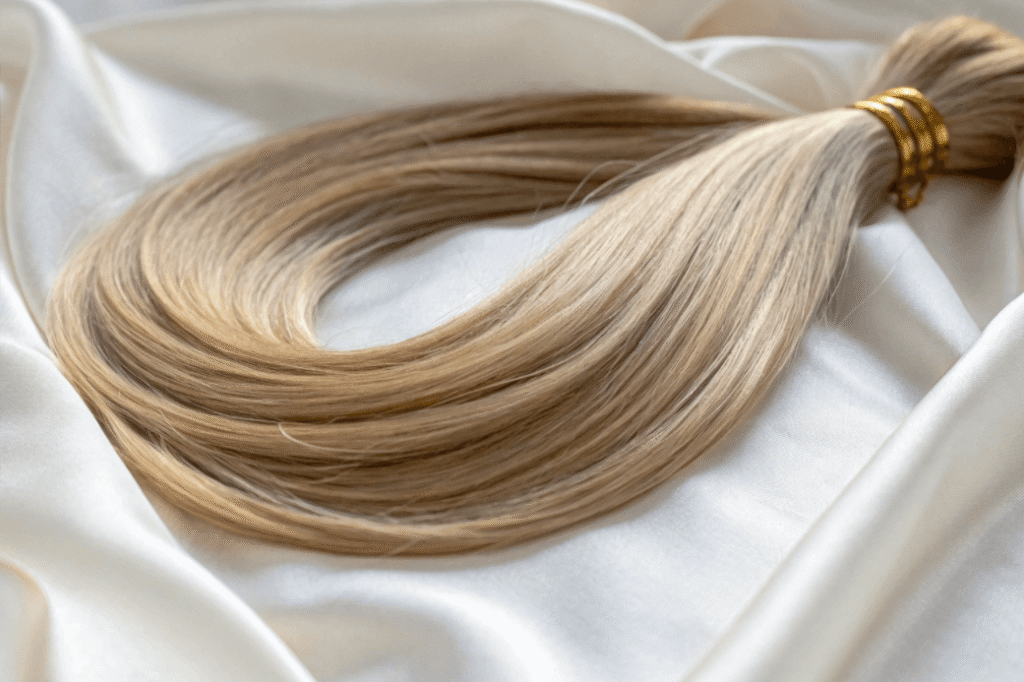
Will Peruvian hair give my clients a lighter feel without sacrificing longevity?
Yes—with the right expectations and care. Peruvian hair often ranges from fine to medium thickness and feels airy even in higher densities. It’s naturally straight-to-loose wavy, with a soft hand that customers describe as “light on the head.” This is ideal for all-day wear and warmer climates.
Durability trade-offs to manage
- Because Peruvian bundles skew finer and softer, they’re more susceptible to mechanical damage from rough brushing, tight elastic, and high heat. That doesn’t mean poor quality—just that longevity relies on gentler handling.
- In my experience, well-sourced, cuticle-aligned Peruvian hair holds up for a year of salon-level care. However, compared to thicker Brazilian strands, it’s less forgiving of frequent high-heat restyling.
When I recommend Peruvian to buyers
- Target customers who want natural, effortless movement without the “weighty” feel of dense bundles.
- Summer or travel collections where comfort and breathability outrank maximum curl density.
- Everyday straight-to-body-wave looks that don’t require aggressive heat tools or tight, repeated restyling.
How do I match regional hair types to my target styles like body wave, kinky curly, or straight?
Start with fiber reality, not marketing names
Many “Brazilian” or “Peruvian” labels in the market are texture descriptors more than verified geography. What matters for manufacturing is strand diameter, cuticle integrity, and processing method (raw vs. steamed vs. acid-treated). Here’s how I map the typical hand-feel to commercial textures your customers ask for:
Straight (silky, sleek, or yaki-straight)
- Best fit: Indian temple hair (fine-to-medium, naturally smooth, high shine).
- Why: Silky base fiber presses bone-straight with less product and blends across many hair types. Yaki finishes can be steamed onto Indian bases for a slightly coarser, relaxed-hair look without heavy weight.
- Watch-outs: If you need high-density straight, increase bundle count or weft density rather than forcing a “heavier” fiber that compromises hand-feel.
Body Wave and Loose Wave
- Best fit: Indian (for elegant, fluid S-waves) or Peruvian (for airy movement).
- Why: Both take steam-set body waves beautifully; Peruvian reads lighter on the head, Indian reads sleeker with more shine.
- Watch-outs: Advise customers to set waves with medium heat and avoid strong-hold, high-alcohol sprays that desiccate finer fibers.
Deep Wave and Water Wave
- Best fit: Brazilian-style (medium-to-thick strands, strong curl retention).
- Why: The thicker fiber retains pattern after washing and daily manipulation, giving the “full” aesthetic.
- Watch-outs: Moisture balance matters; define with water + leave-in rather than heavy oils that weigh down pattern and attract dust.
Kinky Curly and Coily
- Best fit: Brazilian-style or coarser Cambodian/SEA alternatives if available.
- Why: Denser strands maintain coil integrity and resist frizz collapse. Indian bases can be processed to tight textures, but long-term coil memory is generally stronger with thicker fibers.
- Watch-outs: Communicate realistic maintenance (detangling in sections, finger-coiling to refresh).
Texture-to-origin matching cheat sheet
| Target style | Indian | Brazilian-style | Peruvian |
|---|---|---|---|
| Straight/sleek | Excellent | Good | Good (lighter feel) |
| Body/loose wave | Excellent (silky) | Very good (fuller) | Excellent (airy) |
| Deep/water wave | Good | Excellent | Good |
| Kinky curly/coily | Fair–Good (processed) | Excellent | Fair–Good (gentle care) |
What maintenance routines should I recommend to maximize durability for each hair origin?
Proper aftercare is the biggest lever on lifespan—more than origin alone. I build care cards by fiber behavior, not just marketing names.
Indian hair (silky, fine-to-medium; straight-to-wavy)
- Product focus: Smoothing and cuticle-aligned care.
- Routine:
- Wash every 7–10 days with sulfate-free shampoo; follow with a slip-rich conditioner (dimethicone blends work well on silky fibers).
- Heat: 320–350°F (160–175°C). Use a lightweight heat protectant; avoid repeated high passes.
- Detangling: Start ends to roots with a soft paddle brush or wide-tooth comb; minimal tugging.
- Finishing: A drop of serum to tame flyaways—avoid heavy oils that flatten movement.
- Why it works: Fine-to-medium strands benefit from reduced friction and surface smoothing to prevent snags and split ends.
Brazilian-style hair (medium-to-thick; wavy-to-curly; fuller)
- Product focus: Moisture and frizz control to support curl memory.
- Routine:
- Wash every 7 days; co-wash midweek for curl sets.
- Conditioning: Emollient conditioners plus weekly moisture mask; avoid protein overload unless hair feels mushy.
- Heat: 340–380°F (170–195°C) as needed; always protect. Air-dry or diffuse on low to preserve pattern.
- Styling: Water + leave-in + light curl cream or mousse. Scrunch to encourage clumping; avoid heavy butters near roots.
- Why it works: Thicker fibers handle manipulation well but need hydration to keep cuticles lying flat and curls defined.
Peruvian hair (fine-to-medium; lightweight; straight-to-loose wave)
- Product focus: Lightweight hydration without buildup.
- Routine:
- Wash every 10 days or as needed; prioritize gentle cleansing to avoid stripping.
- Conditioning: Lightweight conditioners; occasional hydrating mask, rinsed thoroughly.
- Heat: 300–340°F (150–170°C). Keep passes minimal; use silk/satin at night to reduce friction.
- Detangling: Finger-detangle first, then wide-tooth comb; avoid tight elastics and rough towels (use microfiber).
- Why it works: Finer strands maintain softness and sheen when not weighed down; gentler handling reduces breakage risk.
Longevity guardrails I include on QC cards
- Cuticle alignment and minimal chemical exposure at sourcing are non-negotiable for durability across all origins.
- Recommend bundle rotation (alternate units) for heavy heat users to extend overall fleet life.
- Educate on hard water: chelating wash once a month if buildup or roughness appears.
Final buyer notes from my sourcing bench
- Indian hair: fine-to-medium, silky, easy to blend; strong longevity with cuticle-intact stocks; great for straight and soft waves.
- Brazilian-style: medium-to-thick density; best for fullness and curl retention; excellent for body wave, deep wave, and kinky-curly lines.
- Peruvian: lightweight, airy, versatile; delivers comfort and movement; preserve lifespan with gentler heat and light products.
If your launch brief prioritizes “full-on volume” photos and low bundle counts, go Brazilian-style. If you need universal blending and styling flexibility, go Indian temple hair. If comfort and airy movement are the hero benefits, build a Peruvian line—paired with clear, lighter-care instructions so your customers enjoy the softness without sacrificing service life.