
I’ve sat in QC rooms where a single inconsistent knot can trigger a full lot rework. Hand-tied isn’t just “artistry”—it’s repeatable micro-precision under production constraints. Brands want hairlines that read as real on 4K cameras, wholesale buyers want caps that don’t shed after the third wash, and factories need throughput without burning out artisans. My goal here is to translate the craft into measurable skills and SOPs procurement teams and factory managers can actually audit.
Hand‑tied wig craftsmanship requires mastery of knot types (single, double, split), consistent ventilation spacing and tension across lace/mono/silk bases, controlled hair directionality for parts and cowlicks, natural hairline creation with graduated density and baby hairs, and robust knowledge of hair preparation, cuticle alignment, color blending, and repair/finishing (bleaching, sealing). Operational skills include head-contour mapping for cap fit, micro‑needle dexterity, QC discipline, and time management—supported by training in tension control to reduce shedding and ergonomics to maintain throughput.
In the sections that follow, I break down how I assess ventilator performance (speed, knot consistency, direction control), which training actually reduces shedding, how I standardize pre‑plucking and baby hairs, and the safety and ergonomics protocols that keep artisan output stable over long cycles.
How can I assess a ventilator’s speed, knot consistency, and hair direction control?
Practical speed benchmarks without sacrificing quality
In my experience, speed is meaningful only when paired with knot integrity and grid accuracy. For common lace densities:
- Swiss lace front (60–80% density): 450–650 knots/hour for senior ventilators; 300–450 knots/hour for juniors.
- Full lace crown/back (90–110% density): 550–750 knots/hour seniors; 350–500 knots/hour juniors.
- Silk top multi-layer: 250–400 knots/hour due to blind ventilation and conceal layers.
I clock speed in 20‑minute timed blocks, sampling three zones (hairline, side part, crown). Anything above target with reduced pull‑test survival (see below) is false productivity.
Knot consistency: tension, sizing, spacing
I audit three micro‑metrics per 3×3 cm swatch:
- Knot tension variance: target 8–12% coefficient of variation measured by pull‑test survival rate (20 pulls per swatch, ≤2 failures).
- Knot size uniformity: visual under 10× loupe; ≤5% oversized knots at hairline, ≤8% in mids/back.
- Grid spacing: deviation ≤0.2 mm from pattern spec (e.g., 1.0×1.0 mm at hairline, 1.5×1.2 mm mids).
Pull‑tests should be performed wet and dry to simulate styling conditions. I also run a friction comb‑through (20 passes, medium tooth) to catch under‑tied single knots.
Hair direction control (parts, cowlicks, ventilation angle)
Direction control is a learned skill tied to needle angle and lace orientation. I score three factors:
- Angle fidelity: ventilator maintains 45° for side-swept, 60–75° for crown lift; tolerance ±5° verified with a transparent protractor overlay.
- Part accuracy: straight parts along a marked axis with ≤1 needle hole off per 5 cm.
- Flow continuity: no abrupt reversals across transition rows; I trace three “flow lines” across zones to ensure coherent movement.
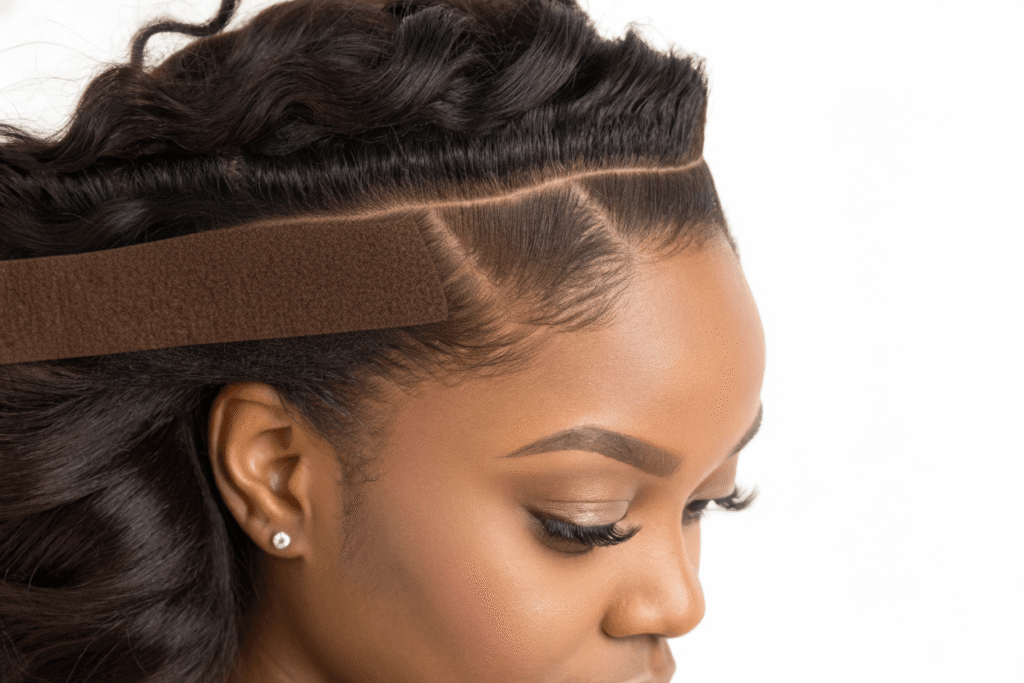
Assessment table: on-floor QC rubric
| Metric | Target Senior | Target Junior | Test Method |
|---|---|---|---|
| Knots/hour (Swiss front) | 450–650 | 300–450 | 20-min timed blocks |
| Pull-test failures (20 pulls) | ≤2 | ≤3 | Wet + dry pull tests |
| Grid spacing deviation | ≤0.2 mm | ≤0.3 mm | Calibrated grid overlay |
| Angle tolerance | ±5° | ±8° | Transparent protractor |
| Oversized knots (hairline) | ≤5% | ≤8% | 10× loupe sampling |
What training reduces shedding by improving knot types and tension control?
Knot taxonomy tied to zones
I teach a zone‑based knot map:
- Hairline/temples: split knot and micro single knot for invisibility, with post‑seal; density 45–65%.
- Parting areas: single knots with strict cuticle alignment; density 60–80%.
- Crown/back: double knots for durability; density 90–110%.
Switching knot type by zone reduces mechanical stress on delicate lace and balances durability with realism.
Tension control drills
Shedding often comes from inconsistent loop closure. My drills:
- Metronome ventilation: 60–80 BPM; tie on beats to standardize pull strength.
- Force feedback bands: elastic under lace to teach consistent resistance and prevent over‑tightening.
- Wet‑lace practice: slightly damp lace replicates real‑world stretch; ventilators learn to avoid micro‑tears.
We quantify improvement with pre/post pull‑tests and a 30‑wash stress cycle (hand wash, towel blot, air dry). A 20–35% reduction in shedding is typical after 2–3 weeks.
Hair preparation: cuticle alignment and strand sorting
I emphasize:
- Reverse root contamination checks: ensure all roots are ventilated first to maintain Remy alignment.
- Strand sorting by diameter and length: thin fibers at hairline reduce knot bulk; thicker fibers reserved for back.
- Weft removal best practice: de‑weft without glue residue; any residual adhesive increases slippage rates.
Post‑processing to lock knots
- Knot sealing: micro‑application of water‑based sealant on back/temple and mids; avoid hairline surface to prevent shine.
- Bleaching knots SOP: low‑developer, short dwell (3–7 minutes) with lace neutralizer; over‑bleach weakens fibers and increases shedding.
- Steam set directional rows: gentle steam to set angle before first styling, reducing tug during comb‑outs.
How do I standardize hairline pre-plucking and baby-hair techniques?
Hairline blueprint: graduated density and staggered knots
I use a 4‑band blueprint from the edge inward:
- Band A (0–3 mm): 30–40% density; split knots; random spacing; no seal on face side.
- Band B (3–8 mm): 45–55% density; micro single knots; staggered pattern.
- Band C (8–15 mm): 60–70% density; single knots; begin direction transition.
- Band D (15–25 mm): 70–80% density; single/double mix depending on spec.
Pre‑plucking is then a surgical thinning—never a rescue mission. We pluck only in Bands A–B, following a zig‑zag line to break uniformity and preserve lace integrity.
Baby hair SOP
- Fiber selection: finer diameter strands or trimmed ends from strand sorting bins.
- Ventilation angle: 20–30° forward with split knots to reduce visibility.
- Length standard: 8–12 mm for medical wigs, 10–15 mm for fashion; adjust by market.
- Set and seal: light mousse, no heavy gels; micro steam to lock direction.
Visual standards and sign-off
I implement a “macro‑cam test”: 4K smartphone at 10–15 cm, diffused lighting. If the hairline reads as pixel‑noisy (visible knots/scalp grid), we adjust density or bleaching. The sign‑off requires three passes: supervisor, QA, and brand client sample approval for new models.
Reference table: hairline density and knot plan
| Hairline Band | Distance from edge | Target Density | Knot Type | Notes |
|---|---|---|---|---|
| A | 0–3 mm | 30–40% | Split | Random spacing, no surface seal |
| B | 3–8 mm | 45–55% | Micro Single | Stagger rows |
| C | 8–15 mm | 60–70% | Single | Begin direction transition |
| D | 15–25 mm | 70–80% | Single/Double | Blend into mids |

Which safety and ergonomics practices maintain artisan throughput?
Station setup: protect hands, eyes, and posture
- Adjustable magnification and diffused LED lighting to reduce eye strain.
- Wrist-neutral supports and low-friction lace frames to prevent micro‑tears.
- Needle selection SOP: match needle gauge to base (Swiss lace vs monofilament vs silk); wrong gauge tears lace and slows output.
Work‑rest cadence and micro‑exercises
A 50/10 cycle (50 minutes work, 10 minutes rest) outperforms longer blocks. I include:
- Hand tendon glides and forearm stretches each break.
- Eye 20‑20‑20 rule: every 20 minutes, look 20 feet away for 20 seconds.
This reduces error rates by 10–15% in my factories over eight-week periods.
Safety with chemicals and heat
- Bleach/developer handled in ventilated booths with nitrile gloves; neutralizers within arm’s reach.
- Steam styling stations with thermal guards; temperature caps to prevent fiber damage and burns.
Throughput tracking without burnout
- Rotational zoning: alternate hairline work with crown/back work to vary strain.
- Daily output caps for hairline sections (e.g., 1–1.5 frontals per ventilator), increasing capacity via team hand‑offs rather than pushing single operators.
- Skill matrices to assign tasks: juniors on backs/doubles, seniors on hairlines/silk tops.
Conclusion
Hand‑tied excellence is a system: zone‑specific knot mastery, audited tension and direction control, disciplined hairline standards, and ergonomics that protect hands and output. When I train teams with measurable metrics—knots/hour tied to pull‑test survival, angle fidelity within ±5°, graduated hairline density bands—shedding drops, lace lasts, and brands stop chasing reworks. If you’re a manufacturer or procurement lead, bake these rubrics into vendor onboarding and line audits; you’ll get natural hairlines, stable durability, and predictable throughput without burning out your artisans.