
I’ve spent years inside wig factories and procurement rooms, balancing what buyers think will sell with the realities of hair sourcing, processing, and production timelines. When an order sheet lands on my desk, I’m looking for patterns—inch-length clusters, density preferences by region, texture skew, and cap construction choices that keep returns low and repeat orders high. The pain point most international buyers share is consistency: reliably hitting the same feel, movement, and lace realism month after month while protecting margin. That means aligning stock to the lengths and styles people actually wear day-to-day, not what only trends on social media.
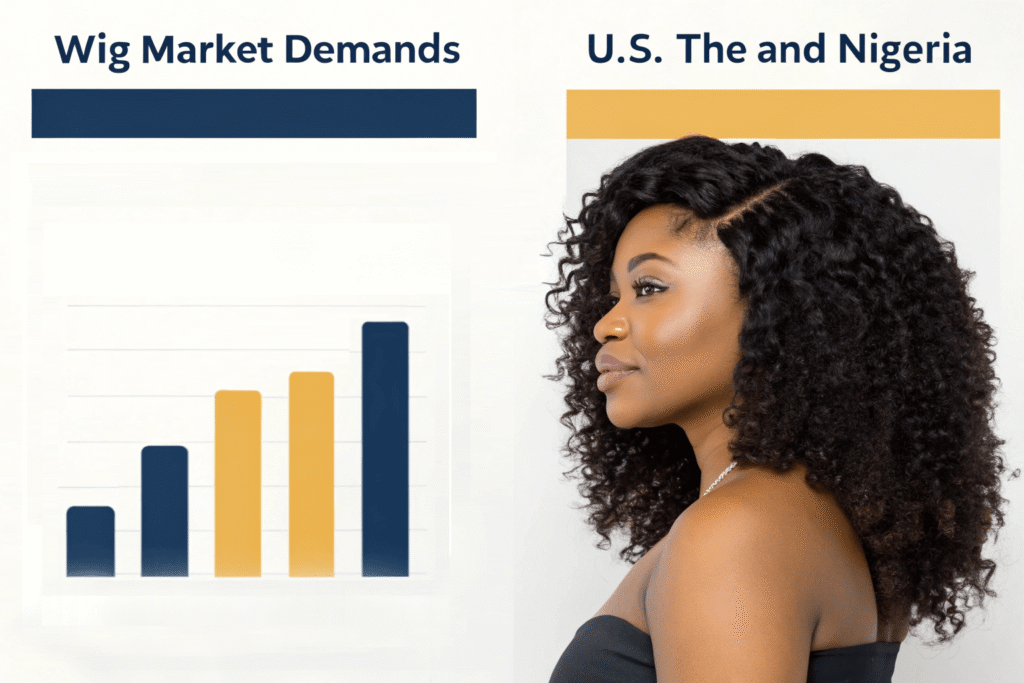
The most requested lengths globally are 12–14 inches for daily wear and 18–22 inches for glam versatility, with 24–26 inches strong on social media and event-driven spikes. Body wave, loose wave, straight sleek, and bob cuts dominate wholesale catalogues. Lace front (13×4/13×6) leads for cost-performance, while HD lace, glueless, and pre-plucked designs are gaining rapidly for convenience and invisibility.
I’ll break down the inch lengths and densities ordered most from U.S. and Nigerian buyers, confirm whether body wave/straight/deep wave remain leading textures, map seasonal demand to stock planning, and recommend a bundle mix and style assortment that optimizes pricing and MOQs without compromising quality. I’ll also anchor decisions in realistic factory workflow—cuticle alignment, steam setting, lace types—and the procurement checkpoints that keep defects and refund rates low.
Which inch lengths (12–30) and densities do my U.S. and Nigerian buyers order most often?
What moves consistently (and why)
- Short daily wear: 10–12 inches for low-maintenance users (frequent travelers, medical users, professionals needing quick styling).
- Versatile medium: 12–14 inches is highly requested for wash-and-go routines, minimal tangling, and easier maintenance.
- Glam/styling range: 18–22 inches consistently drives volume; enough length for curls and sleek looks without the weight/maintenance of 26–30.
- Social and events: 24–26 inches does well around holidays, weddings, graduations, and influencer pushes.
- Ultra-long niche: 28–30 inches sells, but requires tighter QC on bundle weights and cuticle alignment to avoid tip-thinning complaints.
Density preferences by market (typical human-hair lace front)
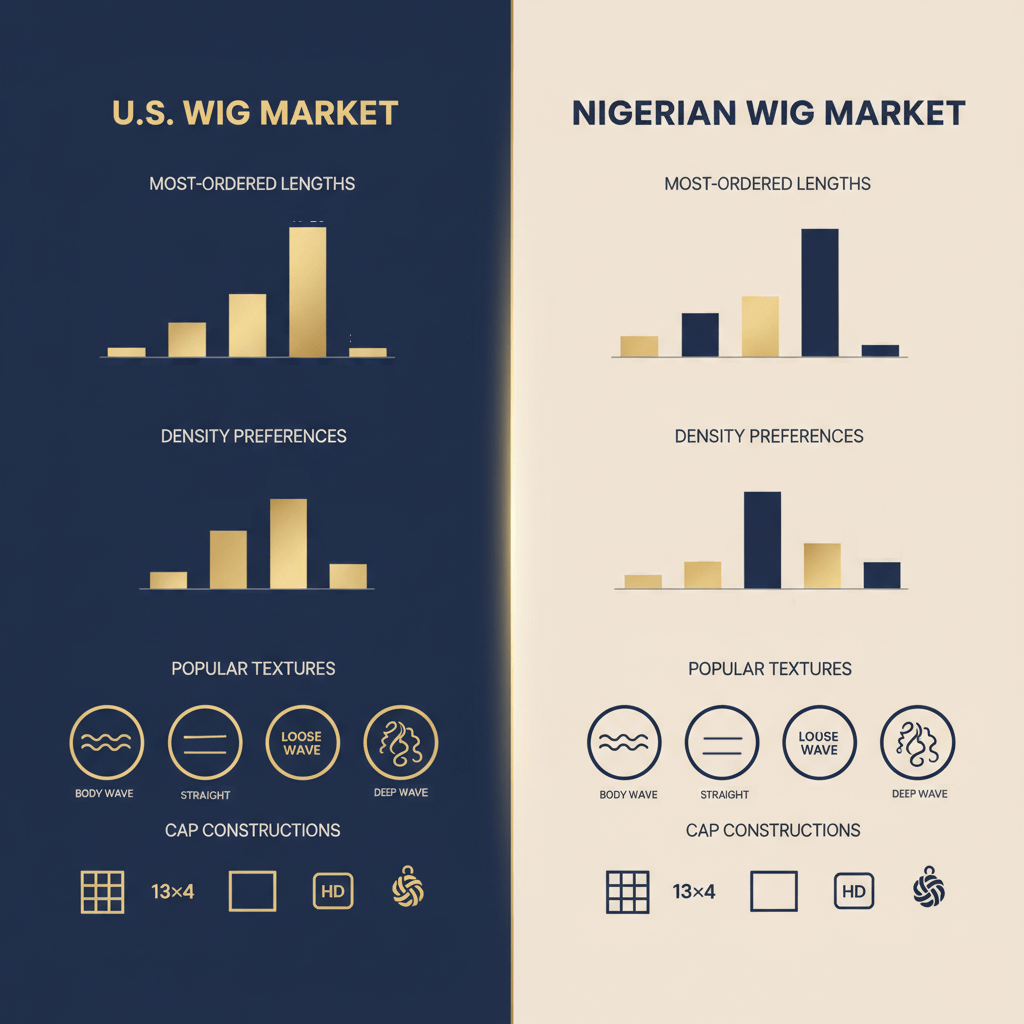
- U.S. buyers: 150% is the daily sweet spot; 180% for photo/video-ready looks; 130% only for office/medical segments seeking lightweight caps. HD lace skews 150–180% because thin lace amplifies hairline realism.
- Nigerian buyers: 180% is the dominant preference for full, event-forward aesthetics; 150% moves for everyday wear; 200% works in deep wave/curly for statement looks but needs careful wefting and ventilation to avoid bulk at the front.
Quick reference: inches and densities that repeat in POs
| Market | Most-Ordered Lengths | Core Densities | Notes |
|---|---|---|---|
| U.S. | 12–14, 18–22, 24 | 150%, 180% | 13×4/13×6 lace fronts; HD lace rising; glueless/pre-plucked convenience |
| Nigeria | 14, 18–22, 24–26 | 180%, 200% | Preference for volume; deep wave/curly in higher density; robust hairline ventilation |
Are body wave, straight, and deep wave still leading styles for my wholesale catalogue?
Yes—and the why matters. In my experience:
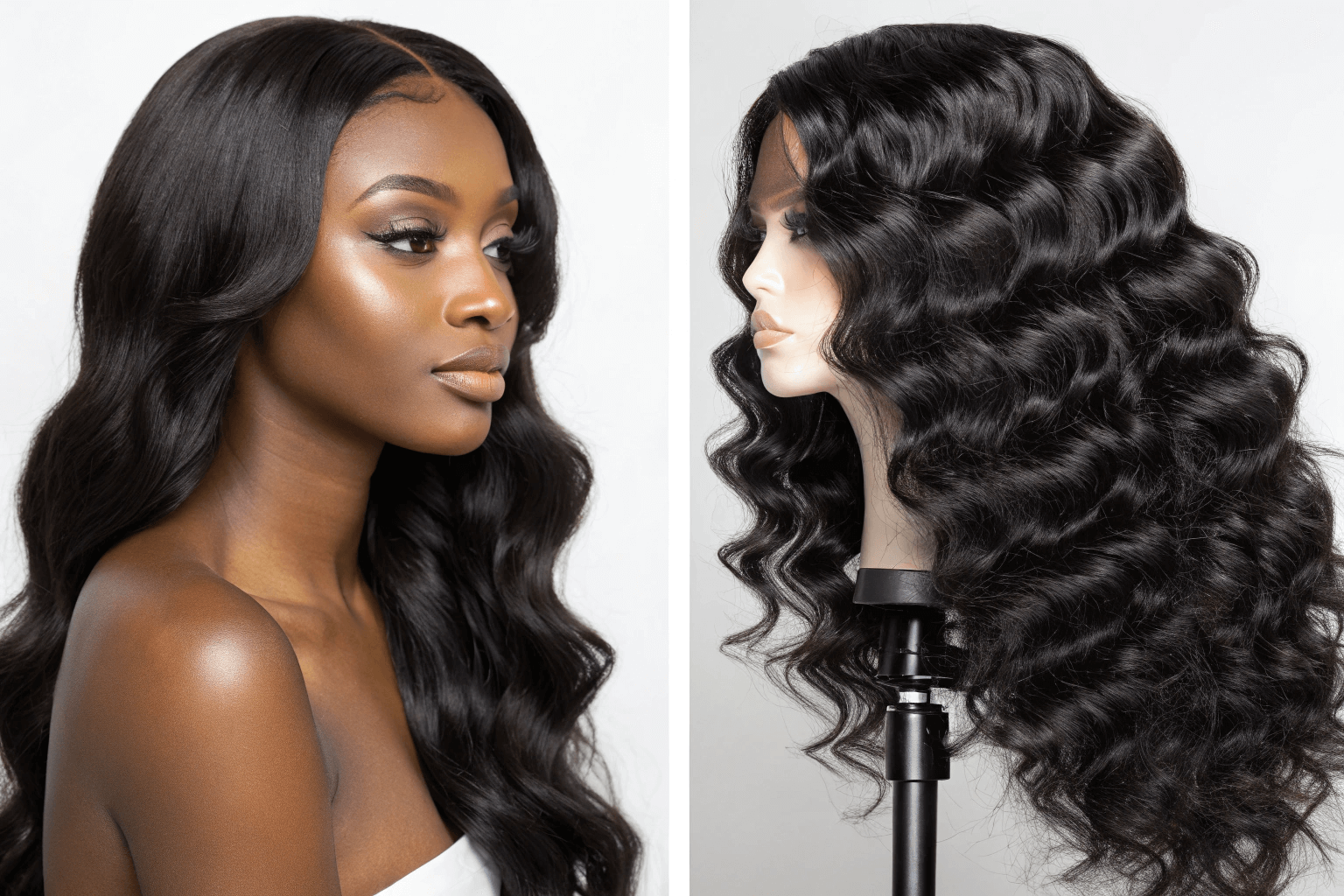
- Body wave: Still the most forgiving texture for everyday wear. It gives natural-looking movement and volume, hides minor density variances, and tolerates humidity better than pin-straight. Steam-set body wave holds memory well without over-processing.
- Straight sleek: A perpetual staple for professional/minimalist looks. To keep returns low, prioritize cuticle-aligned Remy hair with uniform bundle grading; acid bath shortcuts kill longevity and increase dryness complaints.
- Deep wave/curly: A high-growth segment among buyers seeking high-density, event-ready looks and strong social media presence. These require stricter QC: deep steam patterns, anti-matting checks, and elasticized weft tension to reduce shed in high manipulation.
Style hierarchy that keeps margins stable
- Primary catalogue: Body wave, straight, loose wave (widely preferred for soft movement).
- Secondary catalogue: Deep wave, curly/kinky curly, water wave (seasonally strong and trend-responsive).
- Bob styles: Classic blunt, layered, and asymmetrical bobs consistently rank high for office-friendly, polished aesthetics; pair with 12–14 inches for repeat business.
How do seasonal trends affect my stock planning for popular lengths and textures?
Quarter-by-quarter demand rhythm
- Q1 (Jan–Mar): Resolution-season practical buys—12–14 inch, 150% density, straight/body wave; medical and office segments replenish. Keep bob styles ready.
- Q2 (Apr–Jun): Wedding and graduation peaks—18–22 inch in body wave/loose wave; deep wave/curly uptick for photo events; HD lace accelerates.
- Q3 (Jul–Sep): Travel and outdoor events—short lengths (10–12) for low maintenance plus 18–22 for vacations; glueless/pre-plucked becomes a convenience driver.
- Q4 (Oct–Dec): Social and holiday surge—24–26 inch, 180–200% in deep wave/curly; influencer collabs push longer lengths; restock HD lace and tinted lace variants for diverse skin tones.
Practical stock rules I follow
- Hold safety stock for 12–14 inch straight/body wave (high turn, low aging risk).
- Over-index on 18–22 inches from late Q1 to Q3; build an extra buffer going into Q2 for event season.
- Time 24–26 inch replenishment for Q4; confirm vendor bundle weights and tip fullness before committing to long lengths.
- Lace front (13×4/13×6) should be baseline; increment HD lace gradually where your refunds stay low and install feedback is positive.
- Keep glueless and pre-plucked lines active year-round; they reduce installation friction and improve customer satisfaction.
What bundle mix and style assortment should I offer to optimize B2B pricing and MOQ?
My baseline mix (works across U.S. and Nigeria with minimal returns)
- Length allocation (by units in a 100-piece run):
- 10–12 inch: 10–15%
- 12–14 inch: 25–30%
- 16–18 inch: 15–20%
- 20–22 inch: 20–25%
- 24–26 inch: 10–15%
- 28–30 inch: 3–5% (special order or pre-sold)
- Texture split:
- Body wave: 35–40%
- Straight: 25–30%
- Loose wave: 10–15%
- Deep wave/curly/water wave combined: 15–20%
- Density split:
- 150%: 45–55% (U.S. steady seller)
- 180%: 35–45% (both markets; Nigeria’s core)
- 200%: 5–10% (event-focused, mainly deep wave/curly)
Cap constructions that balance realism and margin
- Lace front (13×4/13×6): 70–80% of orders—best cost-to-realism ratio.
- 360 lace: 10–15%—offer for updo flexibility; price to reflect labor.
- Full lace: 5–10%—keep to pre-sold/PO-driven; higher defect risk if ventilation standards slip.
- Add-ons: HD lace (select SKUs), pre-plucked hairlines, glueless bands/combs; tinted lace shades for diverse skin tones.
MOQ and pricing optimization tactics I use
- Tier MOQs by texture and density: higher MOQs on body wave/straight at 150–180% to secure better factory pricing; flexible MOQs for deep wave/curly to manage QC risk.
- Negotiate bundle weights transparently: specify minimum grams per unit by length (ensure tip fullness in 24–30 inches).
- Lock steam-set parameters: request SOPs for wave-setting cycles and temperature ranges to maintain pattern consistency across batches.
- QC checkpoints:
- Pre-production: cuticle alignment audits; reject mixed-direction hair.
- Midline inspection: weft tension and ventilation density checks.
- Final: lace tear test, bleach knot tolerance, shedding/pull test, and moisture-retention assessment (avoid over-acid processing).
- Packaging and aftercare inserts: reduce returns by educating buyers on detangling, heat limits, and wash intervals—especially for deep wave/curly.
Assortment examples by buyer profile
| Buyer Type | Recommended Assortment | Notes |
|---|---|---|
| U.S. multi-channel | 12–14 straight/body wave; 18–22 body/loose; HD lace select | 150% base, 180% for photo-ready SKUs; glueless/pre-plucked standard |
| Nigerian wholesaler | 14, 18–22, 24–26 deep wave/curly; body wave staples | 180% core, 200% on event lines; reinforce hairline ventilation |
| Corporate/medical | 10–12 bobs/straight; monofilament/soft lace options | Lightweight caps, comfort-first, natural density |
Sourcing and manufacturing notes I apply to keep quality consistent
- Hair origin: Prioritize cuticle-aligned Remy from India/Vietnam for longevity; mix Brazilian/SEA texture profiles for fuller looks when density is critical.
- Processing: Avoid acid baths for surface shine—opt for controlled steam processing to set waves; use gentle bleaching protocols on knots to protect lace integrity.
- Factory workflow: Standardize ventilation density by cap area (front, temple, crown) to prevent bulk at the hairline for higher-density units; calibrate weft machines to minimize shed on 200% units.
- Risk controls: Implement random batch comb-through tests on deep wave/curly; verify lace tensile strength for HD lace (thinner lace demands precise handling).
Conclusion
In practice, international demand clusters around 12–14 inches for daily, professional wear and 18–22 inches for versatile glam, with 24–26 inches spiking seasonally. Body wave, loose wave, straight, and bobs remain the backbone of a profitable wholesale catalogue, while deep wave/curly win during event-heavy periods—especially at 180–200% densities in Nigeria and 150–180% in the U.S. To optimize pricing and MOQs, anchor your assortment in lace front SKUs (13×4/13×6), layer HD and glueless features on proven lengths, and enforce tight QC on origin, cuticle alignment, steam-setting, and lace handling. This approach keeps return rates low, margins healthy, and repeat orders strong across regions and seasons.