
I’ve spent years sitting at factory lines in Qingdao, Chennai, and Ho Chi Minh City watching the gap between a great master sample and an inconsistent production run. Style drift usually doesn’t come from one big failure; it creeps in through small, compounding variables—an operator changing knot tension mid-shift, humidity shifting curl set, a dye bath that’s two degrees off, or a buyer swapping an Indian temple lot with a Southeast Asian remy blend. B2B clients feel it immediately: returns spike, color photos stop matching PDPs, and wholesale partners start cherry-picking “good” units. My job has been to bulletproof the SOPs so a unit from batch 001 looks, fits, and wears like batch 401.
Manufacturers ensure style consistency by locking specifications (cap geometry, density maps, color tolerances), standardizing raw materials and blends, and enforcing in-line statistical controls with trained operators. They use master “gold” samples, pre-set ventilating grids, steam-set recipes, and environmental controls to stabilize curl, density, and hairline. Early-stage inspections, AQL-based pre-shipment checks, and barcode/lot traceability tie every finished unit back to the source materials and process parameters.
In this article, I’ll break down the exact SOPs I use to keep curl pattern, density, and hairline design consistent; how I control source blending for texture stability; which in-line inspections catch knotting/parting deviations early; and how barcode-based lot tracking elevates traceability for B2B buyers. Expect practical templates, measurement points, and control limits you can implement this quarter.
What SOPs keep curl pattern, density, and hairline design consistent batch to batch?
1) Lock the form: standardized head molds and pattern blocks
I standardize cap geometry with steel or resin head molds and pattern blocks so cap size, lace shape, temple-to-temple curvature, and frontal contour repeat across SKUs. Each style gets a dedicated mold set, with tolerances:
- Circumference: ±2 mm
- Front-to-nape: ±2 mm
- Ear-to-ear across forehead: ±1.5 mm

Digital CAD patterns and 3D scans preserve original geometry when we update lace type or add anti-slip tapes. Any engineering change triggers a new “gold” cap and a controlled PP (pre-production) run of 30 pcs for fit validation.
2) Pre-set ventilating grids and knotting maps
For hand-tied zones, I issue ventilating grids (printed or laser-etched on film) defining:
- Knot per cell (KPC): e.g., 1–2 KPC at hairline taper, 3–4 KPC mid-top
- Direction arrows for parting and crown whirl
- Transition bands: 8–12 mm feathering at hairline
Operators receive knot type and tension SOPs (single knot for first 2 rows, then double split; pull tension 0.18–0.22 N measured by micro spring scale during training). This protects hairline realism and stops “blocky” density.
3) Template-based cutting guides and length markers
After ventilation/wefting, template stencils and laser length guides control:
- Layer breakpoints (e.g., 9/12/16 inch)
- Fringe length (±3 mm)
- Face-framing angles (±1°)
I audit silhouettes against a side-profile contour board—if the apex-to-crown slope deviates >2°, pieces are re-finished.
4) Color consistency: dye-lot management and spectrophotometry
Every colorway has master swatches and ΔE tolerances (CIELAB) by finish:
- Natural black/brown: ΔE ≤ 0.8
- Fashion shades: ΔE ≤ 1.0
We barcode dye lots and run spectro checks at three points: post-dye, post-conditioning, and post-steam set. Lighting is standardized (D65 and TL84 boxes) to stop cool/warm drift between batches.
5) Curl pattern retention and environment control
Steam-set recipes are locked (temperature, pressure, dwell, and cool-down). I run setting rooms at 45–55% RH and 20–22°C; outside that band, fiber memory shifts and curls relax. We verify curl diameter with ring gauges:
- Body wave: 38–44 mm
- Deep wave: 18–22 mm
Allowable curl rebound variation after two wash cycles: ≤10%.
6) QC checkpoints that verify silhouette, density, and fit
- Cap fit on size blocks S/M/L (tension index ±3%)
- Density by zone weighed on micro-scales (front 0–10 mm, mid-top, crown, nape)
- Silhouette profile photographs vs. gold sample
- Wear tests: 30-minute movement test and two comb-through protocols (wet/dry)
7) SOPs and operator training to reduce stylistic drift
I maintain skill matrices per operator with quarterly re-certification on:
- Knot uniformity
- Parting alignment
- Tension repeatability
Statistical process control (SPC) charts monitor knot counts per cm², cap tension, curl diameter, and fiber diameter. Any out-of-control signal triggers line stop and root cause analysis.
Example control plan (extract)
- Knot density (front band 0–10 mm): target 60–70 knots/in², CL 65, UCL 72, LCL 58
- Cap elastic extension @5 N: 12–14%
- Curl diameter (deep wave): 20 mm target, UCL 22, LCL 18
How do I control hair source blending to maintain texture stability?
Source discipline: single-origin where possible
Texture stability starts with consistent origins. I group products by fiber family:
- SEA remy (Vietnam/Cambodia): thicker diameter, resilient waves
- Indian temple remy: medium diameter, natural luster
- Chinese/NE Asia processed: uniform after steam/acid finish, less variance but lower cuticle integrity if acid-bathed
For premium lines, I lock single-origin remy with cuticle alignment. For price-point SKUs, I specify blend ratios (e.g., 70% Indian remy + 30% SEA remy) and enforce them with incoming inspection.
Lot characterization and blending SOP
- Measure fiber diameter (micrometer or optical): keep within ±3 μm of spec
- Moisture regain check before setting: 10–12% to avoid curl over/under set
- Texture reference: small steam-set tests on each incoming lot, scored against master curl cards
I batch-mix in ribbon blenders with timed cycles and draw multiple sub-samples to confirm homogeneity. Blending tickets record:
- Donor origin and grade
- Ratio by weight
- Pre/post-blend CV% (coefficient of variation) for diameter and color
Acceptable variability table
| Attribute | Target/Spec | Control Limit (Batch Mean) | Intra-batch CV% |
|---|---|---|---|
| Fiber diameter | 72 μm (SEA wave line example) | ±3 μm | ≤5% |
| Natural melanin level | L* 19–22 (un-dyed) | ΔE ≤ 0.8 | ≤6% |
| Oil content (pre-wash) | 0.8–1.2% | ±0.2% | ≤8% |
| Curl set rebound (2 wash) | ≤10% change in diameter | ≤10% | ≤10% |
If any attribute drifts, I re-balance the blend or redirect the lot to a different SKU rather than forcing it into spec.
Which inline inspections catch deviations in knotting and parting early?
First-article and hourly mini-audits
- First 3 pieces per workstation are checked against knot maps and part lines.
- Hourly 5-piece audits measure:
- Knot type and spacing with a 10× loupe grid
- Ventilation direction arrows vs. template
- Tension feel (reference pull test on a sacrificial loop)
Vision-assisted checks
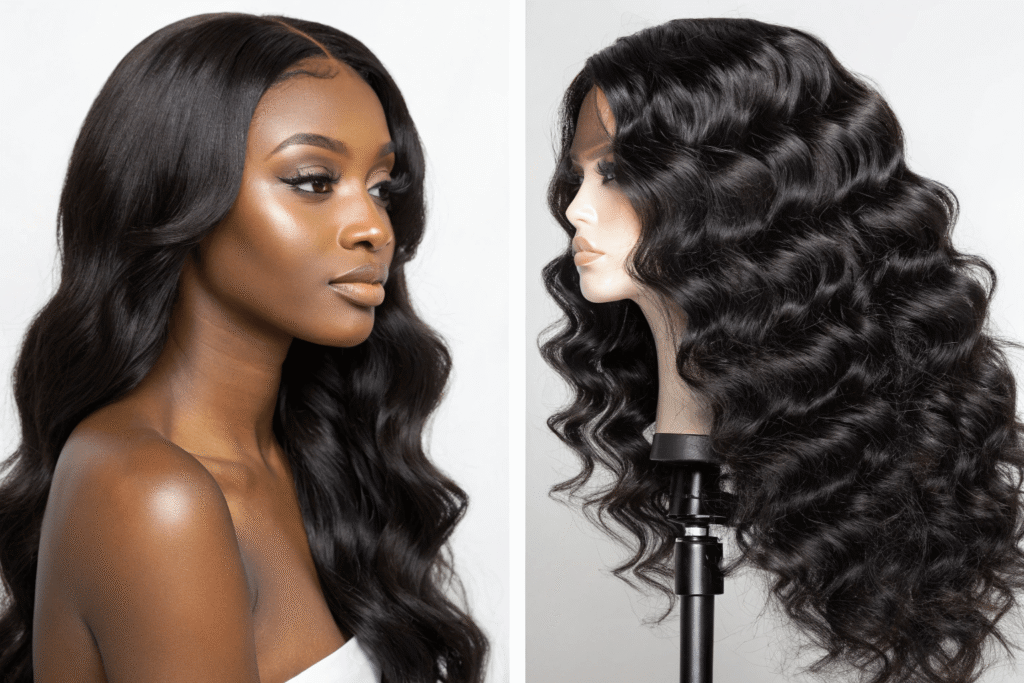
I use macro photography at 8–10 mm standoff. Acceptance: grid invisibility and uniform taper in the first 2–3 rows. Simple AI-assisted counters can flag sparse or crowded cells by pixel density—this is low-cost and effective.
Parting alignment and crown whirl
- Transparent overlay films with printed centerline laid over the mono-top
- Tolerance: part deviation ≤1 mm across 80 mm run
- Crown whirl angle tolerance: ±5° vs. template
Shedding and lock integrity during process
- Micro pull test: random 10 hairs per unit, pull-out force ≥0.25–0.35 N for double knots on mono; ≥0.18 N for single knots at hairline
- Interim comb test: 10 wet and 10 dry passes on fixture; allowable fibers lost ≤2 per 10 passes in hand-tied zones
Real-time SPC and stop rules
Operators log knot count/cm² for defined cells. If two consecutive points breach the warning limit, a line leader inspects immediately. This prevents finishing teams from inheriting unfixable density errors.
Can barcode-based lot tracking improve my traceability for B2B clients?
Yes, and it pays for itself fast. I assign a unique ID at the raw-hair bundle stage and carry it through to finished goods. Each finished unit label encodes:
- Hair origin lot(s) and blend ratio
- Dye lot and spectro report ID
- Cap materials lot (lace roll, elastic, tapes)
- Operator cells and workstation IDs
- Process parameters snapshot (steam-set recipe, RH/Temp band)
- Final QC result and AQL sample reference
What improves with barcode/lot traceability
- Recall precision: Targeted SKU-color-lot holds instead of halting full ranges
- Root cause speed: Returns map back to exact supplier lot or workstation
- Client confidence: B2B portals can display lot conformance certificates
Traceability data model (simplified)
| Node | Key Fields | Scans |
|---|---|---|
| Raw bundle intake | Origin, grade, cuticle status, vendor lot | 1 |
| Blend batch | Ratio, pre/post tests, mixer ID | 2 |
| Dye/finish | Dye lot, ΔE report, bath parameters | 2 |
| Ventilation/wefting | Operator ID, knot map version, tension audit | 2 |
| Setting/finishing | Recipe ID, RH/Temp log, curl gauge | 2 |
| Final QC + pack | AQL result, photo set, packaging form code | 2 |
| Shipment | Carton ID, pallet ID, ASN | 1 |
Integrate this with your customer portal so wholesalers can pull the Certificate of Conformance (CoC), spectro charts, and macro hairline photos by scanning the unit label. Expect a measurable drop in “perceived variance” complaints because you can prove conformance lot-by-lot.
Conclusion
Style consistency isn’t luck—it’s the compound effect of locked geometry, disciplined hair sourcing, controlled environments, trained operators, and data-rich traceability. I standardize molds and pattern blocks, ventilating grids, cutting templates, dye-lot spectro checks, and steam-set recipes. I stabilize texture by controlling origin blends and validating fiber diameter, moisture, and curl rebound before mass set. Inline, I rely on first-article approvals, hourly audits, macro imaging, and SPC to catch knotting/parting drift before it escapes. Finally, barcode-based lot tracking turns quality from a promise into a verifiable dataset for B2B clients. Implement these SOPs, and your tenth production run will look and wear like your first—on purpose, not by chance.