
I’ve sat on both sides of the table—auditing factories in Qingdao and Chennai, and troubleshooting returns with brand owners who can feel a knot through a nylon cap. When purchasers ask me what “hand-tied” really means, they’re rarely asking for a dictionary definition. They want to know if it will photograph better on e‑commerce PDPs, reduce returns from medical hair loss clients, stand up to six months of salon restyling, and scale beyond 100 units per month without knot slippage or quality drift. Those are practical B2B concerns: realism, comfort, durability, lead time, and cost.
A hand-tied wig is built strand-by-strand by ventilators who tie one to three hairs per knot onto lace, monofilament, or PU “skin” bases, delivering natural movement and multidirectional parting that wefted caps can’t match. Compared to machine-made wefting, hand-ventilation yields the most realistic hairline and crown but requires longer lead times, tighter QC, and higher unit costs. Fully hand-tied caps generally reduce pressure points and heat build-up versus wefted constructions, improving comfort for sensitive scalps when coupled with soft linings and correct sizing.
In this article, I’ll explain how hand-tied construction differs from machine wefted builds, how to spec comfort for sensitive clients, how to keep knot work uniform at scale, and how to train ventilators for speed without sacrificing realism. I’ll also include practical tables, workflow visuals, and the exact checkpoints I use in factory audits.
What is a Hand-Tied Wig?
A hand-tied wig is a premium construction where artisans ventilate individual strands through a fine base (Swiss/French lace, monofilament, or thin PU) and secure them with micro knots. In my factories, we standardize: 1–2 hairs per knot on hairlines and crown swirls, 2–3 hairs per knot on mid and nape zones for density balance. This differs fundamentally from machine-made caps where hair is pre-bundled into wefts and stitched in rows.
Construction Process
- Hair prep: sort by length, color level, and cuticle direction; reject acid-bathed bundles for premium lines (they can fuzz early and complicate knot security).
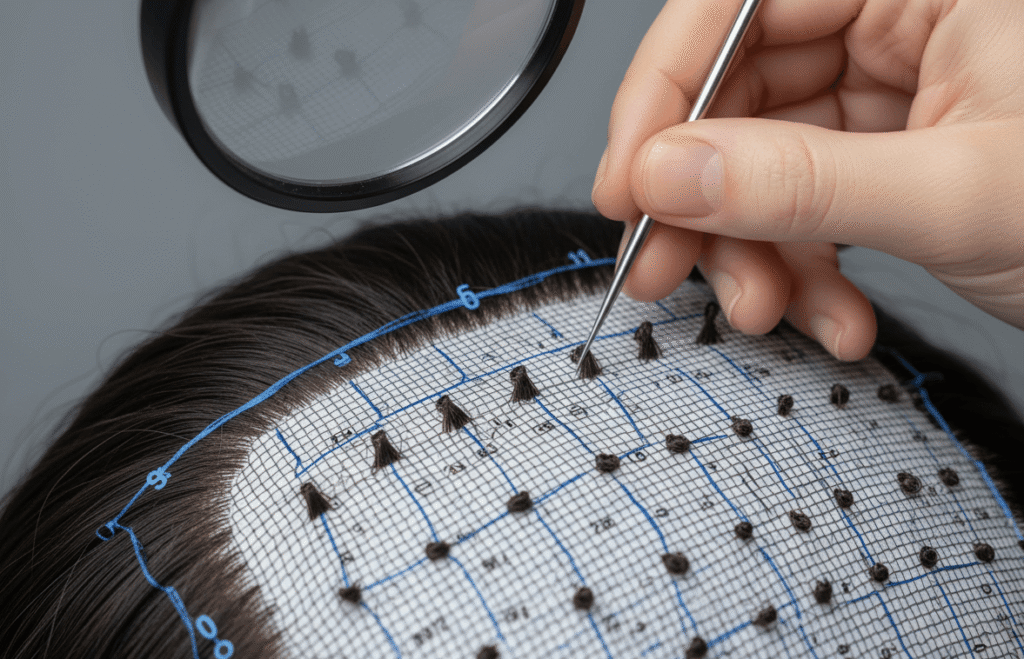
- Base mapping: mark growth patterns (cowlick, crown spiral), parting zone, and density grid in mm².
- Ventilation: use 36–40 gauge needles for hairlines (single, split, or double knots depending on base), 34–36 gauge for body zones.
- Knot setting: steam set at 100–110°C; for PU tops, use medical-grade silicone or acrylic sealant thin-coat on the underside.
- QC rounds: knot count per cm², pull-test (0.6–0.8 kg), visual sheen alignment, and silhouette check on a calibrated head form.
A premium full hand-tied unit can take 80–100 hours, more for ultra-fine Swiss lace and micro-density gradients. Partially hand-tied options (lace top + wefted back) reduce hours by 30–50% with minimal visible compromise for non-exposed nape areas.
Key Advantages
- Natural movement: each strand moves independently, creating chaotic micro-motion that cameras and eyes read as “real.”
- 360° parting: true free-part zones maintain believable scalp reveal.
- Lightweight comfort: no stacked weft ridges; better ventilation and drape on bald or sensitive scalps.
- Styling resilience: with Remy, cuticle-aligned hair and correct knotting, the unit tolerates heat styling and color refinement better than acid-bathed stock.
Comparison to Machine-Made Wigs
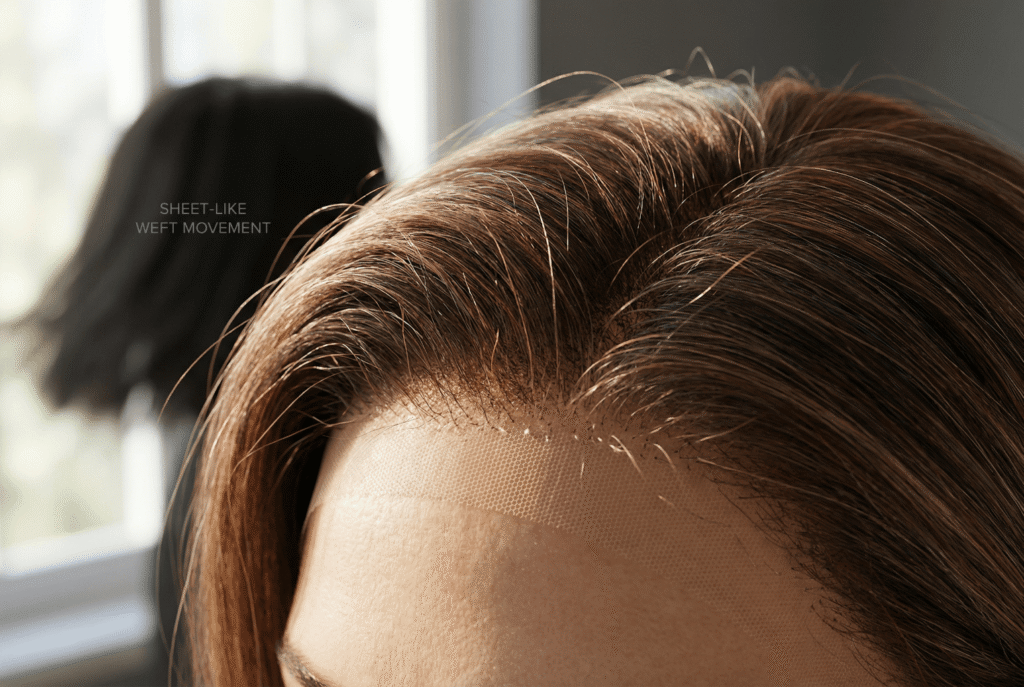
Machine-wefted caps stitch hair in linear rows. They’re faster and cheaper, great for fashion or seasonal SKUs, but rows move as sheets, exposing tracks in wind or under flash. Hand-tied tops, at minimum, solve the “track reveal” risk for high-end retail and medical channels.
Cost Consideration
Expect labor to be 3–6x a wefted cap. Hybrids (lace/mono top + wefted back) hit a strong value point for volume retail while maintaining photo-realism in key zones. Fully hand-tied is best positioned for medical, luxury, and bespoke.
How do I compare hand-tied ventilation to machine-made wefting for realism?
Realism Variables that Matter
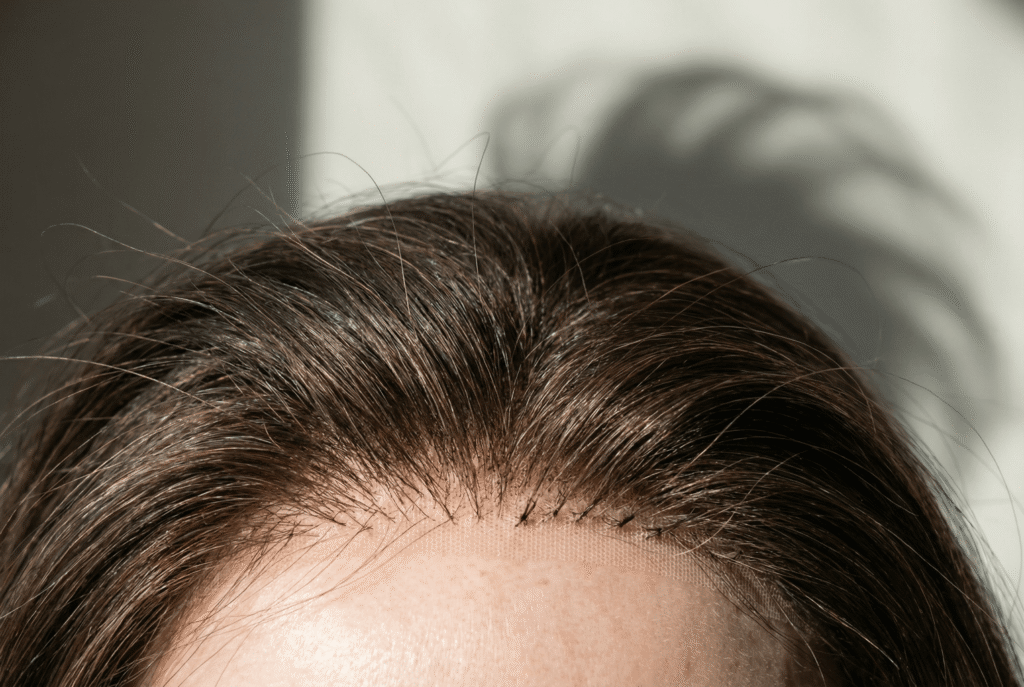
- Hairline: micro knots, staggered densities (40–60 knots/cm² at the front 1 cm), and bleached knots determine first-impression realism.
- Parting/scalp reveal: mono/lace translucency, tint match to wearer tone, and base tension under wear.
- Movement: independent strand swing vs sheet-like weft movement.
- Shine and cuticle: Remy alignment reduces glare and “synthetic look” on camera.
Practical Comparison
| Criterion | Hand-Tied Ventilation | Machine-Made Wefting | Notes/Trade-offs |
|---|---|---|---|
| Hairline realism | Excellent with 1-hair knots, staggered density | Fair; requires lace front for improvement | Lace-front wefted is a useful hybrid |
| Parting flexibility | Free part (top/crown) | Fixed; tracks visible on deep part | Mono/lace top elevates hybrids |
| Movement under wind/flash | Independent strand motion | Row movement; risk of track reveal | Matters for e-comm video and UGC |
| Weight and breathability | Lightest; low bulk | Heavier; ridge pressure at wefts | Impacts all-day wear comfort |
| Production lead time | Long; skilled labor dependent | Short; automated | Affects inventory turns |
| Cost per unit | Highest | Lowest | Choose per channel position |
Where hybrids shine
- Lace/mono top hand-tied + wefted back gives 80% of the visual payoff at 50–70% of the cost/time. For mid-price brands, I spec a 13×13 cm free-part top with graduated hairline and single knots, then wefted nape.
Will fully hand-tied caps reduce scalp irritation and increase comfort?
In my experience with medical distributors, yes—if you specify the right base and finishing. Comfort comes from three levers: base material, edge finishing, and load distribution.
Base and Finishing Choices
- Lace (Swiss/French): most breathable, soft after pre-wash; pair with folded under edges to avoid abrasive cut lines.
- Monofilament: soft mono is gentle and holds knots securely; slightly less airy than Swiss lace but great for daily wearers.
- Thin PU/“skin”: best for realistic scalp visuals on tops; needs vent holes or mesh windows to manage heat.
Comfort Engineering Checklist
- Cap weight: target 60–90 g for 12–16″ lengths; avoid heavy elastics.
- Seam management: cover internal seams with bias tape or tricot; remove glue lumps.
- Pressure distribution: wider ear tabs, flexible stays, and a soft nape tab reduce hot spots.
- Knot choice: single flat knots at hairline minimize tactile feel; seal lightly to prevent scratch.
- Sizing accuracy: 0.5 cm tolerance on circumference and front-to-nape; poor fit causes friction.
Wearer Comfort Comparison
| Factor | Fully Hand-Tied Cap | Wefted/Basic Cap |
|---|---|---|
| Heat build-up | Low–moderate (best with lace/mono) | Moderate–high |
| Pressure points | Minimal (no weft ridges) | Noticeable along track rows |
| Suitability (alopecia/chemo) | Strong choice with soft lining | Mixed; may require liners |
| Long-wear comfort | 8–12 hours feasible | 4–8 hours typical |
Pro tip: for ultra-sensitive scalps, I specify a silk or bamboo lining panel under the top (thin, breathable), plus hypoallergenic tapes around the perimeter rather than full-cap adhesive.
Can I maintain knot uniformity in large orders of hand-tied units?
Yes, but only with process controls that treat knotting like precision assembly. When I scale beyond 100 units/month, I implement the following:
Standardization and Tooling
- Density maps: zone-by-zone templates (e.g., front 1 cm: 40–60 knots/cm², mid: 70–80, nape: 60–70) printed on the base or jig.
- Needle gauges: lock SKUs to needle sizes per zone; color-code tool handles to reduce wrong-knot errors.
- Hair input spec: Remy, aligned by root-tip with 10–15% length blending; avoid oversized bundlelets that tempt 3–4 hair knots in hairline zones.
In-Process QC
- First-article approval per ventilator per order: inspect 5×5 cm swatch for knot count, direction, and lay.
- 100% in-line audits at 30% and 70% completion: use counters (digital clickers) and gridded light boards to spot over/under density.
- Pull tests: sample 10% of units; 10 random knots per unit at 0.6–0.8 kg. Failure rate goal <1/100 knots.
Finishing Controls
- Uniform bleaching: time-in-bath by base type (Swiss lace requires shorter windows); neutralize thoroughly to preserve knot strength.
- Sealant application: thin, even coat; avoid pooling that creates stiff, itchy spots and inconsistent feel.
Metrics to track weekly
- Rework rate on knot density mismatches
- Knot slip incidents post-wash
- Average knots/cm² by zone (SPC charting)
- Throughput per ventilator hour
What training improves my ventilators’ speed without sacrificing quality?
Speed gains come from ergonomics, micro-routines, and competency ladders—not from adding more hairs per knot.
Training Program I Use
- Tiered skill matrix:
- Level 1: nape and sides, 2–3 hairs/knot, 36 gauge
- Level 2: crown swirls and directionality
- Level 3: hairline gradients, single-hair knots, bleach-ready work
- Directional mapping drills: daily 15-minute practice on cowlick spirals and reverse ventilation to reduce redo time at the crown.
- Batch prep: pre-sort micro-bundles (10–15 hairs) with aligned cuticles; reduces handling time per knot by ~10–12%.
- Ergonomics: wrist rests, clamp height at elbow level, magnifiers 3.0x; typically +8–15% speed with lower error rates.
- Takt-time coaching: set target seconds per knot by zone (e.g., hairline 3.5–4.0s, mid 2.5–3.0s), review via short video audits.
Quality Safeguards While Scaling Speed
- Shadow boards for tools to avoid wrong-needle use.
- “Two centimeters rule”: supervisors inspect the first 2 cm of every new zone before the ventilator proceeds.
- Micro-incentives tied to defect-free throughput, not raw speed.
Conclusion
Hand-tied means strand-level construction that delivers the highest realism, superior parting, and better comfort—especially for sensitive scalps—at the cost of longer lead times and higher labor. If you need photo-grade hairlines and low complaint rates in medical or luxury channels, specify fully hand-tied or hybrid caps with a hand-tied top. To scale without losing quality, lock down density maps, tool standards, and in-process QC, and build a training ladder that increases speed via ergonomics and technique, not bigger knots. That’s how I keep returns low, margins healthy, and customers loyal across thousands of units.