
As a supplier who has managed thousands of wholesale units across salons, marketplaces, and DTC brands, I’ve seen U-part and V-part human hair wigs consistently outperform many lace-based styles for customers who prioritize fast installation and a natural scalp finish. These glueless, leave-out constructions are particularly attractive to distributors and retailers seeking fewer returns, higher review ratings, and stronger repeat purchase behavior among DIY users. If you sell to stylists, beauty supply retailers, or eCommerce audiences that value convenience without sacrificing realism, understanding the operational nuances of U-part and V-part caps is essential.
Highlight for decision-makers: U-part wigs use a U-shaped opening and generally require more leave-out, which optimizes blend control for fuller hair types but increases manipulation of the client’s natural hair. V-part wigs use a narrower V-shaped opening that requires minimal to no leave-out, offering stronger protective benefits, faster installs, and fewer fit complaints—often resulting in lower return rates than many lace front alternatives. Both U-part and V-part caps can be configured with combs/clips and adjustable straps for secure wear-and-go installs. For inventory planning, position U-parts as texture-matching favorites and V-parts as the protective, beginner-friendly option that can reduce lace-related returns and boost repeat purchases.
From a merchandising perspective, the best-performing catalogs segment both options by cap size, opening geometry, clip placement, and texture density. In the sections below, I’ll detail which part style blends easier for different customer profiles, how U/V-part caps affect return rates compared to lace, how to set openings and clips for secure installs, and how these constructions influence repeat purchases among DIY wearers. I’ll also share sourcing and QA checklists you can build into RFQs and private label briefs to avoid post-launch surprises.
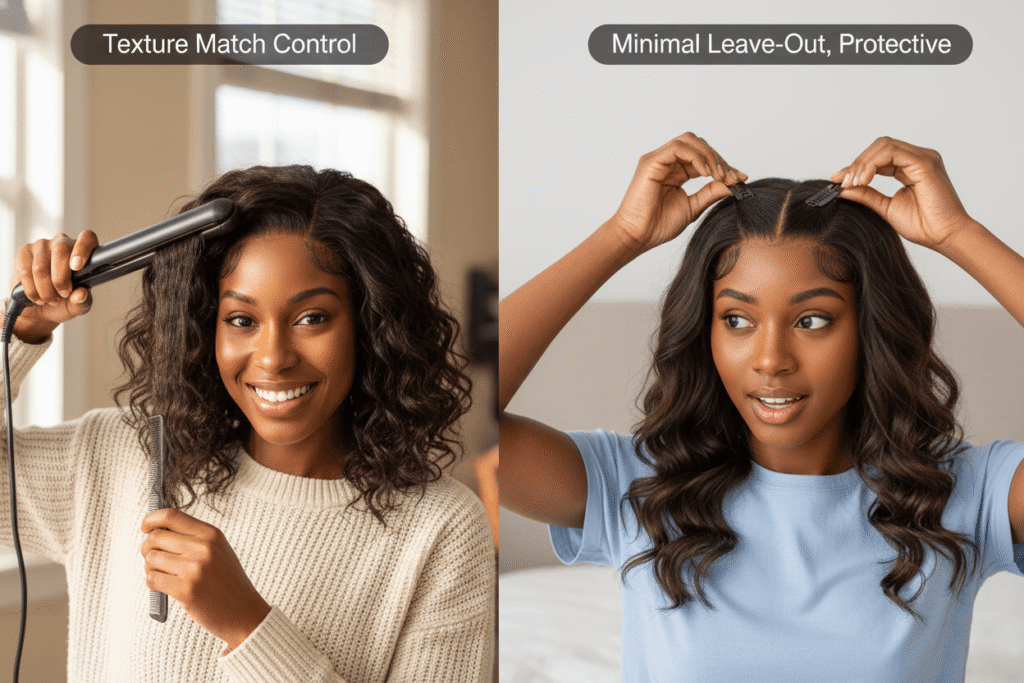
1) What are U-part and V-part human hair wigs?
U-part and V-part wigs are glueless, leave-out wig constructions designed to leverage the wearer’s real scalp and hair at the part line for maximum realism. They are built on a breathable cap with a cut-out (U- or V-shaped) at the crown/front where the user’s own hair blends over and through the opening.
- U-part wig: Features a U-shaped opening, typically wider and longer than V-part. Requires more leave-out. Favored by customers who want meticulous texture matching and volume continuity.
- V-part wig: Features a V-shaped, narrower opening. Requires minimal to no leave-out. Favored by customers with thin, fragile, or recovering hairlines who want less manipulation and faster installs.
Key shared traits for B2B:
- Human hair construction: Usually 100% Remy or single-drawn/double-drawn options, allowing heat styling, coloring, and longevity.
- Glueless wear-and-go: Equipped with combs/clips and adjustable straps; often no adhesives required.
- Realistic part: The user’s own scalp creates the parting, reducing “wiggy” appearance without relying on lace.
Why wholesalers care:
- Simpler user experience = higher satisfaction for at-home users
- Reduced technical styling dependency vs. lace fronts
- Lower education burden for customer service and return prevention
Construction overview (from a sourcing lens)
- Cap base: Breathable mesh or open wefting with reinforced perimeter stitching
- Opening: Bound U or V edge; may be reinforced with ribbon/elastic
- Attachment: 3–5 combs/clips around perimeter + nape comb + elastic straps
- Densities: 120%–200% typical; curled textures often visually denser than straight
- Textures: Straight, body wave, kinky straight, kinky curly, deep wave, coily
- Lengths: 10–30 inches norm; short bobs in high rotation for V-part
2) Which part style gives my customers easier leave-out blending?
In practical terms, “ease of blending” depends on the customer’s hair density, texture, and manipulation tolerance. There isn’t a universal winner—but there are strong patterns you can merchandise around.
Quick answer for catalogs
- For fuller hair types (3B–4C with strong density or medium/coarse strands): U-part
- For thin/fine hair, fragile edges, or low manipulation preferences: V-part
- For the easiest out-of-box realism with minimal styling: V-part
Why U-part often suits texture matching experts
U-part openings are larger (often around 3.5–4.5 inches wide by 1.5–2.5 inches long, depending on size). That bigger window lets users pull out enough hair to mirror the wig texture and density with precision. For customers who love a seamless blowout or silk press with perfect density alignment, U-part is a canvas.
- Pros for blending:
- More leave-out enables controlled texture/density continuity.
- Side or middle parts are easy to set based on opening orientation.
- Great for those who enjoy styling and heat tools.
- Cons:
- More manipulation of natural hair (heat, brushing, edge control).
- Not ideal for thin hairlines or recovery periods.
Why V-part wins on “effortless” blending
With a smaller V-shaped opening, V-part wigs rely on a slimmer ribbon of leave-out—sometimes virtually none if the user uses strategic pull-through or micro leave-out. For busy professionals, beginners, or those concerned about over-manipulating their hair, the V-part offers an easier, faster finish.
- Pros for blending:
- Minimal leave-out = less heat and less daily styling.
- Narrow opening forms a defined part that looks like scalp quickly.
- Strong match for thin/fine hair, postpartum shedding, or edge protection.
- Cons:
- Less space to correct density mismatches if the wig is overly thick at the crown.
- Fewer freestyle parting options compared to wider U-part openings.
Buyer tip: Stock both, but segment messaging
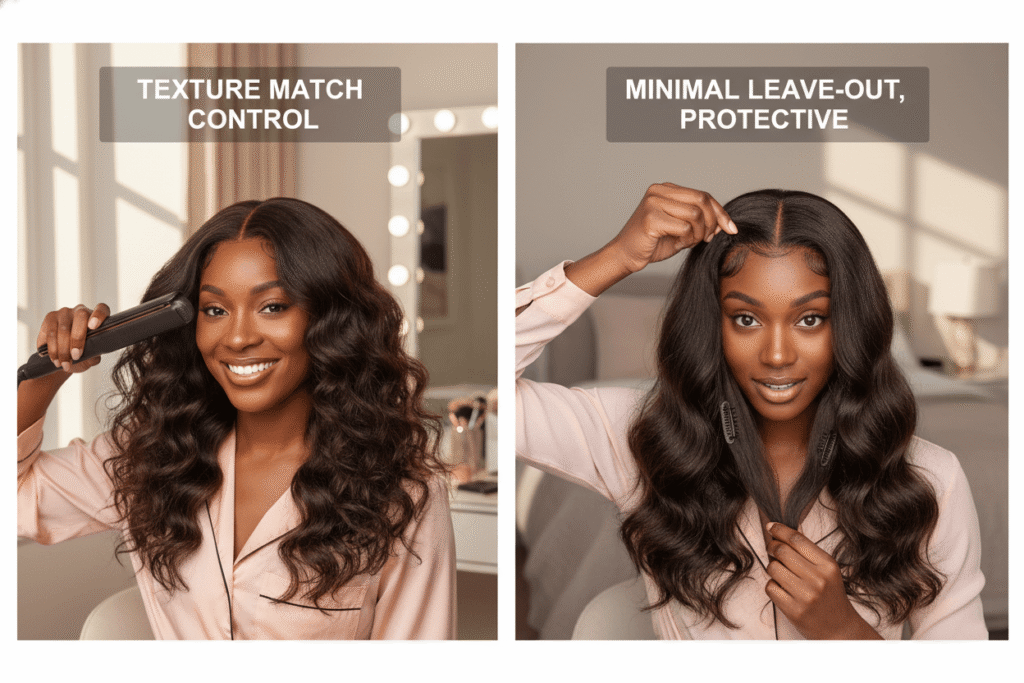
- Position U-part as “precision blend for texture lovers.”
- Position V-part as “minimal leave-out, protective, beginner-friendly.”
3) Do U-part or V-part caps reduce lace-related returns in my catalog?
Yes—both can reduce returns compared to lace front/lace closure wigs, but the magnitude depends on product execution and customer expectations. Lace returns are commonly tied to tinting issues, visible grids, shedding at the lace seam, overplucked hairlines not matching the buyer’s features, and rip/tear events during customization. U- and V-part constructions bypass many of these failure points.
How U- and V-part designs mitigate returns
- No lace tint mismatch: The buyer’s own scalp is the part, so no need for lace tinting or perfect undertone matching.
- Fewer installation steps: Glueless clip-and-go designs shorten the learning curve, reducing buyer frustration.
- Lower delicacy factor: No fragile lace front to rip or overpluck.
- Better longevity: Less adhesion stress on the hairline; comb/clip wear is easier to manage and replace.
Which reduces returns more?
- V-part typically drives the lowest return rates among leave-out styles because of:
- Smaller opening = easier install and fewer blending variables.
- Stronger protective positioning = less damage complaints over time.
- Faster “5-minute” wear-and-go marketing promise that meets expectations.
- U-part returns are still low vs. lace, but can occur if:
- Density around the opening is too high, causing blending difficulty.
- Buyers underestimate the amount of leave-out required or the heat-styling needed.
- Clips are too aggressive for fine hair, leading to discomfort.
Internal benchmark framework (typical ranges)
Note: Actual rates vary by market, education content, and QC.
| Wig Type | Typical Return Drivers | Relative Return Risk (Lower is better) |
|---|---|---|
| Lace front/closure | Tint mismatch, visible grid, customization error | Higher |
| U-part | Blending difficulty for thin hair, clip discomfort | Medium-Low |
| V-part | Crown bulk if poorly ventilated, rare slip reports | Low |
What to fix at the sourcing stage
- Crown density tapering: Pre-taper tracks near the opening to avoid a “helmet” look.
- Smooth binding: Soft ribbon binding to prevent scalp irritation.
- Clip calibration: Gentle yet secure tension; rubberized tips to protect strands.
- Adjustable strap elasticity: Ensure consistent hold without slipping.
4) How should I set cap openings and clips to ensure secure wear-and-go installs?
Secure, comfortable installs are mostly engineering choices. Get these right in your private label specs and you’ll get glowing reviews.
Opening geometry guidelines
- U-part opening sizes:
- Standard: 3.5–4.5 inches wide x 1.5–2.5 inches long
- Petite heads: 3.0–3.5 inches wide
- Large heads: 4.5–5.0 inches wide
- Orientation: Middle-part U is the staple; add side-part U variants for stylists
- V-part opening sizes:
- Narrow “V” apex depth: 1.5–2.0 inches
- Mouth width at top: 1.0–1.5 inches
- Goal: Minimal leave-out while maintaining comfortable pull-through
Buyer tip: Offer S/M/L cap sizes with proportional opening geometry. M fits most, but offering petite and large reduces returns due to poor fit.
Clip and comb placement best practices
- Front perimeter:
- Two clips/combs flanking the opening (left/right)
- U-part: Add one clip across the bridge to stabilize the U
- V-part: Place clips along the V arms with balanced angles
- Crown stability:
- Add a small, soft comb directly behind the apex to anchor lift
- Temples:
- Low-profile side combs to prevent shifting during daily wear
- Nape:
- One comb at nape + adjustable straps
- Optional: Removable elastic band (detachable) for clients who dislike clips
Clip specs to request in RFQs
- Teeth: Fine-to-medium with silicone/rubberized tips for traction without snagging
- Base curve: Slightly contoured to head shape
- Spring tension: Medium—strong enough to hold, not so strong that it breaks fine hair
- Stitching: Double-stitched clip tabs; reinforced with bar tacks at stress points
- Finish: Nickel-free coatings to reduce skin irritation complaints
Cap materials and ventilation
- Mesh: Soft, breathable mesh with stretch at the crown
- Wefting: Open wefts to reduce heat buildup
- Binding: Satin or soft grosgrain around openings to protect edges
- Edge interface: Consider a micro-velvet guard at the opening for comfort
Density and layering for a believable crown
- Reduce density 10–15% within 1–1.5 inches around the opening
- Pre-layer the crown so the wig hair collapses naturally towards the part
- For curly textures, use smaller curl ringlets near the opening for seamless blend
Quality control checklist (pre-shipment)
- Comb tension test: Clips should open/close smoothly with even resistance
- Pull test at opening seam: No gaps, no loose threads
- Fit test on S/M/L head forms: Check gaping around opening; adjust strap range
- Shake test: Secured on mannequin head with standard braid base; shake 10–15 times—no shift
- Wear test: 2-hour wear by a tester with fine hair—confirm comfort and no pain points
5) Will these constructions increase repeat purchases among DIY users?
In short, yes—when executed with the right density, clip comfort, and education, U- and especially V-part wigs foster loyalty. DIY users reward products that are:
- Fast to install
- Forgiving on natural hair
- Realistic on camera and in person
- Reliable across commutes, workouts, and daily wear
Why V-part often cultivates more repeat buys
- Lower skill barrier = fewer “first-time fail” experiences
- Minimal leave-out = less damage anxiety
- Strong day-2/day-3 performance with basic maintenance
Why U-part sustains long-term fans
- Texture purists love the control and hyper-real blend
- Versatility for side/middle parts makes it a staple for styling communities
- Excellent “step-up” product for customers moving from half-wigs
Programs that amplify loyalty
- Texture-matched drop strategy: Launch each texture in both U and V parts simultaneously; let customers cross-shop.
- Tutorial bundling: Include QR code to “5-minute install” videos and a leave-out care guide.
- Care add-ons: Offer heat protectant, edge serum, and satin storage bags as discounted bundles.
- Clip replacement kits: A low-cost accessory that signals care and extends product life.
Types of Synthetic Wigs for Bulk Orders
While our focus is human hair U-part and V-part, many B2B catalogs cross-merchandise synthetic alternatives for budget tiers. If you serve beauty supply chains or price-sensitive markets, segment clearly.
Synthetic U- and V-part analogs
- Pros:
- Lower price points for entry-level customers
- Color variety and curl memory
- Cons:
- Heat limits; cannot match human hair longevity
- Blending can be harder if the user’s leave-out is human hair
Positioning approach
- Use synthetic as a “trial” or fashion color category
- Encourage upgrades to human hair for everyday wearers who value blend and longevity
Advantages and Disadvantages for B2B Sourcing
From a procurement perspective, U- and V-part wigs have distinct trade-offs. Below is a practical matrix to guide assortment planning.
| Factor | U-Part Human Hair Wig | V-Part Human Hair Wig |
|---|---|---|
| End-user difficulty | Moderate (requires more blending) | Low (minimal leave-out) |
| Protective level | Medium (more manipulation) | High (less leave-out, less heat) |
| Return risk vs. lace | Lower | Lowest |
| Complaint pattern | Clip discomfort on fine hair; crown bulk if dense | Crown bulk if poor taper; rare slipping if clip layout is off |
| Merchandising angle | Precision texture match, styling flexibility | Beginner-friendly, quick install, protective |
| Ideal customer profile | Full/thick hair, confident with heat tools | Fine/fragile hair, time-poor, low-manipulation |
| Repurchase likelihood | High (styling enthusiasts) | Very high (DIY wearers, everyday users) |
How to Choose the Right Supplier or Product Line
Great construction wins or loses this category. Here’s how I evaluate factories and private label programs for U-part and V-part.
Supplier evaluation criteria
- Opening accuracy: Consistent U/V geometry across sizes; no warped binding
- Density grading: Tapered crown, logical graduation, correct texture matching at roots
- Clip hardware: Rubberized tips, corrosion-resistant coating, even spring tension
- Cap fit: True S/M/L; adjustable strap elasticity tested for slippage
- Hair quality: Cuticle-aligned Remy; verify with cuticle direction test and tangle test
- Texture fidelity: Kinky and coily patterns should rebound after wash-test
- Color consistency: Natural black ranges often vary; set delta tolerances in PO
RFQ and spec sheet essentials
- Cap size matrix with opening dimensions (S/M/L)
- Clip count and placement map (diagram with measurements)
- Perimeter binding material spec (e.g., soft grosgrain, colorfast)
- Density map by zone (front/crown/nape percentages)
- Hair origin and grade declaration (avoid meaningless “10A/12A” marketing; define performance tests instead)
- Allowed shedding rate per brush test; allowed smell/chemical residue thresholds
- QC acceptance sampling plan (AQL levels for stitching, clip function, shedding)
Pilot run and feedback loop
- Order a pilot of 50–100 units across textures and lengths
- Ship to micro-influencers and salon partners for real-world testing
- Analyze returns and reviews to fine-tune clip tension, density, and opening size
Caring and Storage Tips for Large Inventories
Inventory care is often overlooked, but it directly impacts B2B margins. Human hair U- and V-parts must be stored and handled to preserve texture, luster, and clip integrity.
Warehouse handling
- Climate control: 45–60% RH, 18–24°C; avoid high heat that dries hair fibers
- Packaging: Satin or non-abrasive hair nets; clips closed to avoid snagging bags
- SKU labeling: Include cap size, opening type, texture, density, and length on the outer label
- Rotation: First-in-first-out on curled textures to avoid pattern loss in long-term storage
Pre-ship preparation
- Light detangling with a wide-tooth comb
- Steam refresh for curly/coily textures if needed (low, brief)
- Strap and clip check; ensure clips are closed before boxing
- QA spot check for crown density and opening symmetry
Retail and DTC education assets
- Insert cards with:
- “Minimal leave-out” guide (for V-part) and “How to match density” (for U-part)
- Leave-out care tips: heat protectant, low manipulation
- Clip comfort tips: move clip position, use wig grips if needed
Product Configuration Matrix (Suggested Wholesale Assortment)
Use this as a template for your line plan.
| Model | Opening Type | Cap Sizes | Textures | Lengths (in) | Density Options | Clips/Combs | Positioning |
|---|---|---|---|---|---|---|---|
| U-Classic | U-part (middle) | S/M/L | Straight, Body, Kinky Straight | 12–26 | 130/150/180% | 4–5 | Precision blend, everyday styling |
| U-SidePro | U-part (left/right) | S/M/L | Body, Deep Wave, Kinky Curly | 14–28 | 150/180% | 5 | Side-part lovers, volume continuity |
| V-Ease | V-part (narrow) | S/M/L | Straight, Body, Kinky Straight | 10–24 | 130/150% | 4–5 | Beginner-friendly, minimal leave-out |
| V-Volume | V-part (reinforced crown taper) | S/M/L | Kinky Curly, Coily | 12–24 | 150/180% | 5 | Protective styling with defined part |
Pricing and Margin Planning
For B2B, price bands should reflect hair quality, texture complexity, and construction detail.
- Cost drivers:
- Hair grade and source consistency
- Texture creation process (steam patterns, time, wastage)
- Cap construction labor (binding, tapering, QC intensity)
- Margin strategy:
- Entry V-part (straight/body, 130%) as a volume driver
- Premium V-part (kinky/coily with superior tapering) as margin booster
- U-part side variants as stylist favorites; bundle with heat protectant
Example landed cost vs. MSRP bands (illustrative only)
- U-part straight 150% 18”: Landed $78–$95; MSRP $179–$229
- V-part body wave 150% 18”: Landed $85–$110; MSRP $199–$259
- V-part kinky curly 180% 18”: Landed $105–$135; MSRP $239–$299
Adjust for shipping mode, duties, and brand position.
Marketing Content That Reduces Returns
Educational assets reduce tickets and boost conversions.
- 30-second install reels (V-part): “From box to blend in 5 minutes”
- U-part blend tutorials: Matching density around the U opening with low heat
- Hair health emphasis: Minimal leave-out; rotate clip positions to protect strands
- Comparison pages: “V vs. U—Which is right for your hairline?” with quiz logic
- Texture swatches: Macro photos of roots and curl patterns near the opening
Common QA Pitfalls (and How to Prevent Them)
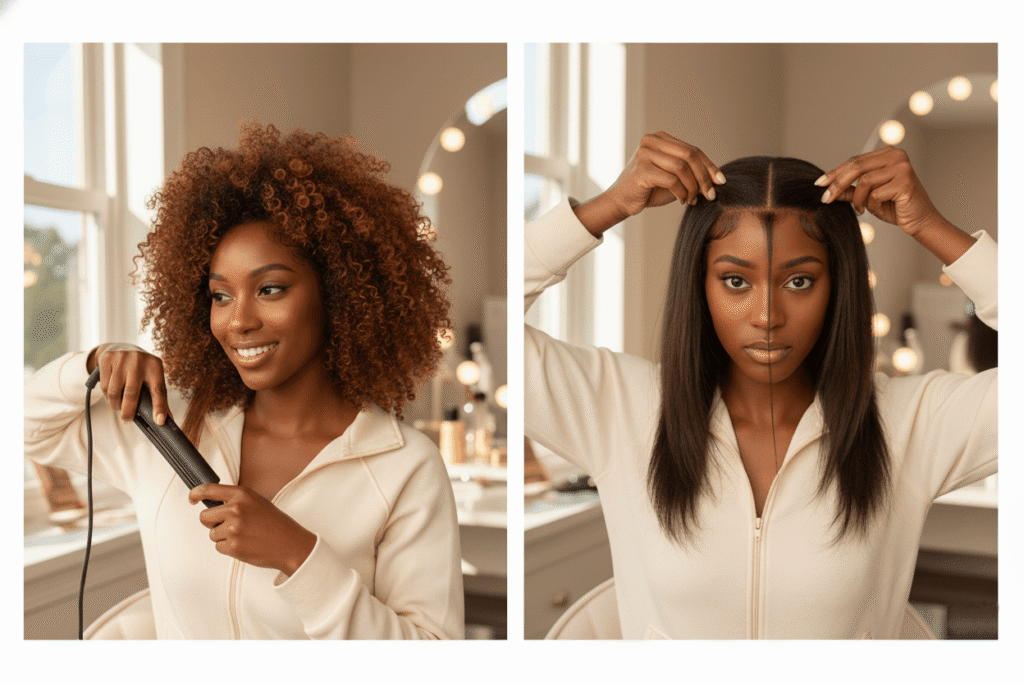
- Crown bulk “helmet” effect:
- Fix: Reduce crown density by 10–15% and add micro-layering near the opening
- Clip discomfort on fine hair:
- Fix: Specify softer tension clips; add wig grip guidance card
- Slippage complaints:
- Fix: Reposition temple clips; ensure nape comb alignment; offer removable elastic bands
- Opening fray over time:
- Fix: Use bound edges with durable thread; double-stitch stress points
Operationalizing a Repeat-Purchase Strategy
If you want U- and V-parts to drive repeat purchases, pair product excellence with lifecycle marketing.
- Post-purchase cadence:
- Day 0: Install tutorial + care guide
- Day 7: Leave-out protection tips + accessory upsell (heat protectant, edge serum)
- Day 30: Style refresh tutorial + intro to new textures/lengths
- Warranty and support:
- 14-day fit assurance for cap size swaps
- Clip replacement kits mailed on request
- Community intel:
- Incentivize reviews with photo/video; gather data on fit, blend ease, comfort
Sourcing Checklist (Copy-Paste for Your Vendor Brief)
- Cap sizes S/M/L with defined circumference and ear-to-ear metrics
- U-part opening (W x L) and V-part opening (apex depth, mouth width) tolerances
- Clip count, placement map, spring tension spec, rubberized tips required
- Perimeter binding: soft grosgrain; colorfast; no sharp edges
- Density map with 10–15% reduction near opening; layered crown
- Hair quality: Remy cuticle-aligned; tangle test pass post-wash
- Texture set: pattern memory test after shampoo/air-dry
- Shedding spec: Brush test maximum X strands/20 strokes
- Strap elasticity spec; slippage test protocol
- AQL plan for stitching, clips, density, odor, and symmetry
FAQ for Buyers (What your customers will ask you)
- Which blends easier for beginners?
- V-part, due to minimal leave-out.
- Is U-part bad for thin hair?
- Not inherently, but it requires more leave-out; recommend V-part for protection.
- Can these be heat-styled?
- Yes, for human hair. Promote heat protectant and moderate temperatures.
- Do I need glue?
- No. Clips/combs and straps are sufficient for most users.
- Will they look natural on camera?
- Yes—real scalp at the part line is the main advantage.
Summary Recommendation Table (Merchandising at a Glance)
| Customer Need | Recommend | Rationale |
|---|---|---|
| Fastest install, minimal learning | V-part | Small opening; “5-minute” wear-and-go |
| Most seamless density/texture match | U-part | Larger leave-out for precision blend |
| Thin or fragile hairlines | V-part | Less manipulation and tension |
| Side-part enthusiasts | U-part (side) | Orientation options and styling range |
| Lowest return risk vs. lace | V-part | Fewer customization steps; strong protection |
| Styling hobbyists and creators | U-part | More control and versatility |
Conclusion: Actionable Takeaways for B2B Buyers
- U-part vs. V-part in one line: U-part equals precision blending with more leave-out; V-part equals minimal leave-out, faster installs, and fewer returns.
- To minimize returns and boost reviews:
- Prioritize crown tapering and comfortable clip tension.
- Offer true S/M/L cap sizes and opening geometries that match each size.
- Educate with concise install tutorials and leave-out care tips.
- To grow repeat purchases among DIY users:
- Lead with V-part as the beginner-friendly hero.
- Keep U-part for texture purists and side-part lovers.
- Bundle accessories and offer clip replacement kits.
If you want help defining your spec sheet, requesting samples, or building a cohesive U/V-part assortment by texture and density, contact me. I can share our latest AQL templates, vendor scorecards, and a ready-to-deploy tutorial asset pack to accelerate your launch.