
I’ve spent years sitting at ventilating tables, auditing bleaching stations, and troubleshooting complaints from brand owners when hairlines look “dotty” under studio lighting. The pain points are predictable: dark knots peeking through lace, inconsistent tone matching across SKUs, and premature shedding when knots are over-processed. Bleached knots, when engineered properly, solve a very specific aesthetic problem—but they can accidentally create durability problems if you don’t control chemistry, time, and hair type at the factory.
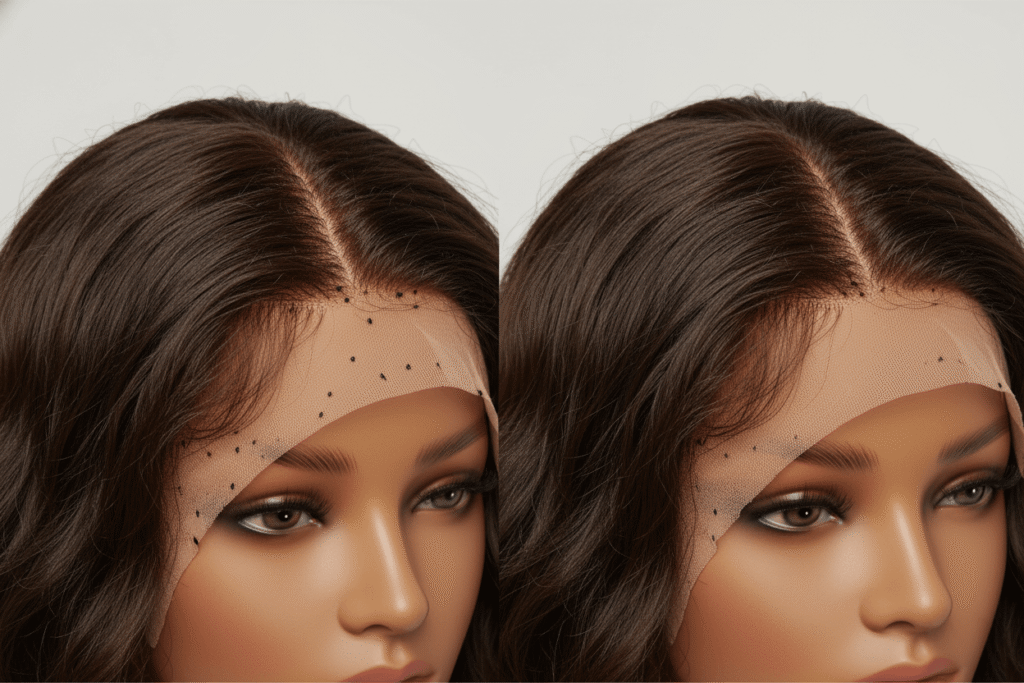
Bleached knots lighten the tiny hair knots tied to lace so the dots don’t show against the scalp, improving hairline realism. They’re typically applied to lace frontals, closures, and full lace wigs, using controlled developers to lift pigment at the knot without fully bleaching the hair shaft. Done correctly, they reduce the need for heavy makeup or tinting at the part while preserving ventilation strength; over-bleaching, however, weakens the tied hairs and shortens lifespan.
I’ll break down where bleached knots make the biggest difference, how to optimize the process for realism without sacrificing strength, how to scale pre-bleached options to save salon time, and the QC tests I use to verify knot integrity post-bleach. I’ll also share alternatives—single knots, pre-plucked hairlines, and tint techniques—that help you hit different price points and durability profiles.
Will bleaching knots improve scalp realism without weakening ventilation?
What bleached knots actually do in production
- In lace wigs, individual hairs are hand-tied (ventilated) to the lace, forming small, visible knots—especially on darker hair. Bleaching lifts melanin in the knot area so the dots visually “disappear” against the lace and scalp.
- Strategic partial bleaching (typically 0.25–0.5 inch along the hairline and at the central part) delivers most of the realism benefit while minimizing exposure of the bulk knot field.
Balancing realism and strength
In my experience, realism improves substantially with controlled bleaching, but ventilation strength depends on five variables:
1) Hair source and cuticle condition: Virgin/Remy Indian or SEA hair tolerates low-volume developers better than already-processed Chinese hair or colored hair. Pre-colored or acid-bathed hair is more prone to breakage.
2) Knot type: Single knots show less, bleach faster, and are weaker; double knots are stronger but more visible and require more care.
3) Developer strength and pH: Use lower-volume (10–20 vol) with buffered alkalinity; avoid high-pH accelerators that blast cuticles at the knot.
4) Contact time: Shorter processing windows (5–12 minutes per pass) with “lift-and-rinse” cycles prevent overexposure.
5) Post-bleach stabilization: Rinse to neutrality, apply protein bonders, then seal knots to lock down ventilation.
When these controls are in place, I achieve a marked realism gain with minimal increase in shedding. If the hair is very light (Level 8+ blondes, ash tones) or the lace/knotting uses transparent/single knots, bleaching may be unnecessary.
Practical specification I give factories
- Target only the hairline band and part line; do not flood the entire lace.
- Developer: 10–20 vol, cream-based, buffered; avoid persulfate-heavy powders unless strictly timed.
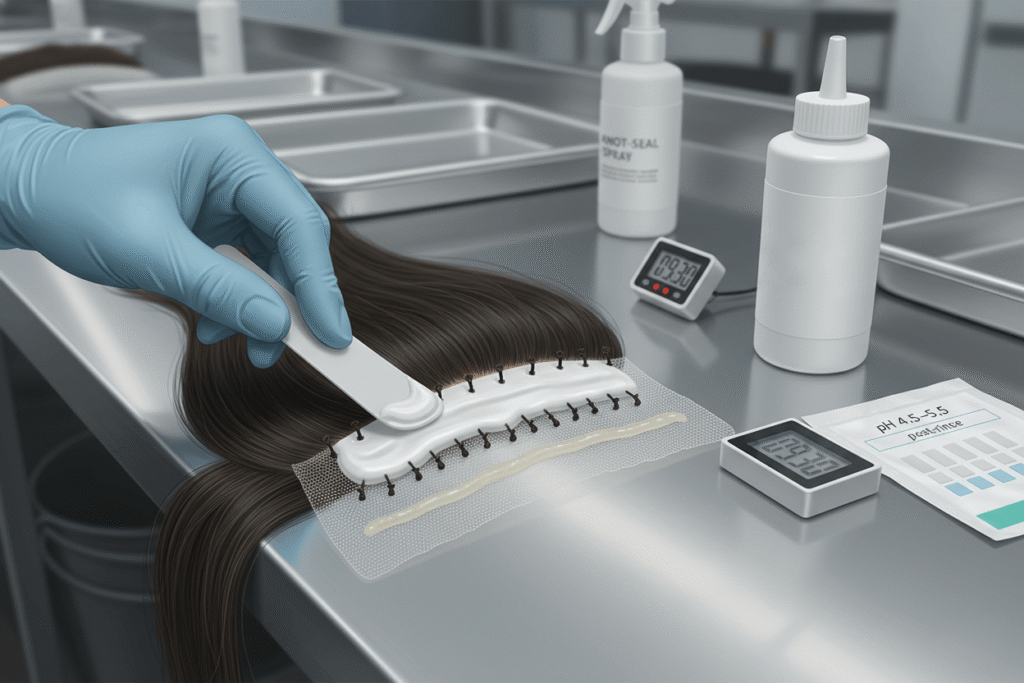
- Process: Apply with a flat spatula to avoid wicking down the shafts; check lift every 3 minutes; total exposure ≤12 minutes per pass.
- Rinse to pH-neutral, bond repair, air dry, then knot-seal.
How do I control over-bleaching risks and color matching across tones?
Risk controls that prevent knot damage
- Pre-screen hair batches: Reject lots with previous high-heat steam processing or acid baths; they lift unevenly and break faster.
- Use barrier methods: Dab petroleum jelly or a water-based barrier on lace beyond the target zone to prevent bleach creep.
- Micro-application: Apply bleach only to the knot area using a butter knife or silicone spatula; avoid saturation of shafts.
- Two-pass approach: Short first pass to assess lift; second pass only where dots remain.
- Immediate neutralization: Rinse thoroughly, follow with an acidic conditioner (pH 4–5), then a protein/bonding treatment.
Color matching across hair and skin tones
I assign tone targets based on hair level and expected scalp/lace tone to avoid “hot” orange knots or too-white halos.
| Hair Shade (Level) | Recommended Knot Lift | Lace/Scalp Tint Strategy | Notes |
|---|---|---|---|
| Level 1–3 (Dark brown/black) | Lift to Level 5–6 (light brown) | Warm beige or neutral lace tint | Avoid over-lift to blonde; looks chalky |
| Level 4–6 (Medium brown) | Lift to Level 6–7 | Neutral-beige tint | Match part area; hairline band only |
| Level 7–8 (Dark blonde) | Minimal lift to Level 8 | Light neutral tint | Often optional bleaching |
| Level 9–10 (Light blonde) | No bleaching | Transparent knots + single knots | Bleach risks > benefit |
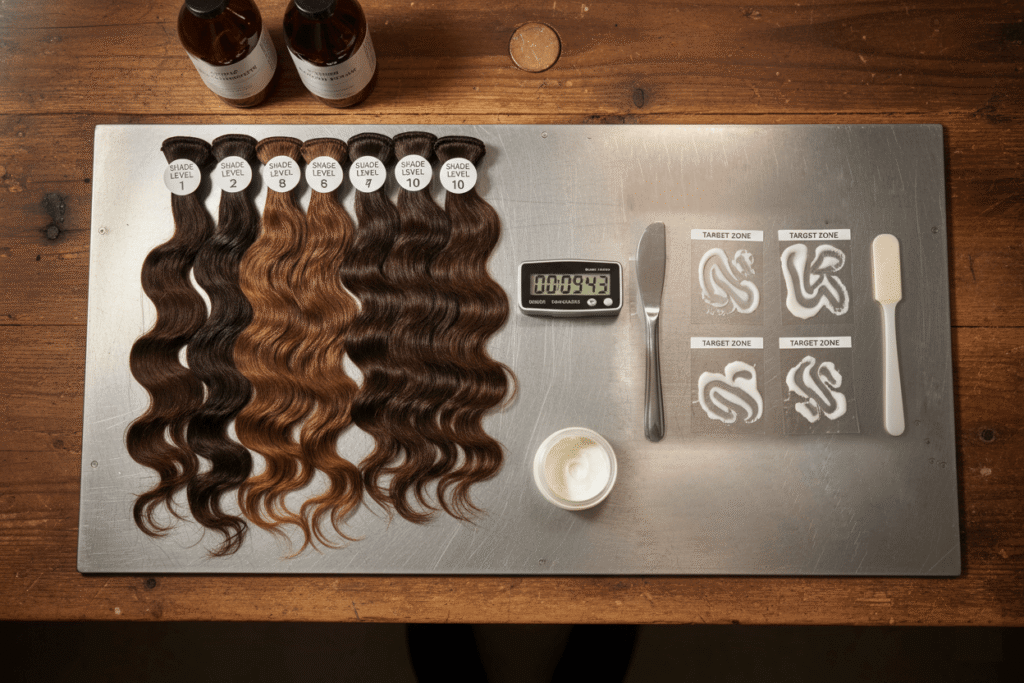
To scale across SKUs, I use three preset “lift bands” (LB-1, LB-2, LB-3) correlated to hair shade families and standardized lace tint swatches. This keeps color matching consistent across lots and reduces rework.
Alternatives when bleaching is unnecessary or risky
- Single knots and staggered ventilation: Less visible dots with minimal chemical exposure.
- Pre-plucked hairlines: Reduces density at the front so fewer knots are visible.
- Makeup tinting/scalp foundation: Fast retail fix that avoids chemical processing for darker units.
- Transparent lace + HD film knotting: Higher cost, lower visibility without bleaching.
Can pre-bleached options reduce salon install time for my customers?
Absolutely. Pre-bleached knots can remove a 30–60 minute step at the chair, reduce chemical handling in salons, and deliver consistent aesthetics out of the box.
How I configure pre-bleached SKUs for speed
- Bleach zones: Hairline band (0.5 inch) + center part line (2–3 inches) pre-defined.
- Knot type by zone: Single knots at the immediate hairline for invisibility; double knots behind the hairline for strength.
- Factory pre-tint: Lace toned to two or three common scalp shades (neutral beige, warm beige, cool beige) to minimize makeup.
- Post-bleach finishing: Bond repair, knot-seal, gentle pre-wash; units shipped “install-ready.”
Table: Install time savings
| Configuration | Salon Prep Steps Eliminated | Typical Time Saved |
|---|---|---|
| Standard pre-bleached hairline | Knot bleaching, neutralizing, bond repair | 30–45 minutes |
| Hairline + part line + lace pre-tint | Above + makeup tinting | 45–60 minutes |
| Add pre-plucked hairline | Above + tweeze/pluck time | 60–75 minutes |
Operationally, pre-bleached options also cut back returns related to DIY over-bleaching mishaps and improve first-wear satisfaction scores.
What QC tests verify knot integrity after bleaching?
I do not ship bleached-knot units without passing four checkpoints:
1) Visual and microscopic inspection
- 10×–20× magnification of the hairline band and part line to confirm uniform lift, no orange halos, and no swollen/distorted lace mesh.
- Random sampling: 3 areas per unit, 5 units per lot.
2) Pull/shedding test (post-finish)
- Standardized pull: 20 controlled strokes with a soft brush from root to tip; count shed strands per stroke.
- Acceptance criteria: ≤0.5 strands per stroke average in bleached zones; ≤0.3 outside bleached zones.
3) Wet stress test
- Soak in lukewarm water (pH ~7), apply mild shampoo, rinse, condition; then brush-out.
- Compare pre- and post-wash shedding; delta should be ≤20% increase in bleached zones.
4) Lace integrity and knot-seal verification
- Dye-penetration check to ensure sealant didn’t glue shafts excessively or leave sticky residue.
- Flex test: Bend and stretch lace 10 times; verify no knot slippage in the bleached band.
Optional advanced checks:
- pH rebound measurement after neutralization (target hair surface pH 4.5–5.5).
- Tension gauge pull on single vs. double knots to benchmark batch strength.
Care guidelines to preserve integrity (included on packaging)
- Gentle washing routine; avoid high-alkaline shampoos.
- No long soaks in hot water.
- Reapply knot-sealing spray every 2–3 washes in the hairline band.
- Avoid aggressive tweezing on bleached zones.
Conclusion
Bleached knots are a targeted aesthetic enhancement: they lighten the visible dots at the lace so scalp realism improves—especially on darker hair—without necessarily sacrificing ventilation strength when controlled properly. The key is disciplined process control: low-volume developer, short timed passes, selective bleaching at the hairline/part, and post-bleach stabilization plus knot sealing. Pre-bleached configurations can materially reduce salon install time and deliver consistent, camera-ready hairlines at scale. With robust QC—microscopic inspection, pull and wet stress tests, and lace integrity checks—you can offer realistic hairlines that hold up in real-world wear, while aligning SKUs to different tone families and durability needs.