
I’ve spent years building glueless lines for brands that serve both retail and salon channels, and I understand why this question keeps coming up. Security is non-negotiable for manufacturers and wholesalers—returns spike when hairlines lift, combs pull, or caps shift mid-day. My goal here is to cut through marketing claims and share the spec-level realities that actually keep a glueless wig on during normal wear.
Glueless wigs can be secure without adhesive when cap fit, tension systems, and hairline/lace choices are engineered correctly. Stability comes from a combination of adjustable straps, elastic bands, combs/clips, and friction interfaces (grip bands, silicone). For day-to-day use, these features are sufficient; for high-movement or extended wear, a hybrid approach (light tack at temples plus internal tension) adds insurance.
In the sections below, I’ll break down how elastic bands and side combs contribute to stability, how I spec ear tabs and cap tension to reduce lift, how to achieve natural hairlines without glue, and which materials prevent slippage while staying comfortable. I’ll weave in practical manufacturing notes so you can set reliable standards across SKUs.
Do elastic bands and side combs keep glueless wigs stable during daily wear?
Elastic systems and anchoring points are the backbone of glueless stability, but they work only when the cap size and placement are correct.
The stability stack: how the components share load
- Adjustable straps (back): Provide macro fit. They set the circumference tension and keep the nape from creeping up.
- Elastic band (internal): Provides micro tension across the frontal/lace area, pressing the hairline edge flat and minimizing lift.
- Side combs/clips: Offer lateral anchoring into the wearer’s bio hair, reducing side-to-side migration.
- Ear tabs: Lock position at the temporal region, preventing rotation and flutter.
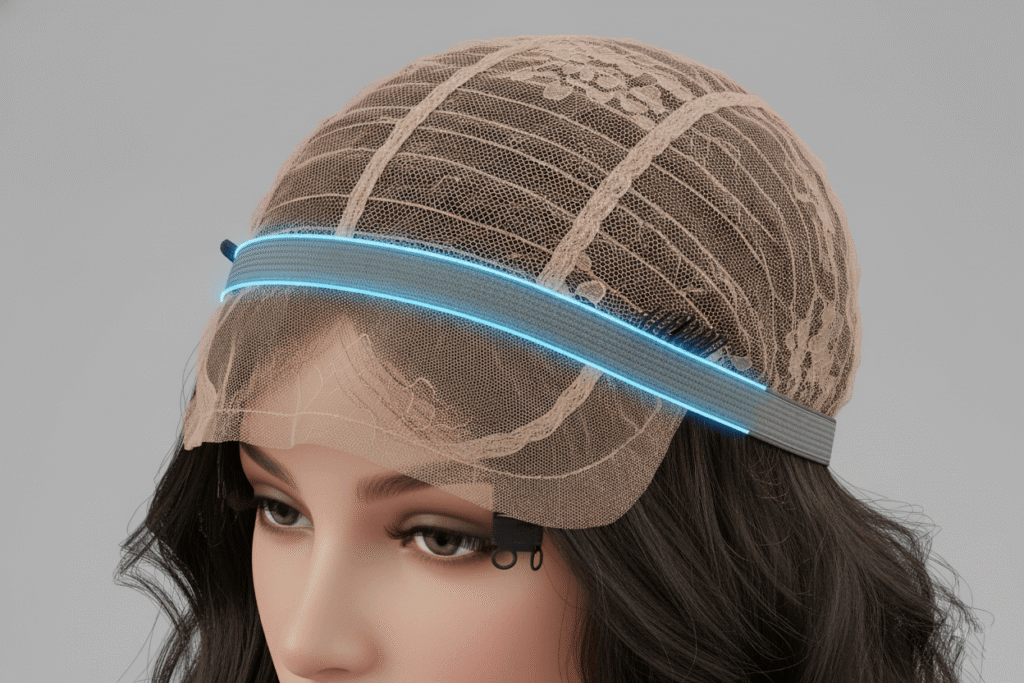
In daily scenarios—commuting, office work, light errands—this stack is enough when the cap is properly sized. Activity level matters: customers doing high-impact workouts or in strong wind can overwhelm the system, which is why I recommend a spec option for hybrid security (minimal adhesive at temples) as an upsell for performance lines.
Placement and band spec details manufacturers should enforce
- Elastic band width: 2–3 cm for balance; narrower bands can create pressure hotspots, wider bands may ride up.
- Elastic tension: Medium-stretch with 15–20% elongation at wear; avoid overly soft elastics that creep or very rigid bands that cause headache complaints.
- Mounting points: Sew the band from temple to temple (behind ear tabs), slightly forward of cap midpoint, to apply downward force across the frontal.
- Side combs vs. clips: Use low-profile, snag-safe combs for fuller hair types; consider clip alternatives or omit for fine hair customers and pair with a wig grip to avoid traction risk.
Buyer watchouts:
- Over-tightening elastic bands creates frontal pressure lines and accelerates lace fatigue.
- Combs/clips on very fine or smooth hair can slip; include SKU variants with silicone-lined bands or market a wig grip accessory.
How should I spec ear tabs and cap tension for safe adhesive-free installs?
Ear tabs and cap tension control rotational stability and hairline behavior. Poorly spec’d tabs are the top reason for “lifts” at temples.
Ear tab engineering: shape, stiffness, and memory
- Shape: Slightly contoured, following the average temporal curve. A 3D profile sits more flush than flat tabs.
- Insert: Thin flexible metal or polymer memory strips that can be gently pinched to customize fit without breaking.
- Coverage: Extend the lace or mono edge just enough to meet the natural temple line; avoid excess lace that flutters.
- Padding: Light tricot or felt lining to prevent abrasion.
Spec guideline:
- Tab stiffness: 0.4–0.5 mm metal memory strip (or polymer equivalent) for adjustable hold without sharp edges.
- Seam allowance: Keep seam bulk low to avoid creating a ledge under lace.
Cap tension distribution
3D dome caps—built with multi-panel stretch and a deeper crown—increase surface contact and reduce point load at the hairline. The aim is even tension from nape to frontal.
- Circumference adjusters: Use dual-side hook-and-eye straps for granular sizing; Velcro can pill and lose grip over time.
- Stretch zones: Strategically place 4-way stretch at the crown and controlled stretch at the sides to prevent side creep.
- Nape design: A reinforced nape with slight elastic helps prevent upward slip.
Table: Recommended tension specs by cap type
| Cap type | Stretch zones | Best use case | Notes |
|---|---|---|---|
| 3D dome stretch + lace | Crown 4-way, sides limited | Daily wear, glueless frontal | Most consistent hairline stability |
| Lace front + mesh back | Back high stretch | Lightweight retail | Watch for nape creep; add grip option |
| Full lace with elastic band | Minimal stretch + band | Premium customization | Precise fit required; pre-size carefully |
Manufacturing tip: Train QC teams to perform a “temple lift test”—apply light upward pressure at each temple on a mannequin head set to size. If the lace edge lifts more than 2–3 mm, increase band tension or adjust ear tab profile.
Can I achieve natural hairlines in glueless designs for my premium lines?
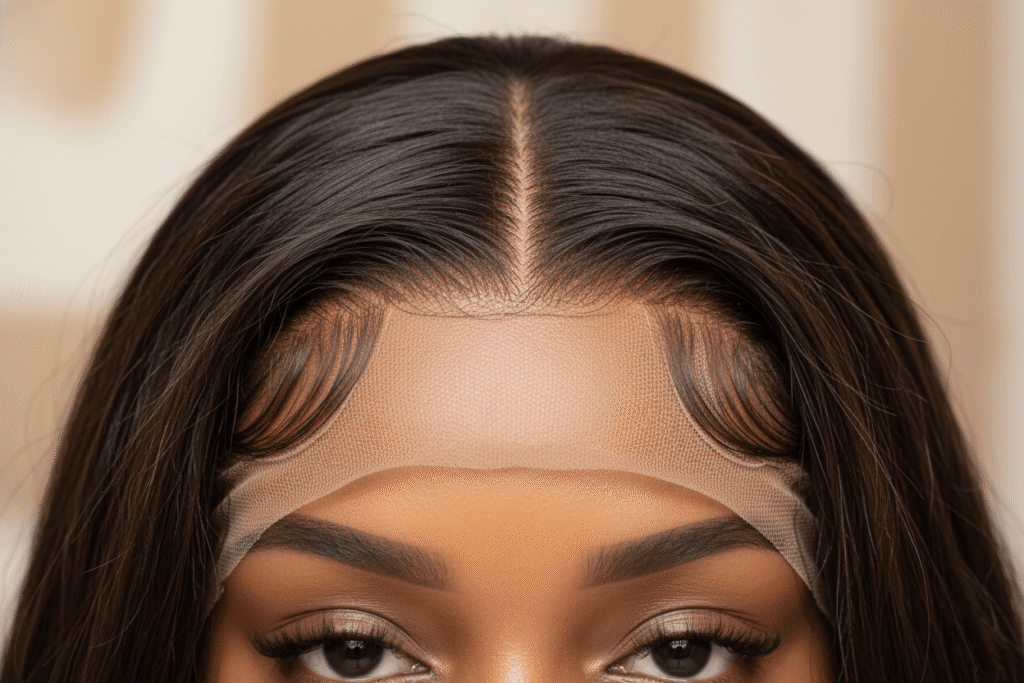
Yes, but natural doesn’t only mean “thin lace.” It’s a dance between lace type, hairline density, knot work, and how the edge is pressed by internal tension.
Lace selection and hairline behavior
- HD lace: Ultra-fine, lays flush, best for melt effect. More delicate; requires clean placement and careful handling to avoid premature fraying.
- Swiss lace: Slightly sturdier with good blend; a practical middle ground for glueless lines.
- Transparent lace: Cost-effective but can reflect under certain lighting; tinting may be necessary.
Pre-plucked hairlines and pre-cut lace reduce bulk and help the wig sit flush without glue. Pre-cut edges should be subtly scalloped—micro irregularity breaks the line and reduces edge visibility.
Knotting and density for a glue-free lay
- Knot size: Single knots or micro double knots at the first 0.5–1 cm; bleach careful to avoid shedding.
- Density map: 70–80% density at the front 1 cm, graduating to standard behind; heavy fronts lift more easily.
- Parting: Lightly bleached or hand-tied micro parts prevent “grid” visibility.
Operational tips:
- Ship with a light pre-pluck and a standardized elastic band angle so the lace edge is gently pressed without “line marks.”
- Offer temple-only tack kits for customers needing extra confidence in wind or performance scenarios.
Which materials prevent slippage while maintaining comfort?
Friction interfaces and breathable linings make or break glueless comfort and hold. Material choices should match scalp types and use cases.
Friction and grip solutions
- Wig grip bands: Velour or velvet exterior with internal silicone dots increase friction against skin or bio hair; excellent for fine hair customers.
- Silicone-lined elastic: Integrates micro silicone strips into bands to reduce micro-slip without full adhesive.
- Medical-grade silicone patches: Small, strategically placed patches at temples or nape can stabilize without irritating most scalps.
Linings and cap fabrics
- Power mesh (soft): Breathable, moderate friction, good for daily wear.
- Tricot/felt at pressure points: Adds comfort under ear tabs and frontal.
- Cotton or bamboo viscose liners: For sensitive scalps; wick moisture and reduce itch.
Table: Material options for anti-slip and comfort
| Component | Material | Benefit | Use case |
|---|---|---|---|
| Elastic band | Silicone-lined medium stretch | Anti-slip with comfort | Daily-wear glueless |
| Grip accessory | Velvet + silicone dots | High friction, scalp-friendly | Fine hair, smooth scalp |
| Ear tab lining | Soft tricot/felt | Comfort at pressure zones | All-day wear, sensitive clients |
| Cap body | Breathable power mesh | Airflow + light friction | Office/commute, warm climates |
Buyer guidance:
- Fine hair or smooth scalps reduce comb/clips effectiveness—bundle a wig grip with those SKUs.
- Overly loose caps will shift regardless of combs or bands; enforce accurate size charts and include clear tightening instructions.
Final manufacturing recommendations
- Offer three tension profiles per cap size: standard, snug (athleisure), and gentle (sensitive scalp).
- Include a sizing guide and a 60-second fit checklist in every box; returns drop when users tighten correctly.
- For premium lines, default to HD or Swiss lace with pre-plucked hairlines and scalloped pre-cut edges.
- Provide a hybrid option: temple mini-adhesive tabs plus internal straps for customers with high-activity needs.
In my experience, brands that treat glueless security as an engineered system—fit, tension, anchor points, lace behavior, and friction—see far fewer complaints and a noticeable uptick in repeat purchases. The “no glue” promise is not only achievable; it’s scalable when the specs are right.