
As someone who lives in the realities of wig manufacturing and wholesale, I know sizing is where expectations and returns collide. I’ve seen beautiful units come back simply because a “medium” wasn’t the same medium across brands, or the customer measured once at noon and not again in the evening when slight swelling or hair density changed the fit. In B2B, getting sizing right isn’t just about a tape measure—it’s about consistent standards, cap constructions, and regional fit preferences that affect your SKU strategy and lead times.
The right wig cap size is determined by three core measurements—circumference, ear-to-ear, and front-to-nape—mapped against a brand-specific size chart and adjusted for cap construction and stretch. Average (21–22.5 inches) fits most adults, but stocking small, medium, and large caps with adjustable features reduces lead times and fit-related returns. A clear sizing chart and regional calibration for the US and African markets further cut exchanges and dissatisfaction.
Below I’ll break down how I measure and interpret sizing, how stocking strategies impact operations, and how a well-built chart and regional nuance keep your B2B orders moving with fewer returns.
How do I measure circumference, ear-to-ear, and front-to-nape for accurate sizing?
The three core measurements that actually predict fit
In my experience, most fit issues trace back to inconsistent measuring. I coach buyers and retail partners to standardize these three:
- Circumference: Use a soft tape along the hairline—start at the center forehead, pass just above the ears, and wrap around the nape. This is your anchor measurement. Petite typically lands around 20–21 inches, average 21–22.5, large 23–24.
- Front-to-nape (front-to-back): From the front hairline straight over the crown to the nape hairline. This controls how the cap seats without riding up or sliding forward.
- Ear-to-ear over top: From the top edge of one ear, over the apex, to the top edge of the other ear. This drives temple tension and crown coverage.
I encourage teams to measure twice—ideally once in the morning and again late afternoon—because minor swelling and bio hair compression change fit. High-density hairstyles or thick bio hair under the cap often require sizing up to avoid pressure points, gapping at the temples, or nape lift.
Interpreting measurements against cap construction
Not all caps behave the same. Stretch wefted caps and hand-tied designs can accommodate slight variance; lace front zones can feel looser or tighter depending on lace weight and elasticity. Most caps include adjusters (straps/hooks) that allow about half an inch of tightening or loosening. If a customer sits between sizes, I default to the larger cap and fine-tune with adjusters rather than forcing a tighter cap that risks headaches or red marks.
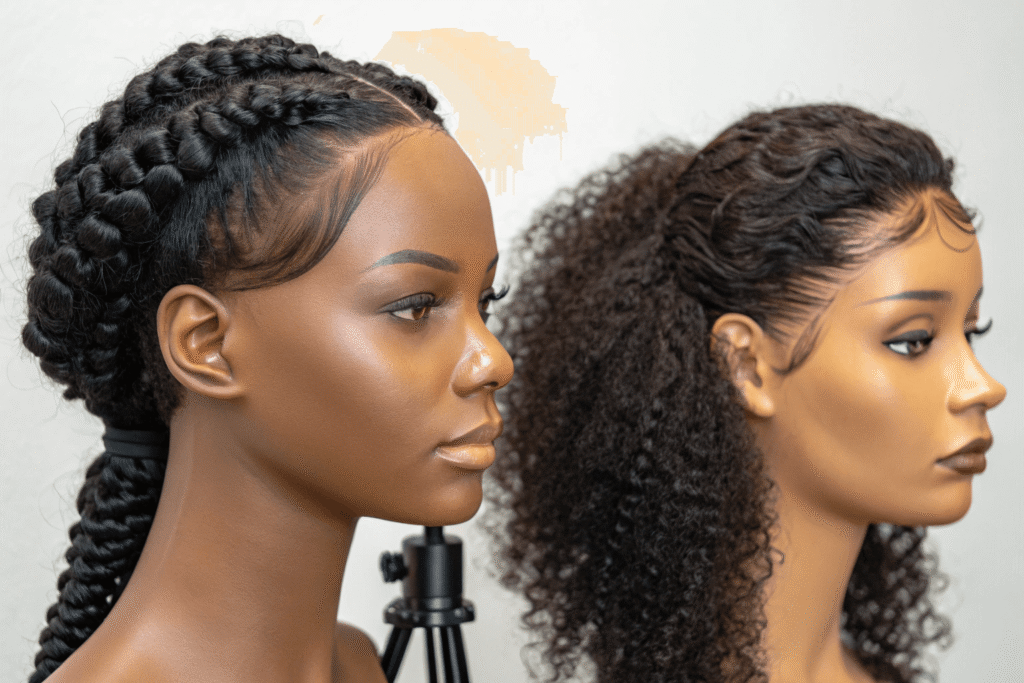
Common fit red flags to share with your customers
- Gapping at temples or sliding forward = cap too large or lace too flexible without anchoring
- Riding up at the nape = front-to-nape too short or circumference too small
- Pressure at the crown or headaches = cap too small or density too high for the cap size
Should I stock small, medium, and large caps to cut lead times?
The operational case for a three-size base
For B2B orders, a core matrix of small, medium, and large dramatically reduces the need for custom caps and accelerates ship times. Average fits the majority of adult buyers, but I’ve found a healthy distribution looks like:
- Small/Petite (20–21 inches): 10–20% depending on target market
- Medium/Average (21–22.5 inches): 60–70% general US; 45–55% in markets with larger average head sizes
- Large (23–24 inches): 15–30% depending on regional mix and protective style prevalence
Cap construction matters: offering the same three sizes across your primary constructions (lace front, full lace, wefted, hand-tied) lets you swap units quickly without remaking bases, particularly when you standardize stretch zones and adjusters.
Suggested stocking matrix
I build stocking strategies by overlaying demand forecasting with cap stretch characteristics.
| Cap Type | Stretch Profile | Size Coverage Strategy | Notes |
|---|---|---|---|
| Wefted with stretch | High | S/M/L covers 95% | Best for fast-turn SKUs; adjusters add ~0.5″ range |
| Lace front (partial stretch) | Medium | S/M/L plus M-L hybrid | Lace tension varies; stock medium with deeper nape for versatility |
| Full lace (minimal stretch) | Low | S/M/L with clear charts | Avoid over-reliance on adjusters; more precise measurement needed |
| Hand-tied (stretch crown) | Medium-High | S/M/L covers 90% | Comfortable, forgiving fit—good for mixed regional demand |
Stocking three sizes cuts lead times by allowing quick allocation. I reserve custom caps for atypical head shapes or specific medical clientele.
Will a sizing chart reduce fit-related returns in my B2B orders?
Yes—if it is specific, visual, and tied to cap construction
A generic “small/medium/large” chart helps, but a construction-specific chart is what actually moves your return rate. I include three measurements (circumference, front-to-nape, ear-to-ear over top) with tolerances and stretch notes for each cap type. I also add “if you’re between sizes, choose larger + use adjusters” and a visual measuring guide.

What I include in an effective chart
- Measurement ranges in inches and centimeters
- Fit notes: stretch zones, lace stiffness, adjuster range (+/− 0.5 inch)
- Density guidance: advise sizing up for high-density or thick bio hair underneath
- Red flag indicators: what gapping, sliding, and nape lift mean
- Brand-specific quirks: if your lace runs tight at temples, say so
Here’s a simple baseline you can adapt:
| Size Label | Circumference (in) | Front-to-Nape (in) | Ear-to-Ear Over Top (in) | Fit Notes |
|---|---|---|---|---|
| Petite/Small | 20.0–21.0 | 12.5–13.5 | 12.5–13.0 | Best for low-density styles; adjusters add ~0.5″ |
| Average/Medium | 21.0–22.5 | 13.5–14.5 | 12.75–13.5 | Fits most adults; works across wefted and hand-tied |
| Large | 23.0–24.0 | 14.5–15.5 | 13.5–14.0 | Consider deeper nape options; minimal-stretch lace needs precise measuring |
When retailers adopt this format, I typically see a noticeable drop in “cap too small/too large” returns within 1–2 cycles.
How do I handle regional head-size differences in the US and Africa?
Regional realities I’ve seen in distribution
Average cap sizes do trend differently by market. In US general retail, medium caps dominate, with steady demand for large due to protective styles, natural hair volume under caps, and preference for comfort. Across several African markets, I plan for a higher proportion of large caps—partly due to protective styling volume, partly due to regional head-size averages, and partly due to climate-driven swelling variability throughout the day.
Practical adjustments to minimize returns
- Calibrate your stocking ratios for each market: for many African distributors, a 40–50% large mix can outperform a US-focused matrix.
- Offer deeper nape options and reinforced temple stays in large sizes to prevent riding up when worn over braids or cornrows.
- Train resellers on measuring over protective styles or instruct customers to measure on compressed hair and then add a sizing buffer.
- Publish regional versions of your chart: same measurements, different default recommendations (e.g., “If you wear thick braids under the cap, choose the larger size and rely on adjusters”).
My final recommendation
Standardize measurement protocol, anchor your product line in small/medium/large with clear adjustability notes, and localize your stocking ratios. Measure twice, prefer the larger size if between, and let construction dictate the tolerance you advertise. When you align measurement, cap behavior, and regional reality, you reduce fit friction, cut lead times, and keep B2B customers coming back.