
I’ve spent years on factory floors and in procurement rooms comparing lace densities, silk laminations, and knotting methods under unforgiving studio lights. When buyers ask me for “the most natural scalp,” they’re really asking for the right balance of parting realism, hairline invisibility, and movement—without sacrificing durability or margin. I know the pain points: HD lace that photographs perfectly but tears in QA, silk tops that wow on parting yet run hot, and monofilament that looks clean but needs precise knot-bleaching to avoid grid visibility. Getting this right is part material science, part craft, and part merchandising discipline.
The most natural scalp illusion comes from a hybrid: HD lace at the hairline paired with a silk or monofilament top at the parting area, anchored on a 100% hand‑tied cap. Full lace offers unmatched multi‑directional parting, silk tops hide knots for a “hair-growing-through-skin” effect, and HD lace “disappears” at the front. Dialed-in density, properly bleached knots, and lace tone matched to skin are non-negotiables for a believable result.
I’ll break down silk vs. HD lace vs. PU-skin, then map SKU decisions across monofilament, lace, and silk. I’ll also show where blending materials optimizes realism, breathability, and cost, and finish with lighting/photography techniques so your online PDPs reflect what customers will see in person.
Do silk tops or PU-skin sections beat HD lace for realistic parting?
What each material does best
- Silk top (double-layer silk): I use silk when the brief demands “zero knots visible.” The double-layer construction buries knots under the silk, simulating hair emerging from skin. It’s unbeatable for parting realism under macro lenses and harsh lighting. Downsides: slightly warmer, a touch more bulk, and limited translucency across a wide tonal range. Works best for mid-to-fair complexions unless tinted.
- PU-skin (polyurethane skin): PU-skin can look hyper-real if injected or V-looped, creating a knotless illusion. It’s excellent for small parting zones or toppers. However, PU has lower breathability and can shine under flash. I use it sparingly—temples, small crowns, or medical wigs where cleaning/adhesion matters.
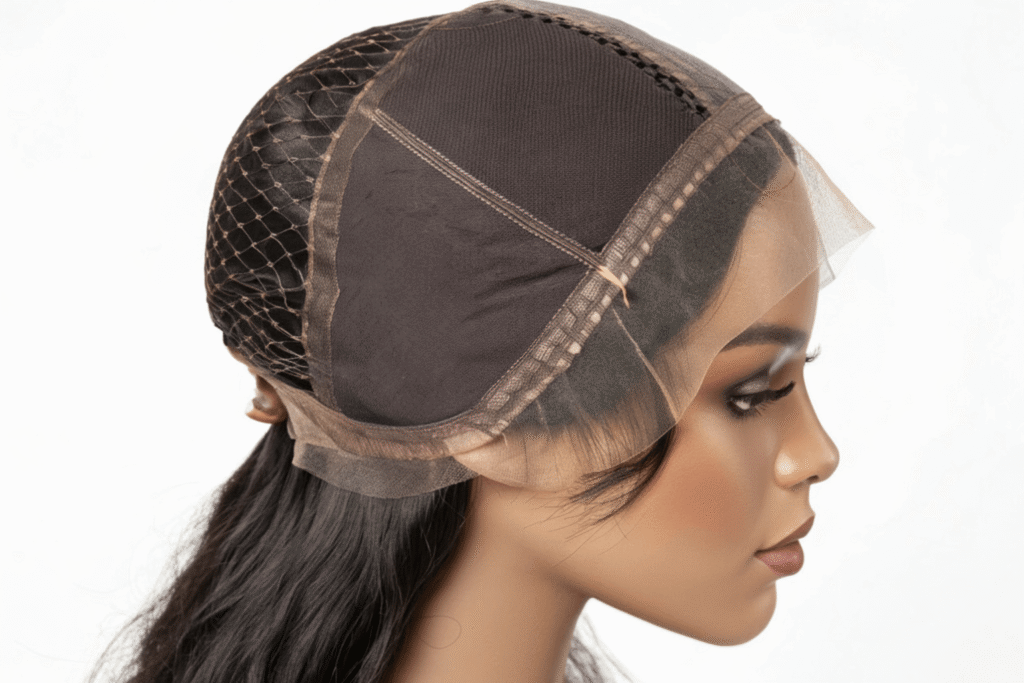
- HD lace (fine Swiss lace): For hairlines, HD lace wins. It’s ultra-thin and transparent, melting into skin with minimal makeup. For parting, HD lace is good but still shows micro knots unless bleached. It’s fragile; QA needs pull-tests and reinforced seams.
Practical verdicts I give buyers
- Front hairline: HD lace (Swiss) with micro knots, pre-bleached; ultra-thin edges for melt-in effect.
- Parting zone: Silk top for “no knot” perfection; monofilament if you prioritize breathability and cost control.
- PU-skin: Use as targeted accents or for adhesive zones; avoid full caps unless medical/adhesive requirements justify.
Real-world considerations
- Knot bleaching: Proper knot bleaching or pre-bleached micro knots is the single biggest lift in realism if you stick with lace/mono parting.
- Lace tone and density: Matching lace color and hair density to skin tone and bio hair density changes everything. Over-dense hairlines kill the illusion; 60–80% realistic front density usually wins.
- Care vs. realism: Ultra-thin HD lace and finer-denier fibers need gentler care; they pass close-up scrutiny but must be positioned as “premium, handle with care.”
How should I choose between monofilament, lace, and silk for my SKUs?
Decision framework by customer use case
- Everyday wearers who value comfort: Monofilament top + lace front on a hand‑tied cap. Breathable, natural parting, realistic hairline, cost-balanced.
- Photo/performance perfectionists: Silk top + HD lace front + hand‑tied sides/back. Knotless parting and invisible hairline for camera work.
- Versatile stylers: Full lace with HD hairline. True multi-directional parting across the scalp, best for updos and deep side parts.
Construction comparison for scalp realism and operations
| Construction Type | Scalp Realism (Parting) | Hairline Realism | Breathability | Styling Flexibility | Typical Cost Tier | Notes for Procurement |
|---|---|---|---|---|---|---|
| Silk Top | Highest (knotless) | High (with lace front) | Medium | High (defined part) | Premium | Ensure silk tone options; add ventilation mesh for comfort |
| Monofilament Top | High (sheer, hand-tied) | High (with lace front) | High | High (multi-direction) | Moderate–Premium | Requires precise knot bleaching; spec denier and grid size |
| Full Lace (Swiss/HD front) | Very High (multi-part) | Highest (HD front) | High | Maximum | Premium | QA on lace strength; reinforce stress points |
| Lace Front + Wefted Back | Medium–High | High | High | Moderate | Moderate | Strong value SKU; communicate realistic hairline benefit |
| PU-Skin Sections | High (small zones) | Medium | Low | Moderate | Moderate–Premium | Use for targeted realism; watch reflectivity and heat |
Sourcing and spec notes I use with factories
- Lace: HD/Swiss in 20–30 denier range; request tensile test data and edge reinforcement stitching.
- Monofilament: Nylon or polyester mono with micro-grid; specify translucency and avoid overly stiff mono that prints under light.
- Silk: Double-layer silk over lace/mesh; pre-tinted options across Fitzpatrick scale; confirm hand ventilation holes to reduce heat.
- Knotting: Single knots at hairline, double knots elsewhere for durability; micro knots with 1–2 hair strands per knot at front.
- Density map: Lower density at front (60–80%), gradual increase to 100–120% at crown; align with target demographics.
Can I blend materials to optimize realism, breathability, and cost?
Yes—and it’s where most brands win. I design hybrids to place realism where the eye looks first while controlling BOM and durability.
Proven hybrid layouts
- HD lace front + silk top center part + hand‑tied sides/back: Premium realism up front and at parting; comfortable and lightweight; strong AOV category.
- HD lace front + monofilament top + wefted back: Best seller blend for mid-tier SKUs; breathable and cost-effective with convincing parting.
- PU-skin perimeter tabs + lace front + mono top: For adhesive-friendly stabilization at temples/ear tabs; keeps core scalp breathable.
Why these work operationally
- Cost leverage: Limit silk to 4×4 or 5×5 parting zone instead of full top; HD lace only at the front 1.5–2 inches.
- Durability: Wefted backs reduce tear risk and speed production; hand‑tied sides preserve movement without full-lace fragility.
- QC control points:
- Color match lace/silk to model skin tones (carry 3–5 lace shades).
- Inspect knot bleaching uniformity—avoid over-bleach that breaks hair.
- Edge tape test on HD lace to ensure melt without fray.
Hair origin and processing impact
- Origins: Indian temple Remy and SEA cuticle-aligned bundles knot cleaner and bleach more predictably than mixed-source hair. Chinese single-donor is excellent for uniform cuticle alignment; South American/Eastern European can offer finer denier for ultra-natural fronts.
- Processing: Avoid heavy acid baths that strip cuticles—knots swell and show under light. Steam processing for texture is fine; keep chemical loads low on hair destined for exposed parting/hairlines.
What lighting and photography tips help me show scalp realism online?
I’ve lost sales to bad PDPs more than to bad products. The scalp illusion must read on mobile in 3 seconds.
Studio lighting and setup
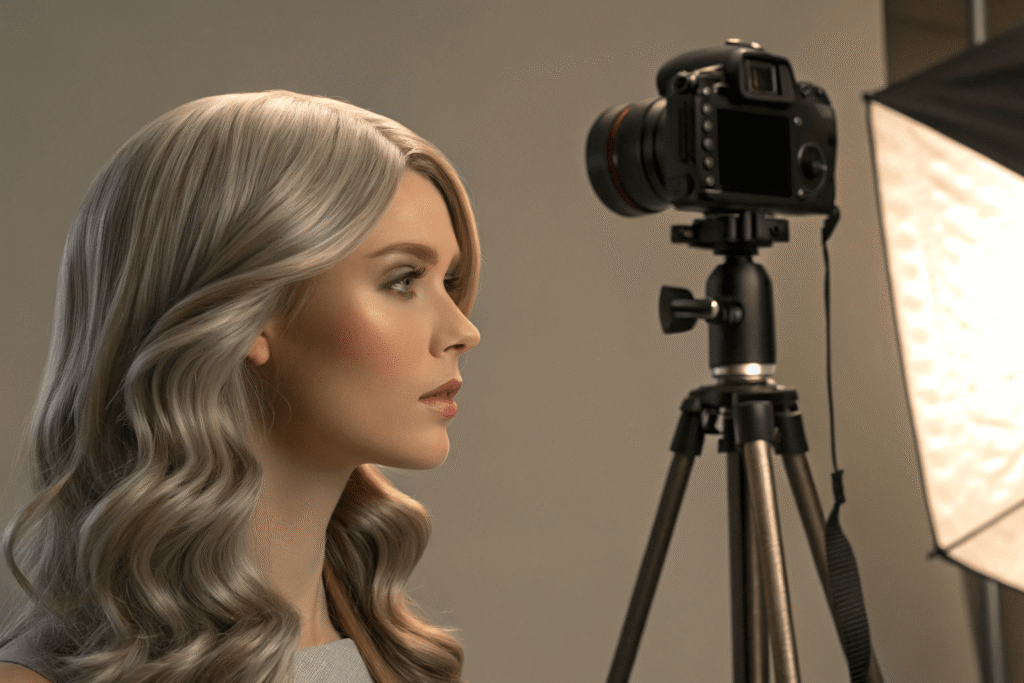
- Key light: Softbox or large diffused key at 45°; low contrast to prevent lace shadowing.
- Fill: Gentle fill from opposite side; avoid hot spots that make PU shine.
- Backlight/rim: Subtle rim to lift hairline edges; helps HD lace melt visually.
- Color temperature: 5200–5600K daylight; keep consistent across shots to avoid tone mismatch on lace/silk.
Camera and angles
- Lenses: 85–100mm for portraits; macro for parting close-ups. Shoot the parting at 30–45° angle and straight-on to show knotlessness.
- Aperture: f/5.6–f/8 for clarity of lace mesh without moiré; avoid too shallow DOF that hides the scalp detail.
- Polarizing filter: Cuts specular highlights on PU-skin and reduces glare on silk.
Styling and prep
- Tint the lace lightly to model’s tone; press makeup sparingly at the hairline.
- Pluck minimally at the front for a graduated density; do not over-pluck—customers zoom.
- Show wet-comb pass over parting to prove knotlessness; include a finger lift to demonstrate cap movement.
Asset checklist per SKU
- Macro of parting (2 angles): silk/mono clarity and knot status.
- Hairline extreme close-up: HD lace melt + micro knots.
- Breathability shot: inside cap showing material blend.
- Movement clip: hand‑tied sections responding to shake/brush.
Conclusion
If I’m building for the most natural scalp appearance, I specify HD lace at the hairline, a silk or monofilament top for the parting zone, and a 100% hand‑tied cap where budget allows. Full lace delivers unmatched styling freedom; silk top wins on “no-knot” parting; monofilament balances realism, breathability, and cost. The final look hinges on knot work, lace color matching, density mapping, and smart hybrids that place premium materials where eyes land first. Finish the job with honest, well-lit photography that proves the illusion—because in B2B, the product you can show clearly is the product that sells consistently.