
I’ve overseen OEM lines in China and Southeast Asia that run tens of thousands of machine-made synthetic wigs per month. The buyers I work with care about three things: predictable cap fit across sizes, consistent fiber density per weft row, and realistic hairline/part options that match retail price points. The pain points are familiar—varying modacrylic batches, stitching drift on open caps, and permatease that solves weft visibility but can read “wiggy” if overused. My aim here is to give you the practical, factory-floor view so you can specify, sample, and QC with confidence.
Machine-made synthetic wigs are built by sewing pre-textured synthetic fibers into horizontal wefts, then machine-attaching those wefts to an elasticized cap with an often-closed lace/mesh crown and permatease for coverage. The result is an open-cap (capless) or partially closed cap with adjustable straps and ear tabs, delivering durability and cost efficiency. Adding a lace-front strip or mono part can elevate realism without sacrificing mass-production speed.
In the sections below, I break down OEM machine wefting and cap assembly, how to spec lace/mono/stretch cap options for your market, the QC checkpoints that keep size and stitching on target, and how to structure PP samples so you validate construction before committing to mass order.
What machine wefting and cap assembly steps should I expect in OEM production?
1) Fiber prep and styling set
- Fiber type: Modacrylic is standard; heat-friendly blends are offered but require lower styling temps and can change hand-feel.
- Pre-set styling: Fibers are steam/heat set into straight, body wave, or curl patterns before wefting to ensure uniform look and faster finishing.
- Color: Dope-dyed fibers ensure colorfastness and batch consistency across runs.
2) Weft manufacturing
- Weft baseline: Fibers are spread uniformly and stitched to a base tape or fabric, typically single or double wefted depending on target density.
- Machine stitching: Zig-zag or triple-step stitches enforce uniform fiber distribution, improving durability but reducing the free movement you get from hand-ventilated caps.
- Density map: Factories follow a density map (nape heavier, crown moderate, top light with permatease) to balance coverage and realism.
3) Cap assembly
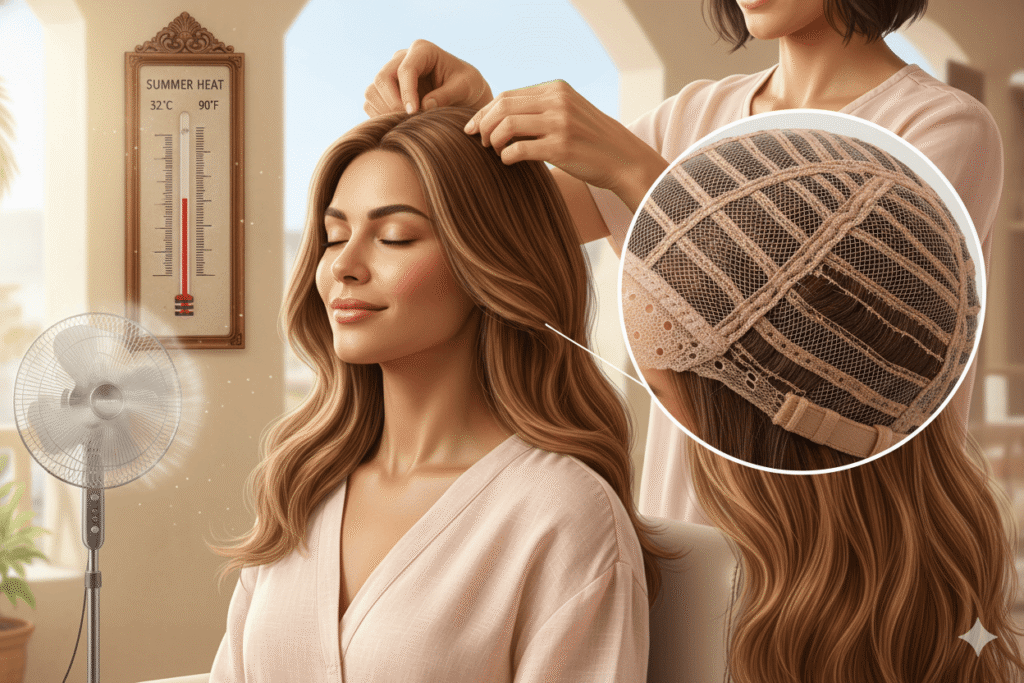
- Cap architecture: Elasticized strips form the base; sides/back are open wefts for ventilation and weight reduction. Crown usually features closed lace or mesh with permatease to hide wefts.
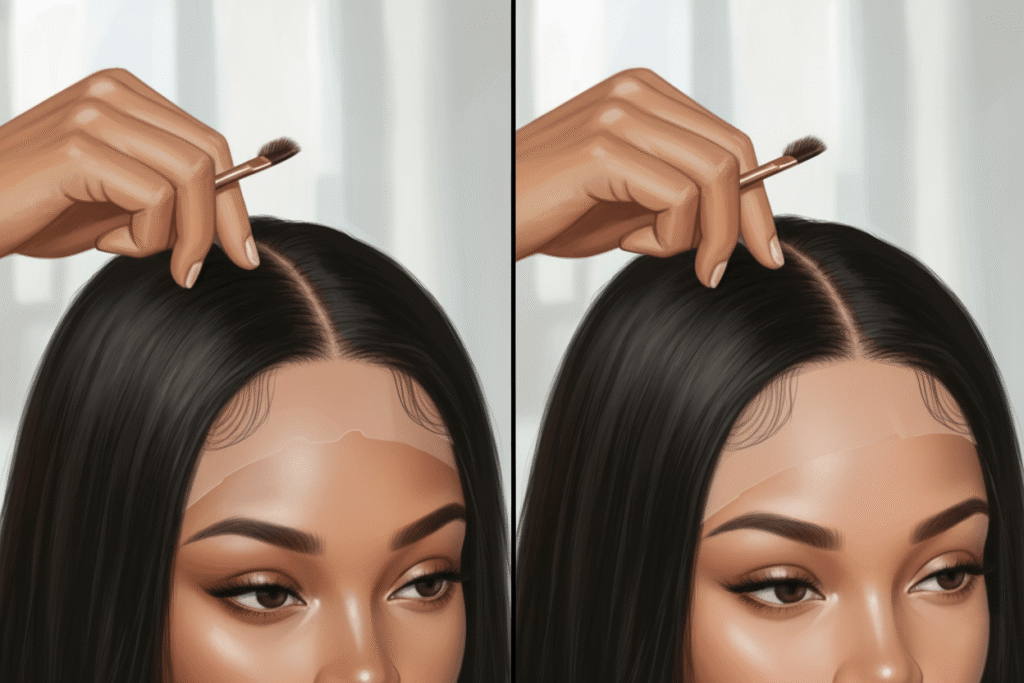
- Hairline/part: Typically non-lace with a fixed, non-hand-tied part; teased roots help disguise the cap. Optional upgrades: lace-front strip or monofilament part.
- Fit components: Adjustable straps (hook-and-loop or bra-style) and metal/plastic-reinforced ear tabs are machine-stitched for secure fit and minor size customization.
4) Weft-to-cap sewing sequence
- Row planning: Horizontal rows installed from nape upward; spacing measured to maintain coverage while preserving ventilation.
- Stitch path: Rows sewn along elasticized bands; thread color matches cap or fiber to minimize visibility.
- Permatease application: Light teasing at the crown/top to mask track lines—calibrated by style and target market preference.
- Edge finishing: Clean fold-back at nape and temples; optional lace-front tape sewn at the front for upgraded SKUs.
5) Final finishing
- Steaming/forming: Final steam set on soft blocks to lock style and cap shape.
- Trimming and QC prep: Loose fibers trimmed; cap inspected for stitch integrity and strap function.
How do I specify cap materials (lace, mono, stretch) to match my market needs?
Your spec should align with price band, retail claims, and climate/use case. Below is a practical matrix I use with buyers.
Cap option matrix
| Cap feature | Use case / market fit | Pros | Trade-offs |
|---|---|---|---|
| Open-cap (capless) | Value lines, warm climates, daily wear | Lightweight, breathable, quick-drying | Potential cap visibility if density too low |
| Closed lace/mesh crown | Mid-range fashion styles | Hides tracks; supports permatease volume | Can feel warmer; permatease needs careful balance |
| Monofilament part (mono) | Mid-to-high range realism seekers | Natural-looking part; directional styling | Higher cost; slightly heavier |
| Lace-front strip | Elevated realism at front hairline | Soft hairline; retail “lace-front” claim | Adds complexity; requires good knotting/blend |
| Full stretch mesh | Comfort and fit variability | Conforms to head; stable sizing | Less breathable than open wefts |
Spec tips I use in RFQs
- Fiber: “Modacrylic, 22–24 denier, heat-set body wave, color code X with ±ΔE 1.0 tolerance.”
- Wefts: “Double-weft from nape to ear line; single-weft above ear line; top density 85% of nape.”
- Crown: “Closed mesh crown with light permatease—target bulk <2.5g at crown to avoid visible teasing.”
- Hairline upgrade: “15 mm lace-front strip, medium brown lace, pre-trimmed, ventilated 12–14 knots/cm².”
- Parting: “Mono part width 25–30 mm centered; fiber direction left-to-right with under-vent to break shine.”
- Cap fit: “Circumference S/M/L with stretch allowance +1.5 cm; ear tabs with wire; straps adjustable ±1.5 cm.”
- Ventilation: “Open wefts on sides/back; spacing 8–10 mm; ensure no track visibility at 90-degree lift.”
Which QC checkpoints ensure my cap shape, size, and stitching consistency?
Incoming and in-line controls
- Fiber batch QC: Denier, color ΔE, curl retention after 3x steam cycles.
- Weft QC: Stitch count per 10 cm, weft width uniformity, shed rate via 20-pull test.
- Elastic bands: Stretch recovery (cycle 10x to 110% extension); stitch bite depth 1.5–2.0 mm.
Cap geometry and fit
- Size measurements: Circumference, front-to-nape, ear-to-ear across forehead, ear-to-ear over top. Tolerances ±3 mm (premium) or ±5 mm (value).
- Crown contour: Check dome height and seam symmetry to prevent “hot spots” and lift at temple.
- Strap function: Locking strength, adjust range, and slippage test after 50 cycles.
Stitch integrity and aesthetics
- Row alignment: Horizontal drift <2 mm across left/right panels.
- Thread tension: No puckering on mesh; no skipped stitches. Inspect at nape and temple stress points.
- Permatease level: Visual test—no visible teasing clumps; comb-through should not expose tracks.
- Lace/mono attachments: Clean seam, no glue bleed, uniform ventilations if included.
Functional wear tests
- Wind lift simulation: 90-degree lift; cap should remain concealed with specified density.
- Wash/dry cycle: 3 cycles—monitor cap distortion, fiber frizz, and weft stability.
- Breathability: Subjective heat build-up vs. open-weft spec; can be supported by airflow measurement.
QC checklist summary
| Checkpoint | Method | Target/Result |
|---|---|---|
| Size tolerances | Tape measure on block | ±3–5 mm per dimension |
| Stitch count/row | Visual + stitch counter | Consistent with spec per 10 cm |
| Elastic stretch recovery | Cycle to 110% x10 | ≥95% recovery |
| Shed rate | 20-pull test | ≤2 fibers released per pull average |
| Row drift | Calipers/visual grid | <2 mm drift across cap |
| Wind lift visibility | 90° lift inspection | No track exposure |
How can I request PP samples to validate construction before mass order?
What to include in your PP (pre-production) sample brief
- BOM and drawings: Cap map with row spacing, density per zone, lace/mono dimensions, strap system.
- Measurement sheet: Target sizes with tolerances; require factory to fill actuals on PP form.
- Fiber batch reference: Lock the fiber supplier, code, and lot—request retain sample swatch.
- Style set parameters: Steam time/temperature, curl pattern code; ask for a settings log printout.
- QC protocols: Enumerate stitch count, shed test, wash/dry cycle, and wind lift visibility checks.
Sample quantities and variants
- Request 2–3 PP units per size (S/M/L) and one stress-test unit for laundering and combing trials.
- If upgrading realism: Include one PP with lace-front strip and one with mono part to compare retail impact vs. cost.
Validation steps on your side
- Fit testing: Live models or standardized head forms; record comfort points and slippage.
- Track visibility: Lift-and-separate tests under bright light; document with photos.
- Density feel: Comb-through at crown and nape; ensure permatease balances coverage without bulk.
- Return feedback: Annotated images + measurement variances; approve with “no change,” “minor change,” or “resample.”
Commercial terms to lock before mass order
- Golden sample status: Mark the approved PP as “Master” with tamper-proof tag; all bulk to match this reference.
- Allowable variance: Define ± tolerances for size, stitch count, and density; link to rework/discount terms.
- Retention samples: Factory to keep one master; buyer retains one; third kept by QA agent if applicable.

Conclusion
Machine-made synthetic wigs deliver scalable, durable, and cost-efficient products by combining uniform weft construction with elasticized open-cap architectures and targeted crown coverage via permatease. Your leverage in OEM lies in precise cap material specs (open weft, mesh crown, lace-front or mono upgrades), a practical density map, and enforceable QC checkpoints for size, stitch integrity, and ventilation. Lock these details in your PP sample brief, validate with structured tests, and approve a golden sample so your mass order reproduces the fit, realism, and durability your market expects.