
I’ve spent years auditing synthetic fiber lines, negotiating contracts, and troubleshooting batches when curl memory fails or a heat-friendly style melts under a store’s steamer. Reliability in synthetic wig fibers isn’t just about brand names—it’s about polymer chemistry, extrusion precision, finishing consistency, and whether the maker can certify the same denier, luster, and heat tolerance month after month. Procurement teams tell me their biggest pain points are spec drift, inconsistent color lots, lead time volatility, and weak traceability when a batch underperforms at QC.
The most reliable synthetic wig fibers come from countries with advanced polymer and extrusion ecosystems—Japan, South Korea, Germany, and Taiwan—supported by strict quality control and batch certification. Japan (Kanekalon, Toyokalon) sets the benchmark for natural look, low shine, and heat stability; South Korea delivers fine-denier, color-consistent fibers; China leads in volume with improving reliability among top-tier makers; Germany and Italy contribute technical, specialty fibers with tight tolerances. Suppliers that certify denier, tensile strength, heat limits, and lot traceability consistently deliver dependable results.
I’ll break down the comparative quality of Japanese, Korean, and Chinese makers, name the supplier profiles that provide stable specs and traceability, outline contracting strategies to secure supply, and detail logistics setups that keep lead times predictable. I’ll also include practical tables and visuals you can share with your team during vendor selection.
How do I compare Japanese, Korean, and Chinese fiber makers for quality?
What “quality” means in synthetic wig fibers
- Polymer base: modacrylic (e.g., Kanekalon), PVC variants (Toyokalon), advanced acrylics and blends
- Fiber attributes: denier uniformity, cuticle-like matte, heat tolerance and recovery, curl memory, dye/solution uptake, static resistance
- Process controls: spin/draw ratios, cross-section control, surface finishing, anti-static and flame-retardant additives
- Certification: denier range, tensile/elongation, softening point, heat limit, lot traceability
Country-level patterns
- Japan: Widely recognized for Kanekalon and Toyokalon—natural hand-feel, low luster, reliable heat margins. Japanese-origin fibers present more cuticle-like optics and softer touch, which helps everyday realism and reduces “plastic shine.” Heat-friendly SKUs tend to carry safer margins, reducing melting risk in retail styling.
- South Korea: Premium fine-denier fibers with consistent color lots and excellent curl retention, favored in fashion-forward SKUs. Korean producers excel at uniformity in extrusion and color masterbatching, which helps multi-store replenishment without visible color drift.
- China: Dominates volume—from budget to mid-tier. Reliability varies; top-tier factories investing in QC and resin sourcing achieve respectable consistency. Strong option for price-sensitive programs when paired with tight incoming QC and supplier audits.
- Taiwan: Stable, uniform fibers with good durability and dye consistency; often used in professional-grade lines where predictable performance trumps extreme softness.
- Germany/Italy: Technical and specialty fibers with precise heat tolerance and strand uniformity; niche or premium theater/high-fashion applications where resilience under styling and color richness matter most.
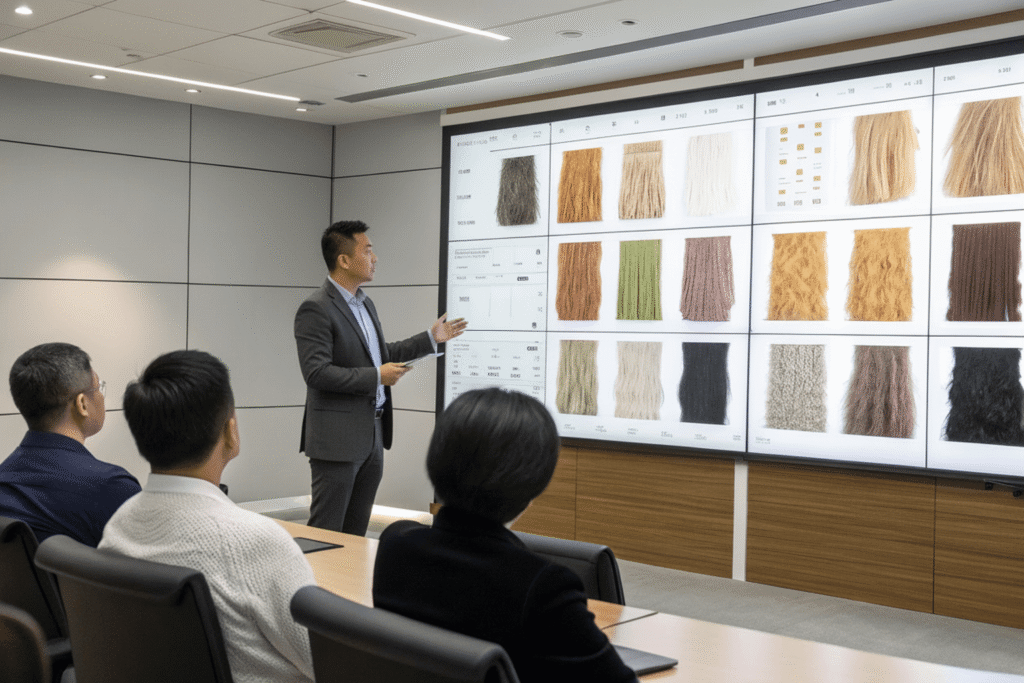
Practical comparison table (procurement-ready)
| Attribute | Japan (Kanekalon/Toyokalon) | South Korea | China (Top-tier) | Taiwan | Germany/Italy (Specialty) |
|---|---|---|---|---|---|
| Denier uniformity | Excellent | Excellent | Good–Very Good (factory-dependent) | Very Good | Excellent |
| Luster (natural look) | Low–Matte, cuticle-like | Low–Medium | Medium–Variable | Medium–Low | Medium–Low, engineered |
| Heat tolerance (HF SKUs) | Very Good (predictable margins) | Very Good | Good–Very Good (spec-dependent) | Good | Excellent (technical fibers) |
| Color lot consistency | Excellent | Excellent | Good–Very Good | Very Good | Excellent |
| Curl memory | Excellent | Excellent | Good–Very Good | Very Good | Excellent |
| Batch traceability | Strong (lot-coded, certs common) | Strong | Improving among top-tier factories | Strong | Strong |
| Price level | Premium | Premium–Upper Mid | Wide range (Budget to Mid) | Mid–Upper Mid | Premium–Specialty |
| Recommended use case | Premium realism, everyday wear | Fashion wigs, fine-denier textures | Price-sensitive programs, scale | Pro-grade stability | Theater/high-fashion, heat rigs |
Which suppliers provide stable specs and batch traceability for my orders?
What I look for in supplier documentation
- COA per lot: denier, tensile/elongation, softening point/heat limit, moisture regain
- Masterbatch/colorant certificates: pigment origin, batch ID, lightfastness rating
- Additives disclosure: flame retardants, anti-static finishes, their concentration ranges
- Process sheets: spin/draw ratios, post-finishing parameters
- Traceability: resin lot → extrusion lot → finish lot → shipment ID
Country-specific supplier profiles
- Japan
- Kaneka (Kanekalon) and Denka (Toyokalon) are the benchmark for soft hand, natural optics, flame-retardance, and predictable heat performance. They typically support strict lot coding and provide spec sheets that align with published product families.
- South Korea
- Korean premium makers are strong in fine denier, consistent color lots, and curl memory. In my audits, they produce clean COAs and offer stable, repeatable finishing that reduces spec drift across seasonal runs.
- China
- Reliability is uneven. For top-tier factories with robust QC and upstream resin control, I’ve seen solid batch documentation and improving traceability. Vet for ISO 9001/14001, incoming resin QC, and whether they can certify heat limits and luster metrics. Avoid vendors who won’t share additive disclosures.
- Taiwan
- Taiwanese producers often excel at uniformity and dye consistency—with practical, well-maintained spec sheets and steady batch traceability suited to professional-grade wigs.
- Germany/Italy
- Specialty technical fibers come with tight engineering specs and excellent documentation; ideal when you need exceptional heat resilience and strand uniformity for high-stress styling environments.
Sample spec/traceability checklist (use in supplier RFQ)
- Provide COA per lot with denier ± tolerance, tensile/elongation, heat limit (°C), moisture regain
- Color lot lightfastness rating and masterbatch IDs
- Additives list with concentration ranges and compliance (REACH/Prop 65 as applicable)
- Lot coding system mapping resin → extrusion → finishing → packing
- Retain 500–1000g retains per lot for 12–24 months for dispute resolution
- Offer corrective action reports (8D) within 10 business days upon nonconformance

How do I secure long-term fiber contracts to avoid shortages?
Contracting strategies that actually work
- Dual-sourcing within the same spec: Primary in Japan/Korea, secondary in Taiwan/China top-tier; qualify both through PPAP-like runs to ensure interchangeability.
- Volume brackets with rolling forecasts: 3–6 month firm orders, 6–12 month non-binding forecasts; attach price adjustment clauses tied to acrylic/PVC resin indices.
- Safety stock at origin + VMI at destination: Vendor-managed inventory for 2–4 weeks of cover in your DC; origin safety stock to absorb extrusion downtime.
- Make-to-Order vs. Make-to-Stock: For specialty colors and fine denier lines, lock MTO windows and firm MOQ to protect capacity during peak season.
Clauses I insist on
- Priority allocation: Supplier commits allocation during resin shortages based on your historical share.
- Lead-time SLAs: Define “dock to dock” timelines, with penalties or expedited freight cost-sharing for late deliveries beyond agreed tolerance.
- Engineering change control: No formulation or finish changes without PPAP, sample approval, and written sign-off; includes color masterbatch shifts.
- Batch retain & dispute resolution: Supplier keeps retains; if your QC fails, independent testing triggers corrective action and cost recovery if root cause is supplier-related.
Useful contract summary table
| Contract Element | Why it matters | What to specify |
|---|---|---|
| Dual-source qualification | Reduces single-point failure | PPAP runs, interchangeability test, shared spec limits |
| Forecasts & MOQs | Secures capacity, stabilizes pricing | 3–6M firm, 6–12M forecast, resin-index price clause |
| Safety stock & VMI | Buffers demand swings and production delays | Origin + destination coverage, replenishment triggers |
| Lead-time SLA | Keeps planning accurate | Door-to-door days, exceptions, penalty/expedite rules |
| Change control | Prevents hidden spec drift | PPAP approval, sample sign-off, notification windows |
| Traceability & retains | Speeds root-cause analysis | Lot coding, retain duration, 8D report turnaround |
What logistics options keep my fiber lead times predictable?
Lane design and modes
- Ocean FCL with weekly sailings: For bulk fiber, standardize FCL to reduce handling risk and stabilize transit times; lock space allocations in peak seasons.
- Premium ocean services: Use faster strings or priority loading during Q3–Q4 when resin/fiber capacity tightens.
- Air for exception management: Pre-negotiate spot air rates for color-critical drops or launch windows; limit to ≤10% of volume to control costs.
- Regional production leveraging: Japan-origin fibers sometimes ship ex-Malaysia (Kaneka) for Southeast Asia proximity—use this to shorten transit into Indonesia/China assembly hubs.
Planning buffers and compliance
- Long lead time planning: Maintain 30–45 days of fiber cover in your DC for premium lines; 20–30 days for mid-tier.
- Port selection: Choose ports with consistent productivity and fewer seasonal congestion issues; factor holiday shutdowns (e.g., Golden Week, Lunar New Year).
- Packaging and handling: Request moisture-controlled, crush-resistant packaging; include humidity indicators for modacrylics to protect hand-feel.
Traceability in transit
- ASN + lot-level tracking: Advance Shipping Notices with lot IDs tied to your ERP so production can plan exact fiber specs into wig lines.
- Milestone visibility: Bookings, vessel ETD/ETA, transship points, and customs clearance milestones fed to planning team weekly.
Conclusion
From a procurement standpoint, reliability in synthetic wig fibers correlates strongly with advanced polymer engineering, strict extrusion controls, and documented batch consistency. Japan (Kanekalon, Toyokalon) remains the benchmark for natural optics, soft hand, and predictable heat performance; South Korea excels in fine denier and color stability; Taiwan and Germany contribute steady, technical fibers; China provides scalable options where top-tier factories now deliver improving QC. To ensure dependable outcomes, anchor your supply base with suppliers that certify denier, tensile strength, and heat limits, enforce traceability in contracts, dual-source critical specs, and build logistics buffers with clear SLAs. Do that, and you’ll keep style integrity, minimize batch disputes, and hit on-time launches—even when the market tightens.