
I’ve spent years inside factories that extrude Kanekalon and Toyokalon filaments, and I know how unforgiving wig hair specifications can be—denier uniformity, curl memory, heat-set response, and luster have to land perfectly for brands to approve a SKU. I also understand why B2B teams are pushing for lower-impact materials: retailers are asking for recycled content, while consumers are increasingly sensitive to “plastic hair.” My goal here is to cut through the hype and explain what’s technically feasible, what will change in your manufacturing workflow, and how to communicate sustainability credibly.
Yes—synthetic wigs can be made from recycled or biobased plastics, but it’s still early-stage for commercial-scale wig filaments. The barrier isn’t extrusion; it’s meeting hair-specific performance targets (denier tolerance, tensile strength, crimp/curl memory, heat resistance, and luster) consistently at scale. Today, most “heat-friendly” fibers are still virgin modacrylic or PET derivatives, while rPET and biobased options are viable in pilot runs with careful resin selection, filtration, and process control.
In the sections below I’ll map the material options (rPET, bio-PET, bio-based PA), the real styling tradeoffs you’ll face, how to avoid greenwashing, and the MOQ and cost implications of launching recycled-fiber SKUs. I’ll also ground the analysis in what I’ve seen across Japanese, Chinese, and Korean supply chains, and how brands are de-risking their first sustainable lines.
How do I evaluate rPET, bio-PET, and bio-based PA for wig applications?
Synthetic wigs today are dominated by modacrylics like Kanekalon/Toyokalon—petroleum-based and not inherently recycled or biodegradable. While apparel has embraced rPET, wig-grade filaments demand tighter specs, which is why adoption has lagged. Here’s how I evaluate each polymer family against wig performance.
Material definitions and what matters for “hair”
- rPET: Recycled polyethylene terephthalate, typically from bottle flake (post-consumer) or industrial scrap (post-industrial). Viability hinges on IV (intrinsic viscosity), metal/gel contamination, and consistency across lots.
- Bio-PET: Chemically identical to PET, but partially derived from bio-based MEG (mono-ethylene glycol). Same performance as virgin PET; sustainability benefit is renewable feedstock rather than end-of-life biodegradation.
- Bio-based PA: Polyamides (nylons) from plant-derived monomers (e.g., PA11, PA610). Offers better toughness and heat resistance than PET in some grades, but moisture uptake and dye packages can complicate styling.
What wig makers actually need in filament
- Uniform denier and cross-section: Filament lines must hold ±3–5% denier tolerance; oval or trilobal cross-sections influence shine and “human hair” look.
- Tensile and elongation: Enough toughness to withstand ventilation/knotting and repeated combing.
- Curl/crimp memory and glass transition: Predictable heat-set at 90–130°C, with stable memory after wash cycles.
- Luster and handfeel: Controlled by polymer refractive index, additives, and surface finish; too glossy reads “plastic.”
- Dye and color stability: Pigmented masterbatch consistency; low yellowing under heat.
Comparative snapshot
| Attribute | rPET (recycled) | Bio-PET (renewable feedstock) | Bio-based PA (PA11/PA610) |
|---|---|---|---|
| Source | Post-consumer/post-industrial PET | Bio-MEG + PTA (fossil) | Plant-derived monomers |
| Filament consistency | Challenging; needs deep filtration and IV control | High; comparable to virgin PET | Good; tougher, but moisture sensitivity |
| Heat-set/styling temp | 90–120°C typical | 90–120°C | 110–140°C depending on grade |
| Curl memory | Moderate; additive-dependent | Moderate; similar to PET | Strong; good resilience |
| Luster control | Needs cross-section + matting agents | Similar to PET | Naturally lower gloss possible |
| Dye approach | Masterbatch pigments (solution dye) | Masterbatch pigments | Masterbatch; acid dyes limited in melts |
| Sustainability lever | Recycled content (%) | Bio-based content (%) | Bio-based content + durability |
| Key risks | Gels, yellowing, batch variability | Limited real-world environmental gain at end-of-life | Moisture uptake; supply scale and cost |
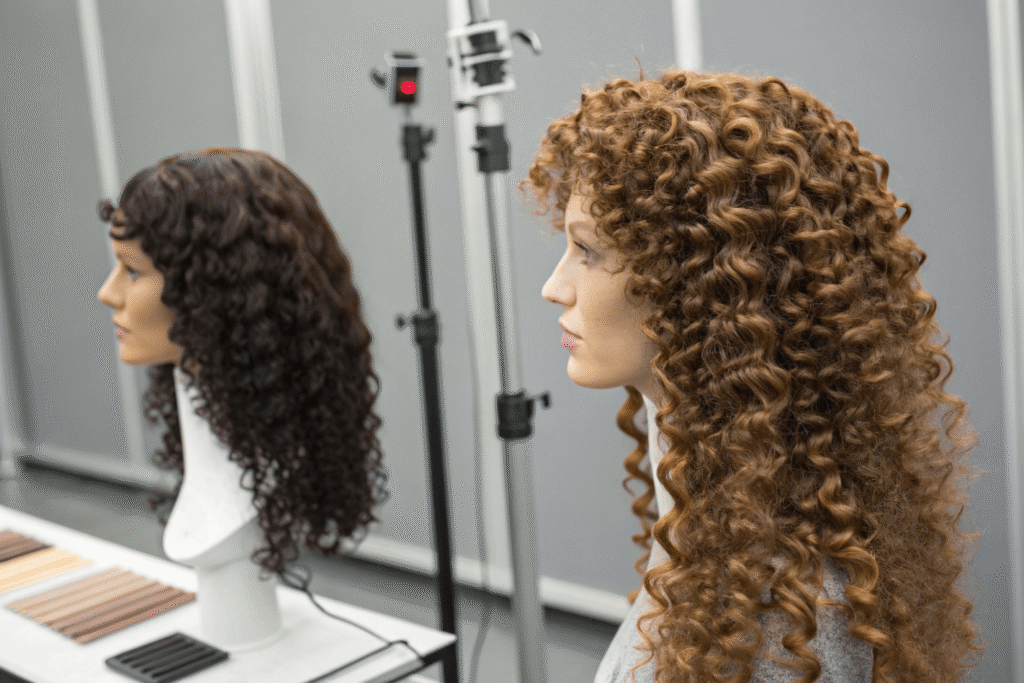
Practical evaluation steps I use with suppliers
- Resin screening: Request IV 0.80–0.90 for PET-based filaments, contaminants <50 ppm metals, and melt filters ≤20–50 μm with continuous screen changers.
- Pilot extrusion: Run at least three lots to test denier stability (e.g., 50D–75D), trilobal spinnerets for natural luster, and in-line quench control.
- Mechanical testing: Tensile/elongation, cyclic crimp retention after 10 wash/heat cycles.
- Styling simulation: Heat-set at different temps, then comb/brush 100 cycles; score frizzing and memory loss.
- Color: Masterbatch compatibility, lightfastness (ISO 105-B02), and yellowing after 130°C exposure.
Bottom line: rPET can work for wigs if filtration, IV control, and masterbatch alignment are dialed in. Bio-PET gives the same processing window as virgin PET with a cleaner story. Bio-based PA is promising for durability and heat, but moisture management and cost need attention.
Which performance tradeoffs should I expect in heat-setting and styling?
Many “heat-friendly” or “future-fiber” lines are still virgin plastic derivatives. Moving to recycled or biobased inputs shifts your heat-setting window and memory behavior.
Heat windows and glass transition
- rPET/bio-PET: Expect heat-set windows around 100–120°C with moderate curl memory. Overheating risks yellowing and gloss changes. Steam-setting can help penetrate and lock crimp but may soften memory in humid climates.
- Bio-based PA: Higher usable heat window (110–140°C) and better resilience after styling. However, moisture uptake can temporarily soften the fiber; post-set conditioning is essential.
Styling tradeoffs I’ve seen in pilots
- Curl memory vs. softness: Additives that improve soft hand can reduce memory. You’ll balance matting agents and plasticizers carefully.
- Frizz resistance: rPET is more sensitive to microfibrillation during aggressive brushing. PA handles brushing better but may feel slightly “firmer” unless softened.
- Shine control: PET family tends to higher gloss; trilobal cross-sections plus matting agents help. Bio-based PA can look more “human” with lower gloss naturally.
- Heat tools: For consumer safety, publish conservative tool temps (e.g., 110°C for PET-based recycled lines; 130°C max for PA). Always specify low-contact, low-dwell instructions.
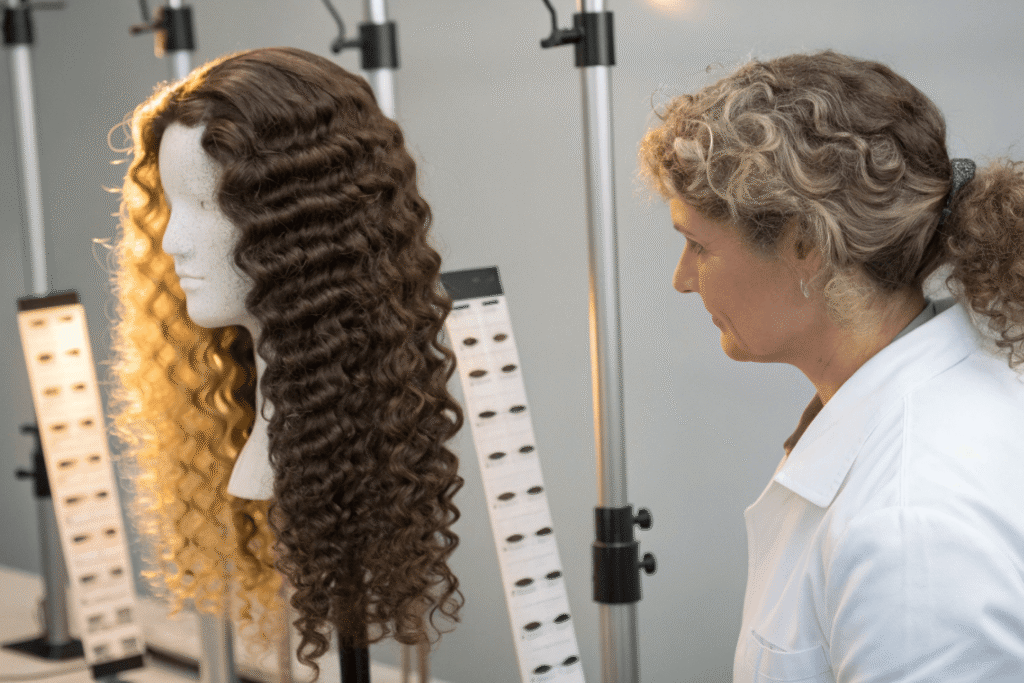
QC checkpoints
- Crimp retention after 5 and 10 wash cycles (warm water + mild detergent).
- Yellowing index after forced aging (130°C for 30 minutes).
- Brush-out tests to quantify frizz and fiber breakage.
How do I communicate sustainability claims without greenwashing?
Given the industry’s reality—most synthetic fibers are petroleum-based and end-of-life recycling is difficult—claims should focus on verifiable improvements, not absolutes.
Claim principles I use with brands
- Be specific: “This SKU contains 40% post-consumer rPET by weight” beats “eco-friendly.”
- Avoid implying biodegradation: PET and PA are not biodegradable in typical settings. Don’t conflate bio-based feedstock with compostability.
- Lifecycle framing: If your benefit is longer lifespan or fewer washes (lower energy/water use), say so explicitly and show testing.
- End-of-life honesty: Mixed fiber types, dyes, and styling treatments complicate recycling. If you pilot take-back, state limits (monomaterial only, specific colors, no adhesives).
Credible frameworks and on-pack language
- Certifications: Recycled Claim Standard (RCS) or Global Recycled Standard (GRS) for chain-of-custody; bio-based content via ASTM D6866. Consider ISO 14021 for self-declared claims.
- Data points: Include recycled content %, bio-based %, and verified supplier scope. Publish a tech sheet summarizing IV, filtration, and quality controls—buyers appreciate transparency.
- Monomaterial designs: Commit to single-polymer constructions and standardized colorants to enable future closed-loop programs. Communicate this design choice as a recyclability enabler, not a guarantee.
Suggested claim examples
- “Made with 50% GRS-certified post-consumer rPET; tested for denier uniformity and curl memory over 10 wash cycles.”
- “Bio-PET filaments with 30% bio-based MEG content; identical performance to virgin PET; not biodegradable.”
- “Designed as a monomaterial wig fiber to support take-back pilots; please see program eligibility by color and SKU.”
What MOQ and cost premiums apply to recycled-fiber SKUs?
Recycled and biobased wig filaments are feasible, but expect higher MOQs and premiums due to resin selection, filtration, and specialized spinnerets.
Typical commercial ranges I’ve seen
- rPET filament MOQs: 300–800 kg per color per denier for pilot runs; 1–3 metric tons for scale to secure consistent IV and masterbatch lots.
- Bio-PET filament MOQs: Similar to virgin PET; 500–1,000 kg per color/denier is common.
- Bio-based PA MOQs: Higher—800 kg to 2 tons per color/denier, depending on supplier capacity.
Cost premiums versus standard modacrylic
- rPET: +8–20% over virgin PET-equivalent filament; can be higher if you require post-consumer only and tighter IV specs.
- Bio-PET: +5–12% depending on bio-content percentage and certification.
- Bio-based PA: +20–40% due to feedstock cost and smaller production base.
| SKU Type | Typical MOQ (per color/denier) | Cost Premium vs. Standard Modacrylic | Notes |
|---|---|---|---|
| rPET filament | 0.3–0.8 t (pilot), 1–3 t (scale) | +8–20% | Tight filtration; risk of yellowing if overheated |
| Bio-PET filament | 0.5–1.0 t | +5–12% | Same processing window as PET |
| Bio-based PA filament | 0.8–2.0 t | +20–40% | Better heat resilience; manage moisture |
Commercialization advice
- Start with limited shade ranges: Fewer pigments reduce variability and simplify QC.
- Lock spinneret and cross-section early: Changing cross-section midstream resets luster and handfeel.
- Negotiate resin lots: Secure 3–6 months of consistent IV and color masterbatch to avoid batch-to-batch styling drift.
- Price positioning: Frame premiums around durability and verified recycled/bio content rather than vague sustainability rhetoric.
Final perspective
Technically, you can extrude wig-grade fibers from rPET or other recycled plastics if you hold uniform denier, tensile strength, curl memory, and heat resistance. Plant-derived PLA exists in textiles but is rarely used in wigs because of heat sensitivity and durability; modified PLA or PHA blends could evolve with higher glass transition temperatures. The real progress will come from collaboration—fiber producers and wig brands piloting recycled-content filaments, certifying performance, and building take-back logistics. If you design monomaterial SKUs and standardize colorants now, you’ll be ready for closed-loop programs when the recycling tech and volumes catch up.