
Human hair wigs sit at the premium end of the wig supply market because they deliver natural movement, heat styling versatility, and a finish that closely mirrors bio hair. For wholesalers, OEM/ODM brands, and distributors, understanding how these wigs are made—down to fiber selection, knotting methods, and post-processing—is essential to safeguard margins and customer satisfaction. I’ve overseen production lines that ship tens of thousands of units annually, and I’ll walk you through what matters most when you’re sourcing at scale.
Human hair wigs are constructed from ethically sourced human hair, sorted and processed for softness and longevity, then attached to caps via hand-tied ventilation or machine wefting. Cuticle alignment (Remy quality), controlled chemical processing, and robust in-line inspections are the three biggest drivers of reduced tangling, consistent texture, and stable color. For B2B purchasing, request documentation on sourcing, batch-level QC, knot density targets, and fiber grading—these are the indicators that distinguish a reliable supplier from a risky one.
As you evaluate your next purchase order, use this guide to compare craftsmanship (hand-tied vs. machine-made), processing steps (cleaning, color correction, perming), and manufacturing checks (incoming, in-process, and final QC). I’ll also share the telltale signs of high-quality cuticle alignment, practical testing protocols, and packaging/storage techniques that keep large inventories sale-ready with minimal returns.
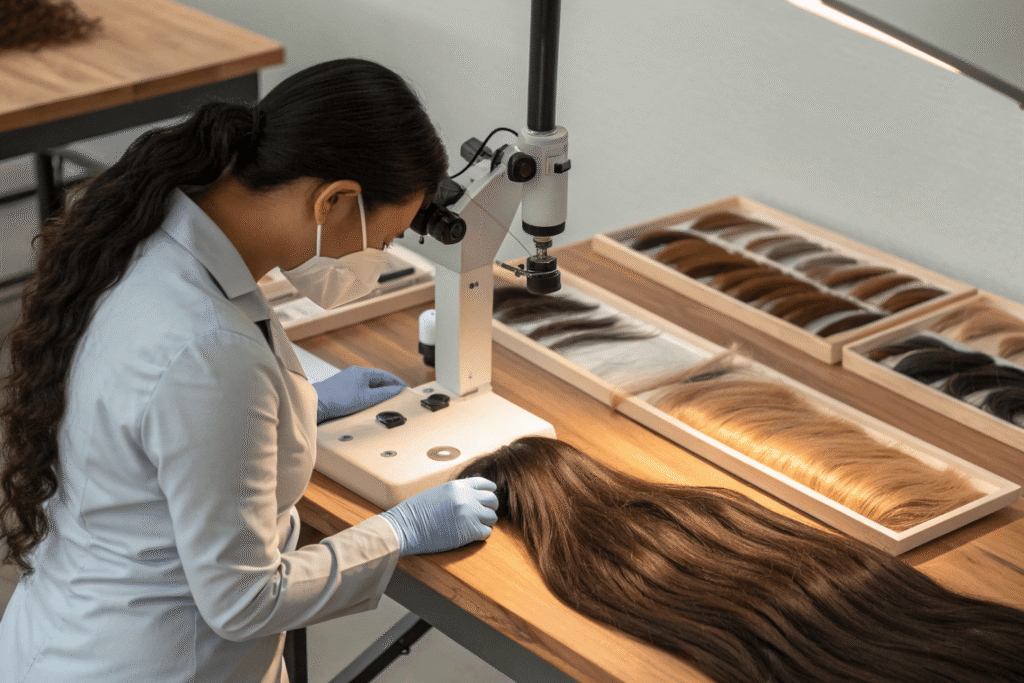
Types of Human Hair Wigs for Bulk Orders
Human hair wigs are hairpieces made from real human hair that mimic natural hair’s look, movement, and styling versatility. In wholesale scenarios, the hair source, fiber grading, and cap design heavily influence both retail performance and warranty risk.
Core Hair Categories B2B Buyers Should Know
- Remy Hair (cuticle aligned):
- Cuticles remain intact and aligned from root to tip.
- Lower tangling, better longevity, and smoother finish.
- Ideal for mid-to-premium private label lines.
- Virgin Hair (unprocessed, single-donor or tightly matched bundles):
- No chemical treatments; natural texture and color preserved.
- Highest durability and premium feel.
- Best for flagship SKUs and high-ticket retail.
- Non-Remy/Processed Hair:
- Often involves acid baths that strip cuticles.
- Typically silicone-coated to mask roughness.
- Lower initial cost, but higher post-sale risk (tangling after several washes).
Common Regions of Origin
- Asia (India, Southeast Asia, China): Wide availability, strong price-to-quality spectrum, versatile textures.
- Europe: Scarcer supply, higher cost, preferred for finer textures and lighter natural colors.
- South America: Medium supply, sought for certain curl patterns.
Ethical sourcing practices aim to ensure hair is obtained with consent and fair compensation, reducing exploitation risks in the supply chain. Request verifiable documentation (e.g., consent forms, traceability reports) as part of supplier qualification.
Cap Construction Options for B2B Catalogs
- Lace Front (13×4, 13×6): Natural hairline, flexible parting at the front, good balance of realism and cost.
- Full Lace: Entire cap ventilated; maximum styling versatility, ideal for premium SKUs and custom orders.
- Monofilament Top: Skin-like top for realistic scalp; multi-directional styling in critical visible areas.
- Machine-Wefted: Cost-effective, volume-friendly; good for base lines and ready-to-wear stockists.

How Do I Tell Hand-Tied Craftsmanship from Machine-Made Construction?
Discerning cap craftsmanship at scale is crucial to reducing return rates and maintaining consistent brand promise across batches. Hand-tied wigs typically look more natural and are lighter but take longer to make and cost more than machine-wefted wigs.
Visual and Tactile Checks You Can Perform
- Knot Uniformity (hand-tied):
- Look for tiny, evenly spaced knots on lace or monofilament.
- The hair pivots naturally; parting can be adjusted without visible tracks.
- Weft Lines (machine-made):
- Identify horizontal stitch lines where hair is sewn into strips.
- Parting is limited; volume appears more uniform but less natural at the scalp.
- Hairline Realism:
- Hand-tied lace fronts show graduated density (lighter at the edge) and baby hairs.
- Machine-made fronts often start abruptly; density is consistent right to the edge.
- Cap Weight and Flex:
- Hand-tied caps feel lighter and conform more comfortably to the head.
- Machine caps feel sturdier but stiffer; sensitive scalps may experience irritation.
Buyer’s Field Test Protocol
- Parting Test:
- Create a zigzag part across the top. Hand-tied caps will show a believable scalp throughout; machine-wefted will reveal tracks.
- Bounce and Pivot:
- Rotate small sections near the hairline. Hand-tied strands pivot 360°; machine-sewn hair has a directional bias.
- Density Gradient:
- Assess density at the front 1–2 cm. Hand-tied designs should be sparser and then build up; machine caps are usually uniform.
Hybrid Constructions for Balanced Catalogs
Hybrid builds use hand-tied sections where they matter most (lace front, monofilament top) and machine wefting on the sides/back. This approach controls cost while preserving visible realism—perfect for mid-tier lines or private label SKUs aiming for mass-market appeal.
What Key Steps in Processing Affect My Wig’s Softness and Durability?
Collected hair is sorted by length, texture, and color, with cuticles aligned (Remy) to reduce tangling and improve longevity. The hair undergoes cleaning, sanitization, and sometimes gentle processing such as color correction or perming to standardize quality. These steps, if poorly controlled, can shorten lifespan and increase return risk.
Processing Flow You Should Expect from a Competent Manufacturer
Sourcing and Pre-Sort
- Ethical acquisition, donor documentation.
- Bundle matching by length, texture, and natural color.
Cleaning and Sanitization
- Mild detergents and anti-microbial rinses.
- pH-balanced conditioning to preserve fiber elasticity.
Cuticle Management
- For Remy: preserve alignment from root to tip.
- For non-Remy: chemical smoothing or silicone coating (know the trade-offs).
Color Correction and Toning
- Low-ammonia or controlled oxidation.
- Batch-standardization to match SKU color codes.
Texture Setting (Perming/Steam Processing)
- Steam-based methods preferred for curl patterns to minimize chemical fatigue.
- Over-processing leads to dryness and breakage.
Final Conditioning and Seal
- Protein or lipid treatments to restore feel post-processing.
- Avoid heavy silicone loads that wash off and cause post-sale disappointment.
How Processing Influences Softness
- Gentle cleansing and conditioning keep the cuticle plates smooth, improving slip.
- Minimal heat exposure and steam-based texture setting retain internal moisture.
- Light, breathable serums can add initial luster without creating heavy buildup.
How Processing Influences Durability
- Preserved cuticles (Remy/virgin) resist frictional damage, reducing breakage.
- Controlled color work prevents cortex weakening and porosity spikes.
- Strong knots and low-density variants on lace fronts reduce shedding during daily wear.
Practical Specification Table: Processing Impacts
| Parameter | Softer Feel (Pro) | Durability Risk (Con) | Buyer Guidance |
|---|---|---|---|
| Heavy Silicone Coating | Immediate silky touch | Wash-off leads to roughness/tangling | Request low-silicone, long-term finish reports |
| Aggressive Bleaching | Light, trendy colors | Fiber brittleness, breakage | Prefer gentle lift; cap density adjustments |
| Steam Texture Setting | Natural curls/waves | Minimal if controlled | Ask for steam process documentation |
| Mild pH Balanced Wash | Smooth cuticle lay | Low risk | Include as SOP; verify chemical MSDS |
| Protein Reconstructions | Restores strength | Overuse can cause stiffness | Specify dosage; test wear and wash cycles |
How Does Cuticle Alignment Impact Tangling in My Human Hair Wig?
Remy hair wigs last longer and tangle less because cuticles remain intact and aligned in the same direction. Cuticle alignment is a frontline defense against friction, matting, and premature roughness—especially after the silicone “honeymoon” wears off.
The Science in Simple Terms
- Each hair strand is covered in overlapping cuticle scales.
- When strands lie root-to-tip in the same direction, those scales glide smoothly.
- Reverse or mixed directions cause scales to lock against each other, creating friction and tangling.
Detecting Alignment as a Buyer
- Strand Slide Test:
- Pinch a small bundle, slide fingers from root to tip—it should feel smooth.
- Slide from tip to root—expect slight resistance but not snagging.
- Microscopic or Macro Visuals:
- Under magnification, aligned cuticles appear consistently oriented.
- Request supplier photos or lab verification for high-value POs.
- Wash Cycles Check:
- After 3–5 washes, non-Remy or poorly aligned hair shows dramatic tangling and roughness once coatings fade.
Operational Benefits of Remy Alignment
- Reduced detangling workload in salons and after-sales care.
- Longer shelf-life and better try-on experience.
- Lower return rates and improved customer reviews.
What to Include in Your PO to Protect Alignment
- Cuticle Integrity Requirement:
- “100% cuticle-intact Remy, single-direction alignment; zero acid-stripping.”
- Batch-Level Certificates:
- Include fiber test reports, visual sampling, and wash-cycle performance data.
- Handling SOPs:
- Specify brushing, washing, and heat-protection SOPs for retail partners.
Which Manufacturing Checks Guarantee Consistent Quality for My B2B Orders?
Consistent quality isn’t an accident—it’s engineered through layered inspections. Below are the checks I insist on before releasing bulk shipments.
Quality Control Stack: From Incoming to Outgoing
- Incoming Material Inspection:
- Verify source documentation, donor consent, and fiber grading.
- Check length uniformity, texture classification, and color baselines.
- In-Process Controls:
- Monitor chemical exposure times, bath temperatures, and pH.
- Verify knot density, direction, and hairline graduation.
- Track weft integrity and stitch consistency for machine-made sections.
- Final QA:
- Conduct stress tests on knots (gentle tugging).
- Perform multi-wash tests on sample units for tangling and shedding.
- Inspect lace integrity, cap comfort, and ventilation accuracy.
Critical KPIs You Can Demand
- Shedding Rate:
- Measurement post-combing: grams lost per 100 strokes.
- Tangling Score:
- Post-wash comb-through time under standardized method.
- Color Delta (ΔE):
- Consistency of color across batches via spectrophotometer.
- Cap Fit Tolerances:
- Circumference, ear-to-ear, front-to-nape with ± tolerances listed.
- Lace Quality:
- Tear resistance, knot stability, and lace shade consistency.
Example Supplier Comparison Table
| Feature | Supplier A (Hand-Tied Focus) | Supplier B (Hybrid) | Supplier C (Machine-Wefted) |
|---|---|---|---|
| Remy Verification | Batch cert + lab photos | Batch cert | Spot cert only |
| Knot Density Control | ±5% tolerance per zone | ±8% tolerance | Not specified |
| Color Consistency (ΔE) | ≤ 1.0 | ≤ 1.5 | ≤ 2.0 |
| Multi-Wash Test (5 cycles) | Included in QA report | Optional | Not included |
| Lace Front Graduation | Custom per SKU | Standard pattern | Limited |
| Lead Time (500 units) | 25–30 days | 20–25 days | 15–20 days |
| Return Rate (historical) | < 2% | 3–4% | 5–7% |
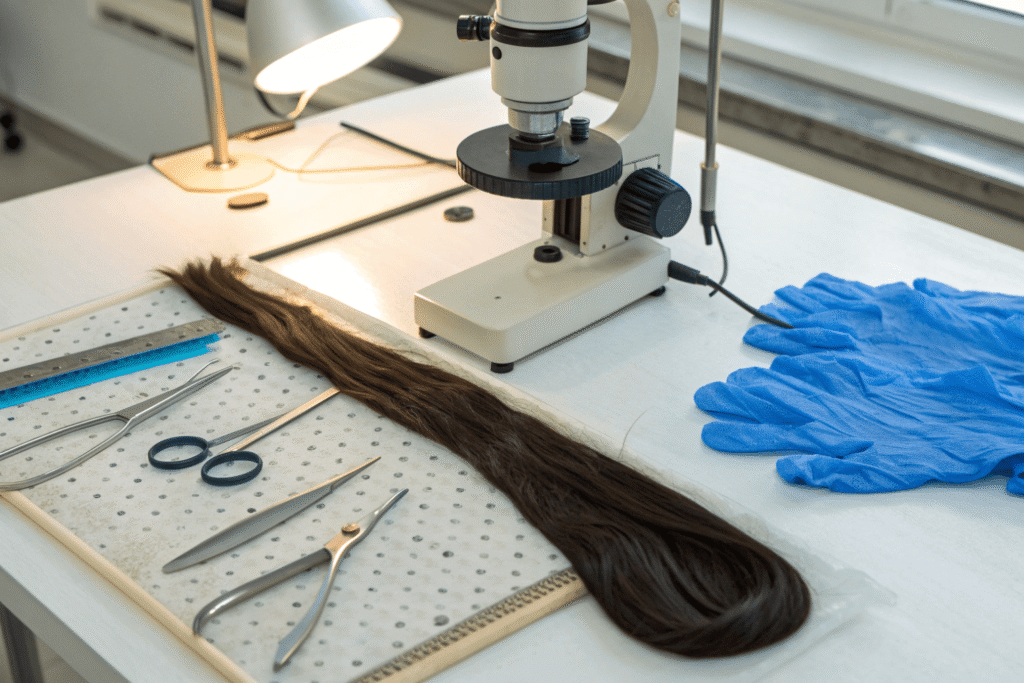
Additional B2B Guidance: Sourcing Strategies, OEM/ODM, and Private Label
When you’re scaling, your sourcing strategy directly influences brand equity and margin stability. Emphasize sourcing strategies for OEM, ODM, or private label orders, and tighten your specifications to reduce ambiguity.
OEM vs. ODM vs. Private Label
- OEM (Original Equipment Manufacturer):
- You provide detailed specs; supplier manufactures to your exact requirements.
- Best for established brands needing control across SKUs.
- ODM (Original Design Manufacturer):
- Supplier provides designs; you brand and possibly tweak.
- Faster time to market; good for testing segments.
- Private Label:
- You brand an existing catalog with minor customization.
- Lowest engineering overhead; high scalability.
What to Put in Your Spec Sheet
- Hair Type:
- Remy/virgin designation, source region, bundle matching criteria.
- Cap Construction:
- Lace front size, monofilament details, machine-weft placement.
- Knotting Standards:
- Density per zone (front, crown, nape), bleaching of knots, baby hair guidelines.
- Color and Texture:
- ΔE thresholds, curl/wave parameters, permissible variance.
- Processing Limits:
- Max bleach level, permissible chemical baths, steam-setting preference.
- QC Protocols:
- Wash-cycle tests, shedding/tangling benchmarks, lace tear resistance.
- Packaging:
- Anti-static inserts, breathable nets, silica gel packs, lot labeling.
- Lead Time and Logistics:
- Production calendar, buffer stock, split shipments, vendor-managed inventory options.
Caring and Storage Tips for Large Inventories
Proper care—gentle washing, heat protection, and storage on a stand—significantly extends the lifespan and appearance of human hair wigs. In a warehouse or retail environment, small operational tweaks prevent large-scale damage.
Warehouse-Level Best Practices
- Climate Control:
- 40–60% relative humidity; 18–24°C ambient temperature.
- Avoid direct sunlight to prevent color shift.
- Storage Orientation:
- Use breathable wig nets; store on stands or molded forms for premium units.
- For bulk: lay flat with shape-preserving inserts to avoid cap deformation.
- Packaging:
- Anti-static pouches, silica gel packets, and perforated boxes for airflow.
- Label with batch numbers, production date, and SKU details for traceability.
Handling SOPs for Staff
- Brushing Protocol:
- Detangle from tips to roots using wide-tooth combs; avoid yank force.
- Washing Schedule:
- Demonstration units: every 8–10 wears or as needed with sulfate-free shampoos.
- Avoid hot water and rough towel-drying; blot and air dry on stands.
- Heat Styling:
- Always use thermal protectants; cap temperature exposure kept minimal.
- Returns Intake:
- Inspect immediately for perfume, product residue, heat damage, and lace tears—log findings for supplier feedback loops.
Inventory Rotation and QA
- Rotate front-of-house samples every 30–45 days to maintain freshness.
- Run spot checks on tangling and shedding after two wash cycles per batch.
- Use barcode tracking for batches to isolate quality issues quickly.
Product Specifications: A Practical Reference
Below is a typical spec layout I use for hand-tied lace front Remy wigs intended for premium retail.
SKU Family Example (Remy Lace Front, 13×6)
- Hair: 100% Remy, Southeast Asia origin, no acid stripping.
- Cap: 13×6 lace front, monofilament top, machine-wefted sides/back.
- Density: 130% standard; 150% option for high-volume regions.
- Knotting: Graduated hairline with bleached knots, baby hairs optional.
- Color: Natural black to level 4; processed shades with ΔE ≤ 1.2.
- Texture: Straight/wavy via steam set; no chemical perm unless requested.
- Lengths: 12–24 inches; mixed bundles ±0.5 inch tolerance.
- QC: Wash-cycle testing (3 cycles), shedding ≤ X grams/100 strokes, tangling grade “A.”
- Packaging: Breathable net, anti-static insert, silica gel, labeled with batch/lot.
Ethical Sourcing and Brand Reputation
Ethical sourcing practices aim to ensure hair is obtained with consent and fair compensation, reducing exploitation risks in the supply chain. As brands face greater scrutiny, clear documentation becomes a competitive advantage.
What to Request
- Consent and Compensation Records:
- Supplier declarations plus third-party audits where feasible.
- Origin Reports:
- Country/region of source with donor program descriptions.
- Traceability Protocols:
- Batch lot tracking from raw hair to finished unit.
Communications Strategy
- Publish a sourcing statement outlining your standards.
- Offer QR codes on packaging that link to batch-level ethics info for premium lines.
- Train retail teams to address customer questions confidently.
Troubleshooting Common Post-Sale Issues
Even top-tier wigs will face occasional customer challenges. The key is to prepare standardized responses that minimize returns and support brand loyalty.
- Tangling After Several Washes:
- Check if customers use sulfate-heavy shampoos and high heat without protectants.
- Offer a conditioning protocol and detangling guide; review whether silicone coats have fully washed off.
- Shedding at Hairline:
- Inspect knot bleaching levels; over-bleaching weakens knots.
- Consider upping knot density slightly or tightening bleaching SOPs.
- Lace Tears:
- Reassess lace denier and staff handling procedures.
- Provide customers with a patch kit or repair service option.
- Color Discrepancies:
- Implement ΔE testing and retain control samples.
- Offer standardized lighting guidelines for online photography.
B2B Checklist for Your Next PO
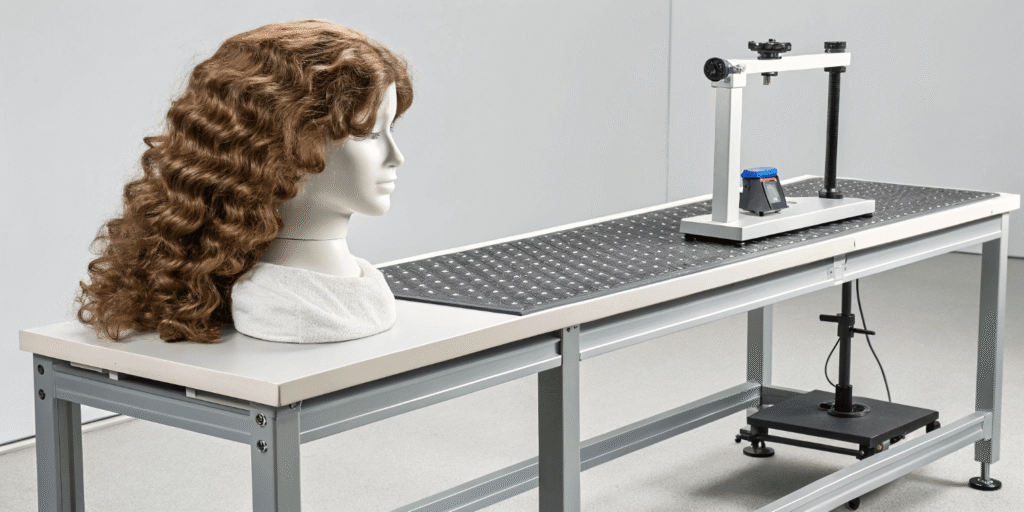
Use this as a quick procurement framework:
- Hair Type: Remy or virgin, origin, cuticle alignment proof.
- Cap Design: Lace front size, monofilament, full lace vs. hybrid.
- Knotting Specs: Density per zone, bleached knots parameters, baby hair policy.
- Color and Texture: ΔE target, steam curl patterns, permissible treatments.
- QC Protocols: Incoming, in-process, final; wash-cycle test inclusion.
- KPIs: Shedding/tangling metrics, lace tear resistance, fit tolerances.
- Ethics: Consent documentation, traceability, audit cadence.
- Logistics: Lead times, split shipments, buffer stock, VMI options.
- After-Sales: Care guides, returns SOP, repair services.
Frequently Asked B2B Questions
Are hand-tied wigs worth the premium for wholesale?
Yes—if your market values realistic hairlines, lighter caps, and versatile styling. Returns are lower when customers prioritize natural appearance. Hybrids can bridge price and performance for mid-tier lines.
How do I standardize curl patterns across batches?
Favor steam processing with documented time/temperature curves. Avoid chemical perms for large runs unless your brand’s positioning supports them, and include post-process moisture-balancing.
What packaging reduces warehouse damage?
Breathable nets, anti-static liners, shaped inserts, and silica gel in perforated boxes. Include clear handling labels and batch IDs for traceability.
Can non-Remy still be acceptable?
In budget lines, yes—but disclose care requirements, expect more after-sales support, and ensure silicone levels aren’t excessive to avoid “bait-and-switch” feel after washes.
Case Insight: Reducing Return Rates by 38% on a 5,000-Unit Run
A client shifted from mixed non-Remy/Remy to fully Remy with strict ΔE ≤ 1.2 on color and added a 3-wash tangling test to final QA. We modified knot bleaching only at the first 1.5 cm of the hairline to reduce shedding. Returns dropped by 38% quarter-over-quarter, and NPS rose by 21 points. The lesson: small spec changes yield outsized outcomes.
Conclusion
- Human hair wigs deliver authentic look and styling power, but quality hinges on cuticle alignment, controlled processing, and robust QC.
- Hand-tied craftsmanship provides superior realism and comfort; machine-made caps lower costs for volume lines. Hybrids offer a smart compromise.
- Align your PO specs with measurable KPIs—shedding, tangling, color ΔE, knot density, lace integrity—and insist on batch-level documentation.
- Proper warehouse care and customer SOPs extend product life and reduce returns.
If you’d like a sample pack with our QC reports and side-by-side comparisons of hand-tied vs. hybrid constructions, contact us or request our latest catalog. We can also customize OEM/ODM specs to your market requirements and ship pilot lots with full traceability.