
As a supplier who has managed OEM/ODM wig programs for fashion labels, medical distributors, and salon chains, I’m often asked what actually determines a wig’s realism, comfort, and lifespan. The short answer: ventilation and knotting. From the tension in each knot to the lace weave and the cuticle orientation of the hair, small technical choices have big commercial outcomes—affecting return rates, customer reviews, and your total cost of ownership across a buying cycle.
Ventilation is the manual process of tying hair to lace/mesh using single, double, split, or V-loop techniques. Single knots look flatter and more natural but shed faster; double knots are stronger but slightly more visible. Density and direction control parting and airflow; lighter lace tones often benefit from bleached knots to hide dark dots, balanced against chemical weakening. For OEM orders, specify lace type (Swiss/HD/French), knot type by zone, densities (front/parting/crown), ventilation direction, hair quality (Remy alignment, texture), pre-bleach parameters, and QC pull-test standards to align durability and realism with your market.
If you sell to discerning hairline customers or the medical market, your decisions on knot type, density, lace denier, and care protocols can reduce complaints and extend service life. In the sections below, I’ll break down the science and the sourcing playbook I use with B2B buyers: how single versus double knots change hairline realism and shedding, why density controls parting and breathability, when to choose bleached knots, and exactly how to codify these parameters in OEM purchase orders to protect your margins and your brand reputation.
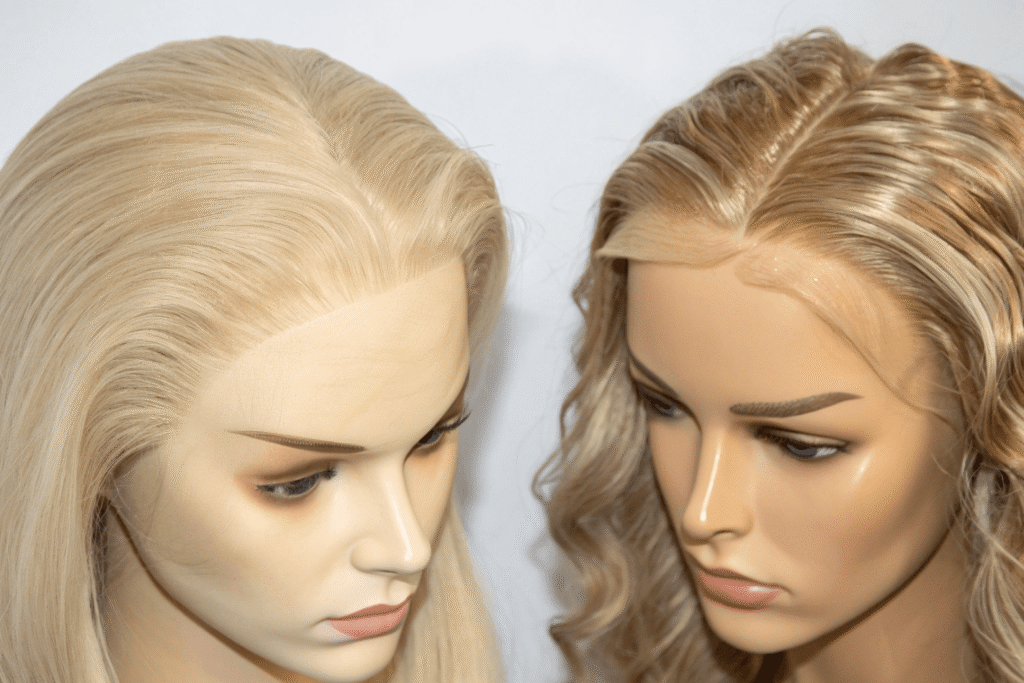
Types of ventilation and knotting: the materials science you sell every day
Ventilation is the manual process of tying individual hair strands to a lace or mesh base so the hair appears to grow from the scalp. Every knot is a micro mechanical joint that trades off visibility against retention. For buyers, understanding those trades lets you build product tiers with clear positioning and fewer surprises post-launch.
Core knot types and what they mean for B2B performance
- Single knot (single tie)
- Look: Flatter, smaller dot; highest hairline realism.
- Strength: Lower retention under repeated combing; more prone to shedding.
- Use: Front hairline, temples, natural parts for premium lines.
- Double knot (double tie)
- Look: Slightly larger, more visible dot; can be camouflaged with texture or bleached knots.
- Strength: Higher retention and longevity; better for high-usage areas.
- Use: Sides, crown, nape; value lines; rental or salon reuse programs.
- Split knot (single split)
- Look: Hair exits on both sides of the lace hole—good coverage with minimal bulk.
- Strength: Moderate; increases perceived density per hair used.
- Use: Mid-sections where you want a fuller look without heavy weight.
- V-loop / injected hair (for skin/poly bases)
- Look: Ultra undetectable “hair growing from scalp” effect; no visible knot.
- Strength: Lower than tied knots unless reinforced; heat-sensitive in thin skin.
- Use: Men’s hair systems, ultra-realistic front edges, photo/video work.
Behind the scenes, knot stability depends on friction and fiber stiffness. Coarser or textured hair (wavy/curly) holds knots better than ultra-silky straight hair, which can slip, especially when conditioned heavily. That’s one reason we typically increase double-knot usage or add micro-crimping for silky textures in client builds.
Lace materials: invisibility vs durability
- Swiss lace / HD lace
- Pros: Finer denier, excellent melt into skin, best for film-grade hairlines.
- Cons: Lower tear resistance; requires careful handling in factories and end users.
- Fit: Premium SKUs, photo-forward brands, medical hairlines.
- French lace
- Pros: Stronger weave, better lifespan and QC yield in mass production.
- Cons: Slightly more visible at hairline (often solved with bleached knots).
- Fit: Balanced performance lines, salons with frequent installs.
- Monofilament tops / hybrid bases
- Pros: Uniform parting realism and comfort; good airflow.
- Cons: Part visibility may need density tuning; cost uptick.
- Fit: Medical market, daily wearers, “comfort” collections.
- Thin skin / PU
- Pros: Hypoallergenic adhesion options, ultra-realistic injection.
- Cons: Lower airflow; heat build-up if density is high; solvent-sensitive.
- Fit: Men’s toppers, specific adhesive workflows, swim/sport users.
As a buyer, match the lace choice to your customer’s behavior: a careful daily wearer can own an HD lace; renters and first-time wearers often do better with French lace for fewer repairs.
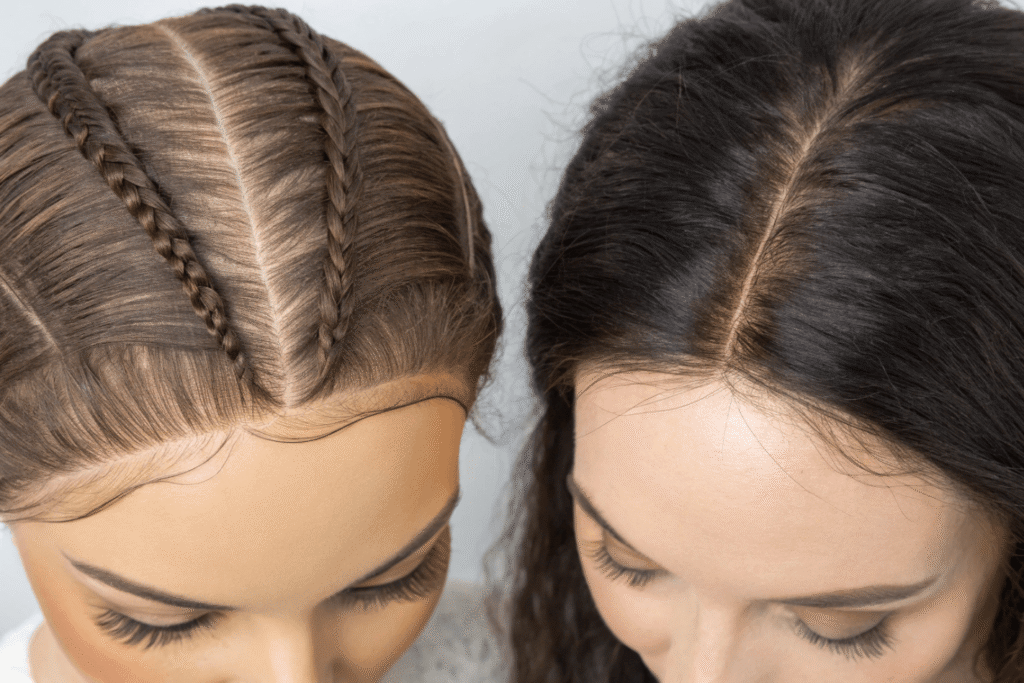
How do single vs double knots change my hairline realism and shedding?
This is the most common trade-off I help buyers calibrate. Single knots are chosen for invisibility, double knots for retention. Your product roadmap should combine both, by zone.
Hairline realism: where millimeters and microdots matter
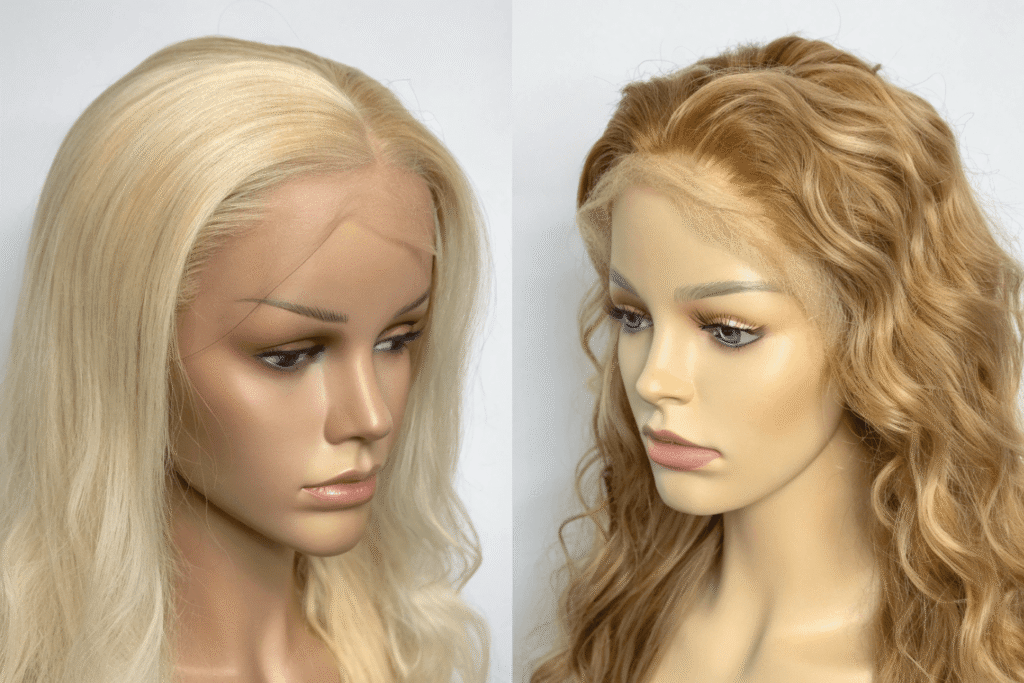
- Single knots sit flatter. Less bulk at the hole means less visible “dot,” especially on fine HD/Swiss lace. On lighter lace tones or light scalp tones, the dot nearly disappears—particularly when paired with subtle bleaching (more on that later).
- Directional ventilation enhances the effect. Forward, reverse, or freestyle patterns can be tuned so the first 0.5–1.5 cm at the hairline behaves like baby hair or feathered edges.
- Density staging is critical. A realistic hairline usually needs 70–90% of the density found just behind it. If you run a uniform density to the edge, it reads “wiggy,” even with single knots.
Practical tip: For brands competing on Instagram/HD video realism, lock a hairline spec such as “Single knots, 60–80% density in first 1 cm, bleached to light brown visibility, Remy straight/wavy, 1–2 rows of split knots behind hairline to transition.”
Shedding and retention: where double knots pay you back
- Double knots increase retention because mechanical friction and entanglement are higher. In salon environments with frequent styling, you’ll see a measurable reduction in early shedding claims.
- Hair fiber matters. Coarse, textured, or yaki fibers grip knots; ultra-silky or heavily conditioned hair slips more. If your market prefers silky European textures, consider double knots behind the front and in stress points (parting, crown).
- Base tension and knot preload: Over-tightening during ventilation can preload stress into the hair shaft, weakening it over time. Quality control should aim for consistent tension—tight enough to hold, not so tight that cuticles fracture.
Buyer rule of thumb by zone:
- Front 0–1 cm: Single knots for realism.
- 1–3 cm behind hairline: Single split or mixed single/double to bridge realism and hold.
- Crown, sides, nape: Double knots for durability.
- Parting line (mono top): Single knots or split knots, lighter density, with controlled direction for clean parts.
Recommended specs table: realism vs durability by zone
| Cap Zone | Knot Type Priority | Typical Density Range (% of mid-cap) | Notes for Buyers |
|---|---|---|---|
| Front hairline 0–1 cm | Single knots (some split) | 60–80% | Bleach optional; HD lace ideal for photo realism |
| 1–3 cm behind line | Split + single/double blend | 80–90% | Transition zone for styling stability |
| Parting line/top | Single or split | 70–85% | Directional ventilation for clean part |
| Crown/sides | Double knots | 100% | Durability; less visual scrutiny |
| Nape | Double knots | 90–110% | Friction zone; higher retention required |
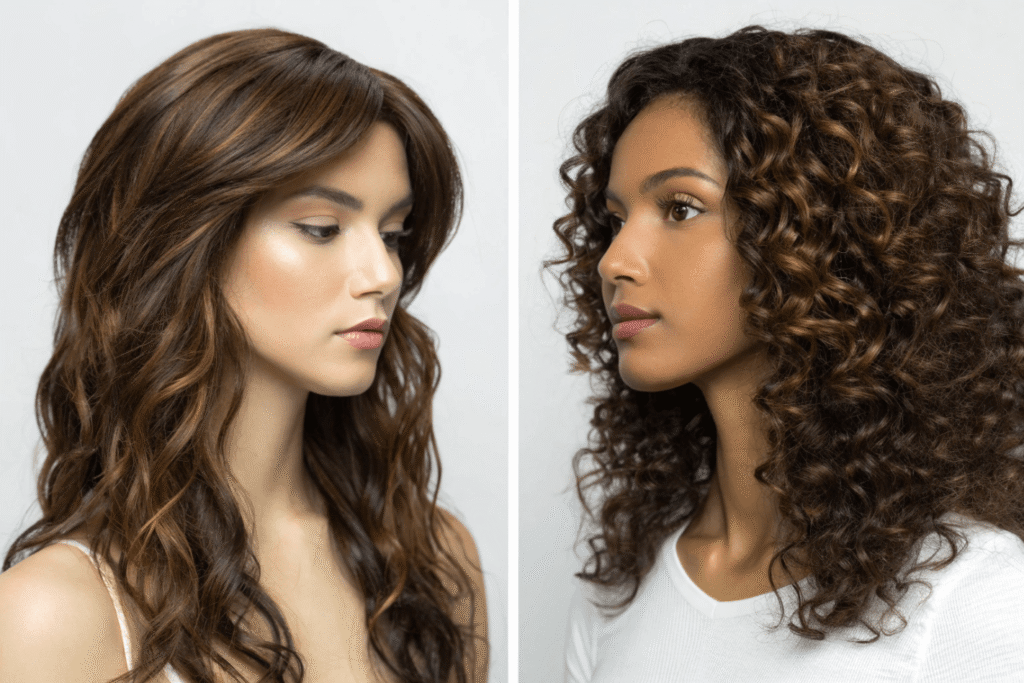
Why does ventilation density affect parting and airflow in my wigs?
Density is not just a look—it’s airflow, scalp comfort, drying time, and service life. Get density wrong and even a premium hair bundle will underperform.
Parting behavior and directional control
- Ventilation pattern controls how hair lays. Freestyle top with balanced cross-ventilation gives flexible parting; linear direction gives a fixed part with crisp visibility.
- High density closes the “windows” between knots. That reduces part visibility and makes restyling difficult. For a “medical mono-top” look, we dial down density along the part and ventilate in opposing directions on either side.
- Strategic spacing mimics natural follicle distribution. In a natural scalp, follicles are not in a perfect grid—slight randomness and micro-gaps read as realism. We simulate this by staggering density and mixing hair diameters (where inventory allows).
Airflow, moisture management, and comfort
- Breathability depends on base porosity plus density. Lace is inherently porous; when density is too high, you negate that advantage.
- Lower density at heat-accumulation zones (crown, vertex) improves evaporative cooling. This is crucial for humid markets and sports/active customers.
- Faster drying after wash cycles. High density retains water and stresses knots during comb-out; moderate density dries quicker, reducing lace deformation and oxidative wear on hair.
Practical density bands for common SKUs
- Film/HD hairline: 60–80% of mid-cap density.
- Everyday lace front with mono top: 70–85% along parting; 90–100% mid-cap.
- High-volume fashion looks: 100–120% mid-cap, but keep hairline staged lower for realism.
- Men’s systems thin-skin front: low density at edge (50–70%), increasing to 90% backward to avoid a see-through scalp yet keep airflow.
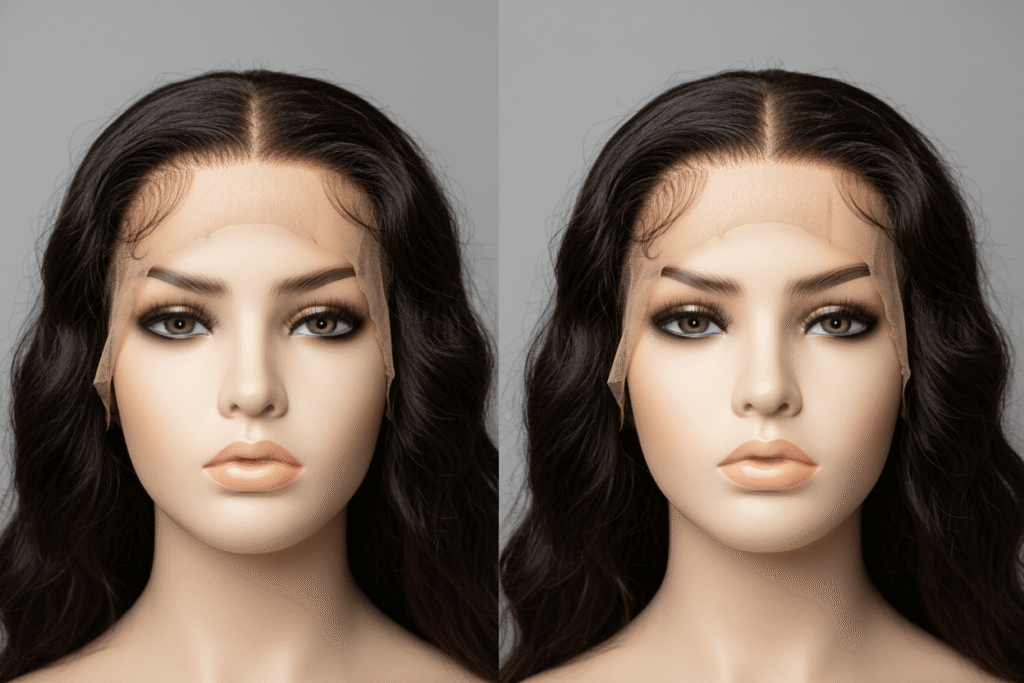
Density, shedding, and returns
Over-dense builds increase friction during styling and washing. More fibers mean more opportunities for tangling, which amplifies combing forces and accelerates knot loosening. We often see 10–15% lower early-shedding tickets when clients move from “very dense” to “balanced staged” specs with the same hair source.
Should I choose bleached knots for lighter lace tones in my market?
Bleached knots reduce the dark dot where hair exits the lace. For customers with fair scalps or light lace tones, the benefit in perceived realism is immediate. But bleaching is a chemical oxidizer—there are trade-offs.
When bleached knots make business sense
- Light or medium lace tones with darker hair. The contrast reduction is dramatic, especially at the front 0.5–1 cm.
- Content-heavy brands. If your product photos, reels, or live installs are a sales engine, bleached front knots convert.
- HD/Swiss lace lines. Fine lace plus bleached knots is the closest to “melt.”
Risk management: how to bleach without killing lifespan
- Targeted bleaching by zone. Bleach only the front rows or parting line—leave double-knotted bulk areas unbleached for strength.
- Time, developer, and temperature control. Over-processing weakens the hair shaft at the knot and can cause premature breakage. We specify developer strength (e.g., 10–20 vol), time windows (8–15 minutes), and immediate neutralization to lock in performance.
- Hair type matters. Coarse or virgin hair tolerates bleaching better than silky processed hair. For silky Remy, use lighter bleach or consider tinting the lace instead.
Alternatives to full bleach
- Lace tint or knot concealer makeup—good for DIY end users, zero chemical damage.
- Use lighter hair near the hairline (blended rooted shades or “soft front” highlight) to reduce contrast without bleach.
- Micro single knots on HD lace—sheer invisibility often makes bleaching optional.
Quick decision matrix
| Market Profile | Recommend Bleached Knots? | Notes |
|---|---|---|
| Light scalp tones, dark hair, HD lace | Yes (front 0.5–1 cm) | Keep developer mild; prioritize single knots at edge |
| Mixed tones, French lace, value line | Optional (front only) | Or use lace tint to preserve durability |
| Men’s thin-skin system | Not applicable | Prefer V-loop/injection; no visible knot to bleach |
| Medical market, delicate scalp | Yes, controlled | Gentle processing; reinforce behind hairline with split/double |
| Fashion high-density builds | Limited | High density already reduces visibility; bleach the first row max |
How can I specify knotting details in my OEM purchase orders?
Clear POs are your safeguard. They align factories, prevent cost creep, and make incoming QC objective. Below is a template and a buyer’s checklist I use with private-label clients.
PO template: ventilation and knotting section
- Cap base and lace:
- Material: HD Swiss lace front 13×6; French lace back; 4″x4″ mono part (if needed).
- Denier/grade: HD 30–40 denier; French standard 40–50 denier.
- Edge finishing: Reinforcement tape on temples and nape.
- Knotting by zone:
- Front hairline 0–1 cm: Single knots, 60–80% density of mid-cap, bleached to light brown visibility, freestyle forward.
- 1–3 cm behind hairline: Split knots mixed with single, 80–90% density, freestyle.
- Parting line (center/left/right): Single knots, 70–85% density, opposing directional ventilation for clean part.
- Crown/sides/nape: Double knots, 95–110% density, direction back/down.
- Special: Baby hair 0.5 cm, 8–10 mm length, single knots at perimeter.
- Hair specifications:
- Origin: [Region], Remy alignment confirmed, cuticle intact.
- Texture: Natural wavy 2A–2B (or as SKU), diameter tolerance ±10 μm.
- Color: Natural 1B or dyed, colorfastness AATCC 61/2A grade 4+.
- Processing: Minimal acid bath; silicone-free or light water-soluble finishing.
- Bleached knot parameters:
- Zone: Front 0.5–1 cm and along designated part.
- Developer: 10–20 vol; time 8–12 min; temperature <30°C; immediate neutralize.
- Acceptance: No rubbery hair, no lace fiber degradation; strength loss ≤15% vs control.
- Density mapping:
- Provide a density heat map or table by zone with grams per cm² or % of mid-cap.
- Total hair weight target ±5 g tolerance.
- QC and testing:
- Knot pull test: Random 20-node sample per cap zone; 1 N for 10 seconds; ≤1 failure.
- Shedding comb test: 20 strokes on wet and dry; loss ≤0.5 g per test set.
- Lace tear test: Force ≥ [spec] N on edge samples.
- Shade tolerance: ΔE ≤ 1.0 across batch (visual AQL II).
- Pre-shipment photos: Macro hairline, parting, inside cap stitching, density card.
- Packaging and care:
- Formed insert to prevent lace deformation; silica gel; care card with low-pH regimen.
- Labeling: Lot no., production date, ventilator ID (traceability).
- Warranty/after-sales:
- Early shedding window: 30 days; RMA threshold if defect rate >2%.
- Spare lace patches and hair bundle for repair per 20 units.
Buyer checklist: avoid ambiguity, avoid disputes
- Define knots per zone (don’t just say “natural hairline”).
- State density numerically. Words like “light” or “full” cause problems.
- Specify ventilation direction by zone (freestyle/forward/back/opposed at part).
- Lock bleach chemistry and limits; ask for a control sample report.
- Confirm hair orientation (Remy alignment) and finishing chemistry (silicone/no silicone).
- Require macro photos of hairline and parting before shipment.
- Add objective pull and comb tests to the QC protocol.
- Define allowable substitution rules (e.g., if HD lace shortage, must get buyer approval).
Advanced considerations: durability science for fewer returns
For B2B, longevity equals margin. The following technical levers reduce breakage and extend service life.
Hair mechanics and knot fatigue
- Hair is viscoelastic. Repeated small loads (brushing, styling) can fatigue knots and shafts even below immediate failure thresholds.
- Remy alignment reduces frictional tangling. When cuticles all face the same direction, combing forces drop, lowering stress on knots.
- Coarse or textured hair increases knot friction and stability; silky hair may require double knots or micro-roughening techniques.
Lace integrity and handling
- Finer lace (HD) sacrifices tear resistance. In production, train ventilators to avoid over-tensioning and to stagger holes to preserve weave strength.
- Edge reinforcement at temple and nape reduces tear complaints during installation and removal.
Chemistry and care that preserve structures
- Low-pH cleansing (pH 4.5–5.5) keeps cuticles compact, reducing swelling that loosens knots and deforms lace.
- Conditioners should be light and focused mid-length to ends; avoid saturating knots and base, which can lubricate and slip knots.
- Heat management: Prolonged high heat near the base damages both hair and lace; specify max iron/blow-dry temps on care cards.
Sourcing strategies for OEM/ODM and private label
When you take a product from sample to scale, small sourcing decisions fix big headaches later.
Tiering your catalog by knotting/lace complexity
- Entry/value line
- French lace, double knots in bulk zones, single/split at part.
- Minimal or no bleach; lace tint included.
- Density 90–100%, conservative hairline staging.
- Core everyday line
- HD front + French back hybrid; staged density; bleached hairline.
- Single hairline, split transition, double back.
- Remy aligned, light finish; mono part option.
- Premium/film line
- Full HD/Swiss front, meticulous single knots, feathered density map.
- Precision bleach protocol; optional injected hair at critical edges.
- Highest QC standards and macro imaging reports.
Vendor qualification and KPIs
- Pilot run: 20–50 units with strict macro-photo sign-offs.
- Scrap/repair rate at factory: Target <5%. High rates signal poor lace handling.
- AQL-based incoming QC with knot pull tests by zone.
- After-sales: Track first-30-day shedding claims; aim <2%.
Price structure and feature mapping
Use features to justify price spreads without over-costing:
- Hairline realism: single knots + bleach = premium.
- Durability: double knots + French lace = value longevity.
- Comfort: staged density + mono top = medical market fit.
Image guide for sales and QC teams
- Macro hairline photo checklist
- Show first 1 cm, three points: center, left, right.
- Confirm knot size, bleach evenness, density staging.
- Lighting: neutral daylight 5500K to avoid color cast.
- Parting line photo checklist
- Straight line visibility, opposing ventilation directions visible.
- Density equalization on both sides of the part.
Troubleshooting: common failures and how to spec them away
- “Dots are visible on pale clients”
- Root cause: Unbleached or large double knots on light lace.
- Fix: Single knots at front + targeted bleach; or tint lace.
- “Shedding in first two weeks”
- Root cause: Single knots everywhere; silky hair; over-conditioning at base.
- Fix: Double knots in bulk zones; care card with base-safe routine; knot pull QC.
- “Part won’t stay clean”
- Root cause: Overly dense freestyle ventilation at the top.
- Fix: Reduce density along part; opposing ventilation pattern; mono panel.
- “Lace tearing at temples”
- Root cause: HD lace without reinforcement; tight installs.
- Fix: French back or reinforced temple/nape tape; install guidelines.
Training your customer support to reduce RMAs
- Send a density/zone diagram with every unit.
- Add QR video for first wash and detangle procedure.
- Pre-install check: Advise clients to avoid oil-heavy products near knots.
- Styling limits: Max temperature and direction (pull tension away from hairline).
Sample OEM spec sheet (condensed)
| Parameter | Spec |
|---|---|
| Base | 13×6 HD Swiss front, French lace back; mono part 1.5″ |
| Hair | Remy aligned, natural 1B, 2A–2B texture, silicone-free |
| Hairline 0–1 cm | Single knots, 70% density, gentle bleach (10 vol, 8–10 min) |
| Transition 1–3 cm | Split + single, 85% density |
| Parting | Single knots, 75–80%, opposed ventilation |
| Bulk zones | Double knots, 100% density |
| Direction | Freestyle top, back/sides downward |
| QC | Knot pull test 1 N/10 s (≤1 fail per 20 nodes/zone) |
| Shedding test | ≤0.5 g after 20 wet + 20 dry comb strokes |
| Tolerances | Weight ±5 g; color ΔE ≤1.0 |
| Packaging | Form insert, silica gel, low-pH care card |
Frequently asked buyer questions
- Q: Can we skip bleaching and still get realism?
- A: Yes—HD lace + micro single knots + lace tint at the front row often suffices. For dark hair on very light scalps, minimal bleach improves conversion rates.
- Q: Why do silky textures shed more?
- A: Lower surface friction reduces knot grip; pair silky textures with double knots behind the line and strict care guidance.
- Q: Does higher density always mean better quality?
- A: Not for ventilation-based caps. Excess density reduces airflow, increases tangling, and can make parts look artificial.
- Q: How do we validate Remy alignment?
- A: Simple water-flow or microscope cuticle tests on incoming hair lots; require supplier to batch-certify and provide retention test data.
Conclusion
Ventilation and knotting are the engineering heart of lace wigs. Single knots deliver hairline realism; double knots deliver retention. Density and direction control parting behavior and airflow—two factors your end-users feel every day. Bleached knots can be a game-changer on light lace tones, provided you control chemistry and limit the zone. And the difference between a smooth launch and a costly RMA wave is often a tight OEM purchase order: lace denier, knot type by zone, density mapping, bleach parameters, Remy alignment, and objective QC pull tests.
If you’d like, I can review your current spec sheets and suggest a zone-by-zone upgrade, send benchmark samples, or build a density map tailored to your market. Contact us to request a sample set, get our QC checklist, or browse our catalog with pre-configured knotting tiers for value, core, and premium lines.