
I’ve spent years specifying lace systems for brands and OEM wig factories, testing batches from Chinese and Indian suppliers, and troubleshooting installs for wholesale clients. The recurring pain point is always the same: balancing realism at the hairline against durability, production yield, and customer handling. Procurement wants consistency and cost control; marketing wants undetectability in 4K; technicians want a lace that won’t shred during ventilation. Understanding HD lace versus transparent lace in real manufacturing terms helps you make trade-offs confidently.
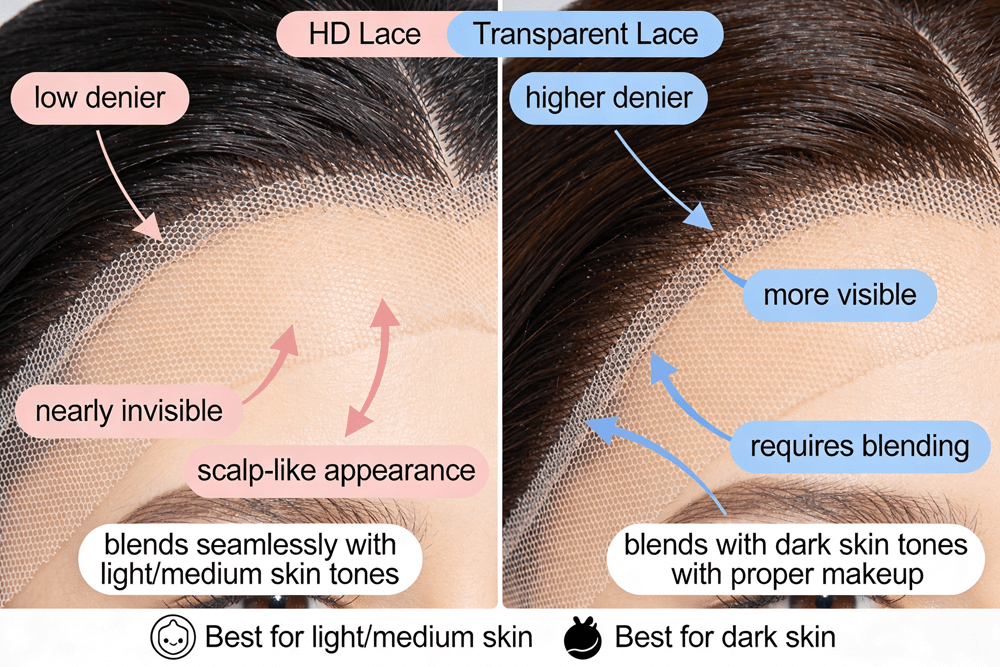
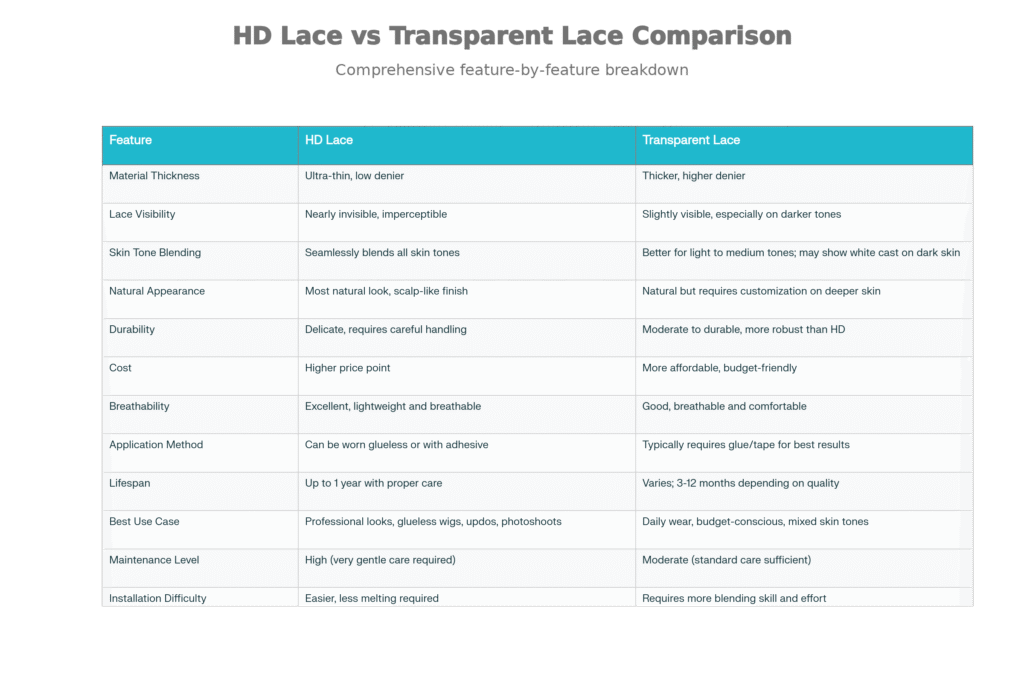
HD lace is a high-definition Swiss lace that’s thinner, softer, and more transparent than standard lace, blending seamlessly with most skin tones. Transparent lace is a regular lace dyed a light tone; it looks clear but is slightly thicker and less invisible than HD. HD delivers the most undetectable hairline, while transparent lace offers better durability and budget efficiency. Choose HD for maximum realism; choose transparent for daily wear and resilience.
In this article, I break down blending results indoors and outdoors by skin tone, the durability realities of HD lace in everyday routines, how tint sprays can close the gap for transparent lace, and the exact lace specifications I request on custom orders. I’ll anchor each section in factory workflow, knotting density, and QC checkpoints so your teams can source, sell, and support with fewer returns.
Which lace disappears best on my skin tone indoors and outdoors?
How HD vs Transparent lace behaves under lighting
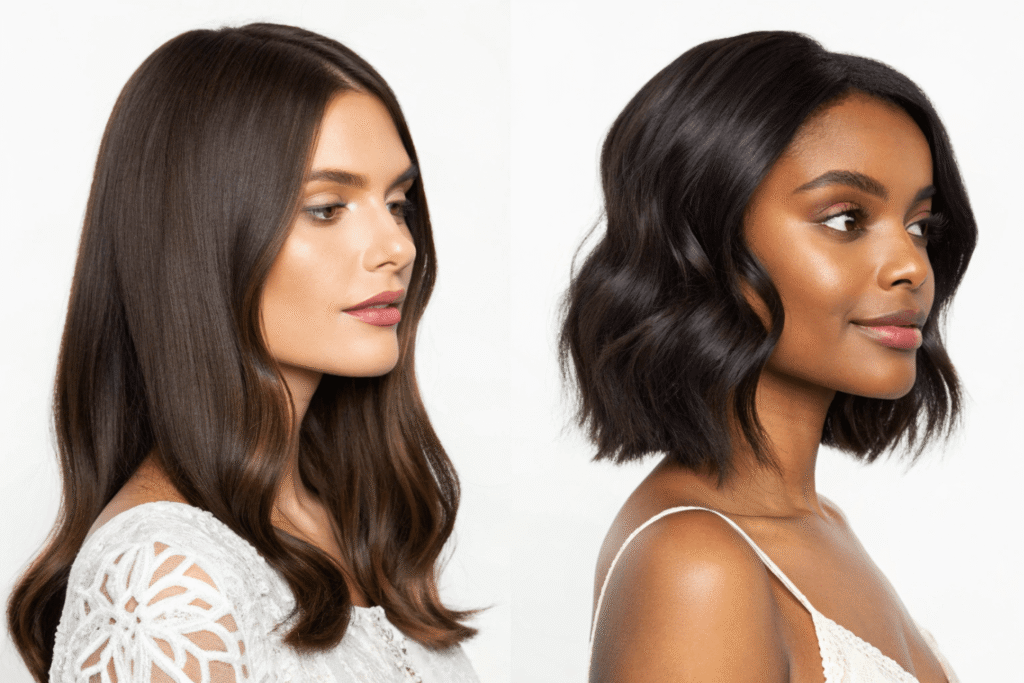
- Indoors (soft/neutral light): HD lace typically “melts” across the board—from very fair to deep complexions—because the mesh denier is ultra-low and the grid visibility is minimal. Transparent lace blends fine on fair to medium tones but can leave a faint grey/white cast on warmer/deeper tones without tint.
- Outdoors (direct sun and mixed shadows): HD holds an advantage because the thinner yarn reduces edge shadowing and grid reflection. Transparent lace can read slightly ashy in sunlight on olive/golden/deep skins unless tinted and well-melted.
Practical blending matrix (field-tested)
Below is how I advise retail partners to match lace to customer tones and environments.
| Skin tone/undertone | Indoor office/LED | Outdoor daylight/sun | Recommended lace choice | Notes |
|---|---|---|---|---|
| Very fair / cool-neutral | HD or transparent | HD or transparent | Transparent acceptable, HD best for close-ups | Minimal tinting needed |
| Light–medium / neutral | HD or transparent | HD preferred | Both viable; HD for photography | Light tint optional |
| Tan/olive / warm | HD preferred | HD strongly preferred | Transparent only with tint spray | Watch for white cast |
| Deep / warm-red undertones | HD strongly preferred | HD strongly preferred | Transparent must be tinted + well-melted | Use warm/golden-brown tints |
Key variable: density at the hairline. Thicker transparent lace can be more forgiving on high-density wigs (130–180%) because it supports knot stability, but it also increases grid visibility. HD lace shines with lighter, pre-plucked hairlines (60–100% front density), minimizing shadow and creating a scalp-like read in direct light.
Factory considerations affecting blend
- Yarn denier and weave openness: HD Swiss lace uses finer yarns with tighter, more uniform weave. Transparent lace uses thicker yarns and can show cell edges under high light.
- Dye tone: Transparent lace is pre-dyed to a light beige; HD is often undyed or minimally toned, relying on thinness to disappear rather than color matching.
- Knotting method: Single knots + strategic ventilation in the first 0.5–1.0 cm enhance melt. HD typically tolerates smaller knots but demands gentler handling.
Is HD lace too delicate for daily wear in my routine?
The honest durability trade-off
In my experience, HD lace is more delicate and prone to tearing or fraying—especially at the temple tabs, ear contours, and the first ventilated row. It breathes better and feels lighter, but daily pull-on/pull-off and aggressive adhesive removal shorten its life. Transparent lace offers greater durability and structure, ideal for beginners and heavy users who reinstall frequently or sleep in units (though I never recommend sleeping in any lace wig).
Daily-wear risk profile
- HD lace: Best for rotational wear, on-set work, photoshoots, and clients who treat hairlines gently. Minimal bleaching needed for realism, but over-bleaching further weakens the lace and knot integrity.
- Transparent lace: Better for commuters, gym users, and customers who need resilience. The thicker material supports high-density wigs and larger knots, improving knot stability over time.
Maintenance protocols I enforce
- Adhesive management: For HD, low-tack glues/tapes and careful solvent removal; avoid scraping. Transparent lace tolerates standard removers better.
- Handling: Stretch the cap from the back, not the lace front. Pin and remove using the ear tabs only after glue has fully released.
- Wash cadence: HD every 10–15 wears with gentle, sulfate-free products; transparent lace is more forgiving at 8–12 wears.
- Storage: Always on a stand; avoid heat and UV exposure that can embrittle lace yarns.
If a client insists on daily HD wear, I specify reinforced temple tapes, slightly denser first row ventilation, and instruct their stylists to use low-heat melting and minimal product build-up at the hairline.
Can tinted lace sprays help transparent lace match me?
Yes—when done correctly
Transparent lace often needs makeup tinting or lace sprays for deeper or warmer skin tones, especially around the hairline. Tint sprays can neutralize the white cast and push the lace into your undertone family (golden, olive, red-warm). They’re effective, but application technique and product selection determine success.
My application workflow
- Prep: Clean lace with alcohol to remove factory residue; quick dry.
- Color test: Spray a swatch card in three intensities; match to jawline in natural light.
- Apply: 2–3 light passes from 20–30 cm away; dry fully. Over-spraying clogs the mesh and reduces breathability.
- Seal: Light mist of setting spray; then melt with low heat after placement.
- Edge refinement: If needed, press a sheer powder (skin-matched) along the edge; avoid heavy creams which can sit in the grid.
When sprays fall short
- Very high-density hairlines can still shadow; consider pre-plucking or lower front density.
- Extremely warm/deep tones may require a custom dye bath for the lace pre-assembly.
- Poor weave quality or thick yarns won’t “disappear” regardless of tint; you’re fighting material physics.
What lace specs should I request in custom orders?
The specification packet I send to factories
Use these parameters to eliminate ambiguity across suppliers and reduce returns.
| Spec category | HD Lace (Swiss) | Transparent Lace (Standard) |
|---|---|---|
| Lace type | Swiss HD, ultra-thin, soft hand | Swiss or Korean transparent, light beige dyed |
| Color/tone | Undyed/natural or light beige | Light beige; request undertone (warm/neutral) |
| Denier & weave | Low denier; tight, uniform cells | Medium denier; stable mesh |
| Hairline density | 60–100% in first 0.8 cm; pre-plucked gradient | 80–120% first 1.0 cm; mild pre-pluck |
| Knot style | Single knots at hairline; double behind | Double knots; single optional at very front |
| Bleaching | Minimal, targeted; protect lace integrity | Moderate at hairline; monitor knot strength |
| Ventilation direction | Randomized + scalp mimic; temple backflow | Standard forward/back with consistent pattern |
| Edge finish | Raw cut with micro-tape reinforcement at temples | Clean cut; optional seam tape for durability |
| Cap build | Breathable cap; elastic band for glueless option | Standard cap; straps + combs; glue-friendly |
| QC checkpoints | Grid visibility under 4K light; pull test at tabs | Tint acceptance test; knot pull/roll test |
Additional spec notes I include
- HD breathability and comfort: Call out “soft hand” and airflow; avoid heavy tinting at factory.
- Transparent lace tintability: Request “open to tint” with no water-repellent finishes that resist sprays.
- Density pairing: For 180%+ overall density, I prefer transparent lace fronts for structural support; for celebrity/bridal units, HD fronts with lighter hairlines.
- Photography requirement: If the unit is for campaigns, specify HD lace + single knots + minimal bleach and pre-plucked gradient for the first centimeter.
Conclusion
In my sourcing and factory work, HD lace delivers the most invisible hairline and scalp-like read, especially across varied skin tones and challenging lighting. It’s thinner, softer, and more transparent—but also more delicate and maintenance-heavy. Transparent lace brings durability, structure, and lower cost, and with proper tinting, it can look excellent on warmer/deeper tones for daily wear. For B2B buyers, align lace choice with use-case: HD for premium, photo-critical builds and glueless comfort; transparent for everyday resilience and high-density styles. Lock in performance by specifying denier, knot styles, hairline density, edge reinforcement, and QC tests up front. That’s how you minimize returns, maximize realism, and keep margins healthy.