
I’ve spent years auditing hair supply lines from Indian temple collections to Southeast Asian community donors, and I’ve seen firsthand how subtle differences in cuticle handling cascade into real-world performance on the production floor and post-sale. When procurement teams ask me why their premium lines consistently win on customer satisfaction, return rates, and styling resilience, the throughline is almost always Remy hair. Keeping cuticles intact and aligned isn’t just a marketing claim—it’s a measurable manufacturing advantage that reduces tangling, extends lifespan, improves dye uniformity, and lowers total cost of ownership.
Remy hair is the industry standard because its intact, aligned cuticles reduce friction, resist tangling, and preserve strand strength and moisture, delivering longer service life and superior realism. Compared with non-Remy, Remy hair needs fewer harsh chemical fixes, holds styles longer, and maintains natural luster and predictable heat response—key for premium lace and hand-tied wigs. Authentic Remy verification in bulk relies on root-to-tip traceability, bundle directionality checks, wet-comb tests, cuticle microscopy, and vendor process audits.
In the sections below, I’ll break down how aligned cuticles work at the microscopic level, what to expect in lifespan comparisons, how to judge the cost-value tradeoffs by market segment, and the exact sourcing checks I use to confirm authentic Remy in bulk. I’ll also share practical testing protocols and vendor audit points your team can implement immediately.

How does aligned cuticle direction reduce tangling and matting?
The friction story: scales, direction, and glide
In my experience, the single greatest predictor of tangling is cuticle directionality. Each hair shaft is covered in overlapping keratin scales. When all strands in a wig flow root-to-tip in the same direction, those scales lie like shingles in the wind—low friction, smooth glide. Misaligned or inverted strands create “scale-on-scale” resistance, which snags neighboring hairs, compacts knots, and accelerates matting during wear and washing.
- Reduced friction: Aligned cuticles minimize inter-strand abrasion, so hair moves freely with head motion and brushing.
- Strength retention: Intact cuticles protect the cortical structure, reducing micro-fractures that lead to breakage and shedding.
- Moisture management: Cuticles regulate water uptake and evaporation; intact alignment maintains a stable moisture balance, limiting frizz and roughness.
Processing implications
Non-Remy bundles often mix root and tip orientations. To tame the inevitable friction, factories resort to acid baths to strip cuticles, then add heavy silicone. That coating washes off within 1–3 shampoos, exposing a rough, porous surface that tangles and mats rapidly. Properly handled Remy hair avoids that cycle, keeping its natural protective layer and a consistent tactile feel long-term.
Styling and color consistency
Aligned cuticles equal predictable behavior under heat. Remy hair holds curl and straightening with fewer passes, less thermal stress, and better rebound. Directionality also stabilizes dye uptake—pigments penetrate more evenly when the cuticle pathways are orderly, reducing banding and patchiness.
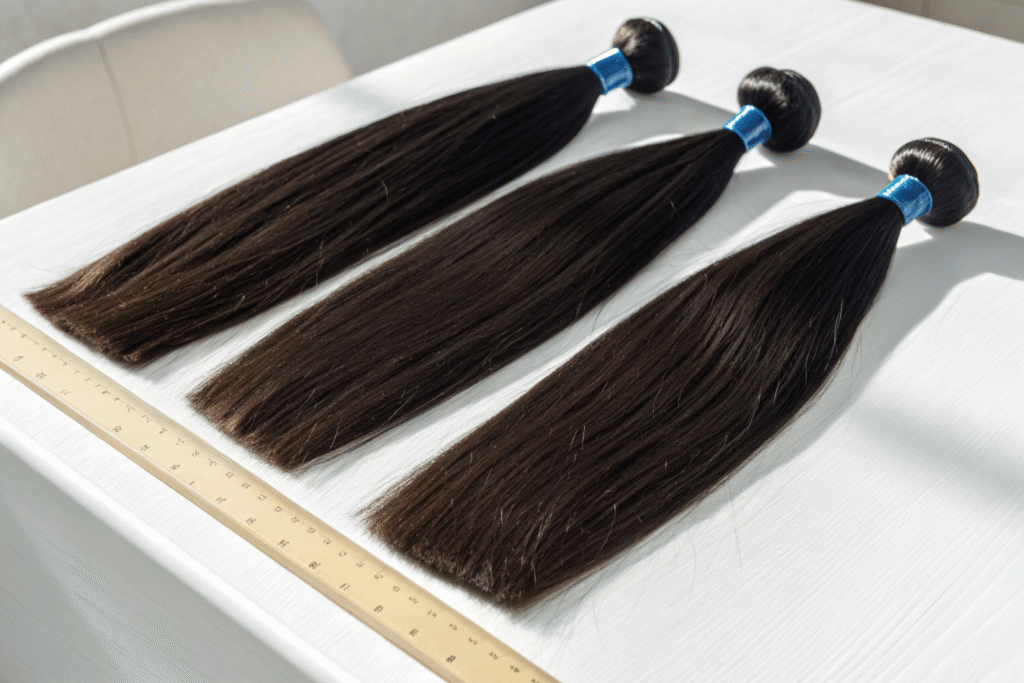
Does Remy consistently outperform non-Remy in longevity?
Lifespan benchmarks I use with clients
- Remy (premium processing, good care): 12–24+ months in consumer use; commercial rentals or high-frequency wear often see 9–18 months.
- Non-Remy (acid stripped, silicone coated): 4–16 weeks before noticeable roughness, increased shedding, and style loss; heavy users may see degradation in under a month.
These ranges vary by origin, bundle uniformity, ventilation technique, and care routines, but the trend is clear: Remy’s intact cuticles deliver longer functional life, even under daily heat styling.
Why Remy lasts longer
- Structural integrity: Preserved cuticles shield the cortex from mechanical and chemical stress.
- Lower chemical burden: Less reliance on acid/silicone means fewer early micro-damages.
- Maintenance efficiency: Remy responds to light conditioners and standard detangling—no need for continual heavy serums to mask damage.
Total cost of ownership
The replacement cycle drives your economics. In wholesale programs I’ve modeled, switching a mid-tier line from non-Remy to consistent Remy increased unit cost 20–40% but cut returns by 30–50% and extended average service life 2–4x. Net margin improved once warranty and replacement logistics were factored.
Comparative Summary
| Attribute | Remy Hair | Non-Remy Hair |
|---|---|---|
| Cuticle state | Intact, aligned root-to-tip | Mixed directions; often stripped via acid |
| Tangling/matting | Low with routine care | High after silicone wash-off |
| Heat styling response | Predictable; holds styles longer | Inconsistent; prone to dryness and breakage |
| Color processing | Even uptake; stable toning | Patchy uptake; requires corrective toning |
| Service life (typical) | 12–24+ months | 1–4 months |
| Maintenance | Light conditioners; minimal serums | Frequent heavy serums; detangling required |

Is the cost difference justified for my target market?
Segment-by-segment justification
- Premium lace/hand-tied lines: Yes. Remy’s uniformity yields cleaner knots, less shedding during ventilation, and a more undetectable hairline. Customers expect longevity and realism; price elasticity supports the upgrade.
- Professional/medical wig programs: Strong yes. Lower failure rates and predictable maintenance reduce clinic support burdens and enhance patient satisfaction.
- Fashion-forward, high-frequency stylers: Yes, if you market styling durability. Remy’s heat resilience and style memory reduce customer frustration and returns.
- Entry-level, price-sensitive markets: Mixed. If buyers prioritize upfront price over lifespan, a controlled non-Remy SKU can work—but manage expectations and offer clear care guidance. Consider hybrid approaches (Remy for front/lace zones, economy wefts elsewhere).
Economic lens
Upfront cost is higher due to donor collection protocols, bundle sorting, and gentler processing. However, when you include reduced warranty claims, fewer replacements, and stronger brand reputation, Remy often lowers per-wear cost.
Cost-Value Model (illustrative)
| Factor | Remy Impact | Non-Remy Impact |
|---|---|---|
| Unit cost | +20–40% | Baseline |
| Return rate | -30–50% | Higher (tangle, shedding complaints) |
| Average wears per unit | 2–4x increase | Lower |
| Support/service time | Reduced | Increased |
| Brand equity (reviews/CSAT) | Improves | At risk |
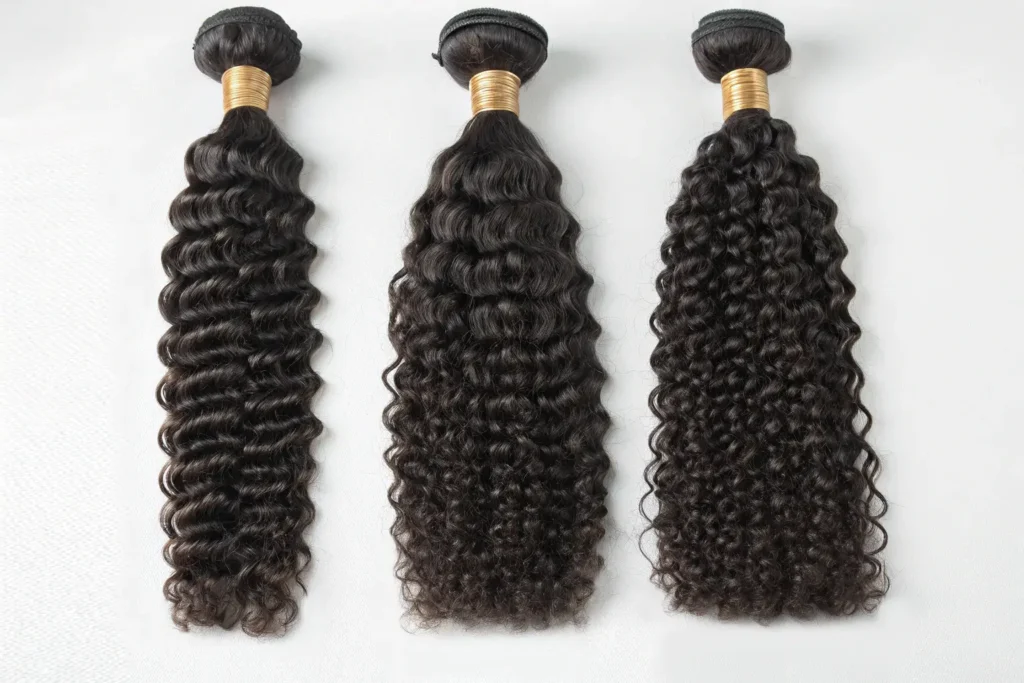
What sourcing checks confirm authentic Remy in bulk?
Field-level origin and collection controls
- Traceability: Require root-to-tip bundle integrity from collection (India temple hair, SEA community donors, Eastern Europe single-donor). No post-collection mixing.
- Elastic banding and tagging: Bundles secured at the root during collection; tags preserve root orientation through transport and processing.
- Vendor declarations: Documented SOPs for handling and sorting; audit their receiving and bundle-turn prevention.
Physical tests I run on incoming lots
- Directionality comb test (dry and wet): Comb root-to-tip and tip-to-root. Authentic Remy shows smoother glide root-to-tip; increased resistance tip-to-root without snagging. Inconsistent behavior suggests mixed orientation.
- Cuticle microscopy: Under 200–400x magnification, check for intact scales and consistent lay direction. Acid-stripped hair shows flattened, eroded, or absent scales.
- Float and absorption: Measure water uptake time and surface behavior. Intact cuticles display predictable hydrophobic/hydrophilic balance; stripped hair saturates rapidly and feels mushy post-dry.
- Heat response panel: Apply standardized curl/flat iron passes at 180–200°C. Remy maintains shape with minimal frizz; non-Remy shows faster dryness and flyaway.
- Dye swatch test: Single-process dye on representative wefts. Remy exhibits uniform tone; non-Remy often bands or blotches due to uneven porosity.
Process audits at the factory
- Pre-wash protocols: Verify no acid baths intended to strip cuticles; only mild cleansing and steam/low-chemical texture adjustments.
- Silicone use: If any, confirm light, breathable finishing rather than heavy occlusive coats designed to mask cuticle damage.
- Wefting and ventilation: Observe handling to prevent inversion; root orientation should be maintained during weft construction and lace knotting.
Documentation and contracts
- Include cuticle integrity clauses, random lot testing rights, and penalties for misrepresentation.
- Specify acceptable origins and bundle homogeneity (avoid “floor mixes” or salon sweepings that often create non-Remy issues).
- Require batch certificates tied to photographic evidence of root banding and production steps.
Embedded insights applied
- Aligned cuticles reduce friction, preventing matting and tangling during wear and maintenance.
- Intact cuticles preserve luster and realistic light reflection under varied lighting.
- Cuticle alignment maintains strand strength, resisting breakage and shedding.
- Remy holds styles longer and responds predictably to heat tools, enabling repeated restyling.
- Proper Remy processing retains moisture balance, enhancing softness and manageability without heavy silicones.
- Fewer harsh chemicals mean longer service life and lower total cost over time.
- Non-Remy’s mixed directions necessitate aggressive acid/silicone fixes that shorten durability.
- Directionality improves color uptake and evenness for consistent dye and tone results.
- Remy construction supports natural movement and density distribution for realism at the part and hairline.
- In premium lace/hand-tied builds, Remy uniformity simplifies knotting and extends longevity.
Conclusion
From procurement to post-sale performance, Remy hair’s intact, aligned cuticles deliver tangible advantages: lower friction, reliable heat response, even color, and extended lifespan. Those benefits translate into fewer returns, stronger reviews, and more profitable premium lines. If your brand competes on realism and durability, the cost delta is justified—provided you lock down sourcing discipline. Implement directionality tests, cuticle microscopy, and vendor process audits, and insist on root-preserved bundles from reputable origins. Do that, and Remy’s “industry standard” status stops being a slogan and becomes your operational edge.