
I spend most of my week inside factories and with procurement teams comparing curl bundles, ventilation maps, and finished caps under bright QC lights. When we chase “natural-looking” on afro-textured wigs, I see the same issues sink otherwise great builds: density that reads helmet-like, bulk at the crown that kills scalp realism, and coils that collapse by week three because weight was misjudged for the length. I’ve learned to treat density not as a single number, but as a distribution plan across the cap that respects curl physics, shrinkage, and comfort for daily wear.
Realistic density for afro-textured wigs typically falls between 130–150% for everyday wear, rising to 150–180% when you want “full but still believable” coils. Densities above 180–200% skew glam or stage-ready unless intentionally styled. The key is strategic distribution—lighter hairline and crown, fuller mid-back—plus pre-plucked edges and coily ventilation patterns that preserve scalp visibility without losing shape.
Here’s how I break it down for B2B buyers and brand teams: a clear density range by length, how to prevent crown bulk while keeping fullness, whether layered cutting really helps on coils, and the ventilation patterns that sell realism up close. I’ll weave in sourcing and factory workflow details so you can brief your supplier or in-house team with confidence.
Which density range balances volume and scalp visibility?
In my experience, the “right” density changes with length and curl tightness. Coils occupy more visual space than straight hair, so the same gram weight looks fuller on 4B–4C.
- Short afro-textured (TWA to 6 inches): 120% looks closest to natural fullness without bulk.
- Medium (8–12 inches): 130–150% balances volume with realistic scalp visibility.
- Long (14 inches+): 150–180% maintains shape and coil definition along the length.
- 200%+: reads wig-like on afro textures unless you want glam or stage volume.
Why these numbers work at the factory level
- Shrinkage and coil compactness: Tighter coils (4B–4C) appear fuller at lower densities. I routinely sign off 130% for coils that would need 150% in looser curls.
- Strand diameter and luster: Selecting realistic strand diameters and avoiding high-luster, acid-bathed hair helps 130–160% read as “my hair,” not “synthetic shine.”
- Weight and comfort: For daily wearers, I favor lighter densities to reduce heat and cap tension, which protects edges over time.
Table: Practical density guidance by length and curl tightness
| Wig length / curl pattern | Recommended density | Notes |
|---|---|---|
| TWA–6″ (4B–4C) | 120–130% | Natural fullness without helmet effect |
| 8–12″ (4B–4C) | 130–150% | Best daily realism, breathable |
| 14–18″ (4B–4C) | 150–170% | Keeps shape down the length |
| 20″+ (4B–4C) | 160–180% | Use only if you want presence; watch weight |
| Looser curls (3C–4A) across lengths | +10% vs above | Looser curl reads flatter; add density modestly |
Procurement checklist:
- Specify density by zone, not just overall percentage.
- Confirm hair origin and processing: steam-textured human hair with intact cuticles reads fuller at lower densities than acid-bathed hair with excess shine.
- Request matte, low-luster finish on textures to keep 130–150% looking authentic.
How do I prevent bulk at the crown while keeping fullness?
Bulk at the crown is usually a distribution problem, not just “too much hair.” I sign off builds that reduce crown weight but preserve side and back volume.
Distribution map that works
- Hairline: 70–80% of base density (pre-plucked) to avoid a dense wall at the front.
- Crown: 80–90% to prevent “helmet peak.”
- Mid-section (parietal/occipital): 100–110%—this is where fullness feels natural.
- Nape/back: 90–100% to maintain silhouette without heaviness.
Construction techniques I request
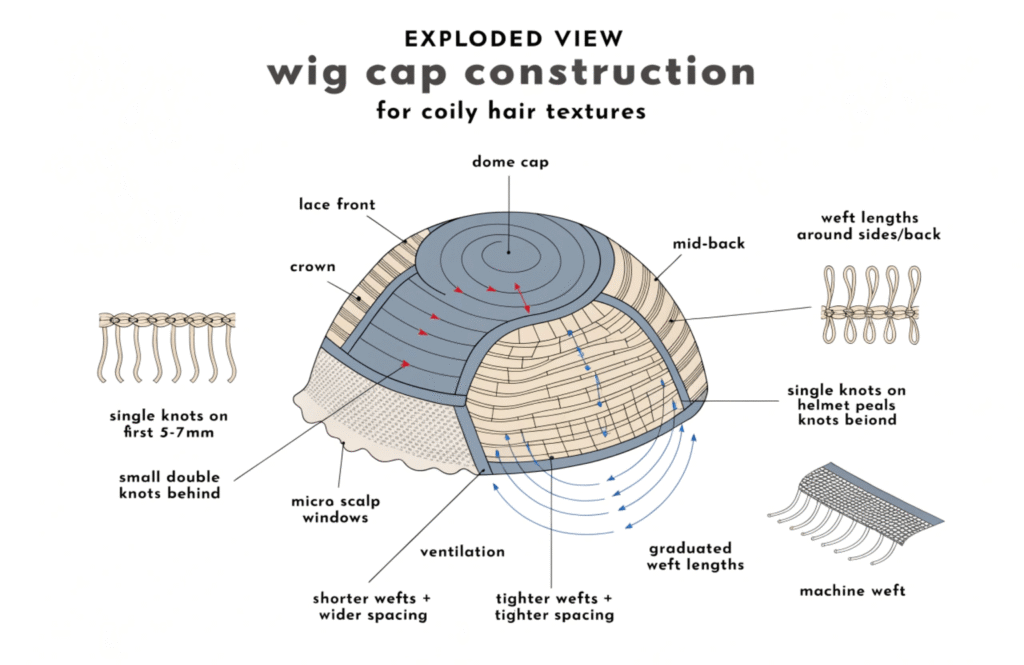
- Ventilation staggering: Alternate 1–2 hairs per hole with empty holes in crown zones to create micro-scalp windows.
- Directional ventilation: Crown hairs should be ventilated in radial spirals to collapse bulk and mimic natural growth.
- Graduated weft mapping: On machine-wefted caps, I start with shorter wefts and wider spacing near the crown, tighter spacing mid-back, then relax again toward the nape.
QC and fit considerations
- Use medium-density bleached knots only in the first 1–1.5 inches of the hairline; over-bleaching thicker zones makes knots fuzzy and adds visual bulk.
- Cap selection: Choose a slightly deeper crown on dome caps for dense coils; shallow crowns force hair to stand up and “helmet.”
Table: Zone-by-zone target density ratios (relative to overall order)
| Cap zone | Ratio vs overall | Goal |
|---|---|---|
| Hairline/temples | 0.7–0.8x | Soft entry, scalp visibility |
| Crown/vertex | 0.8–0.9x | No peak, natural collapse |
| Mid-section (sides/back) | 1.0–1.1x | Body and shape |
| Nape | 0.9–1.0x | Balanced silhouette |
Should I choose layered cuts for better shape and movement?
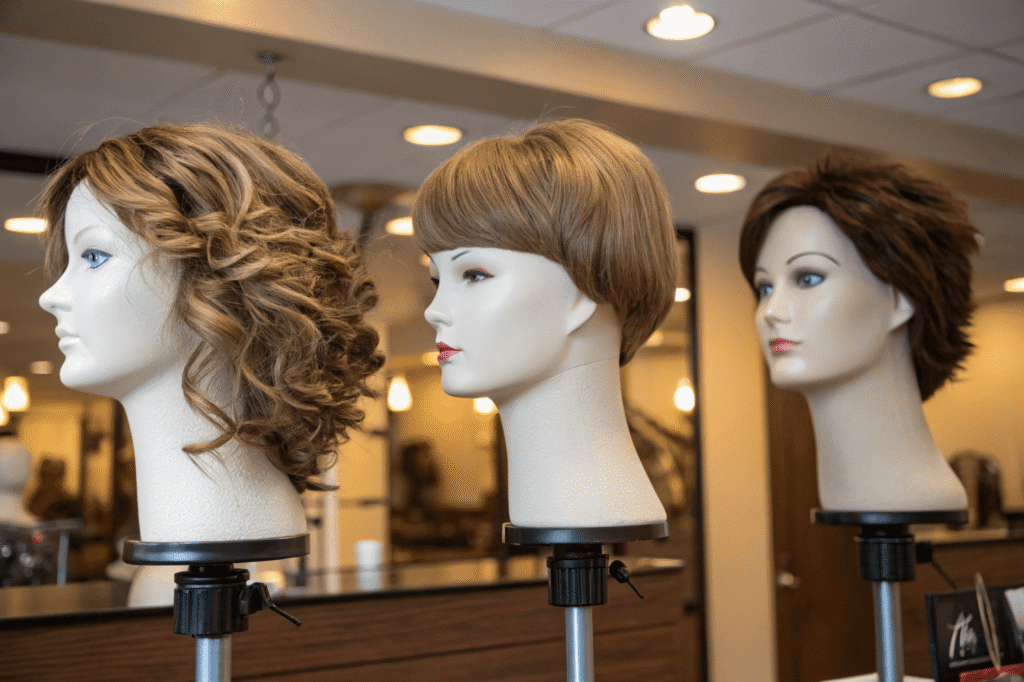
Yes—on afro textures, layering is not optional if you want shape that moves and doesn’t mushroom. I push for layered architecture paired with smart density to keep coils lively.
What I ask stylists to do
- Vertical debulking: Soft, long layers to remove lateral bulk and add vertical lift—critical for round or square face shapes.
- Hidden internal layers: Shorter internal lengths reduce weight so coils spring; this keeps a 150–160% wig feeling like 140% in motion.
- Perimeter preservation: Maintain a slightly denser perimeter for line integrity; over-thinning edges reads sparse under indoor lighting.
Length-specific guidance
- Short (TWA–6″): Minimal layering—just enough to avoid boxy sides. 120% density with light point-cutting is typically perfect.
- Medium (8–12″): Graduated layers with crown length slightly longer than the sides to prevent a flat top. 130–150% density responds well here.
- Long (14″+): Face-framing layers and internal weight removal to keep coil definition. 150–180% maintains shape down the length without dragging the curl.
Wearer comfort and longevity
- Daily wearers: Opt for slightly lighter densities (e.g., 140–150% instead of 160%) with layered internal debulking to reduce heat and protect edges.
- Texture realism: Pair layers with realistic strand diameter and low luster; this lets 130–160% densities pass as natural hair under office lighting.
What ventilation patterns suit coily hair realism best?
The ventilation map makes or breaks scalp realism on coily wigs. I push factories to match afro growth directions and create believable “scalp windows.”
Patterns that work
- Staggered single-hair ventilation at the hairline: Pre-plucked with 1–2 hair per hole behind the first 5–7 mm, then gradually increasing—this prevents a hard edge.
- Radial crown spiral: Ventilate in a true spiral from the vertex to mimic growth; incorrect straight-back crown builds cause standing bulk.
- Brick-lay spacing mid-back: Alternated rows create micro-gaps so coils stack without looking uniform—this is the sweet spot for 130–160% to read natural.
- Strategic sparse edges: Slightly sparser density at temples and the very front edge improves realism even if the overall build is fuller.
Knotting and fiber considerations
- Knot size: Use small, double knots behind the hairline; single knots at the first 5–7 mm for delicacy. On coarser strands, mini double knots maintain hold without visual heaviness.
- Bleach control: Only lighten the first 1–1.5 inches; over-bleached knots on darker lace turn orange and require toner, compromising durability.
- Fiber sourcing: Choose steam-processed, cuticle-aligned human hair; avoid heavy acid baths that strip cuticles and increase shine (shine reads denser and less natural on coils).
Distribution aligned to “afro growth truth”
- Lighter front and crown with fuller midsection and back mimics how afro hair tends to grow and settle.
- Pre-plucked hairlines plus sparse edges improve pass-ability even on higher overall densities.
Conclusion
If your goal is an everyday, believable afro-textured look, I recommend 130–150% density for most lengths, with 120% for short TWAs and up to 150–180% when you want fullness on longer styles. Keep the hairline and crown lighter, concentrate body in the midsection and back, and insist on a radial crown spiral with staggered ventilation for true scalp visibility. Use layered cuts to manage shape and movement instead of simply adding density. Finally, choose realistic strand diameter and low-luster, steam-processed human hair so even 150–160% reads like your own. These decisions—distribution over brute volume, precise ventilation, and smart layering—are what separate “convincing” from “obvious wig” in professional settings and daily wear.