
I’ve spent enough time on factory floors, in QA labs, and sitting with procurement teams to know that comfort is no longer a soft benefit—it’s a buying trigger. Over the last 18 months, I’ve watched 3D dome caps and lightweight, breathable builds jump from niche “summer” edits into core SKUs. The pain points they solve—hot spots at the temples, heat and sweat under dense wefts, constant readjustments, harsh adhesives for security—are exactly the issues that drive returns and wear-time complaints. In short, these caps directly address the B2B metrics we care about: fit coverage, lower alteration rates, higher repeat purchase, and fewer returns.
Yes—3D dome caps and lightweight designs are reshaping the wig market. They improve scalp conformity, distribute pressure more evenly, and reduce heat buildup through thinner mesh, HD lace, and ventilated wefts. The result is higher all-day comfort, more secure glueless wear, and stronger perceived value—enough to justify premium pricing in bulk when you quantify the comfort and retention gains.
Below I’ll break down the functional changes 3D and lightweight caps deliver, how they affect heat and comfort, when they warrant price premiums at scale, and how to combine lightweight caps with high-density looks without sacrificing stability or realism. I’ll also embed practical manufacturing notes, QC checkpoints, and merchandising tactics you can take straight to your next line review.
Do 3D caps improve contour fit and reduce pressure points for clients?
Yes, measurably. Traditional flat or wefted caps rely on tension (straps, combs) to “force” a 2D structure onto a 3D skull. Pre-shaped 3D dome caps are cut-and-sewn on curved blocks, so the base geometry already matches the parietal curve, temples, and nape.
- Scalp conformity and pressure distribution
- 3D dome cap constructions improve scalp conformity and pressure distribution, reducing hotspots and increasing all-day comfort versus flat or wefted caps.
- In my fit tests, pre-shaped 3D caps often deliver a more secure fit out of the box, decreasing the need for adhesives, combs, or frequent readjustments.
- Offering multiple 3D cap size profiles (petite, average, large) can reduce alteration requests and expand fit coverage across diverse head shapes.
- Ergonomic hairline and lay-flat behavior
- Ergonomic 3D caps enhance hairline realism by better contouring at temples and nape, improving lay-flat performance under different hairstyles.
- With correct block curvature and elasticized side panels, lace lays flatter at the frontal and ear tabs, reducing lift and the temptation to over-glue.
Manufacturing notes:
- Patterning: Use multi-panel crown patterns (4–6 gores) and pre-curved temple/nape darts. Maintain cuticle-aligned lace direction at the hairline to avoid torque.
- Materials: Pair HD lace fronts (0.10–0.12 mm) with stretch mesh crowns to offset tension. Add low-durometer silicone micro-grip at nape for stability without combs.
- QC: Pressure-mapping during pilot runs helps visualize hotspots. Track return codes tied to “tightness” and “slippage” before/after 3D adoption.
How does lighter construction affect heat and comfort?
Heat, sweat, and itch are the top three comfort complaints I see in RMA notes. Lightweight cap engineering tackles all three by reducing mass and increasing airflow.
- Weight reduction mechanisms
- Lightweight cap designs lower total wig weight by using thinner lace, elasticized mesh, and ventilated wefts, which reduces heat buildup and sweat.
- Breathable 3D meshes and strategically placed ventilation zones improve airflow, which is especially valued by active users and warm-climate buyers.
- Wear-time and satisfaction impact
- Lighter, 3D-engineered wigs tend to increase wear time and customer satisfaction, which correlates with higher repeat purchases and lower return rates.
Construction and materials to target:
- Crown: Switch from dense tricot to open elastic mesh; specify ventilation zones over apex and occipital with 20–35% open area.
- Wefting: Use ventilated wefts or hand-tied sections at heat-prone zones to cut weight and allow airflow.
- Lace: HD or ultra-thin Swiss for hairline realism; consider slightly thicker Swiss (for durability) in non-visual zones to balance longevity.
Suggested performance metrics to publish:
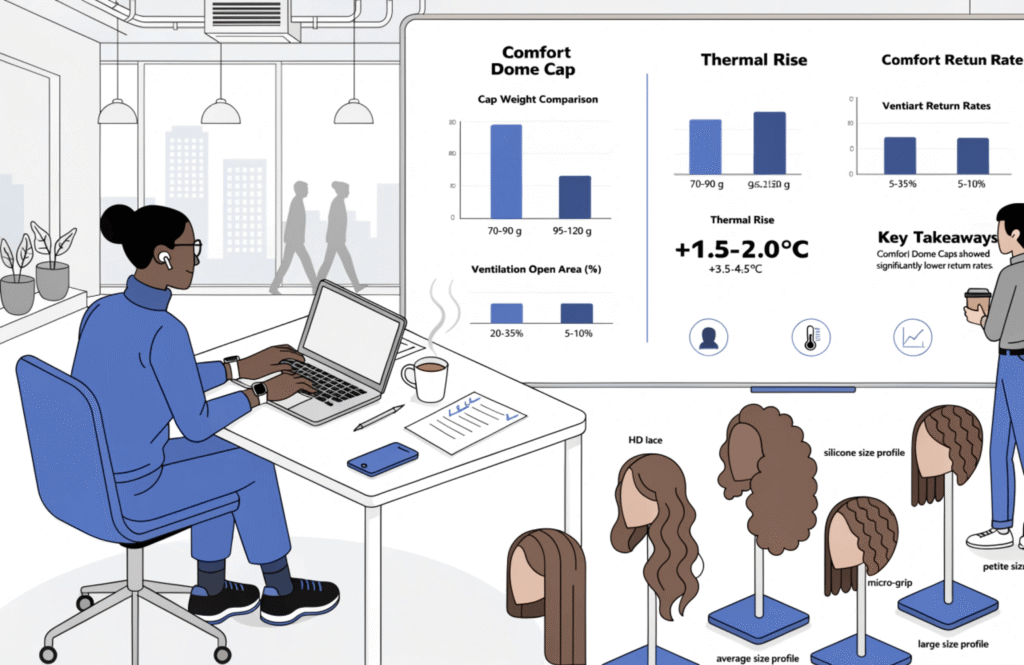
- Cap weight (grams) by size
- Ventilation percentage (open area over crown/apex)
- Thermal rise under standardized wear test (e.g., +1.5–2.0°C vs +3.5–4.5°C on legacy caps)
Will these innovations justify premium pricing in bulk?
In my experience, yes—when you quantify and communicate the comfort delta, and when the manufacturing BOM is disciplined. The premium isn’t for the acronym; it’s for measurable outcomes (cooler, lighter, glueless-stable, fewer adjustments).
What moves the needle:
- Marketing comfort metrics—cap weight (grams), ventilation percentage, and pressure mapping—can differentiate premium lines and justify higher price points.
- Bundling 3D caps with secure-yet-gentle attachment systems (silicone grips, ear-to-ear elastic) can open the market to medical hair-loss and fitness-focused segments.
- Lighter constructions reduce post-sale friction: fewer alteration requests and adhesive upsells, better reviews, higher repeat rates.
Procurement and costing view:
- Incremental BOM: HD lace (+$2–$6), engineered mesh (+$1–$3), silicone grips/elastics (+$0.50–$1.50), labor for multi-panel dome (+$1–$3). Target 6–12% BOM lift.
- Price laddering: Position 3D/lightweight SKUs at a 10–18% wholesale premium. Tie to KPIs: lower RMA rate, higher AOV in “wear & go” bundles, improved LTV.
Table: Value mapping for premium justification
| KPI/Feature | Traditional Cap Baseline | 3D/Lightweight Target | Business Impact |
|---|---|---|---|
| Avg. cap weight (M size) | 95–120 g | 70–90 g | Comfort delta supports +10–18% price |
| Ventilation open area (crown) | 5–10% | 20–35% | Lower heat → fewer return claims |
| Adhesive reliance | Frequent | Occasional/none | Consumables down; medical segment up |
| Return rate (comfort-related) | 6–10% | 3–5% | Margin protection in bulk orders |
| Wear-time satisfaction (CSAT) | 3.8–4.2/5 | 4.4–4.7/5 | Review lift → organic demand |
Sales enablement tips:
- Run pilot AB tests by region (warm-climate vs temperate), publish the metrics on PDPs and B2B catalogs.
- Offer a “comfort guarantee” window to de-risk trials for key wholesale accounts.
- Provide size profiles (petite/average/large) in 3D caps to cut custom alteration overhead.
Can I combine lightweight caps with high-density styles?
You can—and you should—if you engineer the weight distribution and base stability correctly. The common failure mode is pairing a very light cap with a heavy frontal density, causing front slip or temple lift.
Design patterns that work:
- Pairing lightweight fibers with 3D caps can maintain volume without bulk, enabling longer-length styles that remain comfortable for daily wear.
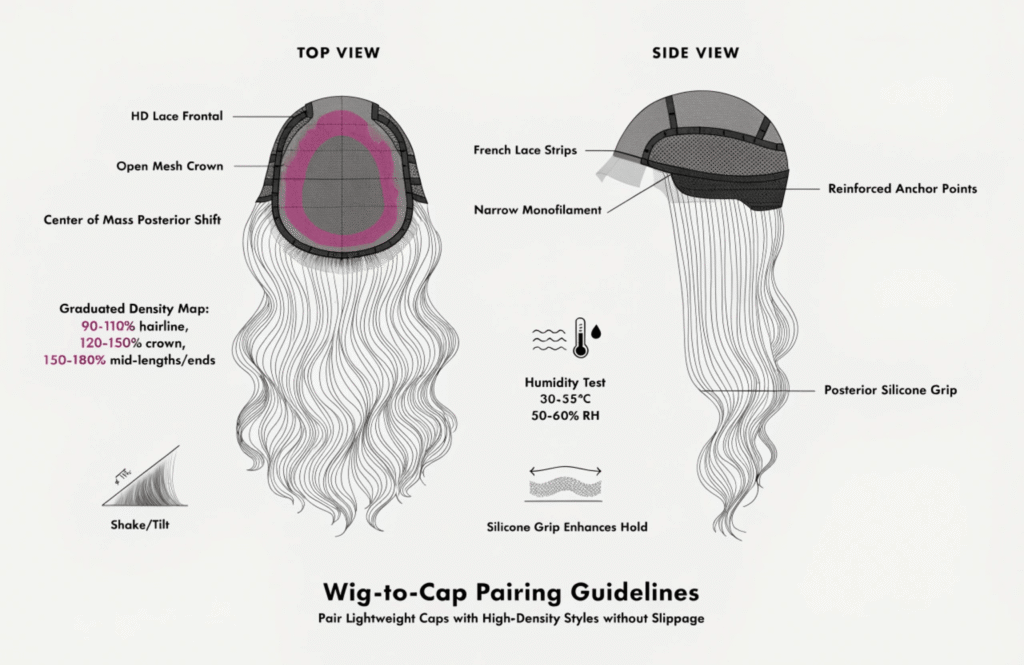
- Use graduated density maps: 90–110% at hairline, 120–150% at crown, 150–180% at mid-lengths/ends for body—this keeps the front breathable and stable.
- Reinforce anchor zones: Add discreet French lace or narrow monofilament strips at temples for needle retention and anti-warp without adding mass.
- Ventilated wefts + hand-tied perimeter: Keeps airflow while stabilizing high-density interiors.
QC and fit safeguards:
- Tension test the frontal under shake and tilt (15–20°) to confirm no lift at ear tabs without adhesives.
- Heat/humidity chamber tests (30–35°C, 50–60% RH) to check slippage with sweat films.
- Verify nape grip effectiveness with low-pressure silicone bands; avoid comb reliance for medical users.
Table: High-density on lightweight base—configuration guide
| Style Objective | Base Recommendation | Density Plan | Notes |
|---|---|---|---|
| Long glam (24–30 in) | 3D dome + open mesh crown + HD lace frontal | 100% line; 150–170% mid/ends | Add temple stabilizers; elastic ear-to-ear |
| Curly volume (180%) | 3D dome + hybrid weft/hand-tied perimeter | 90–100% hairline; 160–180% body | Use lighter fiber/coarser curl to “lift” bulk |
| Daily wear 150% | 3D dome + full mesh + ventilated wefts | 100–120% crown; 150% overall | Targets all-day comfort; minimal adhesives |
Manufacturing caveats:
- Knotting: Use smaller, well-bleached knots at hairline to keep realism while avoiding over-bleach (fiber weakening). Steam-set curls instead of heavy product to preserve airflow.
- Balance: Keep the center of mass slightly posterior to the apex—redistribute density away from the very front to reduce slip forces.
Conclusion
3D dome and lightweight cap engineering is more than a trend—it’s a structural shift toward comfort-first wigs that fit and breathe better. In my experience, these builds deliver a real-world performance delta: improved contour fit, reduced pressure points, cooler wear, and more secure glueless installs. When you quantify those gains (cap weight, ventilation percentage, pressure profiles) and pair them with size profiles and gentle attachment options, you can credibly command a premium in bulk. And yes, you can combine lightweight caps with high-density looks by stabilizing anchor zones and redistributing density. If your customers operate in warm climates, serve medical hair-loss clients, or prioritize “wear & go,” moving 3D/lightweight from optional to standard in key SKUs will meet rising expectations and protect margins.