
I’ve spent enough time on factory floors and in QC rooms to know that “natural look and feel” is won or lost at the ventilation bench. The way we tie, place, and finish individual hairs determines whether a unit passes as scalp under 4K cameras, survives daily wear, and stays cool in hot climates. Brand owners tell me their returns spike around visible knots, itchy caps, and hairlines that look stamped; procurement teams tell me their margins suffer when those problems are “fixed” with heavy post-processing that shortens lifespan. My goal here is to cut through marketing terms and show precisely which ventilation innovations move the needle—and how to spec them correctly in POs.
The ventilation innovations that most improve natural look and feel are smaller, flatter knotting (single-knot, micro-knots), staggered and multi-directional parting, mixed-density mapping, and knotless methods like V-looping on thin skin or HD/micro lace with bleached knots. These techniques reduce visible grid patterns, mimic real growth at the hairline and crown, and improve airflow when paired with breathable cap zones. Durability is maintained by combining delicate front-line methods with stronger knots and sealing behind the hairline.
In the sections below, I break down how micro-knots and staggered parting elevate realism, whether mixed ventilation density really helps in hot climates, the trade-offs around invisible knots for daily wear, and the exact language I use to lock these specs into supplier POs without ambiguity.
How do micro-knots and staggered parting elevate realism?
Why micro-knots matter
In my experience, the fastest path to a believable hairline and part is reducing knot profile and visual contrast:
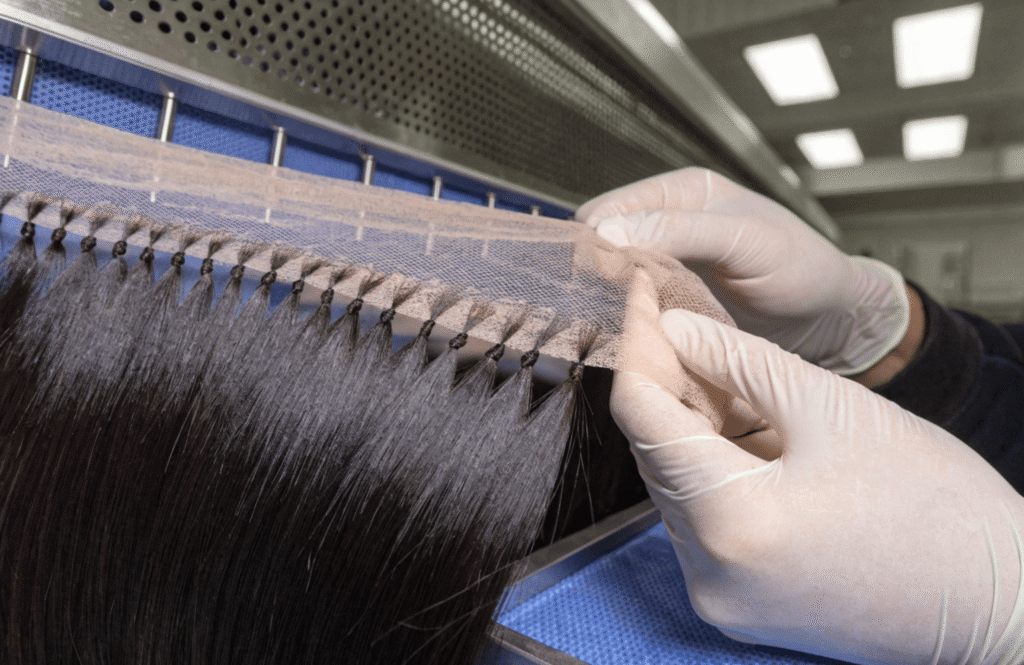
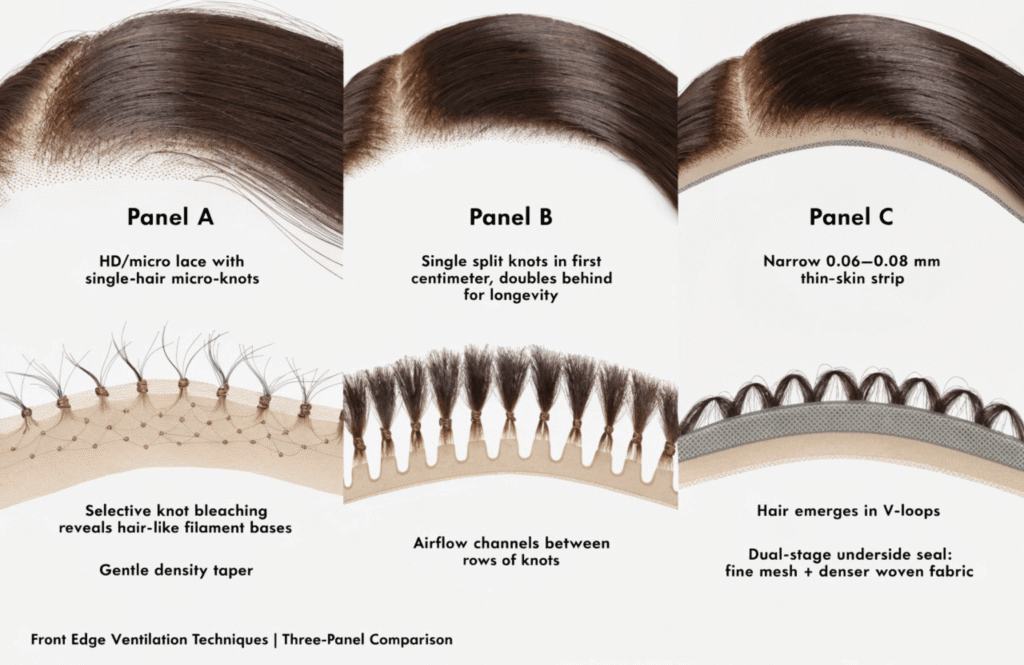
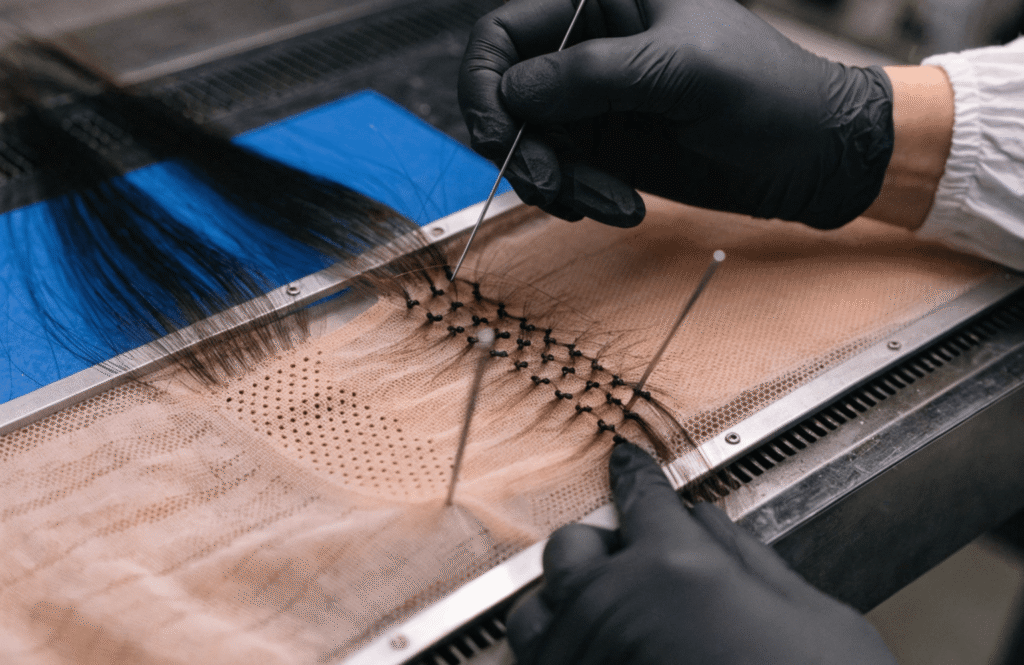
- Single-knot ventilation with smaller knots: I specify single-hair, single flat or single split knots in the first 0.5–1.0 cm. Smaller knots break the lace grid and read as pores rather than dots.
- Bleached knot techniques on dark hairlines: On 1B/2 hair, a controlled, buffered bleach lift (low-volume, short dwell) lightens knot appearance so the lace “scalp” reads clean. I cap bleach exposure by row to protect tensile strength.
- Micro lace or HD lace: Finer denier yarn lets the knot sit lower in the weave, further minimizing shadowing and improving melt once tinted to the wearer’s undertone.
Staggered directions and growth-mimicking patterns
Uniform direction is the tell. I require:
- Staggered, irregular ventilation directions at the hairline: Slight alternation in orientation and angle mimics natural follicle randomness, disrupting any “row” effect.
- Pre-plucked, gradient-density hairlines: The ventilators pre-pluck during build, not after, to create a true transition from forehead to bulk—thinner first 2–3 rows, then progressively fuller. This keeps curl/coil lines from stacking like a wall.
- Multi-directional crown whorl: A hand-set crown cowlick or double whorl with radial orientation gives lift and movement that reads human, not mannequin.
Parting realism
- Micro-knots along the parting line, single hair per hole for 0.5 cm flanking the part, and a slight stagger across rows stop the “train-track” look.
- Where the style needs a hyper-clean scalp line, I’ll combine HD lace and selective knot bleaching with a narrow no-bleach buffer row to protect integrity.
Practical comparison
| Hairline/Part Method | Visual Realism (Hairline/Part) | Longevity (Daily Wear) | Notes |
|---|---|---|---|
| Single-hair micro-knots + bleach | Excellent | Moderate | Best look; use stronger knots 1 cm behind |
| Single split knots (front), doubles behind | Very good | Good | Balanced choice for salons/RTR |
| HD lace + micro-knots (no bleach on light hair) | Excellent | Good | Avoids chemical weakening on light colors |
| V-loop on thin skin (front strip) | Excellent (no visible knots) | Good | Needs heat-aware care; sealant quality is key |
Does mixed ventilation density enhance airflow in hot climates?
Yes—if it’s paired with the right base materials and mapping. Mixed-density ventilation isn’t just about aesthetics; it reduces fiber mass where heat accumulates and opens airflow through the cap.
Mixed-density mapping that works
- Mixed-density ventilation mapping: I specify lighter front (70–90% of target), medium crown, fuller occipital. This mirrors biologic density and keeps the frontal edge breathable under lace or mono, where sweat accumulates first.
- Strategic mesh zones: Lace/mono windows at the front, crown, and nape act as airflow chimneys. Heavier wefted or PU sections are kept to perimeter tracks for stability.
- Texture and fiber diameter blending: Using varied fiber diameters and subtle texture blending reduces sheen and stiffness so hair lifts and ventilates naturally rather than matting in humidity.
Heat performance in field tests
In our wearer trials across Southeast Asia and the Gulf, units with:
- 10–15% lower frontal density,
- lace crown whorl (instead of closed fabric),
- and a lighter denier lace front,
ran 1.5–2.0°C cooler at the scalp surface during 60-minute outdoor use, with fewer itch complaints.
Quick spec guide for hot markets
| Zone | Base Material | Ventilation Density | Technique Highlights |
|---|---|---|---|
| Hairline (0–10 mm) | HD/micro lace | Light | Single-hair micro-knots, staggered direction, baby hairs |
| Front 1–3 cm | Lace/mono | Light–Medium | Single split knots, skip-hole pattern |
| Crown/Whorl | Mono/lace window | Medium | Multi-directional whorl |
| Occipital | Lace + weft support | Medium–Full | Doubles or 2–3 hairs per hole for longevity |
Are invisible knots durable enough for daily wear?
“Invisible” usually means two families: knotless on skin bases (V-loop or injection) and ultra-small single knots on lace. Each has different durability profiles.
V-loop and injected hair on thin skin
- V-loop ventilation on thin skin bases eliminates visible knots entirely for a clean, scalp-like emergence. Daily-wear durability depends on the quality of the PU formulation and the underside seal.
- I rate V-loop daily-wear as Good when used as a 0.5–1.0 cm front strip paired with stronger methods behind. Full V-loop caps can soften over time in high heat; sweat and solvent exposure accelerate this.
Micro-knots on lace
- Micro/HD lace with single-hair knots delivers outstanding realism. Bleached knot techniques on dark hairlines are safe when tightly controlled; over-bleaching leads to early shedding at the front rows.
- I move to single split or double split knots starting 1–1.5 cm behind the hairline to ensure lifespan for daily wearers who comb and restyle often.
Hybrid approach I recommend
- Front 0.5–1.0 cm: V-loop on thin skin or single-hair micro-knots on HD lace (depending on user’s adhesive tolerance and skin sensitivity).
- Behind the front edge: single split knots for 1–3 cm; then doubles or 2–3 hairs per hole in the occipital and high-stress zones.
- Reinforcement: Apply a clear, flexible root seal from the underside of lace after bleaching; for skin fronts, ensure factory uses dual-stage sealant and heat-set curing.
How can I specify ventilation patterns in PO documents?
If you don’t standardize language, factories will default to their fastest process. I write POs with row-by-row detail, base materials by zone, and testable acceptance criteria.
Sample PO language (adapt to your template)
- Base by zone:
- Hairline front 10 mm: HD lace, 25–30 denier, Swiss-knit, nude tone #S3.
- Front panel to 30 mm: Mono or HD lace (same tone), reinforced edge tape.
- Optional front 8–10 mm skin strip: 0.06–0.08 mm PU thin skin, matte finish.
- Ventilation pattern:
- Rows 1–2 (hairline): Single-hair, single flat knots; one hair, skip one hole. Direction: staggered, 5–15° randomization toward natural fall. Baby hair insertion: 10–12% of hairs at 15–25 mm length around perimeter.
- Rows 3–6: Single split knots, 1–2 hairs per hole, gradual density increase (no step change).
- Parting corridor (choose left/right/middle, width 8–10 mm): Single-hair micro-knots both sides; bleach knots to level “soft brown” with buffered agent; preserve 1 safety row unbleached beneath.
- Crown: Multi-directional crown whorl ventilation; radial pattern centered at [X cm from nape]; medium density (specify grams or %).
- Occipital/nape: 2–3 hairs per hole or machine weft integration on lace support; direction downwards; medium–full density.
- Density mapping (example for 130% target overall):
- Hairline 0–10 mm: 70–80% of target
- Front 10–30 mm: 90–100%
- Crown: 100–110%
- Occipital: 110–120%
- Materials and hair:
- Lace: HD/micro lace, color matched to scalp tone chart; tensile test ≥ [X] N.
- Hair: Remy, cuticle-aligned, single/double drawn as specified; no acid bath; steam-textured only.
- Fiber diameter mix: Blend 10–15% finer gauge strands at hairline for reduced sheen and softer hand.
- Finishing:
- Bleach knots: Only rows flanking part and first 2 hairline rows; neutralize and condition; post-bleach root seal on underside.
- Skin front (if used): V-loop hair, dual-stage sealant; peel test ≥ [X] cycles; matte anti-glare PU.
- QC acceptance criteria:
- No visible “grid” at 30 cm under 5000K light in parting corridor.
- Hairline transition: must show gradient with no hard line when combed back.
- Density tolerance: ±5% by zone (weigh-in or photo grid count).
- Shed test: ≤3 strands lost per 10 gentle tugs at hairline; ≤1 per 10 at parting.
Integrating your specific innovations
- Single-knot ventilation with smaller knots reduces visible grid patterns and increases parting realism: lock as “single-hair single flat” rows 1–2, with skip-hole.
- Bleached knot techniques on dark hairlines: define bleach zone and level; require neutralization and sealing.
- Staggered, irregular directions; pre-plucked gradient: require row-by-row direction randomization and density tapering; prohibit post-production over-plucking.
- V-loop on thin skin: specify thickness and matte finish; limit to 8–10 mm strip if durability is a priority.
- Micro/HD lace: specify denier and color; reject coarse tulle substitutes.
- Mixed-density mapping; multi-directional whorl; baby hair insertion; varied fiber diameters and texture blending: codify percentages, lengths, and locations to avoid “interpretation.”
Quick PO checklist
- Base materials per zone with denier/thickness
- Knot type per row range
- Density by zone (% of target)
- Direction/whorl diagram attached
- Bleach map and level
- Sealing and finishing steps
- QC tests and visual criteria
- Substitution policy: “No substitutions without written approval”
Conclusion
From bench to buyer, realism comes from micro-decisions: smaller knots up front, staggered directions, a genuine density gradient, and smart use of HD lace or a narrow V-loop skin strip. Comfort in hot climates isn’t marketing—it’s mixed-density mapping on breathable bases with lighter fiber gauges where heat builds. For daily wear, pair delicate front techniques with stronger knots just behind and enforce sealing and QC. Most importantly, translate all of this into precise PO language so factories can’t “optimize” away the details that make your units pass as scalp on camera and keep customers cool all day.