
When I bought my first synthetic wig, I thought “lace front” and a pretty product photo were enough. I learned the hard way that shine, density, and cap construction can betray a wig the second you step outside. Since then, I’ve tested dozens of synthetics—budget to premium—and I’ve developed a simple checklist to predict whether a wig will actually pass as real hair before I hit “checkout.”
The most natural-looking synthetic wigs combine a lace-front with a pre-plucked, staggered-density hairline, a mono/hand-tied part or top, heat-friendly low-shine fibers, realistic density, and dimensional color. Before buying, verify fiber specs (matte sheen, heat tolerance), lace quality and knots, density/length/cap fit, and realistic color/parting via unfiltered photos or videos in natural light.
In this guide, I’ll show you exactly how I evaluate product listings, photos, and videos so you can pick a wig that looks like your hair on your head—not a costume. I’ll break down fiber specs, lace and hairline realism, density and cap choices, and how to confirm color, parting, and shine levels online. I’ll also share small customization tricks that make a big difference.
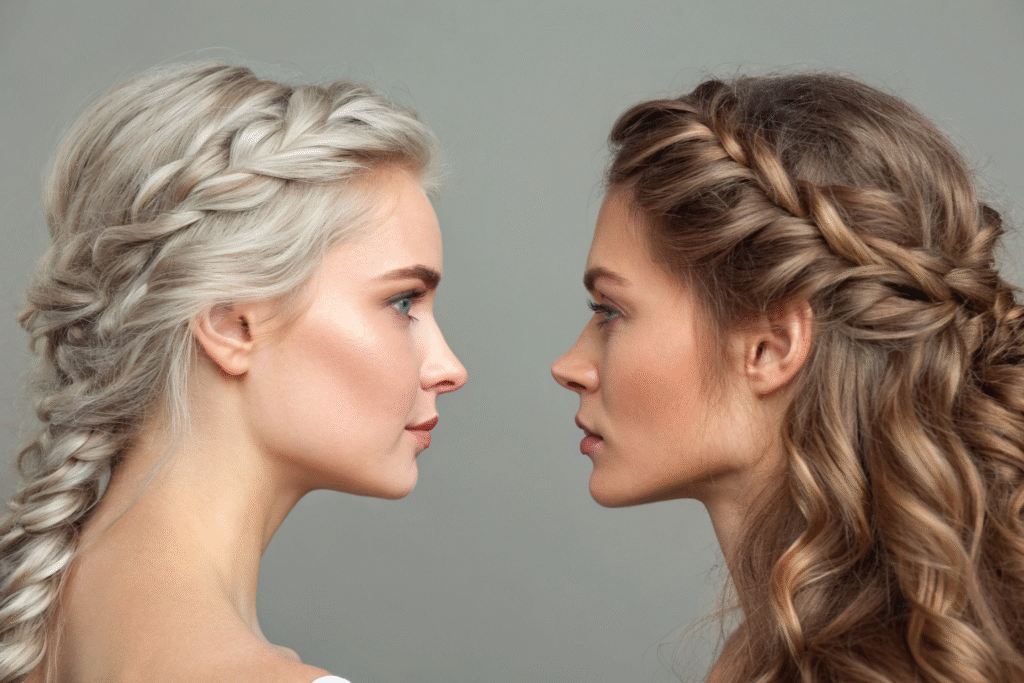
What key fiber specs should I check to know if my synthetic wig will mimic real hair?
Here’s what I’ve learned to look for in the fiber itself—because if the strands read as plastic, no cap magic can save the look.
Heat-friendly vs. standard synthetic fibers
- Heat-friendly (HF) fibers: I prefer HF fibers labeled heat-safe to 270–320°F (130–160°C). They generally have a softer, more human-hair-like drape and a lower, more natural sheen. They can be restyled lightly, which helps settle kinks and reduce factory shine.
- Standard Kanekalon or similar: Can look great when matte-finished, but some blends are inherently glossy. If the listing boasts “high shine,” I skip it unless there are real-life photos showing otherwise.
- Fiber memory: Quality synthetics hold style without getting crunchy. If customer videos show ends flipping oddly or tangling after a few brushes, I pass.
Pro tip: If the brand publishes “denier” (fiber thickness), I look for fine to medium denier for realism—thicker fibers reflect more light.
Shine control and texture
- Finish: I favor “matte,” “low-luster,” or “silky-matte” descriptions. “High-luster,” “ultra-gloss,” or “mirror shine” will read synthetic in daylight.
- Texture: A slight micro-texture (not frizzy) helps scatter light and look like cuticles. Stick-straight, glassy textures often glare under LEDs.
- Tangle tendency: Fibers that snag at nape-level in customer clips usually have too much static or a slick coating—both look less natural after a few wears.
What I do: I compare the wig’s sheen to my own hair in a window-lit room. If the listing video shows reflections that look like polished plastic, the wig will read synthetic in person.
Fiber thickness and movement
- Movement: I watch for bounce and separation when the model turns her head. Realistic fibers separate into wispy sections and fall back softly.
- Ends: Blunt, very uniform ends can look wiggy; a soft, slightly feathered finish looks more like a salon cut.
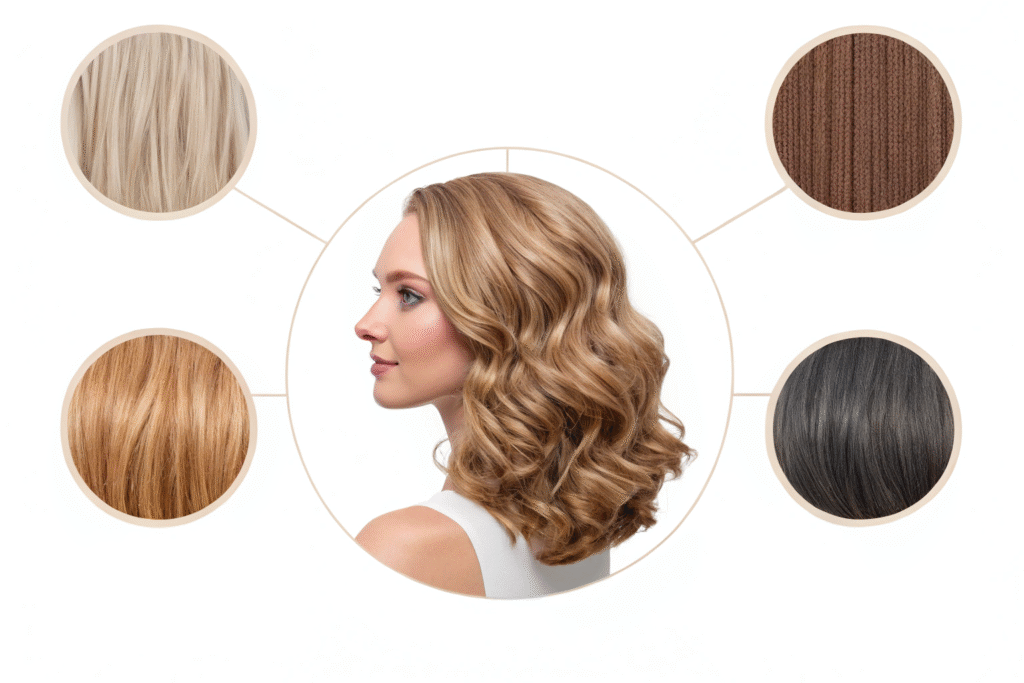
How can I assess lace quality and hairline realism from product photos and videos?
The hairline sells the illusion. A realistic front should be irregular and airy—not a straight, dense wall of hair.
Lace type, color, and knots
- Lace-front construction: I prioritize Swiss or HD lace that’s fine and soft. HD lace can disappear better but is delicate; standard Swiss lace can be slightly more durable.
- Lace tone: Transparent or light-brown lace works for most with tinting; very dark lace on light skin or very light lace on deep skin tones is harder to blend. I look for multiple lace color options or neutral/transparent lace I can tint.
- Knots: Single knots at the front and smaller, staggered knots look more natural than bulky double knots. Bleached knots are rare on synthetics, but lighter/softer knotting can still look convincing.
- Lace size: A 0.5–1 inch lace front is often enough for a believable hairline. Full lace fronts give more styling freedom off the face.
What I check in photos/videos:
- Macro close-ups of the hairline in natural light—no filters or smoothing.
- Visibility of grid pattern: If I can see a harsh mesh grid at the front, it will be harder to melt.
- Lift test: When the model smiles or moves, does the lace lift at the temples? If yes, it’ll need more work or won’t sit flush.
Pre-plucked hairlines and staggered density
- Pre-plucked: I look for graduated hairlines that start sparse at the very front and build density behind. A straight, thick line looks wiggy.
- Baby hairs: Light, sparse baby hairs can help, but too many or identical-length “fringes” scream synthetic. I’d rather trim my own subtle wisps.
- Staggered density at the front: If the listing specifies “staggered front ventilation” or “contoured hairline,” it usually looks more realistic.
What to request from sellers
I message sellers for:
- Unfiltered photos and 10–20 second videos in indirect daylight.
- Side, temple, and nape close-ups.
- A clean hairline shot with hair brushed straight back.
- Part and crown close-ups to check knots and “scalp” effect.
If a seller refuses, I consider that a red flag.
What density, length, and cap construction should I choose to make my wig look natural on me?
I’ve found realism is a balance: the best cap and density mean nothing if the cap doesn’t fit, and the most gorgeous hair looks fake if it’s the wrong proportion for your face.
Density ranges and face balance
- Natural everyday density: 110–130% reads most realistic on camera and in person for straight or softly wavy styles.
- Curly/wavy textures: Can tolerate 130–150% without looking heavy; curls trap air and appear fuller at lower densities.
- Front density: Look for “light” at the hairline, “light-medium” behind it. A tapered front prevents the helmet effect.
- Length realism: Shoulder to collarbone (12–14″) often looks the most believable on first-time wearers. Longer lengths amplify sheen and tangling, which can read synthetic faster.
Face/neck balance tips:
- Petite frames: Heavy density + long length can overwhelm features.
- Round/short necks: Slight layering and a collarbone length elongate the silhouette.
- Fine bio hair: Choose densities that match your natural perimeter if you plan to blend edges.
Cap constructions that read “scalp”
- Lace front: Essential for off-the-face styling and realistic forehead transitions.
- Monofilament part: My go-to minimum for a realistic scalp line. A mono-part (2–2.5 cm wide) lets the scalp show through.
- Monofilament top: Best for flexibility—change part direction without exposing wefts.
- Hand-tied caps or hand-tied tops: Max realism and movement; hair appears to grow from the scalp and moves softly.
- Standard wefted caps: Cool and affordable but less realistic at the part/crown unless combined with a mono section.
Fit, ear tabs, and adjusters
- Cap size: Measure circumference, front-to-nape, and ear-to-ear. A too-small cap rides up and shows edges; too large gapes at temples.
- Ear tabs: I insist on bendable stays to contour the face. They reduce lifting and shadows that reveal the cap.
- Nape adjusters: Velcro or bra-strap adjusters help dial in fit. Silicone napes can grip better if you’re active.
- Comfort lace or felt-lined ear tabs: Prevent friction and help the lace lie flat.
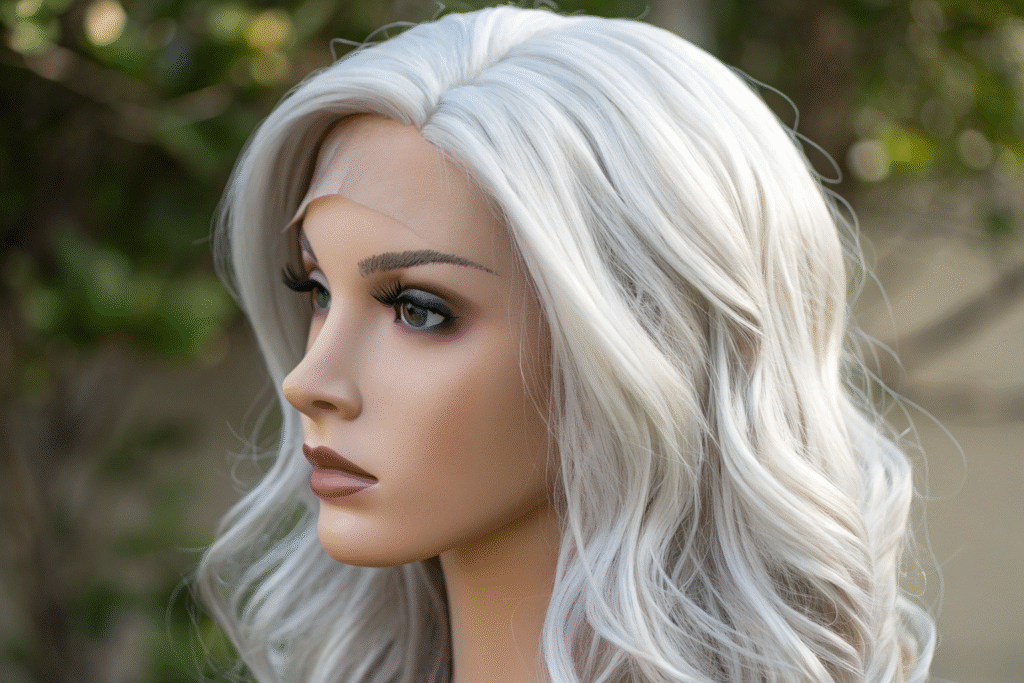
How do I verify color blend, parting, and shine levels online before I place my order?
Color, parting, and shine are the giveaway trio. Here’s how I double-check them remotely.
Rooting, highlights, and undertones
- Rooted shades: Soft 1–2 level darker roots mimic regrowth and reduce the “wig line.” Overly stark or long black roots on a pale blonde can look harsh; I look for soft smudged roots.
- Dimensional blends: Highlights/lowlights and multi-tonal fibers diffuse light and look more like real hair. Flat single-tone colors reflect like plastic.
- Undertones: Compare the swatch to your brows and skin undertone. Ash tones suit cool skin; warm honey/caramel suits warm skin. If you plan to blend sideburns or edges with your bio hair, match the tone, not just the level.
What I ask for:
- Sunlight and indoor (soft white LED) photos.
- A top-down crown shot to see how the blend looks where light hits hardest.
Part realism and mono sections
- Look for “mono-part,” “mono-top,” or “hand-tied top” in the specs. Ask to see a close-up of the part line with the hair gently spread.
- Scalp illusion: The base under the part should look like skin, not mesh. If the base is thick or opaque, it will photograph as a stripe.
- Part width: Real parts aren’t razor-thin or neon-wide; they’re softly irregular. I look for a natural, feathered part edge.
Shine tests in different lighting
- Request a quick video: 5 seconds in window light, 5 seconds under bright indoor lighting. If the wig glows under both, it will remain shiny after powdering.
- Customer photos: Unedited selfies tell the truth. I scan reviews for the same color on different people to see consistency.
Quick comparison tables
Cap and Hairline Options at a Glance
| Construction | Realism Level | Parting Flexibility | Breathability | Price Range | Best For |
|---|---|---|---|---|---|
| Lace Front + Mono Part | High | Low–Medium (fixed area) | Medium | $$ | Everyday realism with set part |
| Lace Front + Mono Top | Very High | High (multi-directional) | Medium | $$$ | Most natural scalp and styling |
| Full Hand-Tied + Lace Front | Highest | High | Medium | $$$$ | Maximum movement and realism |
| Wefted with No Lace | Low | Low | High | $ | Budget, bangs-only styles |
| Wefted + Lace Front | Medium | Low–Medium | High | $$ | Natural hairline with cooler wear |
Fiber and Finish Cheat Sheet
| Fiber Type | Shine | Styling Heat | Movement | Notes |
|---|---|---|---|---|
| Heat-Friendly Synthetic | Low–Medium | 270–320°F (130–160°C) | Soft, natural | Can relax factory shine; needs gentle care |
| Standard Synthetic (Matte) | Low | Not heat-safe (usually) | Good | Great value if finish is matte |
| Standard Synthetic (Glossy) | High | Not heat-safe (usually) | Stiff | Tends to read plastic in daylight |
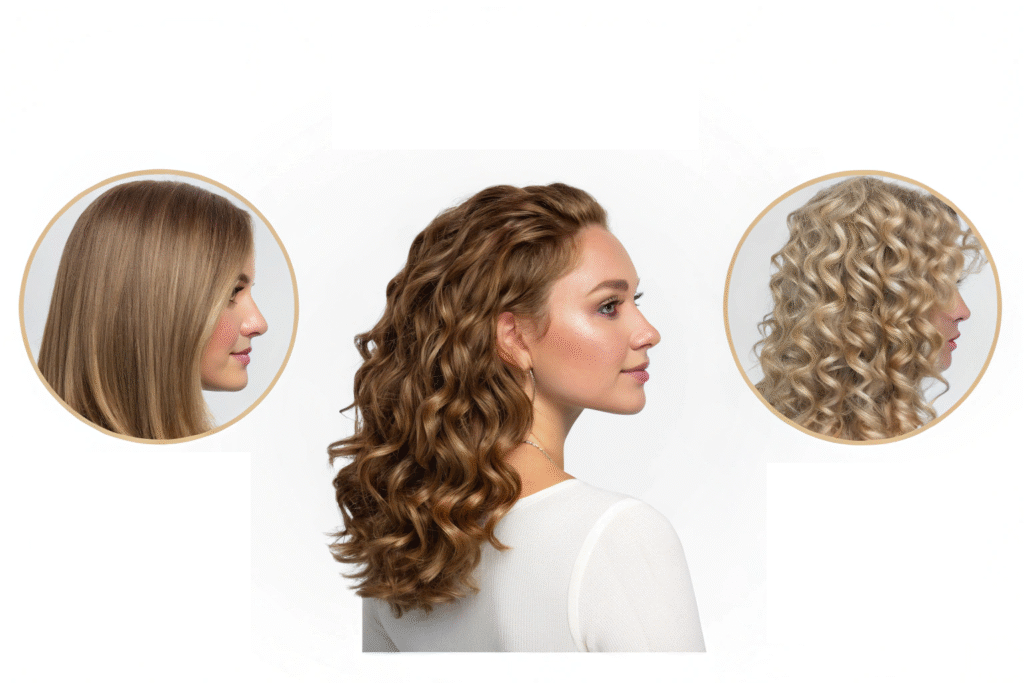
Pre-order checklist (my 60-second audit)
I run through this before purchasing:
- Fiber: Heat-friendly or clearly matte finish; real-life videos show low sheen.
- Hairline: Lace front with pre-plucked, tapered density; small, neat knots.
- Part/Top: Mono part or mono/hand-tied top for scalp realism.
- Density: 110–130% for straight/wavy; tapered front density.
- Length: 12–14″ or layered lengths for first-time realism; avoid ultra-long if unsure.
- Color: Rooted/dimensional; undertone matches brows/skin. Avoid flat single-tone brights.
- Cap fit: My measurements match the size chart; ear tabs have bendable stays; nape adjusters included.
- Proof: Unfiltered photos/videos in natural light; close-ups of hairline, part, crown, and nape.
- Return policy: At least 7–14 days with reasonable restocking terms.
- Plan to customize: Dry shampoo or translucent powder for shine, minor face-framing trim, optional sparse baby hairs.
Minimal post-purchase tweaks for realism
Even the best synthetic benefits from tiny, quick adjustments:
- De-shine: Light mist of dry shampoo or a dusting of translucent powder. Brush through to avoid cast.
- Part perfection: Pluck 2–3 hairs along the part for a soft, irregular line (go slow). Use a skin-toned powder under the part if the base is slightly dark.
- Micro-trim: Snip a few face-framing pieces around temples and cheekbones to break the “fresh-from-the-box” look.
- Subtle baby hairs: Create a few ultra-sparse, uneven wisps—just enough to blur the lace edge.
- Lace tint: Use lace tint spray or diluted foundation to match your skin tone.
- Fit finesse: Bend ear tabs to hug your face; adjust the nape snugly to prevent riding up.
- Friction control: A tiny drop of silicone serum on the nape ends reduces tangling without adding shine.
Conclusion
Based on my experience, the most convincing synthetic wigs aren’t the most expensive—they’re the ones that get the fundamentals right: a lace-front with a softly pre-plucked, staggered hairline; a mono or hand-tied part/top; low-shine, fine denier fibers; realistic, tapered density; and a dimensional color that matches your undertone. Verify all of this with unfiltered daylight photos and quick videos before you buy, and make sure the cap size truly fits your measurements.
If you’re torn between two options, I’d start with the one that offers a mono part/top, rooted dimensional color, and heat-friendly low-luster fibers at a realistic 110–130% density. With a little de-shine and a tiny face-framing trim, you’ll be surprised how natural a synthetic can look. You’ve got this—and your future photos will, too.