
Importing wigs from China can be fast—or painfully slow—depending on your product type, Incoterms, shipping mode, and the season. As someone who manages global sourcing projects weekly, I’ve seen wig timelines range from 10 days to 70+ days. Making the right choices up front is what separates smooth deliveries from stockouts.
Most importers see 10–20 days door-to-door for stock synthetic wigs shipped by air, and 40–70 days end-to-end for custom human-hair wigs shipped by ocean. Production typically adds 7–15 days for stock items and 20–30 days for custom orders, while transit ranges from 3–7 days by air to 18–35 days port-to-port by sea, plus 3–10 days for customs and final mile.
Below, I’ll break down how to shorten your lead time without compromising quality, what timelines to expect for stock vs. custom orders, how Incoterms affect “true” delivery time, and how much buffer to add for peak seasons and port congestion.
1) How do I shorten my wig production lead time without compromising quality?
For wigs, cutting time usually means tightening processes rather than skipping checks. We focus on parallelizing tasks, aligning specs early, and using the right supplier tier for your SKU mix.
The fastest safe wins come from pre-approval of specs, partial production overlaps, smart inspections (AQL-based), and using suppliers with ready fiber/hair inventory and dye lots. Expect 3–7 days saved without increasing risk.
- Lock specs early
- Pre-approve cap construction, lace type (HD/Swiss), density, hair origin/grade, color codes, and packaging before PO issuance.
- Require gold seal samples. This prevents rework cycles that add 5–10 days.
- Use suppliers with ready materials
- Stock synthetic wigs: prioritize factories holding inventory of common fibers, lace, and caps; this can cut 3–5 days.
- Custom human hair: choose partners with pre-sorted remy hair bundles and pre-dyed base colors to reduce processing time.
- Parallelize QA and production
- Approve color swatches, ventilation patterns, and knot-bleaching protocols while base caps are stitched.
- For larger orders, pilot-run the first 5–10% for rapid sign-off, then scale. This avoids end-of-line surprises.
- Right-size inspections
- Use AQL inspections (e.g., AQL 2.5 for major defects) instead of 100% checks for stock styles. It saves 1–2 days.
- For premium human-hair SKUs, combine in-line checks (ventilation, shedding test, tangle test) with a focused pre-shipment inspection.
- Split shipments by priority
- Ship top sellers or pre-sold SKUs via air (first 20–30%) and the balance by ocean. You can start selling 2–3 weeks earlier.
- Pay smarter
- Use instant cross-border payments (TT with pre-advice, Wise, Airwallex). Avoid 2–3 day bank delays. Release production start upon deposit receipt.
- Leverage consolidation intentionally
- If quantities are small, consolidating at a forwarder’s hub can shave cost but may add 2–5 days. Use it when cost > speed is the priority; otherwise skip.
Pro Tip: Pre-book lab dips and color rings for your brand and authorize the factory to proceed within pre-approved tolerances. It can save 2–4 days per order.

2) What timelines should I expect for stock wigs vs. custom wigs from Chinese suppliers?
Timelines diverge sharply based on whether you’re buying stock synthetic wigs or commissioning custom human-hair builds.
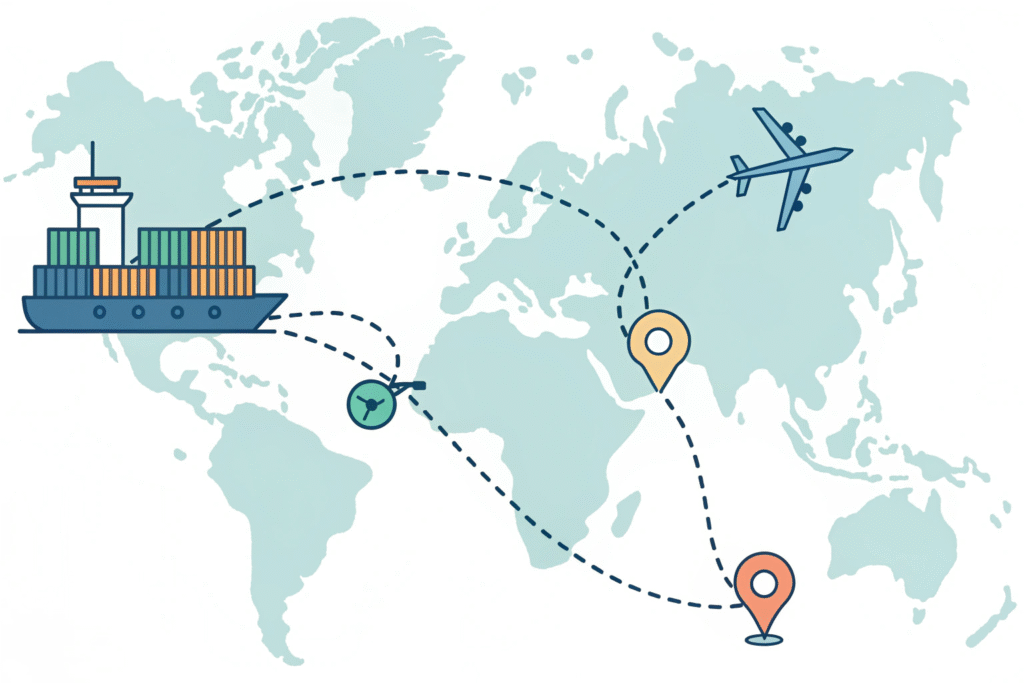
Expect 7–15 days production for stock synthetic wigs and 20–30 days for custom human-hair wigs. Add 3–7 days for factory processing and QA, then 3–7 days for air or 18–35 days for ocean, plus 3–10 days for clearance and final mile.
Typical End-to-End Lead Times
- Stock synthetic wigs (air)
- Production: 7–15 days
- Factory processing + internal QA: 3–7 days
- Air freight (door-to-door): 3–7 days
- Customs + last mile: Included in above for courier/DDP; 2–5 days if standard air cargo
- Total: 10–20 days
- Custom human-hair wigs (ocean)
- Production + QC: 20–30 days
- Internal processing/consolidation: 3–7 days
- Ocean port-to-port: 18–35 days (China to U.S./EU)
- Customs + inland delivery: 3–10 days
- Total: 40–70 days
Regional note:
- Qingdao and Xuchang are major wig hubs; Xuchang is strong for mass synthetic and human-hair blending operations, Qingdao often focuses on premium hand-tied human hair. Lead-time differences are usually 2–5 days based on capacity and material readiness, not location alone.
Quality nuance:
- Human hair requires sorting, wefting, potential dyeing, ventilation, bleaching knots, and multiple QC stages (shedding, tangle, cuticle alignment). These add days versus synthetic.
Example Timeline Table
| Order Type | Production | Factory QA/Processing | Intl Transit | Customs & Final Mile | Total (Typical) |
|---|---|---|---|---|---|
| Stock Synthetic (Air) | 7–15 days | 3–7 days | 3–7 days | 0–5 days | 10–20 days |
| Stock Synthetic (Ocean) | 7–15 days | 3–7 days | 18–35 days | 3–10 days | 31–67 days |
| Custom Human Hair (Air) | 20–30 days | 3–7 days | 3–7 days | 0–5 days | 26–44 days |
| Custom Human Hair (Ocean) | 20–30 days | 3–7 days | 18–35 days | 3–10 days | 44–82 days |
Caution: Adding freight forwarder consolidation saves cost on small batches but adds 2–5 days. Don’t consolidate urgent SKUs.
3) How do my Incoterms (FOB, CFR, DDP) change the total delivery time to my warehouse?
Incoterms shift who controls each leg. That control—especially over booking, customs, and last mile—changes your real-world lead time and variability.
DDP often feels fastest door-to-door because the supplier/forwarder owns customs and delivery, but it can hide delays. FOB gives you speed if you have a proactive forwarder. CFR leaves you responsible for the slowest part—destination clearance and delivery.
Incoterms and Their Impact on Time
- FOB (Free On Board)
- Supplier delivers goods cleared for export onto the vessel/aircraft you book.
- You control carrier selection, cutoffs, priority, and routing—often faster if your forwarder is nimble.
- Time impact: You can minimize dwell at origin by pre-booking space, but you must manage destination clearance and delivery (3–10 days).
- CFR/CIF (Cost and Freight/Cost, Insurance and Freight)
- Supplier books ocean freight to your destination port; you handle destination customs and inland.
- Time impact: Transit is fixed, but handover at destination can create 2–4 day delays if documents or arrival notices lag.
- DAP/DDP (Delivered At Place/Delivered Duty Paid)
- Supplier manages almost everything to your door (DDP includes duties/taxes).
- Time impact: Faster on paper and for your team’s workload; actual lead time depends on supplier’s logistics partner. If they choose economy services or slow clearance channels, add hidden 3–7 days.
Practical Timeline Differences
| Incoterm | You Control | Typical Speed Advantage | Hidden Risks |
|---|---|---|---|
| FOB | Carrier, routing, clearance, last mile | Fast if you pre-book space and use priority services | Requires ops capability; missed cutoffs add days |
| CFR/CIF | Destination clearance + last mile | Moderate; less origin workload | Arrival notice/doc release lags can add 2–4 days |
| DAP/DDP | Very little | Low admin burden; predictable for small shipments | Supplier may pick slower/cheaper services, adding 3–7 days |
Pro Tip: On FOB air shipments, ask your forwarder to move under “consol with priority uplift” or “must ride” where available. It improves uplift probability by 1–2 days during tight capacity.
4) What buffer should I add for peak seasons and port congestion when planning my orders?
Wigs are affected by the same seasonal crunch as fashion and beauty: pre-holiday demand spikes, Chinese New Year shutdowns, and random inspection surges.
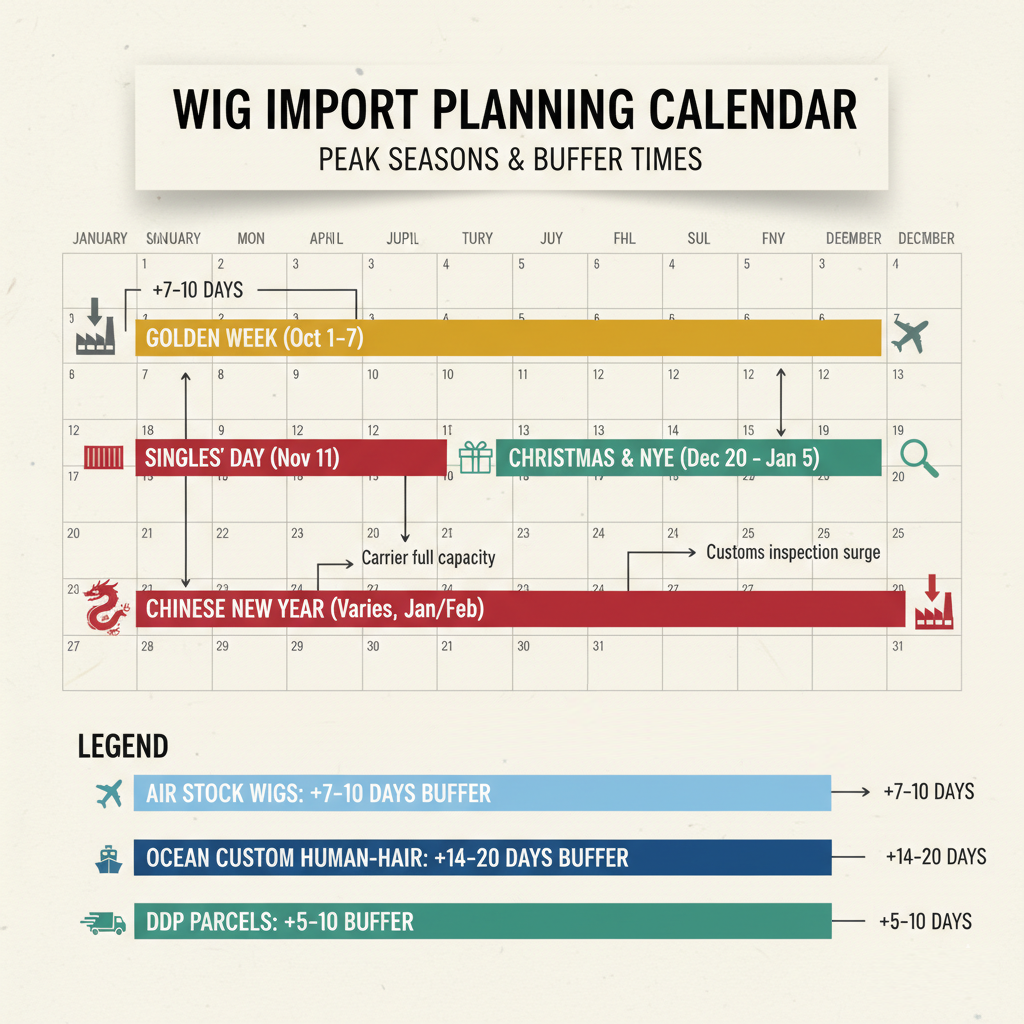
Add 7–20+ days of buffer around Golden Week, Singles’ Day, Christmas, and Chinese New Year. For ocean, budget toward the high end; for air, keep 7–10 days extra.
Known Peak Windows (Plan Ahead)
- Pre–Chinese New Year: 2–4 weeks before CNY; many factories ramp down, carriers are full.
- Post–Chinese New Year: 1–2 weeks for production to normalize.
- Golden Week (early October, China): Export slowdown; rollovers common.
- Q4 (Oct–Dec): E-comm surge around Singles’ Day and Christmas.
Buffer guidelines:
- Stock wigs via air: +7–10 days
- Custom wigs via ocean: +14–20 days
- Any DDP parcel flows: +5–10 days for clearance backlogs
- If your SKUs require stricter import inspections in your market, add +3–7 days
Caution: Documentation accuracy directly impacts clearance time. Incomplete invoices, inconsistent HS codes, or missing fiber/hair composition statements can stall cargo 2–5 days.
Visual Planning Aid
Conclusion: What is the average lead time to import wigs from China?
Most buyers importing wigs from China should plan for 10–20 days door-to-door for stock synthetic wigs shipped by air, and 40–70 days for custom human-hair wigs shipped by ocean. Your exact timeline depends on supplier readiness, inspection scope, shipping mode, Incoterms, and seasonality.
If you need to move faster without sacrificing quality, front-load spec approvals, use AQL-based inspections, split shipments, and keep control of bookings under FOB with a proactive forwarder. Need help building a resilient wig supply plan? Contact us for tailored sourcing advice and a lane-by-lane timeline model for your SKUs.