
Importing wigs from China involves more than picking the right supplier and style—you’re also choosing a payment method that balances cost, protection, and speed. Because wig orders range from small sample buys to high-value bulk shipments, it’s critical to match your payment method to your order size, risk tolerance, and relationship with the supplier.
The most common payment method is T/T (bank wire), typically with 30% deposit and 70% balance before shipment. For first orders, many buyers use Alibaba Trade Assurance or PayPal for added protection on small amounts. For larger shipments (often above USD 40,000), Letters of Credit (L/C) are negotiated. Over time, you can reduce risk and cost by using escrow or milestone payments, and even open-account terms once trust is established.
Below, I’ll break down the most-used options in the wig industry, how deposit/balance terms work around production and shipment, how to lower payment risk as your relationship matures, and what currency and bank fee considerations to plan for.
Should I use T/T, PayPal, L/C, or Trade Assurance for my first wig order?
If you’re placing your first order, choose a method that maximizes buyer protection without overpaying in fees. Each option fits a specific scenario.
For a first-time wig order, use Alibaba Trade Assurance or PayPal for samples and small orders; use T/T with escrow-style milestones for mid-size orders; consider L/C only for large, formal shipments where both banks and supplier can handle document rigor.
Common methods and when to use them
- T/T (bank wire): The industry standard for most wig purchases. Fast, relatively cheap, but low inherent buyer protection if paid directly to the factory’s account. Best for repeat orders or when combined with protective milestones (e.g., balance after QC).
- PayPal: Great for samples or small orders due to platform protection; fees are higher and many factories pass them onto you (3–5%). Some suppliers cap PayPal use (e.g., under USD 600–1,000).
- Alibaba Trade Assurance: Ideal for first-time orders placed via Alibaba. Funds are held in escrow and released per agreed milestones (e.g., after pre-shipment inspection). You can pay by card or bank transfer through Alibaba’s portal.
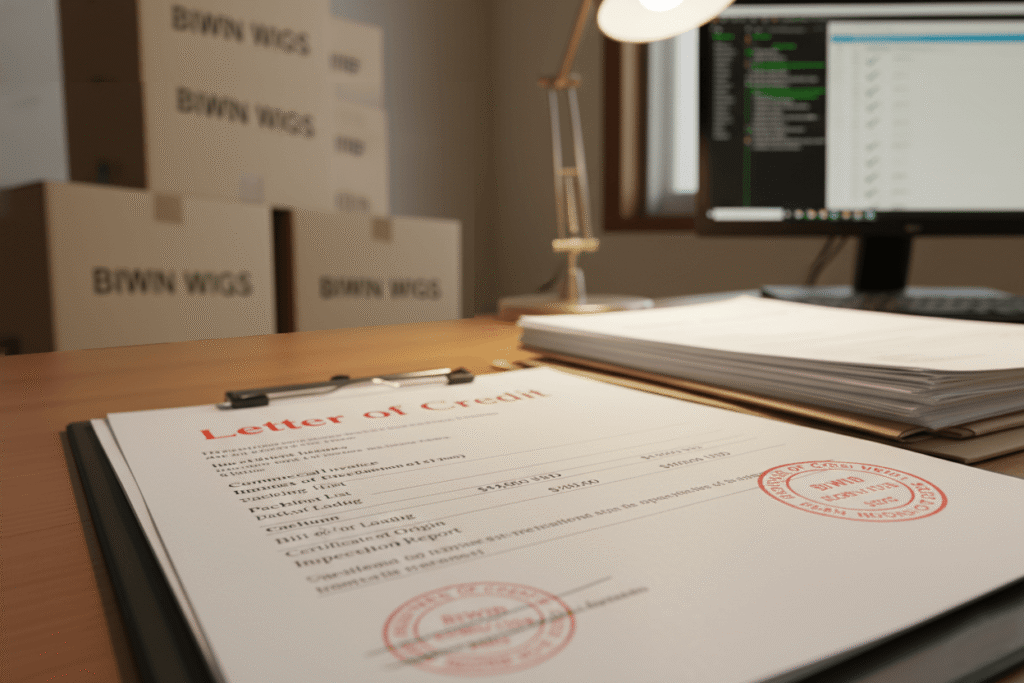
- L/C (Letter of Credit): Appropriate for larger, high-value shipments (commonly USD 40,000+). Bank-guaranteed payment upon compliant documents. Strong protection but higher bank fees and admin complexity.
- Western Union/MoneyGram: Fast but high risk and minimal recourse; typically used only for very small or urgent payments when other rails aren’t possible.
- Credit card (via platforms/gateways): Convenient for small orders; limits and fees apply.
- Open Account (OA): Net terms (e.g., 30/60 days) are rare for new buyers; can be negotiated after consistent orders and credit checks.
Pro Tip: If you’re buying from a supplier you found off-platform but want protection, negotiate to run the first order through Alibaba with Trade Assurance. You’ll pay a small platform fee, but you gain escrow, dispute resolution, and enforceable terms.
Example decision matrix for a first order
- Samples under USD 500: PayPal or Trade Assurance (credit card OK).
- First production order USD 3,000–20,000: Trade Assurance or T/T with a 30/70 structure tied to pre-shipment inspection.
- Large orders USD 40,000+: L/C or T/T with balance against copy of bill of lading and third-party QC.
How do deposit and balance terms (like 30/70) work for wig production and shipment?
Payment terms in the wig industry are structured around manufacturing milestones—especially hair material procurement, coloring, ventilating, styling, and final QC. Understanding how 30/70 or similar terms align to production stages helps you protect cash and quality.
A typical term is 30% deposit to start production and 70% balance before shipment, often released after pre-shipment inspection and receipt of a passed QC report. Always tie deposits and balances to milestones and deliverables.
Typical term structures you’ll see
- 30/70 T/T: 30% deposit to begin; 70% paid after goods are finished and pass QC, before the factory releases the goods or the original bill of lading.
- 50/50 for rush or highly customized SKUs: Higher deposit if the supplier must buy special lace, HD film, or premium Remy hair bundles upfront.
- 20/80 with platform protection: Sometimes possible on Trade Assurance if you hit certain buyer levels or agree to stricter QC milestones.
- Balance against documents: Pay the final balance after receiving a copy of the bill of lading (BL copy), commercial invoice, and packing list—common when sea-freighting full cartons of wigs.
Caution: “Balance before shipment” without third-party pre-shipment inspection is risky. Always get an AQL-based inspection or at least a detailed, time-stamped video inspection covering density, lace quality, knots bleaching, hairline, color tone, and cap construction.
How this applies to wig production
- Materials lock-in: Hair fiber procurement (human hair vs. synthetic) and lace/cap materials require cash. Deposits fund this stage.
- Customization: For colored wigs, balayage, or custom lengths/densities, more labor and scrap risk = higher deposit expectations.
- Lead times: Human hair factories in Xuchang vs. Qingdao can run 10–25 working days depending on SKUs and peak seasons. Align your payment milestones with planned QC and freight booking windows.
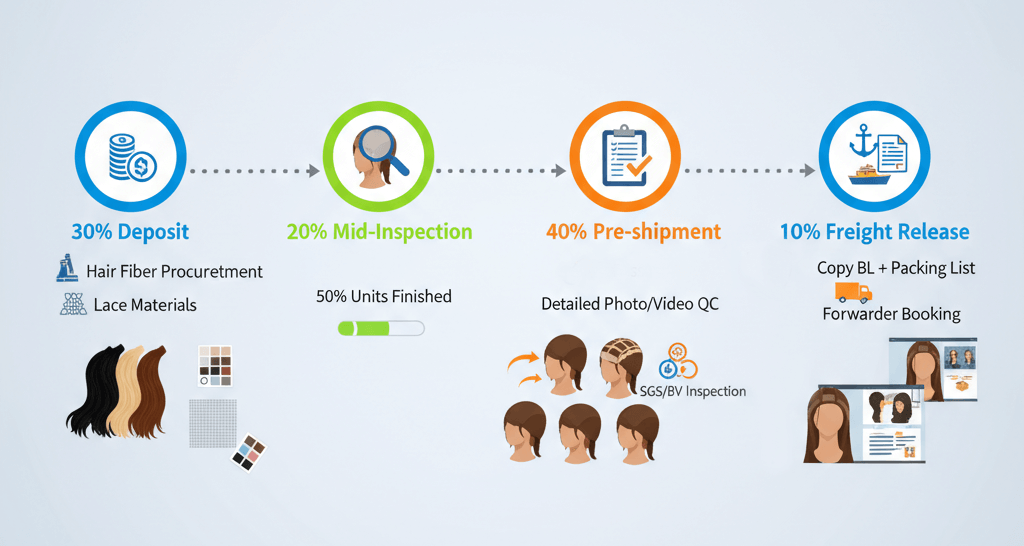
Table: Example milestone-based T/T plan for a USD 12,000 order
| Milestone | Trigger | % Payment | Buyer Protection |
|---|---|---|---|
| Deposit | Sales contract signed; color specs confirmed | 30% | Locks production slot; contract terms enforceable |
| Mid-inspection (optional) | 50% units finished | 20% | Catch issues early; adjust before finishing |
| Pre-shipment | Passed PSI with AQL report + detailed photos | 40% | Pay only after QC confirms specs |
| Freight release | Copy BL + packing list | 10% | Withholds small balance until docs are confirmed |
Pro Tip: If the supplier insists on 30/70 with no inspection, counter with 30/40/30 adding a pre-shipment inspection trigger. Most professional wig factories accept this when they see you’re serious and organized.
How can I reduce payment risk with escrow, milestone payments, or OA after trust is built?
Risk reduction is about structuring payment around performance and using third parties to validate quality and shipment.
Use platform escrow (Trade Assurance) or third-party escrow tied to inspections; negotiate balance against documents; and graduate to partial OA terms only after consistent performance and a basic credit review.
Escrow and platform protections
- Alibaba Trade Assurance: Set milestones—deposit on contract, balance released only after PSI pass and on-time shipment. Specify product specs and defect thresholds in the contract so disputes are enforceable.
- Independent escrow: For off-platform deals or custom orders, you can use law-firm-managed or escrow agency accounts that release funds after SGS/BV/Intertek inspections or lab tests (e.g., colorfastness, tensile strength of lace).
Milestone and document-based payments
- PSI + BL copy: Release the bulk of the balance after receiving a passed inspection report and copy BL showing goods onboard. For air shipments, use airway bill and forwarder confirmation.
- Retention: Keep 5–10% retention for 15–30 days after receipt to cover latent defects in density, shedding, or lace tearing. More common with recurring orders.
Moving toward open-account (OA) terms
- When to ask: After 3–5 successful orders, stable specs, and predictable volumes.
- How suppliers evaluate: They’ll request trade references, credit reports, or use trade credit insurers (e.g., Sinosure). Start with small OA (e.g., 15 days) and expand gradually.
- Hybrid terms: 20% deposit, 60% upon BL copy, 20% net 15 after receipt—often acceptable once trust is built.
Pro Tip: Use third-party QC every order for at least the first 3 shipments—even if you have OA. QC costs (USD 180–300 per day in China) are far cheaper than a rejected batch of lace-front wigs.
What currency and bank fee considerations should I plan for when paying Chinese suppliers?
Hidden costs eat margins: FX spreads, bank wire charges, inbound landing fees in China, and platform commissions. You can optimize them with the right currency and rails.
Plan for 1.0–3.5% total payment frictions across FX, bank fees, and platform charges; consider CNY settlement to cut spreads; and clarify who pays intermediary and inbound fees (SHA/OUR/BEN) before wiring.
Currency choices and FX strategy
- USD vs. CNY: Most wig suppliers quote in USD, but cross-border CNY (RMB) settlement is increasingly common and can reduce FX spreads if you have a multi-currency account (Wise, Airwallex, HSBC, Citi, etc.) and the supplier has a compliant RMB receiving account.
- FX spread: Bank FX spreads can be 1.5–3.0% vs. 0.4–1.0% on fintech platforms. On a USD 20,000 order, a 2% spread is USD 400—equivalent to several QC man-days.
- Quoting policy: Ask for dual quotes (USD and CNY) and pick the cheaper all-in route after modeling fees.
Bank and platform fees to budget
- Outbound wire fee: USD 20–50 per transfer from your bank.
- Intermediary bank fee: USD 10–35 (varies by routing). Specify charge code: OUR (you pay all), SHA (shared), BEN (beneficiary pays). Many suppliers require OUR so they receive the full amount.
- Inbound landing fee in China: Supplier’s bank may deduct CNY 50–150 equivalent; clarify responsibility in the contract.
- PayPal/credit card fees: 3–5% plus currency conversion. Some suppliers add 4% on top of the invoice.
- Alibaba Trade Assurance: Competitive fees baked into the platform rate; typically lower than PayPal for mid-sized orders.
Table: Example fee comparison for a USD 10,000 payment
| Method | FX Spread | Transfer/Platform Fee | Buyer Protection | Est. Total Cost |
|---|---|---|---|---|
| T/T USD via bank (OUR) | 0% (paying USD) | $40–$80 total | Low (contract only) | $40–$80 |
| T/T CNY via fintech | 0.4–0.8% | $0–$15 | Low–Medium (contract) | $40–$95 |
| Alibaba Trade Assurance (card/bank) | 0–1% | 0.8–2.5% typical | High (escrow) | 0.8–2.5% |
| PayPal | 0.5–1.5% | 3–4.5% | Medium–High | 3.5–6% |
Caution: If your supplier insists on BEN or SHA and then claims short payment on arrival, your goods can be delayed. Use OUR and confirm the exact amount they must receive net.
Practical steps to control costs
- Batch payments: Combine multiple POs into one transfer when feasible to amortize wire fees.
- Align currency to costs: If your end-customer pays you in USD but your bank’s USD wires are expensive, a multi-currency account can help you receive USD and pay CNY cheaply.
- Time your FX: If your order schedule is predictable, set rate alerts or use a forward contract for large buys.
Conclusion
For most wig imports from China, I start with Alibaba Trade Assurance or PayPal for small, first-time orders, then move to T/T with a 30/70 structure tied to third-party inspections as volumes grow. For larger shipments (around USD 40,000+), an L/C can make sense if both sides can manage the documentation. To reduce risk, use escrow and milestone payments, consider balance against copy BL, and only graduate to OA terms after consistent performance and basic credit checks. Finally, model currency and bank fees early—CNY settlement and multi-currency accounts can meaningfully improve landed cost.
If you want help structuring secure payment terms and contracts for your next wig import from China, contact us for tailored sourcing advice—we’ll help you balance protection, cash flow, and cost.