
Importing wigs from China can be highly profitable, but only if your suppliers are genuine manufacturers with consistent quality, predictable lead times, and clear commercial discipline. I’ve helped brands scale from pilot orders to multi-container shipments, and the difference between smooth growth and costly failures almost always comes down to supplier vetting.
Vet reliable wig suppliers by verifying legal registration and factory certifications, auditing production (on-site or virtual), stress-testing quality with sealed samples and AQL inspections, validating capacity and lead times with hard data, locking in OEM/ODM protections, and choosing trade terms (typically FOB or DDP) that cap your logistics risk.
Below, I break down how to verify quality for synthetic and human hair wigs, confirm lead-time stability, assess customization capabilities, and pick the trade terms that best protect your margin and timeline.
How can I verify supplier quality consistency for synthetic and human hair wigs?
Consistency is non-negotiable in wigs: 1–2% variation in density, lace tone, curl pattern, or hair origin can trigger returns and bad reviews. Start with paperwork, then stress-test the product.
Request verifiable documentation (ISO 9001, audit reports, REACH/CPSIA), secure sealed pre-production samples, and enforce AQL-based inspections that cover wig-specific defects like lace tears, shedding, and curl inconsistency.
Step 1: Verify legitimacy and QMS
- Match the Chinese business license (company name, Unified Social Credit Code, legal representative) against the National Enterprise Credit Information Publicity System (gongshang). Ask for a color scan with the official red stamp.
- Request ISO 9001 certification and recent third-party audit reports (SGS, Intertek, BV). Check the scope covers hair products/wigs, not unrelated SKUs.
Step 2: Demand material proofs by hair type
- Human hair:
- Request sourcing statements (region, single- or mixed-origin), and “cuticle-intact” declarations for Remy/virgin claims.
- Ask for lab tests: colorfastness, chemical residue, sterilization logs (steam vs. chemical), and documentation of lice/parasite treatment.
- Synthetic hair:
- Fiber type disclosure (Kanekalon, Toyokalon, Futura, heat-resistant blends), heat tolerance specs, melting point, and flame-retardant status if relevant.
- Compliance:
- REACH/CPSIA-related testing for dyes, heavy metals, and formaldehyde in adhesives; ISO 17025-accredited lab reports only.
Step 3: Sealed pre-production samples (the golden standard)
- Ship “sealed” reference samples labeled with:
- Density (e.g., 150%), lace type (HD, Swiss, French), knotting method/bleached knots, cap construction (13×4, 360, full lace), wefting method, length accuracy (+/− tolerance), and color code.
- Required tests: shedding and tangle (comb-through cycles), curl recovery after wash, bleach/dye response, lace tear resistance (measured by pull force), odor/off-gassing check.
Pro Tip: Store one sealed sample at your side and one at the factory. All bulk lots are compared to this master.
Step 4: Implement AQL and defect taxonomy
- Define inspection levels (e.g., AQL 1.5 major, 4.0 minor); use Level II sampling for small orders and Level III for initial large orders.
- Customize defect categories:
- Critical: lace tears, severe shedding, wrong cap size, incorrect hair origin for labeled claims.
- Major: inconsistent curl pattern, visible return hairs, poor bleaching around hairline, color mismatch.
- Minor: loose baby hair density, minor flyaways, packaging scuffs.
- Use third-party inspectors (QIMA, V-Trust, SGS) for pre-shipment inspections; tie payment balance to pass results.
Step 5: Monitor batch variance
- Track density variance, color delta (ΔE), length accuracy, shedding count per 10 comb passes, and RMA rate. Compare over 3–5 batches to flag drift.

Example quality/verification checklist (extract)
- Business legitimacy verified (license + legal rep match)
- ISO 9001 valid and in scope
- REACH/CPSIA labs: ISO 17025 verified
- Human hair: cuticle-intact documentation + sterilization logs
- Synthetic: fiber disclosure + heat tolerance test
- Sealed master sample signed/stamped by both parties
- AQL plan embedded in PO with penalties for nonconformance
What checks help me confirm stable lead times and on-time delivery?
Even great quality fails your brand if deliveries slip. Lead-time reliability depends on raw hair/fiber availability, knotting capacity, QC throughput, and shipping seasonality.
Validate capacity with hard numbers (monthly output, machine lists, workforce), audit production control (order calendar, WIP tracking), and require milestone reporting and OTD KPIs tied to penalties.
Capacity and scheduling proof you should request
- Monthly output by product family (e.g., 8,000 lace fronts, 3,000 full lace).
- Workforce and shifts: total ventilators, wefting operators, QC headcount; training/onboarding rate.
- Machine lists: auto wefting, ventilating aids, sterilization equipment, dyeing kettles, ovens.
- Order calendar screenshot: show your slot placement; capture seasonal constraints (pre–Golden Week, Chinese New Year).
- Raw material buffers: human hair grades and synthetic fiber safety stock in days of cover.
On-site or virtual audit focus
- Walk the raw hair sorting area, fiber dyeing/conditioning line, sterilization, ventilating stations, and final QC.
- Confirm bottlenecks: hand-ventilation for HD lace fronts often constrains lead time.
- Inspect their production control board or ERP—look for WIP tracking and rework logs.
Lead-time norms by region (indicative)
- Xuchang (Henan): high capacity, good for scale; 15–30 days for standard SKUs, +7–15 days in peak season.
- Qingdao (Shandong): skilled handwork; slightly longer for complex lace; 20–35 days.
- Guangzhou/Guangdong: fast sampling, mixed capabilities; 15–28 days.
- Note: Human hair color #613 or custom balayage adds 5–10 days; ventilated HD hairlines add 3–7 days.
Table: Lead-time risk controls
| Control | What you ask for | Why it matters |
|---|---|---|
| Capacity proof | Output/month, workforce, machine list | Detect overpromising |
| Order calendar | Screenshot with your PO slotted | Confirms realistic start |
| Material buffer | Hair/fiber stock days on hand | Shields against input shocks |
| Milestones | Sample sign-off, materials in-house, 30/60/90% WIP, FRI booked | Early warning system |
| OTD KPI | On-time delivery % last 6 months | Predicts future reliability |
| Penalties | Liquidated damages per late day | Aligns incentives |
Caution: If a supplier says “any quantity, any time” without data, capacity is likely outsourced or unstable.
How do I assess customization capabilities for my ODM/OEM wig needs?
Customization is where margin and differentiation live. You need both technical depth and IP protection.
Verify technical breadth via a structured capability matrix, run a design-for-manufacturing (DFM) workshop, pilot complex SKUs, and lock down OEM/ODM contracts with tooling ownership and non-disclosure clauses.
Capability mapping
Build a matrix and confirm evidence:
- Cap constructions: 13×4, 13×6, 360, full lace, U-part, glueless caps.
- Lace options: HD, Swiss, French; lace tone range; pre-plucked hairlines; bleached knots (shallow vs. deep).
- Hair options: virgin/Remy single-drawn, double-drawn; textures (body wave, kinky curly, yaki); density gradients.
- Color work: #1–#613, ombré, balayage; tolerance ΔE targets; bleach/dye performance.
- Special processes: pre-bleached knots without lace burn, PU skin weft, injection molding, ventilated baby hair control.
- Packaging/branding: logo tags, silk bags, barcode/GS1 labels, compliance mark inserts.
DFM and sampling workflow
- Share tech packs: spec drawings, density map by zone, lace tone palette, curl diameter, and post-wash appearance targets.
- Conduct a DFM call: challenge specs that cause rework (e.g., deep-bleached knots on HD lace without reinforcing mesh).
- Pilot run:
- 30–100 units across sizes/colors to expose process variability.
- AQL tightened for pilot (e.g., 1.0 major).
- Compare to sealed master sample; run wear/wash tests (3 cycles).
Contractual protections (OEM/ODM)
- IP clauses: no self-selling or listing of your designs; penalties and take-down obligations.
- Tooling/molds/trims ownership: explicitly yours; returned on demand.
- Confidentiality: NDA with sub-supplier flow-down.
- Change control: no material/process substitutions without written approval and new master sample.
- Serialization: unique lot/serial per unit for traceability.
Pro Tip: Approve two factories for the same SKU with identical masters. Track delivered variance and RMA cost per vendor to decide long-term allocation.
Table: OEM/ODM readiness checklist
| Area | Evidence you want |
|---|---|
| Technical depth | Past work samples, process videos, DFM notes |
| Sampling speed | 5–10 working days for standard caps; 10–15 for HD hairlines |
| Repeatability | Pilot run Cpk ≥ 1.33 on density, color, length |
| Documentation | SOPs, WI for knotting, bleaching, QC gates |
| IP protection | Signed OEM/ODM + NDA + tooling ownership |

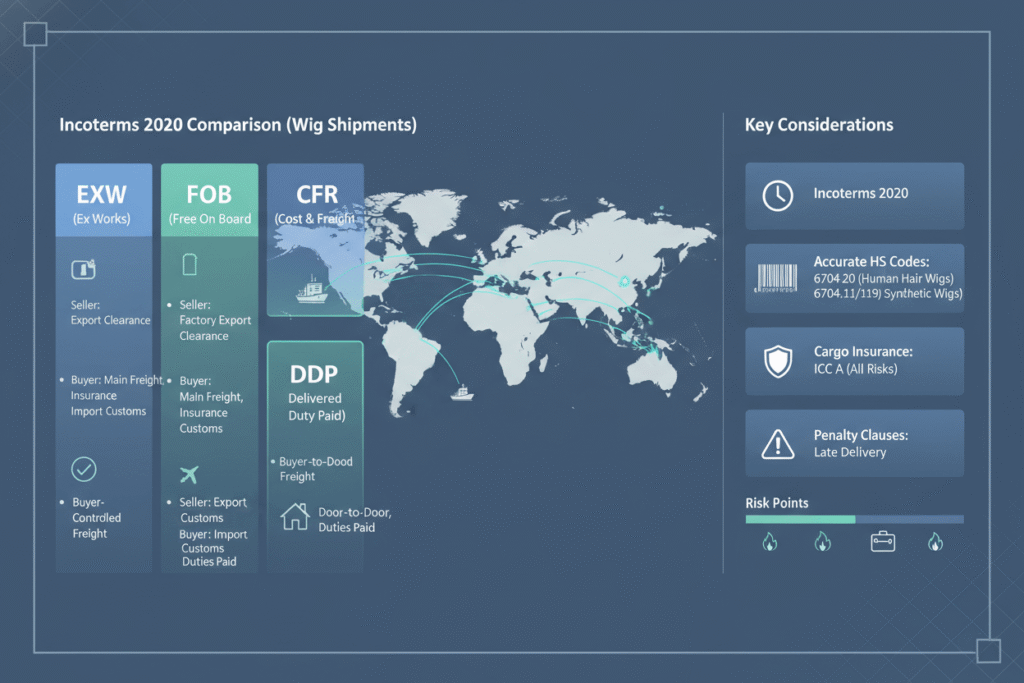
Which trade terms (EXW, FOB, CFR, DDP) should I choose to reduce my risk?
Your Incoterm shifts who controls freight, customs, and risk points. For most first-time or growth-stage wig importers, FOB or DDP offers the best balance.
Choose FOB to control freight and keep factory responsibilities through export clearance, or DDP to externalize end-to-end logistics—avoid EXW unless you have local support, and use CFR only if you can manage destination risks.
How the main terms affect you
- EXW (Ex Works): You pick up at the factory.
- Pros: Maximum control; can be cheapest.
- Cons: You handle everything (export clearance, trucking, export VAT paperwork). High risk for non-local buyers.
- FOB (Free On Board): Supplier clears export and loads on vessel/plane at named port.
- Pros: Supplier handles China-side formalities; you control main freight and insurance. Transparent cost benchmarking.
- Cons: You manage destination customs, duties, and delivery.
- CFR (Cost and Freight): Supplier books main sea freight to your port.
- Pros: Simple ocean cost on supplier.
- Cons: You still handle insurance, destination charges (can be inflated), customs. Limited control over schedules/rollovers.
- DDP (Delivered Duty Paid): Supplier handles door-to-door, including duties/taxes.
- Pros: Simplest; great for small parcels/air express; predictable landed cost.
- Cons: Risk of misdeclared values, hidden surcharges, or non-compliance. Ensure they’re legally able to import in your country.
Practical recommendations for wig imports
- Small/light shipments (samples, small e-comm drops): DDP air express with reputable forwarder and full-value declaration.
- Regular B2B shipments: FOB from Qingdao, Tianjin/Xingang, Ningbo, or Shenzhen. You select the forwarder, add cargo insurance (ICC A), and manage customs with a customs broker.
- Avoid supplier-controlled CFR if you’ve faced surprise “destination charges.”
- Always specify Incoterm version (Incoterms 2020) and named port/airport.
Caution: Under-declaration to “save duties” on DDP can get your shipments seized and your brand flagged. Insist on accurate HS codes (typically 6704.20 for wigs of human hair; 6704.11/6704.19 for synthetic—confirm with your broker) and true values.
Conclusion
Vetting reliable wig suppliers when importing from China is a disciplined process: verify legal and QMS credentials, demand material proofs, lock in sealed master samples, enforce AQL inspections, audit real capacity to protect lead times, and stress-test customization via DFM and pilot runs. Use OEM/ODM agreements to guard your IP, and choose FOB or DDP to balance cost and risk. Diversify across 2–3 qualified factories and track batch variance and RMA costs to keep suppliers honest.
If you’d like a tailored supplier scorecard, factory audit checklist, or help setting AQL plans for wigs and hair extensions, contact us—we can fast-track your sourcing with fewer surprises and better margins.