
If you’re sourcing wigs from China, distinguishing a true manufacturer from a trading company isn’t just a formality—it affects your unit costs, customization options, lead times, quality consistency, and after‑sales control. I’ve vetted dozens of wig suppliers across Xuchang, Qingdao, and Yiwu; the differences show up in documents, process depth, capacity data, and how they quote and schedule production.
Verify the business license and business scope, match legal entity details across audits/export records, conduct an unscripted live factory tour, and stress‑test technical know‑how and process flexibility. Factories show production assets (ventilating stations, dyeing/perm rooms, QC lines), capacity/output logic, batch‑based lead times, and stable, tiered pricing tied to material and labor. Traders show broad catalogs, low MOQs, faster but inconsistent lead times, and volatile pricing.
Below, I break down exactly what to request, how to run an effective verification, and how to read pricing, MOQs, and catalogs to spot trading behavior quickly.

What factory proofs (business license, production photos, ISO) should I request?
Before you dive into video tours and pricing, get the paperwork and proof of operations aligned. This is the foundation for confirming you’re dealing with a real manufacturer.
Ask for the Chinese business license with unified social credit code, verify business scope for manufacturing terms, and cross‑check the same legal name on certifications, audits, and export records. Require dated production photos/videos and capacity data that make operational sense.
Core documents to request and why they matter
- Business License (营业执照) + Unified Social Credit Code (统一社会信用代码)
- What to check: Registered name in Chinese, legal address (should be industrial zone, not an office tower), and Business Scope (经营范围). Look for “manufacturing/production/processing” (制造/生产/加工). “Wholesale/retail/trading” without manufacturing is a red flag.
- Corporate registry screenshots
- Use China’s National Enterprise Credit Information Publicity System to confirm status, address, shareholders, and scope match what you were sent.
- Consistency across certificates and audits
- ISO 9001, BSCI/SEDEX, or customer audit reports should list the same legal entity and facility address. Mismatched names = they’re showing a partner’s audit.
- Export evidence
- Ask for masked customs/export records (last 6–12 months) or shipping docs showing the same entity as exporter or manufacturer.
- Tax/VAT capability (as relevant to your trade structure)
- Confirm they can issue standard VAT fapiaos in the same legal name. While not definitive for exports, it’s a consistency check.
Visual and operational proof
- Dated production photos/videos (with time stamps or metadata if possible)
- Areas to see: Raw fiber/hair storage, sorting/combing, ventilating/hand‑tying lines, dyeing/perm rooms with pots/steamers/ovens, bleaching/knot‑bleaching stations, QC lines, packaging area with in‑process orders.
- Equipment list and capacity
- Examples: Number of ventilating frames, dyeing pots, steamers, ovens, injection machines for synthetic bases. Request daily/monthly output by product type (e.g., “Lace front 13×4: 280 pcs/day across 22 frames”) and check if it aligns with labor headcount and shift patterns.
Pro Tip: Cross‑validate capacity by asking for the last three months’ production logs or planning boards (blurred customer names acceptable). Capacity plotted by work center is hard for traders to fake convincingly.
Can I use third-party audits or video calls to verify in-house production?
Yes—and you should. Audits and live tours quickly reveal whether you’re speaking with a factory team or a coordination layer.
Run an unannounced live video tour and follow a fixed route from raw hair intake to final packing. Back it up with a third‑party factory audit that includes worker interviews and process traceability.
How to structure a decisive live video tour
- Short‑notice request
- Ask for a tour within 24–48 hours during working hours to reduce staging.
- Route to follow
1) Receiving/raw hair intake and storage
2) Sorting/combing and wefting/ventilating setup
3) Dyeing/perm rooms (look for active dye baths, steamers, ovens)
4) Knotting/ventilating lines (verify workers, tools, density templates)
5) Bleach bath/knot‑bleaching stations and drying racks
6) QC checkpoints (density checks, cap construction checks, lace inspections)
7) Final packing with visible WIP and production boards - What to ask live
- Show today’s production board with order codes and quantities.
- Pan across equipment serial plates; count frames/pots to match capacity claims.
- Ask supervisors about today’s defects/rework and corrective actions.
Caution: Tours that only show offices, samples, or a small “demo” line in an office park are common trader tactics. Factories should show scale, flow, and people at work.
Third‑party verification that goes beyond social audits
- Commission a factory audit (e.g., local QA firms in Xuchang/Qingdao)
- Scope: Floorplan mapping, equipment list, headcount by department/shift, order traceability from intake to packaging, worker interviews, chemical handling/safety in dyeing areas, and photo evidence.
- Inline and pre‑shipment inspections
- For wigs, an inline inspection during ventilating or post‑bleach is more predictive than only a final AQL check.

How do I read product catalogs and MOQs to spot trading behavior?
Catalogs, customization depth, and MOQs reveal how close a supplier is to the process. Factories are constrained by their own tooling and labor mix; traders aren’t—and that difference shows.
Factories show deep process customization (caps, lace, densities) with batch‑based MOQs; traders show broad, eclectic catalogs, tiny MOQs, and limited process changes.
Signals in catalogs and customization
- Depth vs. breadth
- Factory: Narrower range, detailed tech sheets (cap constructions, lace types, ventilation densities per cm², hair ratios, bleaching parameters).
- Trader: Very broad range, including unrelated beauty SKUs; spec sheets are marketing‑heavy and light on process data.
- Process‑level customization
- Ask: Can you adjust cap net weight, lace grade (HD/Swiss/French), front hairline ventilation density gradient, bleach bath time/temperature limits, or hair ratio (e.g., 50% 18”, 30% 16”, 20% 14”)?
- Factory answers cite constraints (e.g., “Max bleach 12–15 mins at X°C for this hair grade or knots slip”); traders give generic yes/no.
MOQs and batch logic
- Factory MOQs
- Higher per style/color/density because of dyeing minimums, batch set‑ups, and line scheduling. Expect 50–200 pcs per spec for steady pricing.
- Trader MOQs
- Will accept very low MOQs (1–20 pcs per spec) by pooling from multiple sources, but pricing is higher and consistency varies.
Table: Catalog and MOQ signals that suggest factory vs. trader
| Indicator | Factory Pattern | Trader Pattern |
|---|---|---|
| Catalog scope | Focused, process‑rich | Broad, mixed categories |
| Customization | Deep, technical constraints explained | Limited, generic responses |
| MOQ per spec | Medium–high, batch-based | Very low, pooled inventory |
| Spec sheets | Include densities/cm², hair ratios, process windows | Marketing specs, few process details |
Pro Tip: Request a bill of materials and operation list for one SKU (e.g., 13×4 lace front, 150% density, body wave). Factories can outline labor steps and takt time; traders usually can’t.
What signs in pricing and lead times indicate a manufacturer vs. trader?
Pricing models and lead times are where factories can’t easily “act” like traders and vice versa. Follow the money and the calendar.
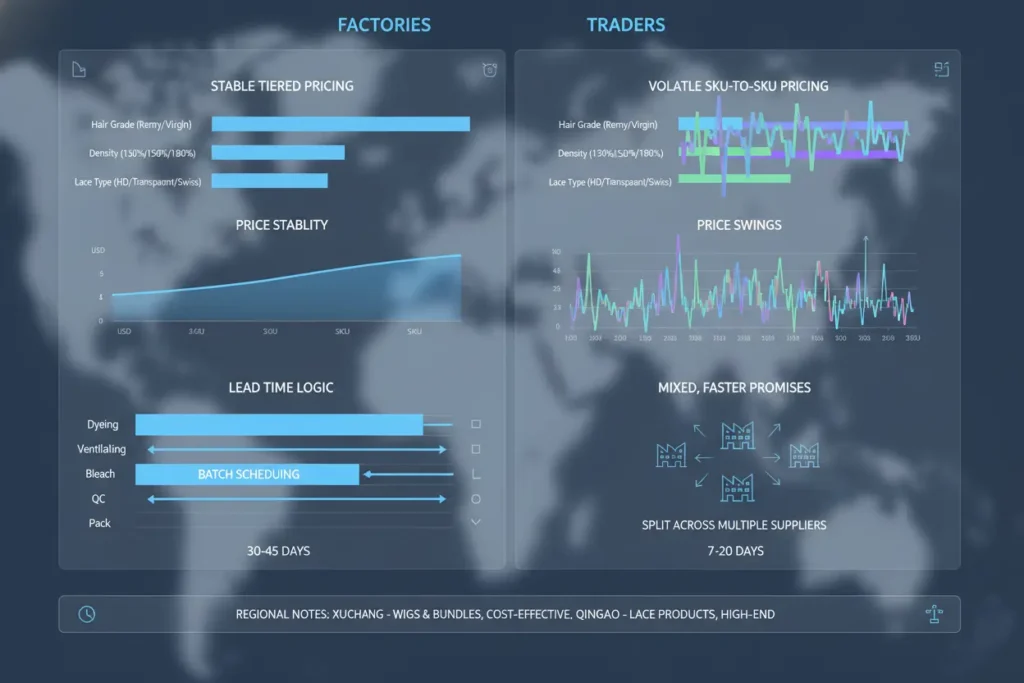
Factories quote stable, tiered pricing tied to material grade and labor hours with batch-based lead times. Traders quote volatile prices, promise faster shipping from mixed sources, and show uneven lead times across similar SKUs.
How pricing behaves
- Factory pricing
- Transparent tiers by hair grade (e.g., remy vs. virgin vs. single‑donor), lace type (HD vs. Swiss), density, and length mix.
- Small‑quantity surcharges explained by set‑up losses and dyeing minimums.
- Price revisions track input costs (hair grade availability, chemical costs, wages), not week‑to‑week swings.
- Trader pricing
- Inconsistent across similar SKUs; identical specs may vary unexpectedly.
- Sudden promotions or “today only” pricing, or price hikes after deposit if their upstream costs changed.
Lead times you should expect
- Regional nuance
- Xuchang (Henan): Largest ecosystem; human‑hair ventilated products often 15–35 days for standard SKUs, longer for complex customs.
- Qingdao (Shandong): Strong in human hair and European/US‑focused lines; slightly longer for niche lace and high‑end grades.
- Synthetic bases/injection: If in‑house injection molding exists, expect mold/setup implications; otherwise, they outsource that step.
- Factory lead times
- Batch‑based, longer for custom specs; clear critical path (dyeing → ventilating → bleach → QC → pack). Delays are explainable by work‑center bottlenecks.
- Trader lead times
- Faster promises for small quantities by splitting among multiple suppliers; replenishment times vary widely order to order.
Table: Pricing and lead-time patterns
| Factor | Factory | Trader |
|---|---|---|
| Price stability | Stable tiers by grade/length/density | Volatile, SKU-to-SKU inconsistencies |
| Small order cost | Surcharges tied to setup/batch | Often higher unit price but no setup logic |
| Lead time logic | Batch schedule, work-center constraints | Fast for small orders, variable for repeats |
| Response to change | Explains impact by process step | Blames “supplier” or offers substitute SKUs |
Caution: A supplier who is “factory” but quotes three different prices for the same spec across three days is almost certainly brokering.
Conclusion
To tell if your Chinese wig supplier is a real factory or a trading company, align the legal entity, facility address, and business scope across the business license, audits, and export records; then pressure‑test production reality with a short‑notice live tour and third‑party audit. Read catalogs and MOQs for process depth, and scrutinize pricing/lead‑time logic for batch‑based consistency. When you import from China at scale, this diligence pays back in lower costs, fewer surprises, and better quality control.
If you’d like help running a vendor verification or planning audits in Xuchang or Qingdao, contact us for tailored sourcing advice—we can set up tours, inspections, and side‑by‑side cost modeling within a week.