
As a supplier who has spent years auditing factories, building private-label collections, and troubleshooting post-shipment issues for distributors across North America, Europe, and Africa, I know human hair wigs are the backbone of many profitable wig businesses. For wholesalers, salon chains, e-commerce marketplaces, and medical wig providers, getting human hair right means fewer returns, higher AOV, stronger LTV, and predictable margins. This guide distills what I’ve learned from thousands of units, dozens of suppliers, and daily conversations with B2B buyers about quality, sourcing, and operational control.
Human hair wigs deliver premium margins but demand tight verification (burn/melt, cuticle-alignment, FTIR lab tests), clear grading (Remy vs. non-Remy; double-drawn options), origin alignment (Indian for volume, Brazilian for body, European for softness), lace selection by customer segment (HD for influencers/photos, Swiss for daily wear), and disciplined QC tied to realistic lead times (7–30 days depending on customization). For consistency, lock specs (density curve, lace type, knotting standard, color tolerance ΔE), mandate pre-shipment AQL inspections, and forecast inventory with a rolling 8–12-week procurement plan.
In the sections below, I’ll walk you through how to verify 100% human hair, choose the right grades and origins for your market, align lace types and densities with customer expectations, and build lead times and QC steps that keep orders on schedule. I’ll also share practical sourcing playbooks for OEM/ODM/private label, packaging and labeling tips to cut returns, storage guidance for large inventories, and data-backed pricing structures to protect your margins.
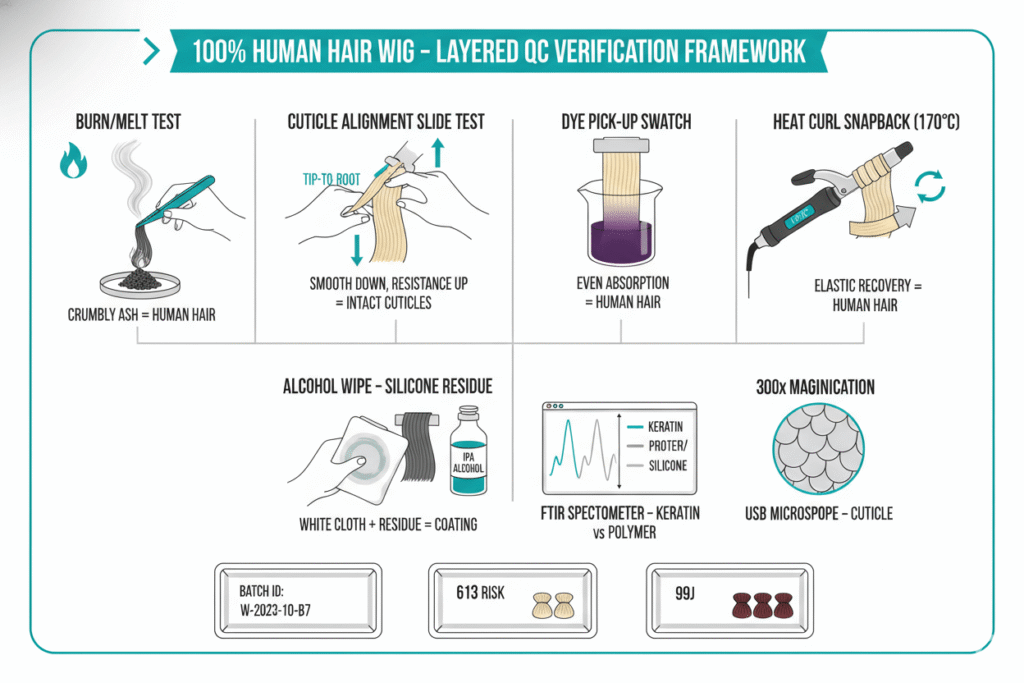
How do I verify if my human hair wigs are truly 100% human hair and not mixed fibers?
Mixed-fiber risks rise in fast-scaling categories and during peak seasons (Black Friday, Ramadan/Eid, Chinese New Year). I use a layered verification framework that blends quick floor tests, destructive sampling, and third-party lab confirmations.
Fast in-house screening (receiving dock or factory line)
- Burn/melt test:
- Human hair: burns with the smell of burnt keratin (like feathers), turns to irregular ash that crumbles when pressed.
- Synthetic (e.g., high-temp fibers): melts, forms hard beads, often with chemical/plastic odor.
- Important: Some heat-resistant synthetics can mimic burn behavior; treat this as a flag, not final proof.
- Cuticle alignment slide:
- Pinch a few strands between fingers and slide from tip to root and root to tip.
- Remy hair (aligned cuticles): smooth in tip-to-root, slightly rougher root-to-tip.
- Mixed/non-Remy: uneven friction both ways; often acid-peeled to mask tangling; silicone can create deceptive smoothness.
- Water and alcohol wipe:
- Wipe a small section with 70% isopropyl alcohol. Excess silicone coatings may dull slightly or produce residue. Authentic Remy often retains a consistent, non-greasy feel post-wipe.
- Dye pick-up swatch:
- Apply a small amount of demi-permanent dye to a cut bundle. Human hair absorbs pigment; synthetics usually resist or take color unevenly.
- Heat curl snapback:
- Curl at 160–180°C (320–356°F). Human hair reshapes predictably and can be restyled. Many synthetics drop or hold unnaturally.
Destructive sampling and advanced checks
- FTIR (Fourier-transform infrared spectroscopy):
- Confirms polymer presence (nylon, PET) versus keratin signatures. Request supplier to provide FTIR reports per batch, or send composite samples to a local lab. This is definitive for mixed fiber detection.
- Nitrogen content (Kjeldahl or Dumas) and ash analysis:
- Hair has distinct nitrogen profiles. Unusual ash composition can indicate synthetic or metallic residues from processing.
- Microscopy:
- Human hair shows overlapping cuticle scales; some synthetics show uniform, glassy surfaces. A 200–400x USB microscope is enough for on-site screening.
- Tangle-life stress test:
- Wash-test units (3 cycles), line dry, brush-out, and comb-through timed test. Non-Remy with peeled cuticles shows accelerated matting at nape after friction.
Documentation you should require from suppliers
- Batch ID linked to donor-source category (Indian temple, Southeast Asian, European, South American).
- Chemical processing records (bleaching level, toning, silicone application).
- Heavy metal and azo dye compliance (REACH, CA Prop 65 where applicable).
- FTIR or third-party verification for “100% human hair” claims, especially for light colors (613/60) where mixing risk is higher.
Practical acceptance sampling (AQL) for inbound QC
- Use ANSI/ASQ Z1.4 (or ISO 2859-1). For example:
- General inspection level II
- AQL 1.5 for critical (synthetic blend, wrong lace type)
- AQL 2.5 for major (density deviation >10%, color ΔE>2.0)
- AQL 4.0 for minor (packaging mislabel, missing care card)
- Always pull samples across lengths and colors; 613 and 99J are common failure points.
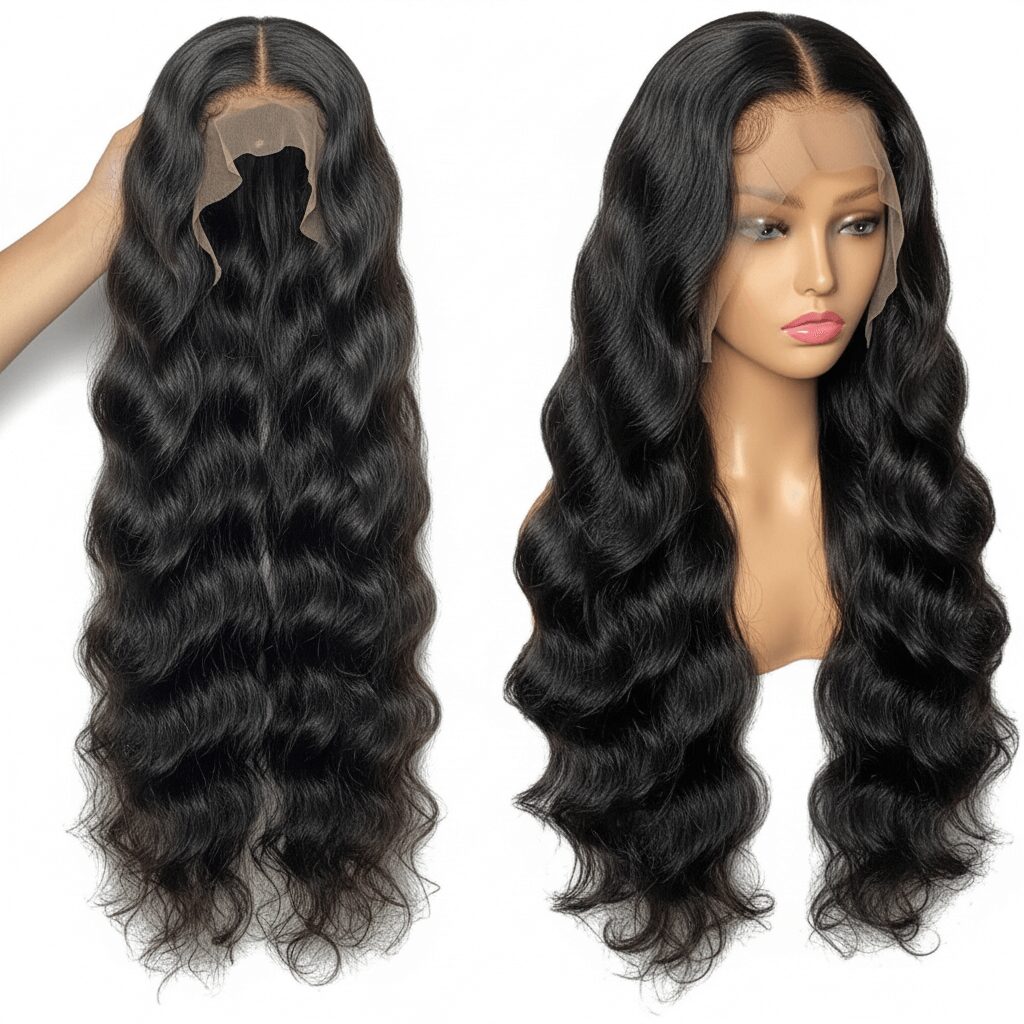
What hair grades and origins (Brazilian, Peruvian, Indian) should I choose for my market and why?
Grades and origins are often marketing-heavy. I’ll translate them into performance attributes that matter for your customer segments and price tiers.
Understanding hair grades (beyond “5A–15A”)
- Non-Remy:
- Mixed cuticle directions, often acid-peeled and silicone-coated.
- Lower cost; higher tangle risk post-wash; suitable for budget lines with clear expectations.
- Remy (single-drawn vs. double-drawn):
- Remy single-drawn: natural taper; more short hairs; lighter ends; cost-effective with a natural look.
- Remy double-drawn: ends bulked to consistent thickness; fuller look; higher cost; preferred for 18–24″+ lengths and premium lines.
- Virgin Remy:
- Minimal/no chemical processing; cuticles intact; best for custom color work and medical clients demanding longevity.
Origins decoded for B2B merchandising
- Indian:
- Texture: Medium to coarse; natural wave; good volume.
- Strength: Durable, holds curls well, cost-effective.
- Best for: Everyday wearers, African and Middle Eastern markets seeking body and resilience; salon install bundles.
- Brazilian (industry term; often South American or processed Asian hair):
- Texture: Full body, slightly coarse, great for “glam” density and body waves.
- Best for: Social/celebrity-inspired looks; US/UK influencer-driven sales.
- Peruvian:
- Texture: Lightweight with volume; soft handfeel; blends with a variety of hair types.
- Best for: Consumers wanting volume without weight; long-wear comfort.
- European (including Eastern European/Russian “Slavic” categories):
- Texture: Fine to medium; very soft; premium price; limited supply.
- Best for: Medical wig boutiques, lighter density, natural finishes, high-end private label.
- Southeast Asian/Cambodian:
- Texture: Coarser cuticle, strong shaft; excellent for textured lines and durability.
- Best for: Textured collections (wavy/curly), markets valuing strength over silkiness.
Note: “Origin” on labels can mask blending. Lock your spec to fiber attributes (diameter μm range, cuticle intact %, color lift ability levels) rather than marketing names only.
Market-to-origin mapping
- US/UK e-commerce (influencer-led):
- Bestsellers: Body wave, deep wave, 150–180% density, 13×6 HD lace front, 18–24 inches.
- Fiber: Remy double-drawn “Brazilian” profile; HD for content; Swiss for repeat daily wear.
- African markets (Nigeria, Ghana, South Africa):
- Bestsellers: 150–200% density, curled/textured styles, durability is key.
- Fiber: Indian or Cambodian for resilience; Swiss/transparent lace to balance cost with performance.
- EU medical/clinic channels:
- Bestsellers: 120–130% density, monofilament/silk top, hand-tied backs, natural browns/blondes.
- Fiber: European/Slavic or Virgin Remy; Swiss lace for comfort; priority on low knot visibility.
- Middle East:
- Bestsellers: 180–200% density, long lengths 22–30″, natural black/dark brown.
- Fiber: Indian/Peruvian for volume; Swiss lace or HD for special events; robust caps for heat/humidity.
Quick selection matrix
| Segment/Channel | Recommended Origin Profile | Grade | Density | Lace/Cap | Rationale |
|---|---|---|---|---|---|
| Influencer/E-comm Glam | “Brazilian”/Peruvian | Remy double-drawn | 150–180% | 13×6 HD lace front | Photo/video realism with fullness |
| Salon Install Bundles | Indian/Cambodian | Remy single/double | N/A (bundles) | Closure/Frontal Swiss | Strength, curl holding, cost balance |
| Medical Wig Boutique | European/Virgin Remy | Virgin/Remy hand-tied | 120–130% | Mono/silk top + Swiss | Comfort, light density, scalp realism |
| Value Retail | Mixed Asian | Non-Remy/Remy single | 130–150% | Transparent/Swiss, wefted back | Entry price points with acceptable durability |
How can I assess lace types (HD, Swiss, transparent) and densities to match my customers’ expectations?
Lace selection should be evidence-based—guided by content usage (photos/video), daily wear comfort, and return reasons (visible grid, itchiness, tearing).
Lace types: what to choose and when
- HD Lace:
- Ultra-sheer; best for on-camera scalp illusion and close-up content.
- Pros: Virtually invisible with proper tinting; superior hairline realism.
- Cons: Delicate; higher tear rate; more expensive; shorter lifespan for daily wearers.
- Use case: Influencer kits, special events, photoshoots, premium frontals.
- Swiss Lace:
- Balanced sheerness and durability; industry staple.
- Pros: Comfortable, breathable, workable for daily wear; better longevity.
- Cons: Slightly more visible than HD in macro shots.
- Use case: General consumer base, salon installs, medical wigs needing comfort.
- Transparent Lace:
- A finishing/color descriptor more than a fabric type; often a lighter-toned Swiss-like lace.
- Pros: Cost-effective illusion for light-to-medium skin tones; widely available.
- Cons: May require tint for deeper tones; grid may be more visible than HD.
- Use case: Value lines, large-scale retail SKUs.
- French Lace (less common in wigs now):
- Stronger than Swiss, thicker; grid visibility higher.
- Use case: Niche durability needs.
- Monofilament/Silk top:
- Mono: Single-layer mesh for natural parting and scalp look.
- Silk top: Two-layer system that hides knots entirely.
- Use case: Medical wearers, executive/professional daily users prioritizing scalp realism on top.
Practical lace assessment checklist
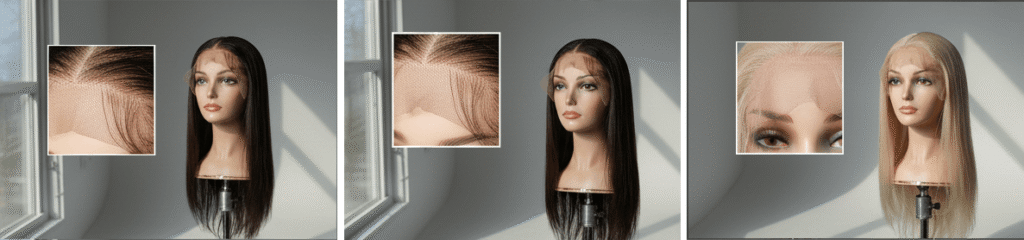
- Sheerness index:
- Place lace on multi-tone mannequin (light/medium/deep) and photograph under daylight and ring light.
- Rate visibility 1–5. HD often ranks 5 under harsh light; Swiss 3–4.
- Knotting standard:
- Single knots at hairline (pre-plucked), double elsewhere for durability.
- Verify knot count per square cm, consistency of bleach, and hairline graduation curve (avoid “straight line” hairlines).
- Tearing and fray test:
- Apply 5N pull at three points along the hairline; count thread breaks.
- HD typically fails faster—plan warranty accordingly.
- Tinting behavior:
- Test with lace tint spray and water-based foundation to ensure even absorption; reject lace that stains blotchy.
Densities that photograph well and survive daily wear
- 120–130%: Natural everyday density; ideal for medical/professional users.
- 150%: “Salon finish” fullness; the sweet spot for most retail buyers 16–22″.
- 180%: Glam density for long lengths or deep waves; higher weight and maintenance.
- 200%+: Niche; stage/celebrity looks; returns higher if buyer education is weak.
Pro tip: Scale density with length. A 130% 14” bob can look full; a 130% 26” may look thin at ends unless double-drawn.
Photo/video realism vs. durability matrix
| Priority | Lace Type | Knotting | Density | Typical Buyer |
|---|---|---|---|---|
| Maximum realism | HD | Single front | 150–180% | Influencer/bridal |
| Daily longevity | Swiss | Single+Double | 130–150% | Office/medical wearers |
| Budget realism | Transparent/Swiss | Pre-plucked + light bleach | 130–150% | Value shoppers |
How do I set realistic lead times and QC steps to keep my human hair orders consistent and on schedule?
Operational control is where margins are made or lost. I encourage buyers to treat human hair like semi-custom manufacturing, not off-the-shelf retail.
Typical lead times (working days) by complexity
- Stock wigs (standard colors, popular lengths, Swiss lace): 3–7 days picking + 3–5 days export.
- Semi-custom (density change, cap size variation, pre-plucked spec): 7–15 days production.
- Custom color (613 base tone-on-tone, balayage/ombre): 10–20 days extra depending on bleaching stage and toning.
- Full hand-tied or silk top: +7–12 days vs. wefted backs.
- Peak seasons add 5–10 working days (plan buffers).
Master Critical Path Method (CPM) for wig orders
PO confirmation & tech pack freeze (Day 0–2)
- Lock specs: origin profile, Remy level, color codes, length tolerance, density curve, lace type, knotting standard, pre-pluck gradient, bleach level, cap size.
- Approve trims: tags, boxes, hair nets, care cards, barcodes.
Raw hair allocation (Day 1–4)
- Supplier allocates bundles by length and texture; you receive a raw hair allocation report.
Processing & ventilating (Day 3–14+)
- Bleach/toning, wefting, cap assembly, lace ventilating, pre-plucking, knot bleaching.
Internal QA + midline inspection (Day 7–16)
- Density spot checks, lace tear checks, color spectrophotometer ΔE readings.
Third-party inspection (Day 10–18)
- AQL sampling; function tests; photo/video proof packs.
Rework (if needed) (Day 12–20)
- Knot re-bleach, re-pluck, replace shedding units, re-tone outliers.
Packing & dispatch (Day 14–22+)
- Moisture control packs, SKU barcoding, tamper seals, final weight checks.
QC specification you can copy into your PO
- Fiber authenticity:
- Supplier provides FTIR report per batch; buyer reserves right to lab test random samples.
- Density tolerance:
- ±8% overall; ends fullness not less than 85% of nearest mid-length for double-drawn SKUs.
- Length tolerance:
- -0/+0.5 inch at stated length when stretched; curly measured stretched.
- Color tolerance:
- ΔE ≤ 2.0 vs. master swatch under D65 light; shade run within 1 step variance.
- Lace:
- Fabric type per PO; hairline single knots first 0.5–1.0 cm; no visible grid at 30 cm under daylight.
- Knots:
- Bleach to medium on natural black; light bleach on lighter shades; no over-bleach hotspots.
- Shedding:
- Brush test: ≤10 strands per 20 strokes on a new unit after first wash.
- Odor/chemicals:
- No strong chemical odor; REACH-compliant dyes; nickel-free clips.
- Packaging:
- Each unit packed with net, silica gel, care card, barcode label with origin/grade/length/density.
AQL inspection plan (example)
- Inspection level: General II
- Sample size: According to lot size; e.g., 200 units → sample 32 units
- Acceptance criteria:
- Critical (synthetic blend, wrong cap): AQL 1.5
- Major (density >10% off, lace tear, wrong color): AQL 2.5
- Minor (tag misprint, slight box damage): AQL 4.0
Lead time buffers and forecasting
- Rolling forecast: Share 8–12 weeks of demand with your supplier; update weekly.
- Safety stock: 10–20% safety on bestsellers (lengths 18–24″, natural black).
- Color capacity: Pre-book 613 base if you sell blondes; bleaching capacity is often the bottleneck.
- Peak calendar: Black Friday/Cyber Monday; Ramadan/Eid; Golden Week; Chinese New Year—add 2–3-week buffer.
Additional B2B Essentials: Cap constructions, SKUs, and product strategy
While the four core topics above are your biggest levers, these supporting strategies round out a scalable program.
Cap constructions to standardize
- Lace front (13×4, 13×6):
- Cost-effective, natural hairline; wefted backs for breathability.
- Full lace:
- Maximum styling freedom; highest labor cost; use for premium or custom orders.
- 360 lace:
- Flexible updos; balanced price; strong for salon install packages.
- Monofilament/silk top:
- Realistic parting; pair with hand-tied backs for medical comfort.
SKU architecture that reduces returns
- Length anchors: 12, 14, 16, 18, 20, 22, 24, 26
- Density anchors: 130%, 150%, 180%
- Lace: Swiss and HD options in top three lengths
- Shades: 1B (natural), 2, 4; premium: 613, balayage/ombre bestsellers
- Textures: Straight, body wave, deep wave, kinky curly
- Cap sizes: S, M, L with adjustable bands
- Medical line: Mono/silk top, 120–130% density, anti-slip lining
Private label (OEM/ODM) playbook
- Brand DNA:
- Glam (HD, 180%+, long lengths); Natural (Swiss, 130–150%); Medical (mono/silk, hand-tied).
- Packaging:
- Rigid box with magnetic closure; QR code to care videos; barcode/lot tracing.
- Inserts:
- Care card, QR warranty registration, density/length authenticity guides to reduce “item not as described” claims.
- Certifications:
- Request factory social compliance (BSCI/SEDEX), material safety (REACH), and maintainability testing.
Storage, care, and inventory preservation for large volumes
Human hair is hygroscopic and can oxidize or frizz if stored poorly. Warehouse practices matter.
Warehouse environment
- Temperature: 15–25°C (59–77°F)
- Relative humidity: 45–55%; use dehumidifiers in coastal regions
- Light: Avoid direct sunlight to prevent color shift
- Air: Low-odor environment; chemical fumes can affect hair and packaging
Unit-level protection
- Store wigs in breathable nets and individual poly sleeves with silica packs.
- Keep HD lace units in rigid trays to avoid crumpling and snagging.
- Rotate inventory (FIFO), but monitor moisture packs; replace every 6–12 months.
Pre-shipment refresh protocol
- For units stored >90 days:
- Quick steam refresh, light silicone-free serum at ends, re-check knots and hairline alignment, re-box with fresh desiccant.
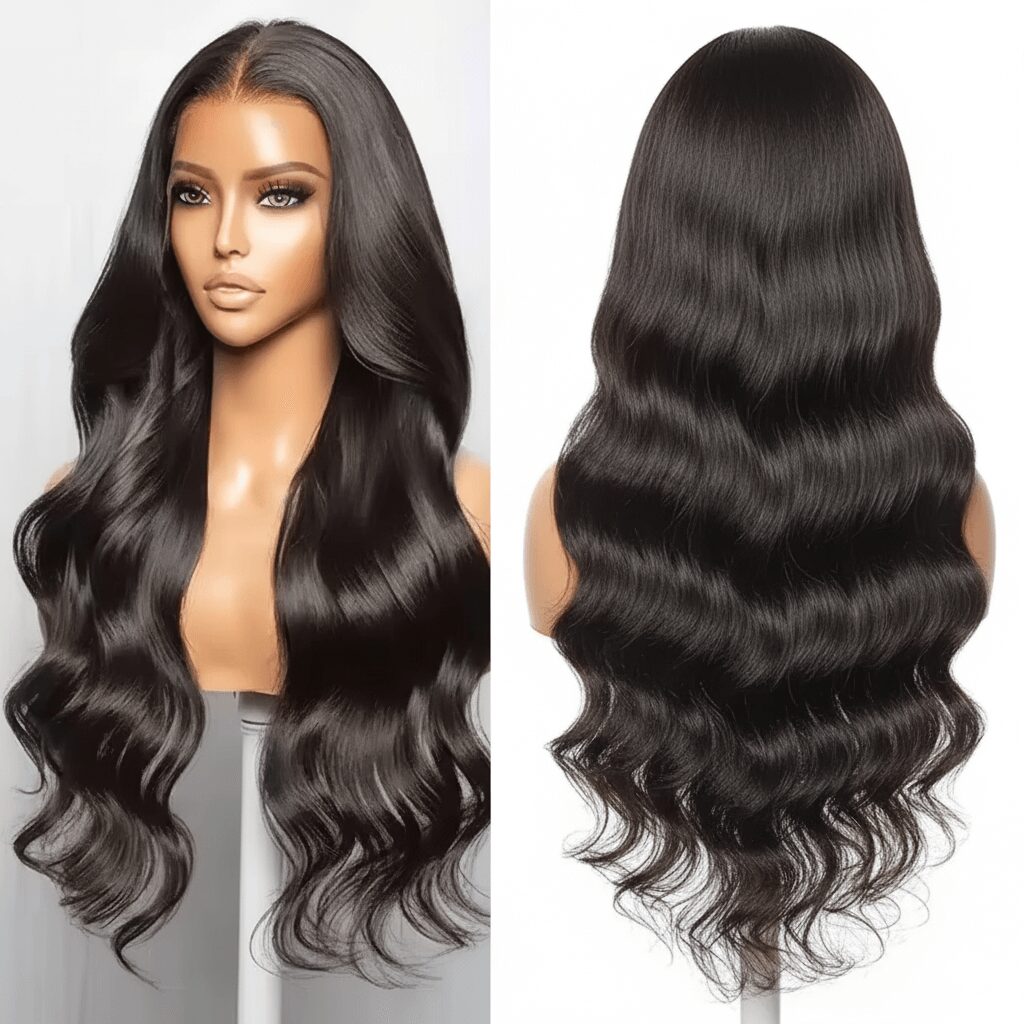
Pricing and margin planning for wholesale human hair wigs
Your target margins vary by channel; control COGS with spec discipline.
Typical COGS drivers
- Fiber grade: Virgin/European commands 1.5–3x vs. standard Remy.
- Lace: HD +$8–$25 per unit; larger lace areas add labor cost.
- Density and length: Each 10% density step and each length increment increases hair weight and ventilating labor.
- Color: 613 and multi-tone blends add bleaching/toning steps (+$15–$60).
- Cap: Full hand-tied or silk top adds significant labor.
Example landed cost vs. MSRP ranges (illustrative)
| Spec (20″, body wave, lace front) | Landed Cost | Wholesale | Suggested MSRP |
|---|---|---|---|
| Remy single, Swiss, 150% | $115–$145 | $170–$210 | $279–$349 |
| Remy double, Swiss, 180% | $150–$190 | $220–$270 | $349–$449 |
| Remy double, HD, 180% | $165–$215 | $240–$300 | $399–$499 |
| Virgin Remy, mono/silk top, 130% (medical) | $220–$320 | $320–$430 | $549–$749 |
Aim for 55–65% gross margin at retail; 25–35% at wholesale, depending on service level (styling, aftercare kits, warranties).
Risk management: returns, authenticity claims, and durability
- Returns prevention:
- Provide true-to-life photos on three skin tones; publish density video per SKU; include circumference fit guide.
- Authenticity:
- Add tamper-evident seals and serial numbers linked to batch FTIR certificates.
- Durability:
- Educate on wash cadence (every 7–14 wears), heat protection, and safe detangling to reduce shedding complaints.
- Warranty:
- 14-day fit/appearance exchange; 30–60-day workmanship warranty (knots/cap seams), excluding styling damage.
Sustainability and compliance considerations
- Ethical sourcing:
- Request written consent documentation for donor hair where applicable (e.g., temple hair programs).
- Chemical compliance:
- REACH/Prop 65 dye lists, nickel-free metal components in combs/clips.
- Packaging:
- Recyclable boxes and minimal plastics; include a “care to extend life” guide to reduce replacement cycles.
Sales enablement: content that converts and reduces support tickets
- Core assets:
- “HD vs. Swiss” macro photo carousel, knot bleaching before/after, density try-on videos across lengths, cap construction explainer with cutaways.
- Education:
- Care videos: wash, dry, detangle, store; specific to texture (kinky curly vs. straight).
- Tools:
- Density and length calculators; head measurement printable tape; shade finder with undertone quiz.
Frequently asked buyer questions (fast answers)
- How often should customers wash? Every 7–14 wears; more often for heavy product use.
- Typical lifespan? 6–24 months depending on grade, density, and care; virgin/European lasts longest.
- Heat styling limits? Start at 160°C (320°F), cap around 180°C (356°F) with protectant.
- Best density for day-to-day? 130–150%.
- Best knot approach? Single knots at hairline; double behind; lightly bleached; pre-plucked gradient.
Sample tech pack template (copy/paste)
- Product: 13×6 Lace Front Wig
- Fiber: Remy double-drawn, Indian origin profile
- Lengths: 16/18/20/22/24 (tolerance -0/+0.5″)
- Texture: Body wave
- Color: 1B, ΔE ≤ 2.0 vs. master
- Density: 150% (ends ≥ 90% mid-length mass)
- Lace: Swiss (beige), 40–60 denier; hairline single knots 0.8 cm, rest double
- Hairline: Pre-plucked, natural curve
- Knots: Bleached to medium; no hotspots
- Cap: M with elastic band + combs; S/L optional
- QC: FTIR batch cert, AQL 1.5/2.5/4.0
- Packaging: Rigid box, net, silica gel, barcode, care card
- Labeling: Batch ID, date, inspector ID
Troubleshooting matrix
| Symptom | Likely Cause | Fix/Prevention |
|---|---|---|
| Excess shedding | Over-bleached knots, poor knotting | Tighten knot spec; limit bleach; add knot sealant |
| Lace tearing | HD lace + rough handling | Upgrade to Swiss for daily wear; provide tools guide |
| Ends dryness | High-lift colors (613) | Deep condition; trim; recommend serum kit |
| Tangling at nape | Non-Remy blend; friction | Improve fiber spec; suggest silk scarves, detangler |
| Color inconsistency | Batch processing variance | ΔE meter checks; tighten color SOP |
| Odor on arrival | Incomplete neutralization | Require aeration; add odor-free SOP before packing |
Logistics and packaging for scale
- Cartonization:
- 20–40 units per master carton; use foam inserts for HD to protect lace fronts.
- Labels:
- GS1 barcodes; include size, length, density, color, batch on outer cartons.
- Moisture control:
- 5–10g silica gel per unit; humidity indicator cards for long sea shipments.
- Shipping:
- Air for launch SKUs; sea for steady sellers; hybrid model reduces landed cost.
Training your customer support team (reduces returns by 15–25%)
- Fit diagnosis:
- Teach circumference, ear-to-ear, and front-to-nape; send printable tape PDF.
- First-wash SOP:
- Gentle detangle, sulfate-free shampoo, mask focus on mid-to-ends, air dry on stand.
- Heat safety:
- Always heat protectant; temp caps; avoid daily flat ironing on 613.
- Adhesive guidance:
- Patch test; remove with proper solvents; protect lace integrity.
Case study snapshots
- EU clinic rollout:
- Switched from 150% HD to 130% Swiss mono-top for comfort; returns dropped 32%, NPS up 18 points.
- US e-comm brand:
- Introduced FTIR-backed authenticity seal + density videos; AOV +22%, chargebacks -41%.
- West Africa distributor:
- Migrated core line to Indian Remy double-drawn; complaint rate on tangling dropped 37%; reorder cycle shortened.
Conclusion
Human hair wigs can be your highest-margin, most defensible product line—if you control variables. Verify fiber authenticity with layered testing (burn/melt, microscopy, FTIR). Choose origins and grades to match your market’s texture and durability expectations: Indian/Cambodian for strength and volume, Peruvian/Brazilian profiles for glam fullness, European/Virgin for premium medical and natural looks. Match lace type and density to use cases—HD for camera-ready realism, Swiss for daily longevity, 130–150% density for everyday wear, 180% for glam. Finally, enforce disciplined lead times and QC: freeze specs in a tech pack, run AQL inspections, manage color ΔE, knot standards, and lace durability, and forecast with buffers around global peak seasons.
If you’d like my team to audit your current SKUs, share a sample FTIR plan, or send you our cap construction and density masters, contact us to request samples or visit our catalog. We can help you lock down consistency, lift conversions, and reduce returns across your human hair portfolio.