
Importing wigs from China can be highly profitable, but only if your pricing is built on accurate landed cost. Freight surcharges, destination port fees, and duty/VAT layering can easily add 10–30% to your total cost—especially for low-density goods like wigs where volumetric weight drives freight. I’ll walk you through a practical framework we use with wig importers, including Incoterms choices, per‑unit allocation, and data you need to model sea vs air.
To calculate landed cost for wigs from China, start with your product price and add international freight (sea/air), insurance, origin/export fees, import duty and taxes (based on HS 6704), customs/brokerage charges, destination port/terminal fees, domestic delivery, and compliance costs. Convert all items to one currency, then divide by sellable units to get the per‑unit cost. Incoterms determine which components you must add (FOB vs CIF vs DDP).
If you’ve struggled with inconsistent quotes or surprise destination charges, the sections below show how to standardize inputs, compare modes, and convert totals into SKU-level pricing you can rely on.
Should I Use Incoterms Plus DDP/DAP Quotes, or Build My Own Landed Cost Using FOB/CIF?
Choosing the right Incoterms structure determines which cost buckets you control and which you must estimate. For wigs, where duty can be low but destination/terminal charges are high, transparency matters.
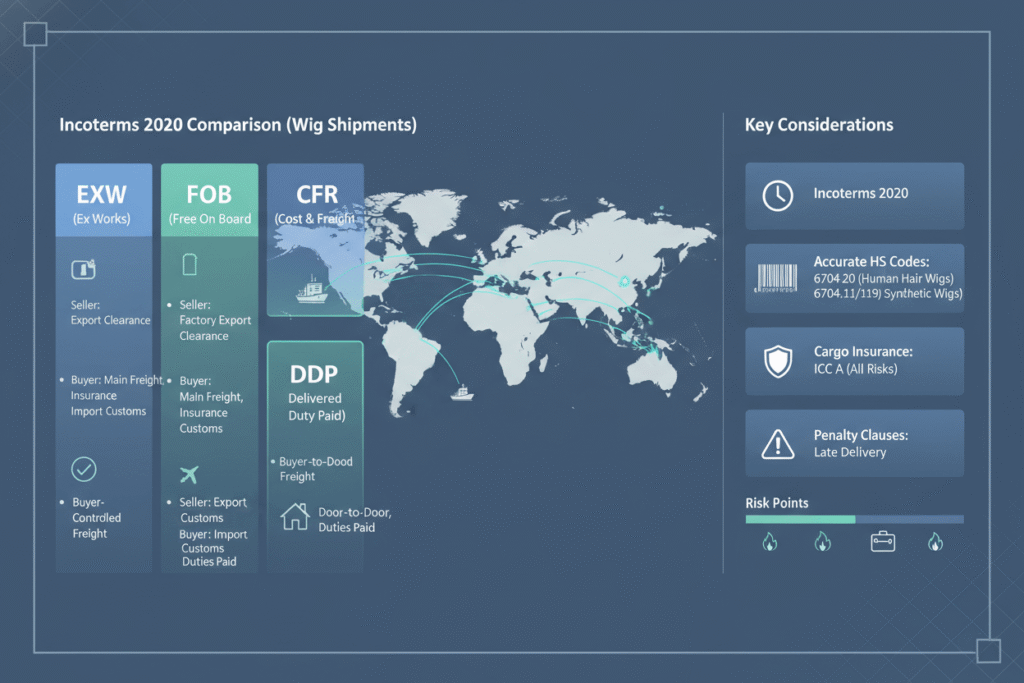
Use FOB if you want full visibility and control over freight and destination costs; use CIF if you’re comfortable with supplier-arranged main carriage but still budget for destination fees; use DDP/DAP when speed/simplicity trumps cost transparency—especially for small, urgent wig shipments.
What each Incoterm changes in your cost build
- FOB (Free on Board): Supplier handles export clearance and delivers to the China port. You add ocean/air freight, insurance, import duty/taxes, customs/brokerage, destination port/terminal charges, and domestic delivery.
- CIF/CIP: Freight and insurance are included to the arrival port/airport, but you still add destination/terminal, customs/brokerage, duty/taxes, and last‑mile delivery. Beware: CIF rarely includes terminal handling or delivery order fees.
- DAP/DDP: Freight forwarder or courier bundles most or all charges. DDP includes duty/taxes; DAP excludes them. Great for small/urgent shipments but can carry a premium per unit.
Pro Tip: For recurring wig SKUs, negotiate FOB with your supplier and contract main carriage with your forwarder. It reduces variability, lets you optimize by season and route, and prevents “black box” destination fees buried in CIF arrangements.
When DDP makes sense for wigs
- Sample runs, new colorways, or marketing drops where time-to-shelf matters more than pennies per unit.
- E-commerce replenishments under 100–200 kg volumetric weight via express courier DDP (duty/tax prepaid), avoiding port congestion and complex terminal charges.
How Do I Convert Freight, Duties, and Fees into a Per‑Unit Cost for My SKU Pricing?
The goal is to allocate all shared costs fairly across sellable units so your SKU margins reflect reality.
Sum all landed cost components in one currency, subtract non‑sellable units (defects/returns), then allocate shared costs by a driver (units, weight, or volume) that best fits the shipment. Divide by sellable units to get a per‑unit landed cost.
The allocation drivers that work for wigs
- Units: Simple and often acceptable when SKUs are similar size/weight.
- Net weight: Good if hair density varies by SKU.
- Cubic volume (CBM): Best for volumetric freight (common with boxed wigs and mannequins). Air freight uses dimensional weight; LCL sea freight is quoted per CBM.
Caution: If you mix human‑hair and synthetic wigs in one shipment, use volume allocation for freight and unit allocation for duty (since duty is based on HS code rates per line item). Document your method for audit consistency.
Example: Converting totals to per‑unit(The amount is provided merely as an example for understanding. The actual cost shall prevail)
- Shipment: 1,000 human‑hair wigs, each boxed at 0.004 m³ (total ~4.0 CBM), FOB Qingdao to Los Angeles.
- Costs (USD):
- Product (FOB): $25,000
- Ocean LCL freight: $1,600
- Insurance: $75
- Origin fees (China THC, doc): $180
- Destination fees (THC, wharfage, doc, DO, deconsolidation): $650
- Customs/brokerage: $145
- Drayage + domestic delivery: $500
- Duty: 0% (HTS 6704.20, human hair wigs; confirm current measures)
- Taxes: No VAT/GST in US; add MPF/HMF if applicable (e.g., MPF 0.3464% of customs value; HMF 0.125% on ocean to US)
- MPF: ~$86.6 on $25,000 FOB
- HMF: ~$31.25
Total landed cost: $25,000 + 1,600 + 75 + 180 + 650 + 145 + 500 + 86.6 + 31.25 = $28,268.85
Assume 2% defects/unsellable: 980 sellable units.
Per‑unit landed cost: $28,268.85 ÷ 980 ≈ $28.84
Pro Tip: Keep a “cost waterfall” tab in your pricing sheet. If destination fees spike, you’ll see exactly how much margin is hit and can adjust retail or reorder quantities.
What Data Do I Need (HS Code, Weight/Volume, Port Pair, Surcharges) to Model My Landed Cost?
Accurate modeling depends on correct classification and lane-specific freight data.
Collect HS code (likely 6704), product description, unit weight and dimensions, total CBM/kg, port pair, Incoterm, shipment type (FCL/LCL/air/courier), and all surcharges (origin/destination, documentation, brokerage, taxes). Currency and payment terms also affect landed cost via FX and cash‑flow.
Required data points for wig imports
- HS/HTS code and material:
- 6704.20: Wigs of human hair (often duty‑free in many markets; verify special measures).
- 6704.11/6704.19: Wigs of synthetic fibers; duty varies by country.
- Country valuation rule:
- Duty base is FOB (e.g., US) or CIF (e.g., EU). This changes the duty and VAT/GST calculation.
- Physical specs:
- Unit net weight, box dimensions, pack count per carton, total cartons.
- Total gross weight and total CBM for the shipment.
- Route and mode:
- China port/airport (e.g., Qingdao, Xuchang via Zhengzhou, Shanghai).
- Destination port/airport (e.g., Los Angeles, New York, Rotterdam).
- Seasonality and space market (peak season GRI can add $300–$1,000 per container or higher LCL rates).
- Surcharges and fees:
- Origin: export clearance, THC, doc fee, trucking to port.
- Main carriage: ocean base rate, bunker/fuel, GRI, PSS; air: chargeable weight, FSC.
- Insurance: CIF value rate (often 0.1–0.3%).
- Destination: THC, wharfage, doc, delivery order, deconsolidation (LCL), port security.
- Customs: brokerage, classification, duty, taxes (VAT/GST), MPF/HMF or equivalents.
- Domestic delivery: drayage, final‑mile trucking.
- Financials:
- Currency for supplier and forwarder quotes, FX rate on entry date.
- Bank transfer fees, FX spreads (often 0.3–1.5%), payment terms (prepay vs DA/LC).
Table: Typical cost components by Incoterm
| Cost Component | FOB | CIF/CIP | DAP/DDP |
|---|---|---|---|
| Product cost | Buyer pays | Buyer pays | Buyer pays |
| Export clearance & origin THC/doc | Supplier | Supplier | Supplier/Forwarder |
| Main freight + insurance | Buyer | Supplier/Forwarder | Forwarder/Courier |
| Destination terminal/DO/deconsol | Buyer | Buyer | Forwarder |
| Customs brokerage | Buyer | Buyer | Forwarder |
| Duty & VAT/GST | Buyer | Buyer | DDP: Forwarder; DAP: Buyer |
| Domestic delivery | Buyer | Buyer | Forwarder |
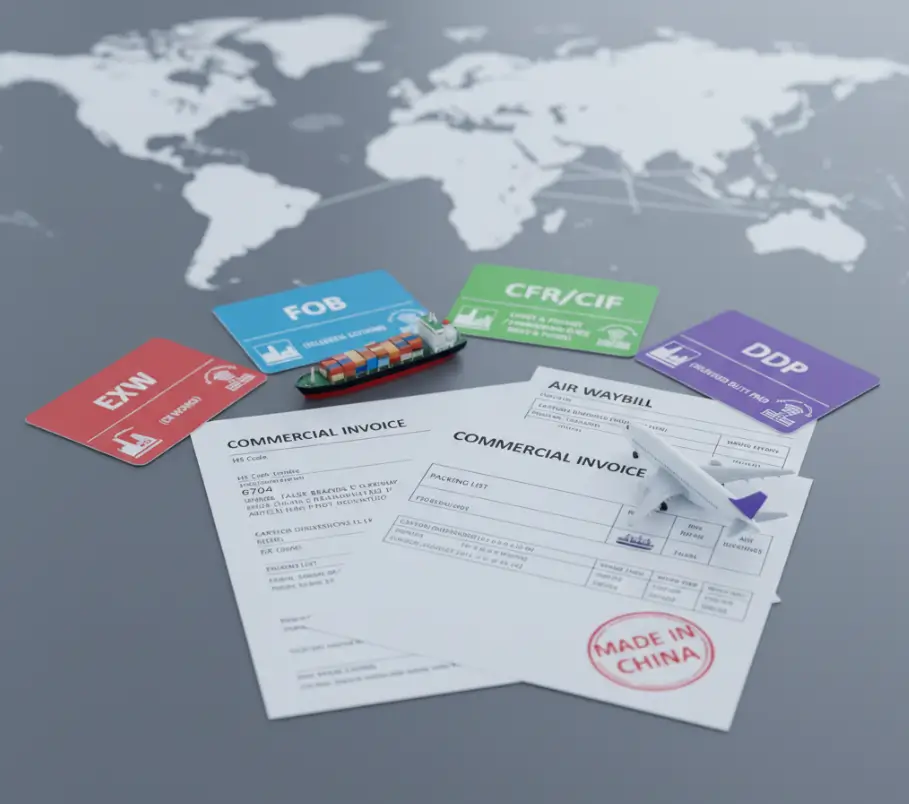
Caution: Destination terminal charges are not covered by CIF—budget them explicitly. For LCL, deconsolidation and delivery order fees can be material.
Can I Use a Landed Cost Calculator to Compare Sea vs Air for My Wig Shipments?
Yes—and you should, especially since wigs pack light but bulky. The mode decision often hinges on volumetric weight and cash‑flow timing.
Use a calculator that accepts CBM and chargeable weight, applies duty/VAT to the correct customs value (FOB vs CIF), and includes destination fees. Run scenarios for LCL sea vs air vs courier DDP to see per‑unit differences and lead‑time impacts.
How to compare modes for wigs
- Sea LCL:
- Best for 3–12 CBM shipments where time allows 20–35 days door‑to‑door.
- Lower cost per unit; higher destination fees than courier.
- Air freight:
- Chargeable weight = max(actual kg, dimensional kg). For wigs, dimensional often wins.
- Faster (5–10 days), cost per unit can double or triple vs LCL depending on season.
- Courier/Express DDP:
- Bundled price includes freight, clearance, duty/taxes. Ideal for <200 kg chargeable or urgent drops.
- Simplifies landed cost but at a premium.
Table: Mode comparison for a 4.0 CBM wig shipment (illustrative)
| Mode | Transit Time | Main Carriage Cost | Destination Fees | Duty/Taxes Handling | Per‑Unit Impact* |
|---|---|---|---|---|---|
| Sea LCL (FOB) | 25–35 days | $1,600 | $600–$800 | Buyer | Lowest |
| Air Freight | 5–10 days | $3,500–$5,000 | $200–$400 | Buyer | Medium–High |
| Courier DDP | 4–7 days | $5,000–$6,500 | Included | Included | Highest |
*Assumes 1,000 units; actuals vary by lane/season.
Pro Tip: Include inventory carrying cost in your comparison. Faster modes reduce stockouts and may justify higher freight if margin or velocity improves.
Conclusion
To accurately calculate the freight‑inclusive landed cost when you import wigs from China, assemble the right data (HS 6704 classification, volume/weight, route, surcharges), choose Incoterms that fit your control needs, and model all components—product, freight/insurance, origin/destination fees, duty/taxes, brokerage, domestic delivery, and compliance. Convert to one currency, account for FX and payment terms, and allocate across sellable units to get a reliable per‑SKU cost. This discipline prevents margin surprises and helps you confidently choose between sea, air, or courier.
If you want a tailored spreadsheet and current lane benchmarks for Qingdao/Xuchang to your port, contact us—we’ll help you build a defensible landed cost model and negotiate better freight for your wig SKUs.