
Customizing wigs when you import from China is one of the best ways to differentiate your brand—whether you sell salon-grade lace fronts or affordable fashion synthetics. Chinese suppliers are highly capable at bespoke specs, from HD lace and density mapping to multi-tone balayage and steam-set curls. The key is translating your creative brief into a manufacturing-ready tech pack, then managing sampling, approvals, and QC like a pro.
To customize wig styles and colors when importing from China, build a precise tech pack (cap construction, lace type, density, parting, knots, sizes), provide physical color references (Pantone/hair color rings), request pre-bleached knots and pre-plucked hairlines with defined curl codes and steam-setting parameters, and follow a sample-to-mass production flow with AQL QC and lighting-verified color checks.
Below, I break down what to include in your spec sheet, how to handle color matching (including ombre and highlights), what customization options are realistic at scale, and the typical sampling/lead-time timeline we use with Chinese factories.
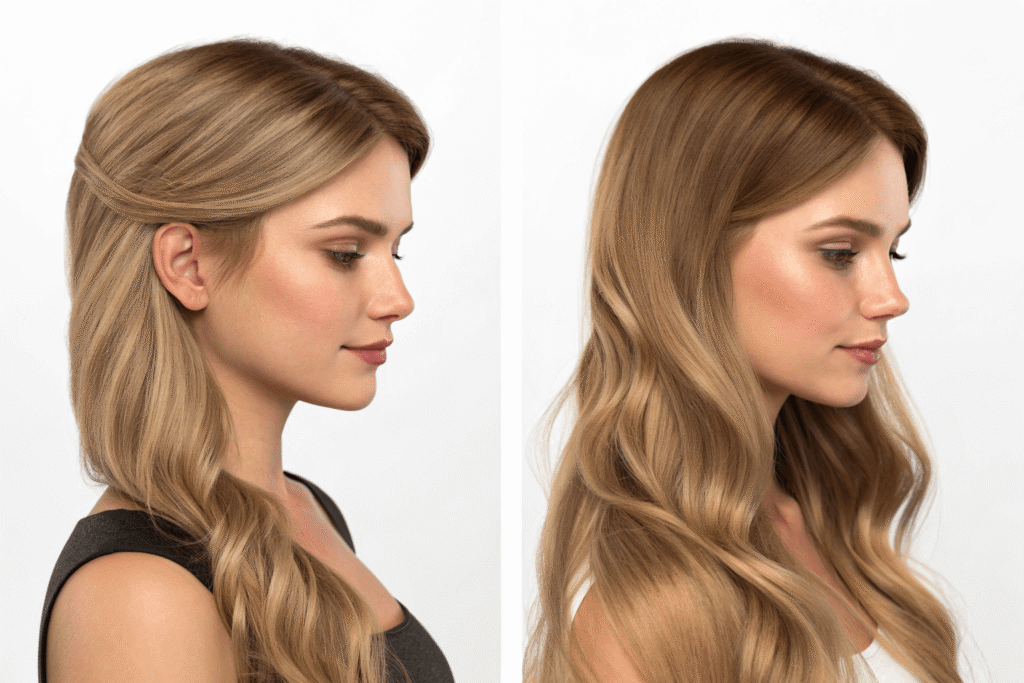
What Specs (Cap Size, Lace Type, Knots, Density, Parting) Should I Include in My Tech Pack?
Before you brief a factory, lock down construction, fit, and finish. This is the backbone of consistency and cost control.
Your tech pack should read like an instruction manual—cap construction, lace type, dimensions, density by zone, knots and bleaching level, parting, hairline treatment, and test criteria all specified clearly with tolerances.
Core Construction Specs
- Cap structure: Lace front (13×4, 13×6), full lace, 360 lace, or closures (4×4/5×5/6×6). Note if glueless ear tabs, silicone strips, or combs are required.
- Lace type and color: Swiss lace, HD lace, or transparent; specify lace gsm if possible. Include lace color (light/medium/dark brown; request factory swatches).
- Ventilation/knotting: Single/double knots, injection/V-loop for skin tops, return ratio (baby hairs/returns), and knot spacing (e.g., 1.5–2.0 mm grid).
- Knots treatment: Bleach level target (e.g., “lift to level 7 with ≤10% breakage”), or “no bleach, use light-brown knots.”
- Parting: Free part, middle, side, or pre-defined C or L part; add silk/PU top dimensions if required.
- Density: Overall density (e.g., 150%) plus zone distribution:
- Hairline: 80–100%
- Front 1–2 cm: 90–110%
- Crown: 120–130%
- Nape: 100–120%
Include tolerance (±5% by weight). - Lengths: Overall length and layer map (front framing, crown, nape). For layered looks, attach a cutting guide.
- Cap sizes: Circumference, front-to-nape, ear-to-ear over top, temple-to-temple, nape width (S/M/L or custom in cm).
- Hardware and finishes: Adjustable straps, combs, elastic band, label placement, and seam tape zones for stylists.
Pro Tip: Ask for a “density chart by zone” on the factory worksheet. It reduces over-bulking at the hairline and keeps the silhouette wearable.
Hair Type and Grade
- Hair fiber: Synthetic, heat-resistant fiber (note max styling temp), or human hair (non-Remy/Remy/cuticle-aligned “virgin”).
- Origin/style goals: Use performance requirements, not just marketing terms. Example: “Cuticle-aligned, double-drawn, ≤12% short hairs under 6 cm.”
QC and Testing Criteria (add to PO)
- Shedding test: 10 comb-throughs ≤X strands.
- Tangle test: 24-hour hang test post-wash, ≤1 knot per 10 cm.
- Color fastness: AATCC wash rub ≥Grade 4; for dark roots over 613, confirm no bleeding.
- Lace tear strength: Minimum N rating (if supplier can test).
- Pre-shipment checks: AQL II with your sampling plan and defect list.
How Do I Match Pantone or Hair Color Rings for Ombre, Highlights, and Balayage?
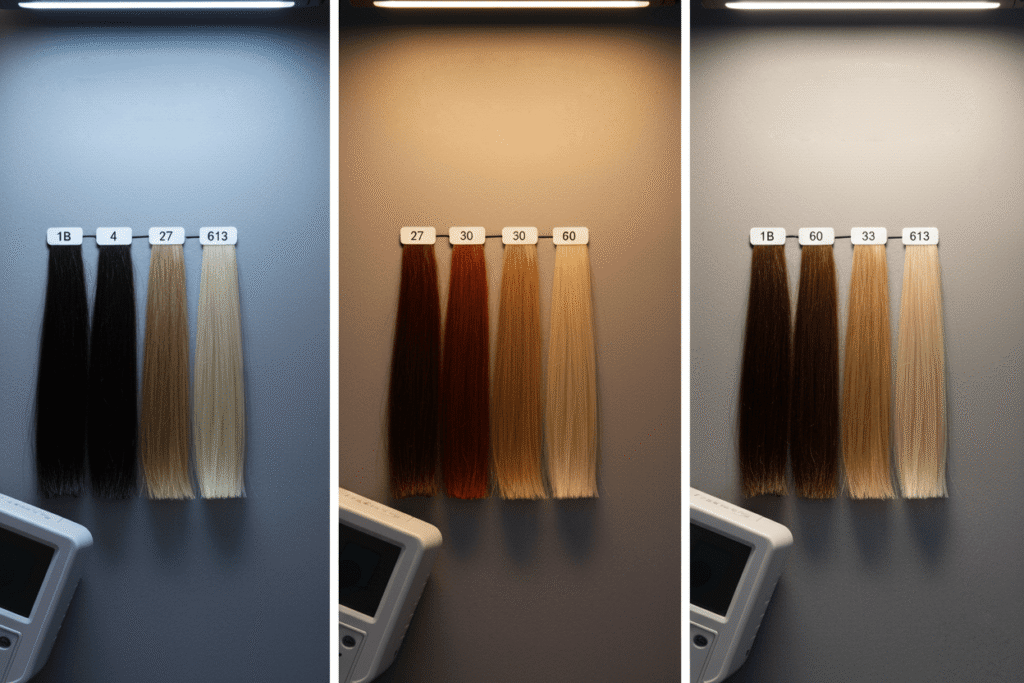
Color is where most projects go off the rails—screens lie, lighting differs, and “613” isn’t identical across all mills. Treat color control like product development, not a guess.
Use physical references—hair color rings, Pantone chips, or your own swatches—and require small dyed-strand tests and multi-light verification before production. For multi-tone work, supply a map with ratios and blend transitions.
The Right References
- Hair color rings: Reference industry standards (1, 1B, 2, 4, 6, 27, 30, 33, 60, 613, etc.). Note that vendor rings vary—pick one system and mail your actual ring to the factory, or buy theirs.
- Pantone: For fashion colors (pastels/neons), specify Pantone TCX with tolerances (ΔE ≤2 under D65 if the lab can measure). Always include a hair strand swatch dyed to your Pantone.
- Physical swatches: Best practice is a 10–20 cm strand for each target color plus a “do-not” rejected swatch.
Multi-Tone Mapping (Ombre/Highlights/Balayage)
- Provide a visual map indicating:
- Root length (e.g., 2.0–3.0 cm root: 2/3 or 4/5 level)
- Transition length and blend ratio (e.g., root:mid:tip = 25:35:40)
- Highlight width (mm) and spacing (cm) for piano/foil looks
- Balayage face-framing density (% of front panel)
- Define density per color: e.g., “Highlights are 20% of total fibers, width 2–3 mm, staggered.”
Caution: “613” base with dark roots can stain during shipment in humid conditions. Require sealed, dry packaging and a 48-hour color-fast test after steaming.
Verification Workflow
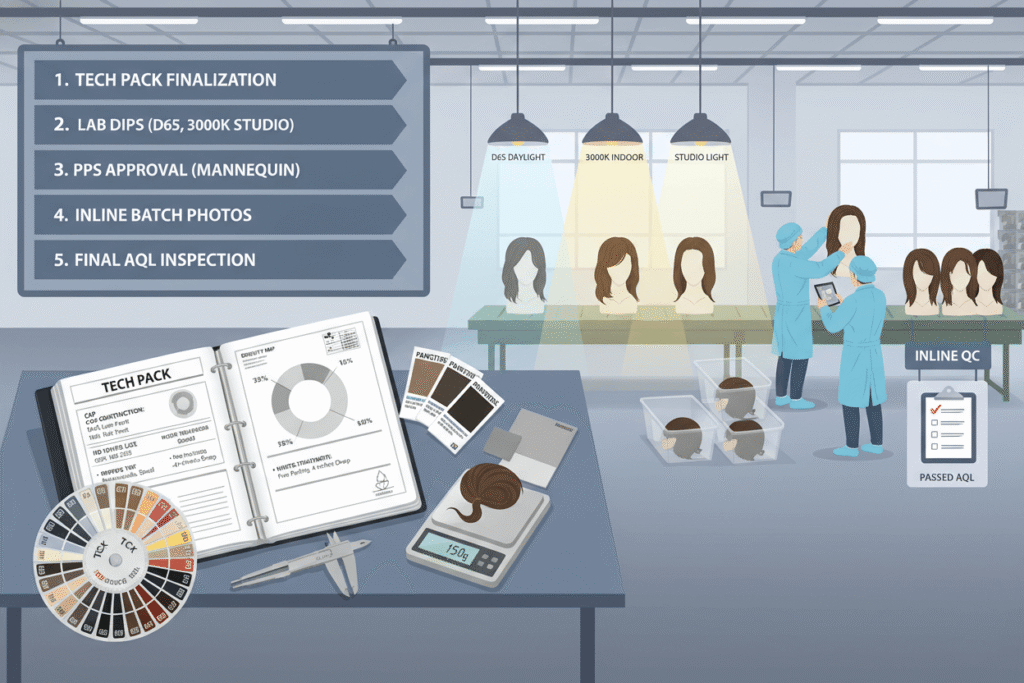
1) Lab dip/strand test: 3–5 variants for approval, shot under D65 daylight, warm indoor (2700–3200K), and studio light.
2) Pre-production sample (PPS): Full cap sample in final colorway.
3) Inline check: Mid-production batch photos/videos on white mannequin and gray card.
4) Final AQL: Inspect at least 5–8 units across tones to confirm uniformity and undertone consistency.
Can I Request Pre-Bleached Knots, Pre-Plucked Hairlines, and Specific Curl Patterns?
Yes—these are standard in most Chinese factories, but quality varies. The devil is in parameters and acceptable limits.
You can and should request pre-bleached knots, pre-plucked hairlines, and defined curl patterns—just specify bleach level, hairline recession and baby hair density, curl codes, and steam-setting parameters to keep results consistent batch-to-batch.
Pre-Bleached Knots
- Spec: Target lift level (6–7 for dark roots), max breakage rate, and “no orange halos.”
- Alternatives: For fragile lace/613 bases, use tiny single knots + light-brown tint instead of aggressive bleaching.
- QC: 10x macro photo at the part and temple; tug test to check breakage.
Pre-Plucked Hairlines and Baby Hairs
- Hairline recession: e.g., 0.8–1.2 cm natural gradient from front edge.
- Density taper: Hairline 80–100%, then graduate to crown 120–130%.
- Baby hairs: Length 3–5 cm around temples and part; density “light.”
Curl Patterns and Setting
- Standard codes: Straight, Body Wave, Deep Wave, Water Wave, Kinky Curly, Afro Kinky, Jerry Curl, etc. Send reference photos and curl diameter (mm) when possible.
- Setting method: Request steam-setting parameters (temperature, duration, cool time). Example: “Steam set at 120–130°C for 18–22 minutes; cool on form 6 hours.”
- Longevity: For synthetics, specify heat-safe rating (e.g., 160–180°C max). For human hair, ask for post-set stabilization to reduce drop after wash.
Pro Tip: Add a post-wash retention spec: “After 1 wash and air-dry, curl drop ≤15% by length; wave pattern remains uniform ±1 curl per 10 cm.”
What Is the Usual Sampling and Lead-Time Flow from Prototype to Mass Production?
Planning timelines is essential for launches, influencer campaigns, and seasonal color drops. Lead times shift by factory load, materials (HD lace is slower), and color complexity.
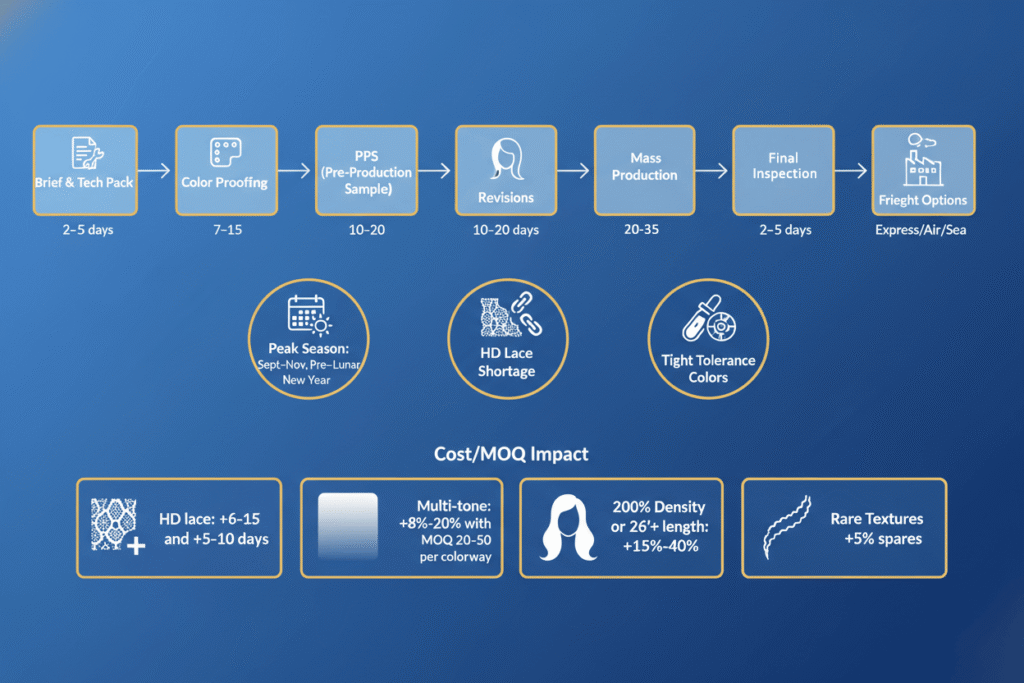
Expect 7–15 days for lab dips/strand tests, 10–20 days for a pre-production sample, and 20–35 days for mass production—longer for HD lace, rare textures, and multi-tone colors. Build in time for approvals and shipping.
Typical Development-to-Delivery Timeline
| Stage | What Happens | Usual Lead Time |
|---|---|---|
| Brief & Tech Pack | Specs finalized, target costs, MOQ confirmed | 2–5 days |
| Color Proofing | Strand/lab dips, photo/video under 3 lights | 7–15 days |
| Pre-Production Sample (PPS) | Full cap sample: fit, color, density, knots | 10–20 days |
| PPS Revisions (if needed) | Adjust bleach, density, or curl set | 7–12 days |
| Mass Production | Ventilation, coloring, setting, QC | 20–35 days |
| Final Inspection & Pack | AQL check, batch photos/videos | 2–5 days |
| Freight | Express 3–7 days; air 7–12; sea 25–40+ | Varies |
Factors that extend lead time:
- HD lace shortages; custom caps and unusual sizes.
- Multi-tone balayage/piano colors with tight tolerances.
- Rare textures (tight Afro/kinky) and double-drawn human hair.
- Peak seasons (Sept–Nov holiday build, pre–Lunar New Year).
MOQ and Cost Notes
| Option/Spec | Typical Impact |
|---|---|
| HD lace | +$6–$15 per unit; +5–10 days lead time |
| Multi-tone (ombre/balayage/piano) | +8%–20% cost; higher MOQ (20–50 pcs per colorway) |
| 200%+ density or 26”+ length | +15%–40% cost; longer sourcing time |
| Rare curl textures | Higher reject rates—budget for 5% spares |
Caution: Don’t skip PPS. It’s your legal “golden sample.” Lock it in with photos, weight, and measurements; require deviations to be pre-approved.
Bonus: Packaging, Branding, and Aftercare
Add these to your PO so the unboxing matches your brand:
- Woven/printed labels, hangtags, branded silk/satin bags, care cards.
- Aftercare instructions tailored to color/curl longevity (fewer returns).
- Barcode/QR for batch traceability (helps with RMA and influencer seeding).
Conclusion
Customizing wig styles and colors when you import from China is absolutely achievable—and scalable—when you convert creative ideas into factory-ready specs. Nail your tech pack (cap, lace, density map, knots, parting, sizes), control color with physical swatches and multi-light verification, define hairline/curl parameters with steam-setting details, and follow a disciplined sample-to-mass production timeline with AQL inspection.
If you want help turning your brief into a production-grade spec pack—or need factory matchmaking and QC templates—contact us for tailored sourcing advice. We can accelerate your first PO and reduce color/fit surprises before launch.