
Custom brand packaging is one of the easiest and highest-ROI ways to differentiate wig products sourced from China. Because most wig factories have long-standing relationships with specialized packaging converters, you can bundle OEM/ODM services—boxes, silk bags, hang tags, care cards, and barcode/UPC labels—into the same order and ship fully retail-ready units.
Yes—Chinese wig suppliers commonly offer OEM/ODM packaging, including custom boxes or silk bags, brand labels, tags, care cards, and UPC/barcodes. Expect MOQs of 100–500+ for customized components, provide print-ready vector artwork with Pantones, approve proofs, and plan 7–15 extra days for packaging production.
Below, I break down options, realistic MOQs and unit costs, how to submit dielines and files, and what to ask if you need kitting, bundle labeling, and Amazon/retail compliance.
What are my options for boxes, silk bags, tags, care cards, and barcode/UPC labels?
You have a wide menu of packaging components that Chinese suppliers can tailor to your brand. The right combination depends on your channel (Amazon vs. salon retail), price point, and shipping method.
Most factories can produce or source rigid boxes, mailers, card boxes, silk/satin bags, hang tags, care cards, and barcode labels—each with distinct MOQs, costs, finishes, and lead times. Mix components to hit budget and compliance targets.
Core packaging formats
- Rigid gift boxes (magnetic or drawer style): Premium unboxing, ideal for higher-ticket human hair wigs. Typical finishes include matte/gloss lamination, foil stamping, spot UV, and emboss/deboss.
- Corrugated mailer boxes: Strong protection for e-commerce. Suitable for air/parcel shipments and FBA. Exterior CMYK print with interior one-color branding is common.
- Card paper boxes (300–350gsm): Economical retail cartons, optional PVC window to display curl pattern or lace front.
- Silk/satin drawstring bags: Lightweight, upscale feel for storage; great as inner packaging within a mailer.
- Polybags (biodegradable options available): Cost-effective primary or secondary packaging; can be custom printed with warnings and recycling marks.
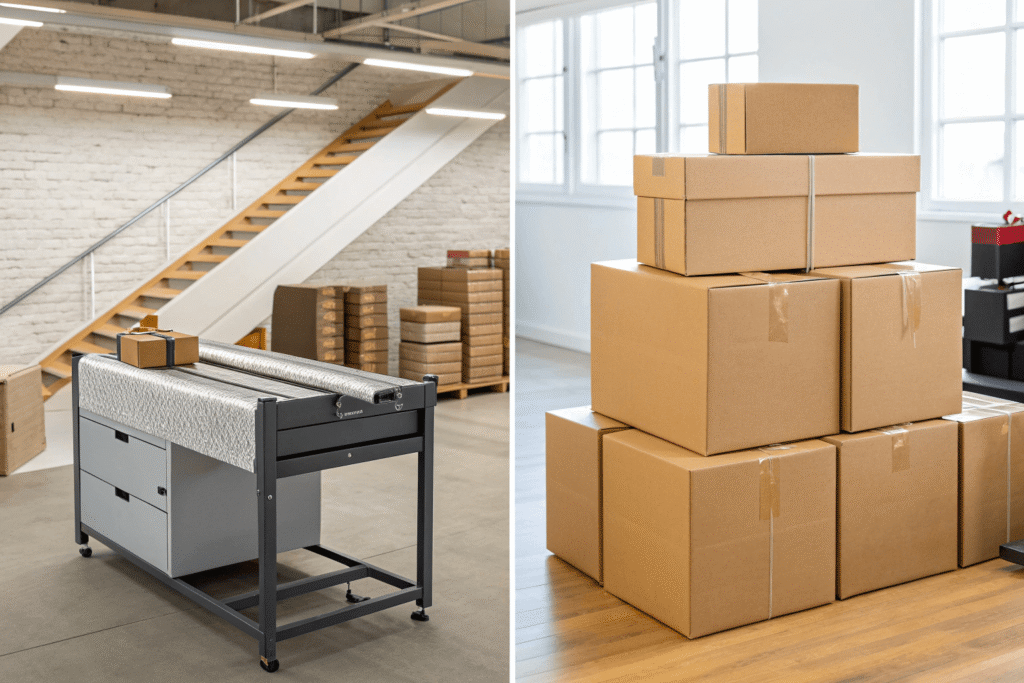
Inserts and labeling
- Hang tags: Include brand, style code, color code, length, density (e.g., 150%), cap type (13×6 HD lace), care icons, and MSRP/SKU.
- Care cards: Simple, pictogram-based care steps reduce returns. Include detangling, washing, drying, storage, and heat-use guidelines.
- Barcode/UPC/EAN labels: Printed and applied to the master carton and each retail unit. Ensure scannability (quiet zones, contrast, size).
- Warranty/authenticity cards: Optional QR linking to your brand site or registration page.
- Bundle belly bands and header cards (for extensions): If you sell bundles alongside wigs, request consistent branding across both lines.
Finishes and sustainability options
- Finishes: Matte/gloss lamination, soft-touch, foil, spot UV, emboss/deboss, ribbon pulls, magnetic closures.
- Eco-friendly: FSC-certified recycled paper, soy inks, water-based coatings, biodegradable polybags.
Pro Tip: If you’re selling lace wigs, consider a shallow rigid box with a fitted insert to prevent lace wrinkling. Ask for a molded paperboard or foam cradle sized to your cap dimensions.
What MOQ and unit costs should I expect for custom packaging and inserts?
Budgeting is easier when you know typical thresholds. Costs vary by material, print colors, finishes, and volume. Shipping method also affects your total landed cost because bulky boxes increase dimensional weight.
Expect MOQs of 100–500 for simple bags/tags and 500–2,000 for printed boxes. Unit costs range roughly from $0.10 to $2.00+, with finishes, multi-color CMYK, and low volumes driving price up. Custom packaging often adds 7–15 days to lead time.
Typical MOQs and price ranges
- Silk/satin bags: MOQ 100–500; $0.15–$0.60 per bag (screen print or heat transfer).
- Rigid magnetic boxes: MOQ 500–1,000; $0.80–$2.00+ depending on size, board thickness, foil, and inserts.
- Corrugated mailers: MOQ 500–1,000; $0.25–$1.00 depending on E-flute vs. B-flute, two-sided print.
- Card paper boxes: MOQ 1,000–2,000; $0.10–$0.50 depending on GSM, window, and coatings.
- Hang tags: MOQ 500–1,000; $0.03–$0.10 per tag (with string/eyelet extra).
- Care cards: MOQ 500–1,000; $0.02–$0.08 per card.
- Barcode labels: MOQ 500–1,000; $0.01–$0.03 per label if printed by supplier; or free if printed inline on carton artwork.
Caution: Very low MOQs often mean digital printing instead of offset. Digital is fine for short runs, but colors can shift compared to your brand Pantones, especially across reorders. Lock Pantones and request physical proofs if color consistency is critical.
Lead times and scheduling
- Packaging production: +7–15 days beyond wig manufacturing; +2–5 days for proofing.
- Combined schedule: If wigs take 10–20 days, expect 20–35 days total with custom packaging. Add transit time (air vs. sea).
Cost levers
- Reduce colors (1–2 spot colors) or switch to black + one spot to cut price.
- Use stock box sizes from the converter’s library to avoid new cutting dies.
- Consolidate SKUs: One box size with different stickers instead of multiple printed versions.
- Order higher volume less frequently to amortize plate/die costs.
Table: Quick view of common options and estimated economics
| Component | Typical MOQ | Est. Unit Cost (USD) | Notes |
|---|---|---|---|
| Silk/Satin Bag | 100–500 | $0.15–$0.60 | Embroidery increases cost/time |
| Rigid Magnetic Box | 500–1,000 | $0.80–$2.00+ | Soft-touch + foil adds ~$0.10–$0.30 |
| Corrugated Mailer | 500–1,000 | $0.25–$1.00 | Two-sided print increases cost |
| Card Paper Box | 1,000–2,000 | $0.10–$0.50 | Window + PVC adds ~$0.05–$0.12 |
| Hang Tag | 500–1,000 | $0.03–$0.10 | String/metal eyelet extra |
| Care Card | 500–1,000 | $0.02–$0.08 | Heavier stock costs more |
| Barcode Label | 500–1,000 | $0.01–$0.03 | Or print as part of box artwork |
How do I provide dielines and print files to avoid color variance in packaging?
Clean files and precise specifications ensure your brand prints correctly the first time and stays consistent on future reorders. Treat packaging like a technical product, not just design.
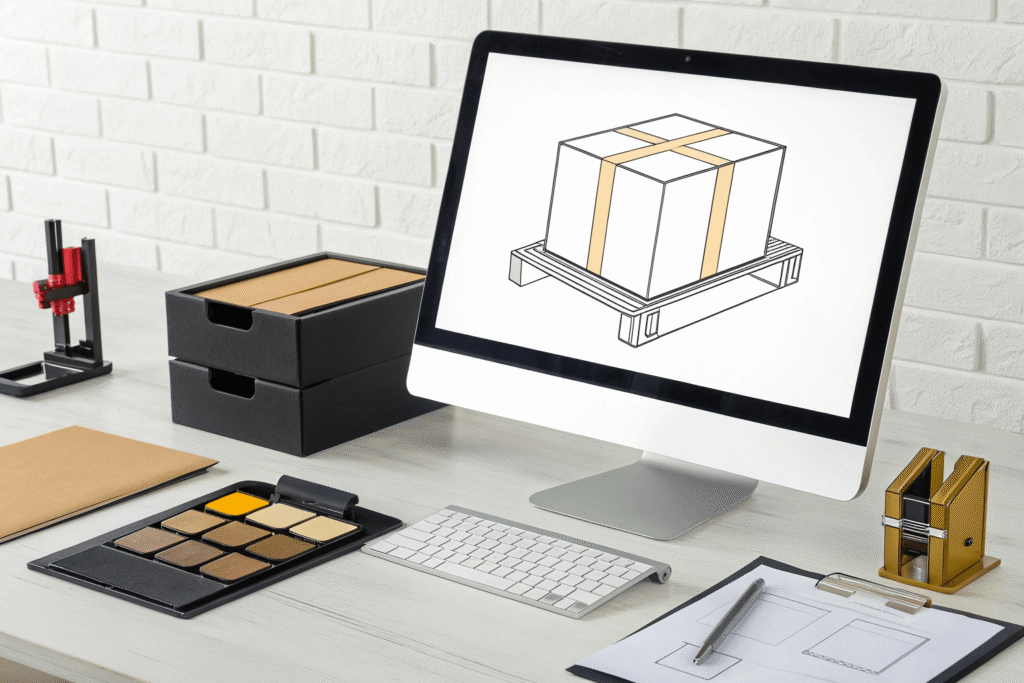
Send vector artwork (AI/EPS/PDF), supplier-provided dielines, embedded or outlined fonts, Pantone references, and print specs. Approve digital and, ideally, physical proofs to lock color and finishes before mass production.
File preparation checklist
- Request dielines from the converter: Exact box/bag dimensions, panel folds, bleed (typically 3 mm), and safe margins.
- Artwork format: Print-ready vector (AI/EPS/PDF). Outline fonts; include linked images at 300 dpi minimum.
- Color: Specify Pantone Solid Coated for spot colors; define CMYK builds for full-color images; provide color chips if available.
- Black ink: Use rich black for large areas (e.g., C60 M40 Y40 K100) but keep barcodes in 100% K for crisp scanning.
- Finishes: Call out foil color (e.g., Pantone 871 gold), emboss/deboss depth, lamination type (matte/gloss/soft-touch).
- Barcodes: Provide UPC/EAN data, ensure size and quiet zones meet GS1 guidelines; test print on your office printer for scanability.
- Regulatory text: Fiber content, country of origin (e.g., Made in China), care instructions, choking warnings (if applicable), recycling symbols.
Proofing workflow
- Supplier sends digital proof (PDF) with dieline overlays for content check.
- Optional color swatch prints or press proof for Pantone verification.
- Physical sample (pre-production): Confirms materials, finishes, magnet strength, ribbon length, and true color.
- Golden sample sign-off: The benchmark used for mass production and inspections.
Pro Tip: Ask who owns the printing plates and cutting dies. If you pay for them, insist they be dedicated to your brand and stored for future runs to keep color and fit consistent.
Technical pack essentials
Create a one-page spec per SKU and a master technical pack:
- Dimensions and tolerances
- Materials (board grade, GSM, fabric type)
- Pantone references and CMYK builds
- Artwork placement with measurements
- Barcode data and placement
- Insert structure (foam/paper cradle)
- Labeling text for compliance (US/EU/UK)
Include this tech pack as an attachment to your purchase contract.
Table: Common color pitfalls and fixes
| Issue | Cause | Fix |
|---|---|---|
| Color shift across reorders | Different press/ink batches | Lock Pantones; demand press proof or swatches |
| Dull blacks | 100% K only on large areas | Use rich black for solids; 100% K for barcodes |
| Blurry logos | Raster artwork at low DPI | Supply vector files; 300 dpi images minimum |
| Misaligned foil | Poor registration or dieline | Tighten tolerances; approve physical samples |
Can my supplier handle kitting, bundle labeling, and Amazon/retail compliance?
If you need retail-ready units out of the box, most wig factories can coordinate kitting and labeling with the packaging converter and the fulfillment team.
Yes—many suppliers can assemble wigs into boxes/bags, attach hang tags, apply UPC/FNSKU labels, add suffocation warnings, and follow Amazon prep standards. Confirm a kitting SOP upfront and verify compliance with inspection.
Kitting and assembly
- Unit-level tasks: Place wig on insert, add hairnet, tissue paper, care card, hang tag; close box and add tamper seals if required.
- Bundle labeling: For hair bundles, belly bands with size/weight; apply set-level labels (e.g., 3x bundles of 22″).
- Master carton prep: Apply carton labels with SKU, color, size, inner/outer counts, and barcode (ITF-14/Code 128 as needed).
Amazon FBA and retail specifics
- FNSKU labels: Must be scannable, correct size, placed on the unit’s principal display panel.
- Suffocation warnings: Required for polybags ≥ 1 mil thickness and openings ≥ 5 inches—print or sticker.
- Prep guidance: “Sold as set” labels for kits; do not separate tags for multi-piece packages.
- Carton specs: Comply with weight/dimension limits; use 32 ECT or 44 ECT corrugate depending on route.
- Country of origin: Mark “Made in China” on the product or packaging per US Customs rules.
Caution: Synthetic vs. human hair may trigger different labeling expectations in certain markets. For example, the EU may require explicit fiber composition language; US retail often expects clear care icons and heat-use notes to prevent misuse.
SOP and QC
- Write a kitting SOP: Step-by-step assembly, photo examples, label placement guides.
- Pre-shipment inspection: Use AQL sampling to check printing, color, assembly, and label accuracy against golden sample.
- Drop tests: ISTA 1A/2A-style tests for e-commerce cartons reduce damage claims.
Conclusion: Custom Brand Packaging for Chinese Wig Imports
Custom packaging is absolutely feasible when you import wigs from China—and it’s often the fastest way to elevate perceived value and reduce returns. Define the right mix of boxes or silk bags, lock MOQs and costs early, send precise dielines and Pantone-based artwork, and leverage supplier kitting for Amazon/retail compliance. Most importantly, approve physical samples and embed your technical pack in the purchase contract to keep color, fit, and labeling consistent across reorders.
If you’d like help building a packaging spec that fits your channel and budget, contact us for tailored sourcing and compliance support.