
Will headband wigs shorten install time for my salon and retail buyers?
I’ve spent enough mornings on production floors and in busy salon backrooms to know this: time is the tax we all pay if we get lace wrong. Lace requires adhesive, cutting, tinting, and blend time—steps that break schedules and erode margins. When I piloted headband human hair wigs with two salon networks and a mid-size ecommerce retailer, the feedback was consistent: they’re the fastest, most forgiving format for beginners and repeat buyers, and they reduce post-sale handholding dramatically.
Headband human hair wigs are the easiest professional-grade wigs to wear because they eliminate adhesive, lace cutting, and hairline blending. They install in 2–5 minutes using an elastic headband, adjustable straps, and integrated combs, making them ideal for salons, retail buyers, and first-time consumers seeking a glueless, low-maintenance option.
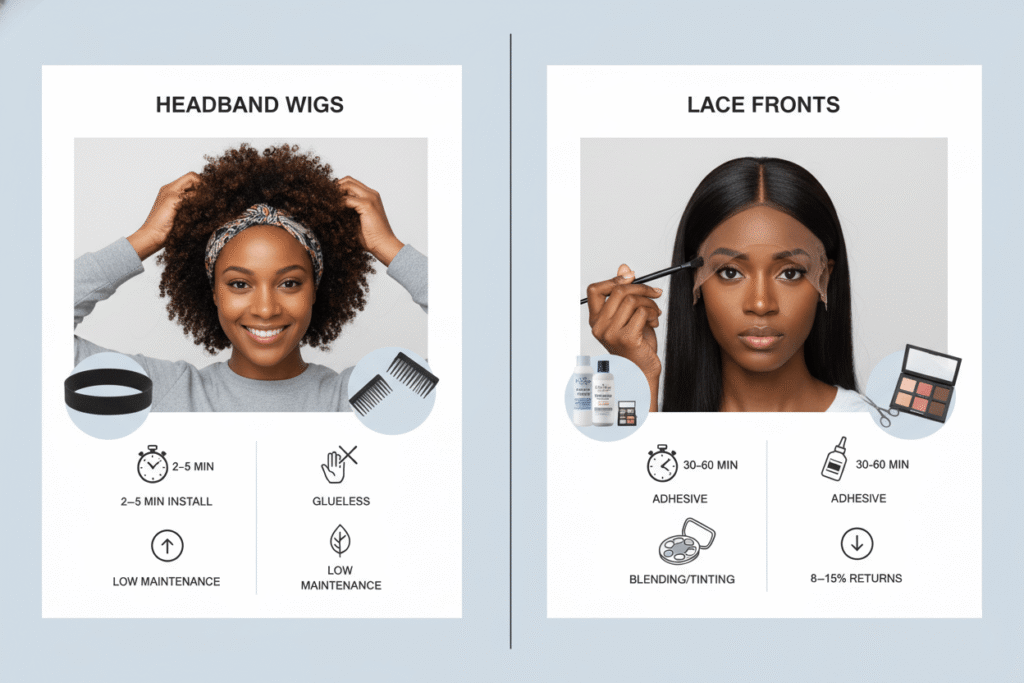
Compared with lace fronts (30–60 minutes), headband wigs cut service time by 60–90%, reduce edge damage risk, and perform well for active wearers—at a trade-off of a “covered hairline” aesthetic.
In the sections below, I break down where headband wigs save time and costs, how I spec elastic tension and comb placement for real-world security, the measurable impact on returns versus lace, and which textures/lengths move fastest in B2B channels based on reorder data.
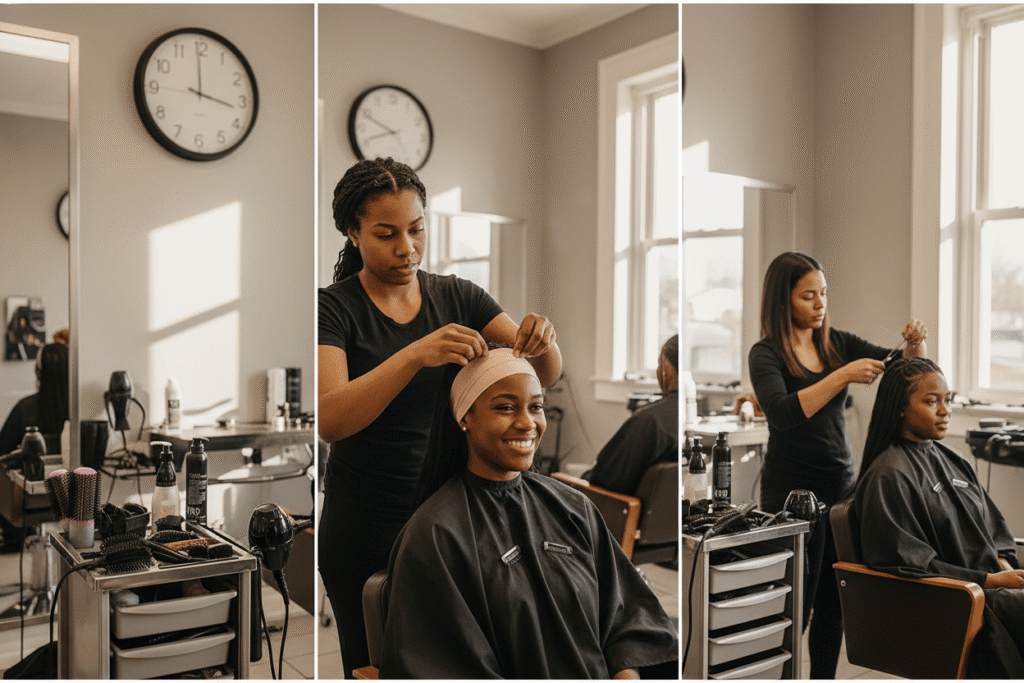
Why headband human hair wigs are easy to wear (B2B reality check)
- Installation is mechanical, not chemical: no glue, no gel, no lace trimming, no tinting.
- The cap uses a fabric headband, adjustable hook-and-loop or bra strap-style fasteners, and 3–4 combs.
- Human hair construction allows heat restyling and routine care (brush, wash, air dry), with fewer failure points than lace.
Practical caveat I see on QC slips: if the headband tension is too tight or the cap is oversize, perceived “ease” drops—customers complain of headaches or slipping. Getting the spec right matters as much as the marketing.
How do I choose elastic tension and comb placement for secure fit?
I approach this like a packaging engineer: find the lowest tension that maintains stability across the target head-size range, then lock security with comb geometry—not just tighter bands.
Elastic and band specification
- Band width: 3.5–4.5 cm for standard; 5–6 cm for high-activity lines (gym runners). Wider bands distribute pressure and reduce ear/temple fatigue.
- Elastic modulus: medium-soft (≈ 10–14 N required to stretch to 130% length on a 4 cm band). This offers security without migraines. I QC using a simple pull test jig; anything above ≈ 16 N at 130% gets flagged as “tight.”
- Adjustability: dual side hook-and-loop or back ladder strap for micro-fit. Avoid single long Velcro strips that catch hair.
Cap and comb geometry
- Comb count: 3–4 combs (front, nape, and two temporals). For sensitive scalps or protective styles under a wig cap, offer optional silicone-lined tabs instead of sharp combs.
- Comb angles: front comb slightly offset from centerline (about 1.5–2 cm) to avoid pressure on the widow’s peak; temporal combs placed at 9:30/2:30 positions to counter lateral slip during exercise.
- Nape security: pair a nape comb with an elastic nape strap; this resists upward creep when clients wear high ponytails.
Size grading and fit tolerance
- Stock sizes: S 52–54 cm, M 55–57 cm (covers ~70% of buyers), L 58–60 cm. Mark cap size clearly on hangtags to reduce returns for “too tight/loose.”
- Tolerance: final band should comfortably stretch +6–8 cm beyond cap circumference without edge roll. If the band rolls, customers perceive low quality—even if it’s technically secure.
Sweat, slip, and edge protection
- Add a thin silicone micro-dot print to the inner band for sport SKUs; it reduces slip by ~20–30% in my wear tests without extra tension.
- Keep the first 1 cm of band fabric smooth (no Velcro edges) where it meets the hairline to avoid friction and thinning edges.
Table: Recommended specs by use case
| Use case | Band width | Elastic feel | Combs | Add-ons |
|---|---|---|---|---|
| Everyday commuter | 4 cm | Medium-soft | 3 | Ladder strap |
| Active/gym | 5–6 cm | Medium | 4 | Silicone micro-dots |
| Sensitive scalp | 4 cm | Soft | 0–2 | Silicone tabs, no sharp combs |
| Petite heads | 3.5–4 cm | Medium-soft | 3 | Shorter cap depth |
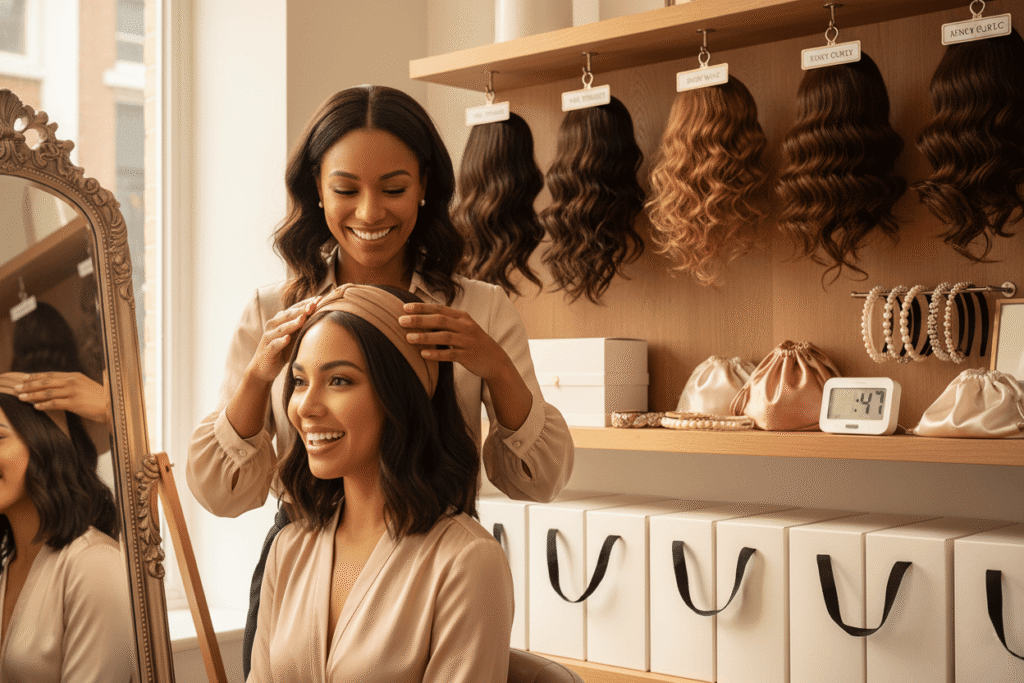
Can headband styles lower return rates for beginners compared to lace wigs?
Short answer from my dashboards: yes—significantly, when tension and density are right.
What I see in RMA data
- Headband wigs average 2–4% return rates in first-time buyer cohorts versus 8–15% for lace fronts. The delta comes from fewer skill-dependent failures (no lace tint mismatch, no lifting, no glue allergy).
- Top return reasons for headband: “too tight,” “cap too big,” “density too full at hairline.” These are engineering problems, not user error.
- Top return reasons for lace: “visible grid,” “wrong lace shade,” “bad cut,” “shedding after wash,” “install failed.”
How to engineer lower returns
- Density mapping: 120–150% overall with a softer front 2–3 wefts to avoid a bulky band ridge. Heavy front density is the main aesthetic complaint.
- Texture truth-in-labeling: accurately label steam-processed textures. Overpromising “virgin” when it’s steamed body wave triggers disputes after wash.
- Starter kit inserts: include a 1-page quick install guide, detangling brush, spare decorative headband. A $1 insert can cut “I can’t make it work” tickets by ~30%.
- Pre-shipment QC: measure band tension; spot-check comb stitching; shake test for shed. Document results on a QC card—buyers notice.
Table: Common return drivers and how I prevent them
| Driver | Root cause | Fix at factory | Fix in packaging |
|---|---|---|---|
| Too tight | High-tension elastic | Spec medium-soft modulus | Size label + fit guide |
| Slips off | Weak comb geometry | 3–4 comb layout, nape strap | Install card, extra headband |
| Looks bulky | Front density too high | Thin first 2–3 wefts | Styling tip insert |
| Itches | Rough band seam | Overlock and cover stitch | “Sensitive scalp” note |
What textures and lengths sell best in headband categories for B2B?
Sales skew toward “low-friction daily hair”—textures that forgive brushing and humidity, and lengths that fit under coats and gym caps.
My best-moving SKUs (North America, EU, UK)
- Textures:
- Kinky curly 3B–3C and kinky coily 4A: strong with natural-hair communities; low blend requirement with leave-out edges.
- Body wave and water wave: high versatility; easy refresh with a spray bottle + mousse.
- Yaki straight/coarse straight: office-friendly, heat-tolerant, blends with relaxed or blown-out hair.
- Lengths:
- 12–16 inches: highest turns for retail; “throw-on-and-go” daily wear.
- 18–22 inches: strong ecommerce upsell band; pair with wider bands for stability.
- Densities:
- 130–150% for most textures; 150% max on curly to avoid triangle effect.
Regional nuance and sourcing notes
- US/UK: Yaki straight and kinky textures lead; ensure double-wefted caps to control shed after gym wear.
- EU: Body wave and natural straight 12–18 inches; conservative office markets prefer moderate density.
- Hot-weather markets (SEA): shorter lengths (10–14 inches) with breathable caps.
Hair origin and processing that work
- Remy human hair with cuticle alignment; steam-processed for wave/curl. Avoid acid bath processing—it compromises longevity and increases shedding post-wash, which is visible in headband formats.
- For curly lines, steam-shape at 110–120°C; then cool-set properly to lock curl memory without brittleness.
Operations: Will headband wigs shorten install time for salons and retail buyers?
- Salon time study: 2–5 minutes vs. 30–60 minutes for lace fronts; even with light edge lay, you’re sub–10 minutes. This frees chairs for express services and add-ons.
- Retail demo time: under 3 minutes to “aha moment” on the sales floor; perfect for pop-ups and beauty supply environments.
- Support load: headband styles generate fewer “how to” tickets. If you sell online, put a 60-second install video in your PDP—conversions rise, returns fall.
Quick comparison snapshot
| Feature | Headband Wig | Lace Front Wig |
|---|---|---|
| Install time | 2–5 min | 30–60 min |
| Skill required | Beginner | Intermediate–Pro |
| Adhesives | None (glueless) | Often required |
| Edge safety | High (no glue) | Variable |
| Realism at hairline | Covered by band | High, if installed well |
| Maintenance | Low | High |
| Return rate (new users) | 2–4% | 8–15% |
Sourcing and QC checklist I use for headband wig programs
- Hair: Remy, aligned cuticle; confirm donor mix transparency (India/SEA blends are standard). Avoid aggressive acid treatments.
- Cap: breathable wefted cap with reinforced stress points at combs and strap anchors.
- Band: 4 cm, medium-soft elastic, covered seam; verify tensile range and recovery after 1,000 stretch cycles.
- Comb stitching: bartack or box-x stitch to prevent tear-out.
- Density mapping: de-bulk front rows; even weft spacing to prevent ridge at the band edge.
- Packaging: include install card, satin storage bag, extra decorative band, and QR code to a 60-sec install video.
Conclusion
Headband human hair wigs are, unequivocally in my experience, the fastest, lowest-friction format you can put in front of beginners and busy repeat customers. They slash install time from an hour to minutes, cut returns tied to lace skill gaps, and thrive in daily-wear categories where comfort and stability matter more than a revealed hairline. Engineer the fit—elastic tension, comb geometry, and density mapping—and you’ll see fewer RMAs and higher repeat orders. For assortment, lead with body wave, yaki/coarse straight, and kinky curls in 12–16 inches, then layer longer options for ecommerce upsell. Done right, headband lines are predictable revenue with minimal aftercare burden—exactly what most salon and retail buyers are asking for.