
I get this question from brand owners and factory buyers all the time, especially when they’re scaling SKUs across diverse markets. In my experience working with manufacturers in China and suppliers across India and Southeast Asia, lace color sounds simple—but it’s where returns, poor reviews, and wasted inventory quietly stack up. Matching the lace to the wearer’s scalp/forehead tone (not their overall skin tone) is the difference between “passable” and undetectable.
Yes, you can customize the lace color of a human hair wig, both at order time and post-production. Most brands should stock a streamlined range (transparent, light brown, medium brown, dark brown, plus HD) and use a clear naming system. HD and transparent lace cover the widest range; when in doubt, choose slightly lighter and tint down using professional lace sprays or makeup—these are cost-effective for bulk buyers and easy for end-users to adjust.
Below I break down which shades to offer, when to use tinted lace versus tint sprays, how to standardize names to avoid confusion, and a quick sample process that helps buyers approve lace colors confidently and fast.
Which lace shades should I offer to match my clients’ skin tones?
The practical core lineup
From a B2B standpoint, most ready-to-wear programs can run profitably with this five-SKU base:
- Transparent
- Light Brown
- Medium Brown
- Dark Brown (offer where demand data supports it)
- HD (ultra-thin, more translucent Swiss-type lace)
What I’ve seen: transparent, light brown, and medium brown make up the majority of sales; dark brown moves slower but is essential for certain markets. HD lace blends across a wider range of complexions and helps reduce “near-miss” returns.
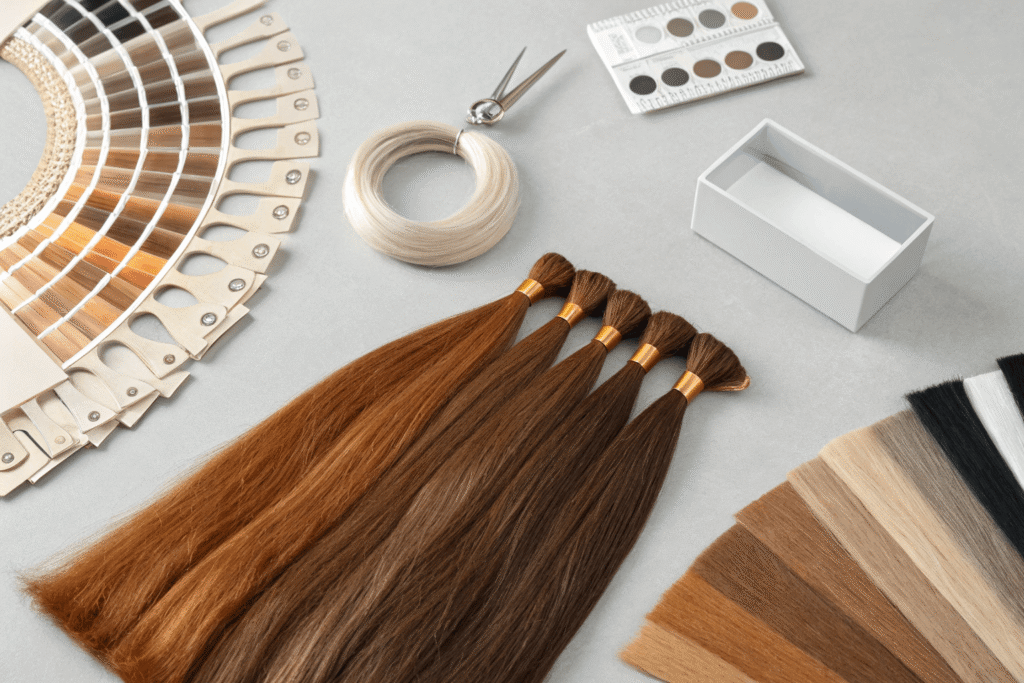
Match to scalp/forehead tone, not overall skin
- Train your sales and customer support teams to request a photo of the buyer’s hairline or part area under natural light. That’s the true match zone.
- For lower-density hairlines or clean, pre-plucked hairlines, precision in lace shade matters more; dark roots or high-density fronts are more forgiving.
Default rules that reduce returns
- When unsure, ship transparent or HD. Transparent is marketed as the most versatile; HD is thinner, more translucent, and often blends best without tint.
- If a perfect match isn’t available, start slightly lighter and tint down. Overly dark lace is harder to reverse.
Quick reference: when each shade works best
| Lace Shade | Typical Use Case | Notes for Buyers |
|---|---|---|
| Transparent | Broad, all-market default | Safe for unknown end customer; quick to tint down if needed |
| Light Brown | Light-warm to tan scalp tones | Most forgiving after transparent; high sell-through in US/EU markets |
| Medium Brown | Medium to deep-warm scalp tones | Pair with pre-bleached knots for most natural hairline |
| Dark Brown | Deep, cool-to-neutral scalp tones | Stock where demand is proven; avoid overbuying |
| HD | Cross-tone blending; premium SKUs; photoshoots | Thinner and more translucent; higher cost, lower durability if mishandled |
Do tinted lace options or makeup tint sprays work better for bulk buyers?
Cost, speed, and control: the trade-offs
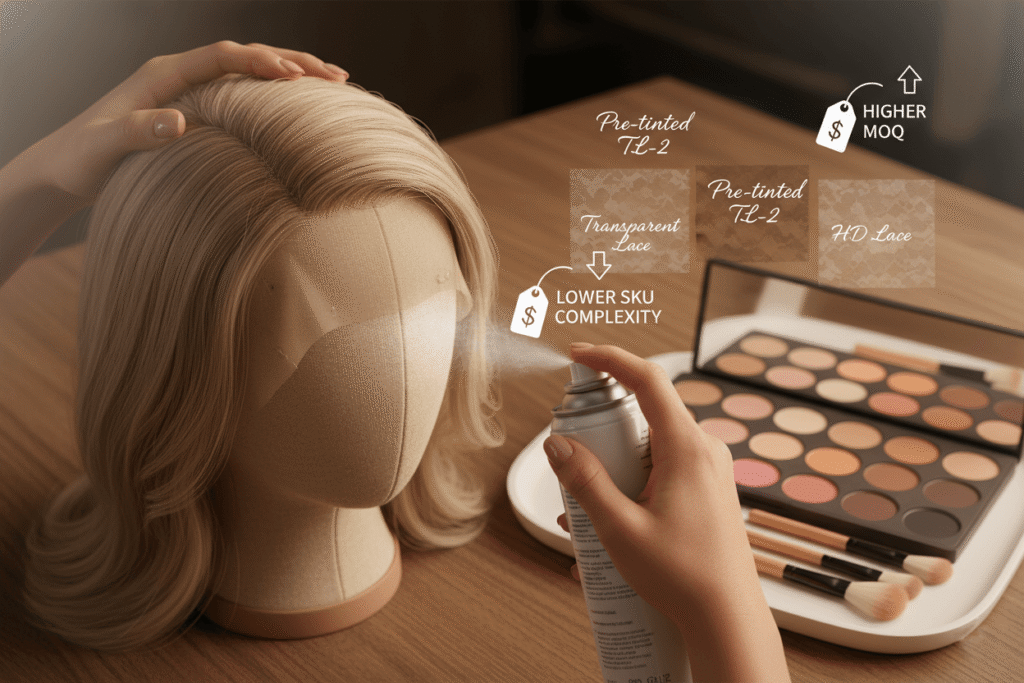
- Pre-tinted (factory) lace: Better out-of-box match for defined customer segments, but increases SKU complexity and minimums. Useful for custom programs with predictable demographics or private-label assortments.
- Post-purchase tint (sprays/powders/foundation): More flexible and economical at scale. Buyers can adjust by 1–2 shades as needed. Semi-permanent; expect touch-ups after washing or sweating.
- HD lace: Often eliminates the need for heavy tinting. It’s thinner, blends across more tones, and can reduce assortment size—but costs more and can be more delicate.
Practical guidance I give wholesalers
- For mass-market eCom: Lead with HD and transparent. Bundle a lace tint mini (spray or powder) as an upsell or kit.
- For salon or boutique buyers: Offer light and medium brown as core, plus transparent. Teach stylists to finish with tint spray or foundation at install.
- For enterprise/private-label programs: Pre-tinted lace in 2–3 shades tied to your customer demographics, plus a fallback transparent/HD.
Performance realities
- Tint sprays/powders: Semi-permanent; easy to refresh; won’t compromise lace integrity. Good margin add-on. Needs education on aftercare.
- DIY dye (tea/coffee/fabric dye): Can shift 1–2 shades permanently, but batch variance is high. I only recommend this for controlled in-house processing.
- Start lighter, tint down: Consistently produces more natural results and fewer “halo” edges than starting too dark.
How can I standardize lace color naming to avoid confusion?
Adopt a simple, unambiguous taxonomy
Confusing naming is a top driver of wrong-shade claims. Standardize your catalog and packing slips with a code + name:
- TL-0 Transparent
- TL-1 Light Brown
- TL-2 Medium Brown
- TL-3 Dark Brown
- TL-HD High Definition (HD)
Add undertone tags where relevant (N = neutral, W = warm, C = cool) if your customer base requests it, e.g., TL-2N.
Map supplier terms to your standard
Factories often use overlapping terms (“beige,” “brown,” “tan,” “mocha”). Require suppliers to label shipments with your codes. Include a conversion key on purchase orders and QC sheets.
| Supplier Term | Your Standard Code | Notes |
|---|---|---|
| Beige / Nude | TL-0 | Treat as Transparent |
| Light Beige / Tan | TL-1 | Light Brown |
| Brown | TL-2 | Medium Brown |
| Dark / Deep Brown | TL-3 | Dark Brown |
| HD / Film Lace | TL-HD | Verify it’s true thin, translucent HD lace |
Visual tools to reduce disputes
- Ship every B2B account a physical swatch ring labeled with your codes.
- Publish a lighting-standardized PDF shade guide. Specify “match to scalp/forehead tone.”
- Print the shade code on the box, hangtag, and inner QC sticker to avoid warehouse mis-picks.
What sample process helps my customers approve lace colors quickly?
A fast, low-friction SOP I use with brand clients
1) Discovery:
- Ask for two photos: hairline and natural part in indirect daylight, plus their preferred makeup finish (matte/dewy) which can shift perceived tone.
- Confirm hairline density (natural, pre-plucked, high density) and root color; precision matters more on low-density lines.
2) Digital pre-match:
- Recommend a default: HD or TL-0 if uncertain; TL-1 for warm light-to-tan; TL-2 for medium; TL-3 for deep/cool.
- Send a one-page guide on “slightly lighter + tint down” best practice.
3) Physical confirmation (for orders > X units):
- Mail a 5-piece lace swatch card (TL-0, TL-1, TL-2, TL-3, TL-HD).
- Ask clients to place swatches on the forehead and part line, take photos in natural light, and circle their pick.
4) Production lock:
- Record the final code on PO, carton, inner tag, and ERP record.
- For first-time accounts, add 5–10% of units in transparent as a buffer to rework via tint if any mismatches occur.
5) Post-delivery support:
- Include a QR code to a 60-second “tint down” tutorial using lace tint spray or foundation.
- Provide a care note: tint may require touch-ups after washing or sweating; reapply on clean, dry lace.
QC checkpoints that catch problems early
- Verify “HD” is actually thinner and more translucent than standard Swiss lace (micrometer or side-by-side comparison).
- Spot-check color consistency under D65 lighting. HD can read lighter; document this in your guide.
- Confirm knots: if the lace is darker but knots are not bleached, the hairline will still look dotted. Offer pre-bleached knots on TL-1/TL-2 as standard.
By streamlining to a core shade range, leaning on HD and transparent for versatility, and codifying a simple naming system with physical swatch confirmation, I’ve seen brands cut lace-related returns by 20–35%. The key is teaching buyers to match the scalp/forehead, defaulting lighter, and giving them easy tinting tools to fine-tune on install.