
I get this question weekly from brand owners and procurement teams comparing vendor quotes side by side: same “10A” claim, wildly different density at the ends, and a price delta that makes no sense on paper. In my experience, the confusion stems from mixing two systems—technical “drawn” ratios (a real manufacturing step) and the unregulated “A-grade” marketing labels (which vary by factory and country). If you’re buying at scale, understanding how single vs double drawn is built on the factory floor will save you from overpaying for air-weight bundles or rejecting shipments for stringy tips.
Single drawn to double drawn describes the ratio of long strands to short strands in a bundle, which directly controls how full the ends look. Single drawn bundles usually contain about 40–60% of strands at full advertised length with a natural taper, while double drawn targets roughly 70–90% long strands for thicker, blunter ends. “A-grade” numbers (8A, 10A, 12A) are marketing shorthand and not standardized—always verify the long-hair ratio in QC.
I’ll break down the density math behind single vs double drawn, how grades translate to shedding, tangling, and wear, whether double drawn is worth it for premium customers, and the exact data points I ask factories to include in QC so you can sign off with confidence.

What does single vs double drawn mean for thickness and ends?
The drawn system in practical terms
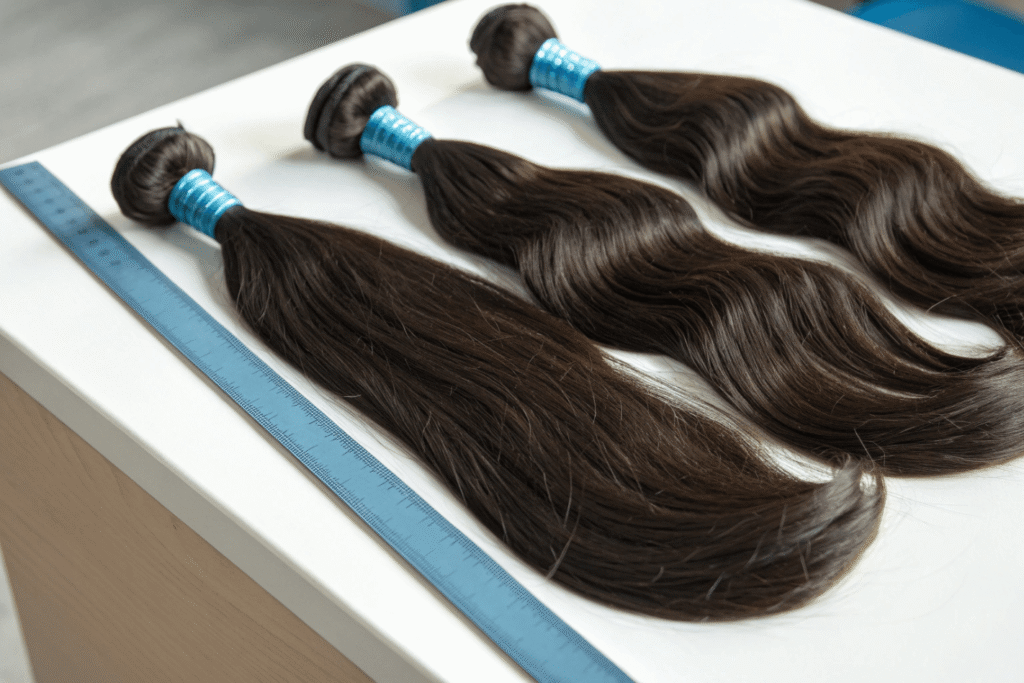
- Single drawn: mixed lengths with a natural taper from thicker roots to thinner ends. In production, workers perform minimal “drawing” (short-hair removal). You’ll typically see 40–60% of strands at the advertised length; the rest are shorter (e.g., in a 20-inch bundle you’ll find 14–18 inch fillers).
- Double drawn: manually sorted to a tighter long-hair ratio, commonly 70–90% full-length strands. Ends look noticeably fuller and more blunt. The higher the ratio, the more labor and waste (short hair removed), and therefore the higher the cost.
These are density specifications, not quality guarantees. Source, cuticle alignment (Remy), and processing (acid bath vs steam) still dominate performance.
Visual and weight implications
- Single drawn: more natural, layered look; appears thinner at the tips. Lighter on the head; may require more bundles for very full styles, especially over 20 inches.
- Double drawn: thicker and blunter from root to tip; reduces the number of bundles needed to achieve target density but can feel heavier and denser on the head. Ends hold shape longer with less trimming.
Typical density ratios by manufacturing tier
| Drawn Tier | % Full-Length Strands (typical) | End Profile | Bundle Planning |
|---|---|---|---|
| Single Drawn | 40–60% | Natural taper | Add 0.5–1 extra bundle for long lengths (20”+) |
| Double Drawn | 70–90% | Full, blunt ends | Fewer bundles needed for target volume |
| Super Double Drawn | 85–95% | Ultra-full, uniform | Premium looks (bobs, blunt cuts), highest cost |
Note: Ranges vary by region and vendor. Vietnamese/SEA double drawn often skews higher in ratio than mass Chinese commodity hair at the same label.
How do grades affect shedding, tangling, and long-term wear?
Short answer: drawn grade influences appearance and maintenance cadence, but fiber integrity and processing define long-term performance. I treat drawn grade as a styling/density choice and Remy/cuticle integrity as the durability choice.
Shedding
- Primary drivers: weft construction (tight, double-stitched; silicone-free), weft sealing, and cuticle condition.
- Effect of drawn grade: double drawn can shed slightly more during first wear due to higher manual sorting and trimming near tips; stable thereafter if wefts are well-made. Single drawn may appear to “thin out” faster at the ends—not necessarily from shedding, but because short fillers drift out with brushing.
- Procurement note: specify weft tensile test (pull test), post-wash shed count per 100 strokes, and weft stitch density (stitches/cm).
Tangling
- Primary drivers: Remy alignment and whether an acid bath stripped cuticles. Non-Remy or acid-stripped hair tangles regardless of drawn grade.
- Effect of drawn grade: denser ends on double drawn can compact if silicone is heavy or cuticles are rough, leading to snags near the last 3–4 inches. Proper Remy with light steam processing mitigates this.
Long-term wear and maintenance
- Single drawn: may need periodic dusting or trimming to keep tips neat; looks naturally layered; lighter feel reduces traction on lace.
- Double drawn: holds shape and fullness at the tips longer; better for blunt styles and repeated heat styling; can feel heavier, so cap design and weight distribution matter for comfort.
Key truth: Remy alignment, cuticle integrity, and donor origin affect performance more than draw grade alone. An 80% double drawn that has been acid-bathed will underperform a 55% single drawn with intact cuticles.
Is double drawn worth it for my premium customer base?
For premium clients who pay for a camera-ready finish and repeat wear, yes—if you pair double drawn with verified Remy/cuticle-intact sourcing and responsible processing.
When double drawn pays off
- Product-market fit: blunt bobs, luxury straight, and long, sleek looks where thin ends trigger returns.
- Fewer bundles needed: often offsets part of the cost in 18–24” lengths; improves unit economics on ready-to-wear wigs and frontal sets.
- Lower salon rework: less end-trimming and point-cutting saves stylist time, which premium customers notice.
Caveats before you upgrade
- Heavier density: ensure cap engineering (ventilation zones, elastic placement) to maintain comfort. Consider reducing overall wig density (e.g., 130–150% instead of 180%) when using high-ratio double drawn to avoid a “helmet” feel.
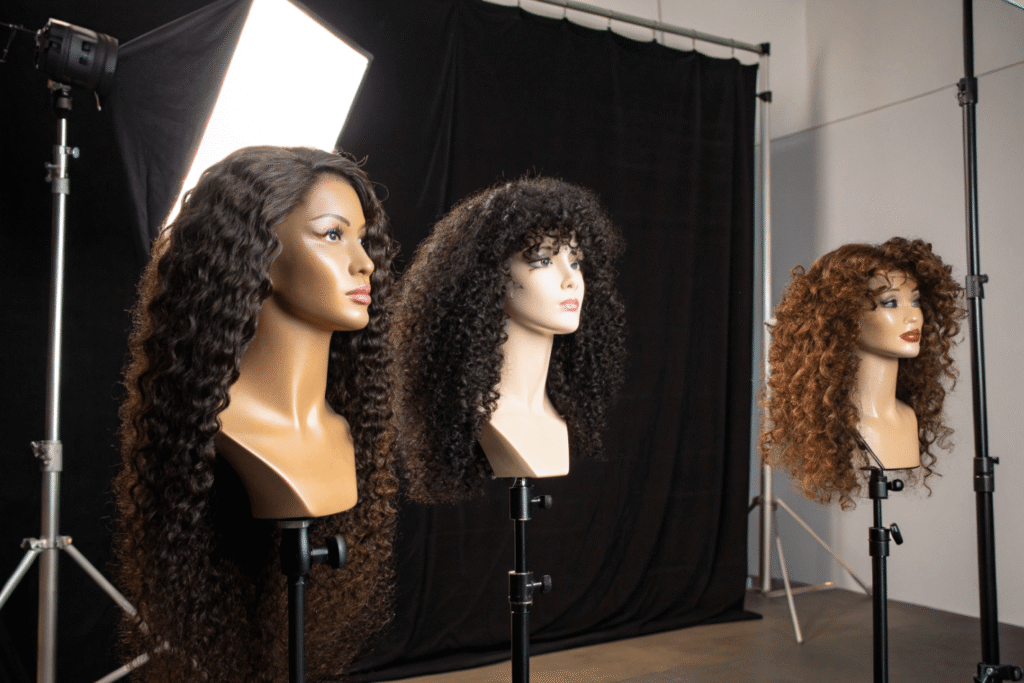
- Style intent: for layered, beachy, or highly textured styles, single drawn can look more believable and lighter. Curls hide thin ends—double drawn isn’t mandatory for deep curl SKUs.
- Cost stack: double drawn pricing includes higher labor and hair waste. If the vendor’s “10A double drawn” is only 65% long-hair ratio in practice, you’re paying premium for mid-grade density.
Recommendation: for a premium line, run a split SKU strategy—double drawn for straight/body wave and blunt cuts (core premium), single drawn or low double drawn for curls and textured lines where layering is desired.

How can I verify grading standards in factory QC reports?
I never sign off on “A-grades.” I sign off on metrics. Here’s the QC data I require and how to audit it.
QC metrics to specify in your PO
- Long-hair ratio by sample count: report % of strands at full advertised length for each lot (e.g., ≥75% for double drawn, test n≥300 strands per bundle across 5 bundles/lot).
- Length distribution histogram: 2-inch binning (e.g., 12–14–16… to full length) to confirm short filler removal.
- Weight accuracy: net grams per bundle (without ties/tags) within ±2 g tolerance.
- Weft construction: stitches per cm, weft width variance, and weft sealing method; require post-wash shed count per 100 brush strokes.
- Cuticle alignment verification: root-to-tip glide test pass rate and 30x microscopic cuticle presence sampling.
- Chemical processing disclosure: acid bath (Y/N), neutralization pH, silicone application (Y/N, type, add-on %, wash-off cycles tested).
- Moisture regain and elasticity: after 2 wash cycles (sulfate-free) to simulate early customer use.
- Color/steam processing: steam pattern time/temp; for colored lots, delta E color variance across 5-point sampling.
On-site or third-party checks
- Strand-count method: clamp a small lock, measure full-length strand proportion against a ruler; repeat across at least five random spots per bundle to avoid cherry-picking.
- Cross-section weight test: trim last 3 inches and weigh—double drawn shows a higher tip mass percentage vs single drawn of same length/weight.
- Tangle simulation: standardized comb-through cycles on wet and dry states, record snag events.
- Vendor transparency: request a video of the drawing line—manual sorting tables, waste bins, and length gauges. Real double drawn lines have visible short-hair discard.
Sample QC template (what I ask suppliers to fill)
| Parameter | Spec (Double Drawn) | Lot Result | Pass/Fail |
|---|---|---|---|
| Long-hair ratio | ≥75% at full length | 82% | Pass |
| Length distribution | ≤15% below -4 inches | 9% | Pass |
| Shed count (100 strokes) | ≤8 fibers | 6 | Pass |
| Cuticle alignment pass rate | ≥95% | 97% | Pass |
| Acid bath | Not allowed | N/A | Pass |
| Net weight (100g ±2g) | 98–102g | 101g | Pass |
A-grades vs drawn grades—how to reconcile in contracts
- Force the supplier to map their “A-grade” to your numeric long-hair ratio. Example: “Vendor 10A = Buyer Double Drawn 75% LHR minimum.”
- Include a price ladder tied to measured LHR bands (e.g., 65–70%, 71–80%, 81–90%) to prevent paid-for density drift.
- Add a right-to-rework or price reduction clause if two consecutive lots fall below spec.
Quick procurement rules of thumb
- For 20–24” straight wigs aimed at premium buyers, specify double drawn at 75–85% LHR with Remy/cuticle-intact, no acid bath, and stitches ≥3.5/cm.
- For curled textures, single drawn 55–65% LHR is acceptable if ends will be shaped; prioritize Remy and low silicone over density.
- Always request pre-ship photos of tips compressed between fingers; thin, see-through fans indicate low LHR despite big “A-grade” claims.
Conclusion
From a manufacturing standpoint, “single vs double drawn” is simply the long-hair ratio—the lever that controls how full your ends look, how many bundles you need, and how the wig feels on the head. Single drawn (about 40–60% LHR) gives a natural taper and lighter wear; double drawn (about 70–90% LHR) delivers fuller, blunter ends at higher cost and weight. But durability lives upstream: Remy alignment, cuticle integrity, and gentle processing outweigh any label like 8A or 12A. For premium lines, double drawn is worth it when verified by QC: demand long-hair ratio reporting, length distribution, cuticle checks, and transparent processing data. Tie payments to measurable specs, not marketing grades, and you’ll buy density—not disappointment.