
I spend a lot of time in wig plants watching planners juggle celebrity-inspired one-offs with 5,000-piece bulk runs for e‑commerce drops. The tension is real: buyers expect fast, precise customization (lace tint, density gradients, curl patterns), while finance needs predictable throughput and margin. In hair, the added complexity is biological variability—bundles from India don’t behave like SEA straight, and a 10% change in curl spec can add hours at steam-setting. If we don’t architect products and schedules deliberately, “custom” becomes code for WIP bloat, overtime, and quality drift.
Factories balance custom orders and mass production efficiency by modularizing products, postponing customization to late-stage assembly, and sequencing work with advanced planning to batch similar specs. They hold dual inventories (common caps/hair bases vs. special trims), reserve capacity windows for customs, and enforce tight sample-approval SOPs to prevent rework. With configure-to-order playbooks, SMED changeovers, and data-driven forecasting, plants maintain takt on bulk lines while turning custom promises reliably.
In the sections below, I’ll show how I modularize caps and hair assemblies to pre-build popular SKUs, how I schedule small custom runs without derailing bulk, what data I track to forecast styles and plan raw hair inventory, and how I write sample SOPs that eliminate back-and-forth. I’ll include tables, concrete parameters (venting rates, density curves), and the planning cadences my procurement teams actually use.
Can I modularize caps and pre-make popular SKUs to shorten custom lead times?
Yes—and in hair, modularity is your fastest lever. I design a configure-to-order (CTO) architecture where 70–80% of the wig is standard and pre-made, and the last 20–30% is configurable at late-stage.
- Cap system: Standardize 3–4 lace base templates (13×4 HD, 13×6 Swiss, 5×5 closure, full lace), with pre-stitched strap/ear tab kits and pre-sewn weft tracks for common sizes (S/M/L). Keep the hairline pre-vented to a conservative baseline (e.g., 110% density, straight gradient), so customization only requires incremental plucking or filling.
- Hair modules: Pre-weft 10–12 top sellers by origin/texture/length bands: e.g., Indian natural wavy 12–20″, SEA straight 12–30″, Brazilian body wave 14–24″. Keep bundles steam-set to “neutral” profiles that can be up- or down-processed (e.g., light body that can be tightened to deep wave).
- Postponement: Delay lace tint, final density adjustments, and parting (middle/side) to final assembly. This preserves upstream takt on wefting/ventilating.
What I pre-make in practice
- Caps: 60% of monthly cap volume as semi-finished (straps, combs, labels, QC’d seams). 20% as finished “naked caps” (for drop-in ventilating).
- Hair: 6 weeks of ABC movers (A: 4 weeks on hand; B: 2–3; C: 1–2), with safety stock on common origin-lengths that have slow procurement (e.g., SEA long straight 26–30″).
- Semi-finished wigs: Top 20 SKU shells (e.g., 13×4, 180% density base, 18” straight) in undyed natural color. This turns many “custom” orders into ATO (assemble-to-order) jobs.
Key parameters to standardize
- Knots: 1–2 hair per knot on hairline 1.5 cm band; double knots elsewhere.
- Density bands: 90–110% hairline; 130–150% mid; 160–180% crown for “base” builds.
- Venting grid: 0.8–1.0 cm standard; keep 0.6 cm grid templates only for premium lines.
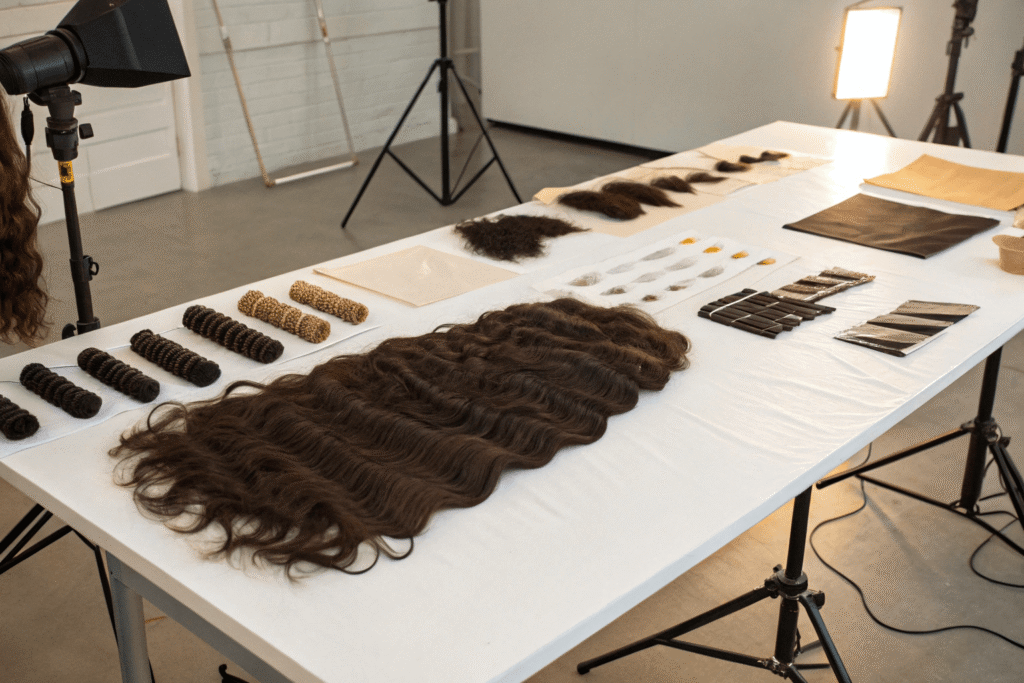
Table: Example modular BOM for CTO wig builds
| Module Group | Standard Options (Pre-made) | Late-Stage Options (Customizable) |
|---|---|---|
| Cap Base | 13×4 HD, 13×6 Swiss, 5×5 closure | Cap size micro-adjust, ear tab angle |
| Hair Origin/Texture | SEA straight, Indian wavy, Brazilian BW | Curl re-steam (tighten/loosen), bleaching |
| Length Bands | 12–16, 18–22, 24–30 inch | Mixed-length layer blends |
| Density Template | 130/150/180 profile | Hairline plucking, baby hair pattern |
| Color | Natural 1B undyed | Tones, balayage, #613 overlays |
| Finishing | Labels, straps, combs | Lace tint, parting, hot pressing |
This structure converts 70% of custom SKUs into 2–3 day lead time finalization rather than 10–15 day end-to-end builds.
How do I schedule small custom runs without disrupting bulk lines?
I protect bulk takt by isolating customization to flexible cells and time windows, then use APS to batch by changeover drivers.
- Flow segmentation: Keep continuous wefting, dyeing, and base cap sewing on fixed takt lines. Route customs to mixed-model cells (ventilating benches, tint booths, finishing) with SMED kits for quick changeovers.
- Constraint-based capacity planning: Reserve 10–20% of weekly capacity in finishing/ventilating cells for customs. Hard-fence this time so bulk doesn’t consume it during spikes.
- Sequencing logic: Use APS rules to batch by the highest-cost changeover first: chemistry (dye color families), then lace type, then length/texture. For ventilating, sequence by lace type and density grid to minimize needle/tool swaps.
Practical schedule pattern (weekly)
- Mon–Thu: Bulk lines run at fixed takt; customs run in two 3-hour windows/day (10:00–13:00, 16:00–19:00).
- Fri: 50% of ventilating/tint capacity reserved for spillover customs and remake buffers.
- Daily 30-minute DDM (digital daily meeting) between planning, QC, and purchasing to reconcile WIP and expedite parts.
Changeover reduction with SMED
- Pre-stage color chem sets by family (cool browns vs warm blondes).
- Quick-swap ventilating needles and pre-cut lace panels by sku cluster.
- Standardized work with visual guides at each bench; 5S carts per texture family.
Table: Example APS sequencing rules for mixed orders
| Driver | Rule Example | Impact |
|---|---|---|
| Chemistry | Batch all ash-brown tones before warm browns | Fewer dye pot purges |
| Lace Type | Run HD then Swiss in blocks | Reduce needle and tension changes |
| Length/Texture | Group 18–22” straight before 24–30” straight | Minimize fixture swaps |
| Density Profile | Process 130/150/180 templates together | Keep venting grids constant |
Commercial controls
- MOQ pricing tiers for customs (e.g., surcharge <20 pieces) to absorb setup.
- Promise windows aligned to capacity fence (e.g., customs quoted at 5–7 working days based on reserved cell time, not on aspirational averages).
What data should I track to forecast styles and plan raw hair inventory?
In hair, bad forecasting shows up as color/texture stockouts and stranded long lengths. I track a tight set of demand, process, and procurement signals and feed them into rolling 13-week and 26-week plans.
Demand signals
- Style mix: cap types, parting preferences, density curves, lace type share.
- Length/texture curves by market (US vs EU vs MENA): e.g., EU favors 12–18”, US 18–24” straight/body wave.
- Color: #1B natural vs pre-bleached #613 share; seasonality of balayage/ombre.
- Channel promotions/calendar: marketplace sales, influencer drops, holidays.
Process/Yield signals
- Ventilating hours per density profile and lace type.
- Dye yield loss by origin/length (long SEA straight has higher breakage).
- Steam-set recovery rates per texture (tight curls vs body wave).
Supply signals
- Lead times by origin: India temple hair 2–3 weeks; SEA straight long 4–6; Eastern Europe Slavic raw 6–10.
- Supplier reliability and grade variance (Remy alignment pass rate).
- Currency/FX and export controls that affect cost/lead time.
Forecasting cadence
- Weekly: 13-week rolling forecast, lock current week, freeze week+1 for bulk, week+2 adjustable for customs.
- Monthly: 26-week horizon for long-length procurement and HD lace buys.
Inventory policy
- Dual inventory: common parts (caps, straps, 1B bundles) with higher turns; special components (#613 long, rare textures) on VMI or make-to-order.
- Safety stock on A movers using service-level targets (e.g., 95% fill for 18–22” SEA straight).
- Postponement WIP: semi-finished 1B shells; bleaching done only on firm demand.
Key metrics I monitor
- Forecast accuracy by family (MAPE): target <20% on A movers.
- Plan adherence on critical cells (ventilating, dyeing): >90%.
- Supplier OTIF and quality PPM (cuticle alignment failure rate).
- Ageing inventory by length/texture: trigger promotions for >60 days age on C movers.

How can I set SOPs for sample approval to avoid rework?
Most rework starts with fuzzy briefs. I run a gated sample process with unambiguous specs, visual evidence, and sign-offs that flow straight into MES/APS.
Stage 0: Commercial brief (must-have inputs)
- Cap: type, size, lace grade, parting.
- Hair: origin, texture, length, density profile (hairline/mid/crown), color target.
- Finishes: baby hair, bleached knots, tint level, hot press profile.
- Tolerances: length ±0.5″, density ±5%, color ΔE ≤ 2 (or standardized swatch).
Stage 1: Digital prototype
- CAD/CAM or digital twin for density map and lace grid; share 3D renders with BOM.
- Approval in PLM; lock version control and target takt-time.
Stage 2: Lab dip / hair swatch
- Provide 10 g swatch processed to target color/texture; include wet/comb/heat tests.
- Client sign-off on physical swatch with light booth photos.
Stage 3: T0 sample (PP sample)
- Build from production-intent modules; record parameters: venting rate (hairs/min), dye curve, steam profile.
- QC checklist with measurements: cap dimensions, density by zone (grams), shedding/pull test, lace tensile.
Stage 4: Golden sample creation
- After approval, tag as “Golden” with QR code linking BOM, work instructions, photos, and test data.
- Freeze critical specs; any change triggers ECO (engineering change order) and new sample cycle.
Documentation and controls
- Photo/video protocol: standardized angles, color card, mannequin type, RAW files with exposure notes.
- Limit iterations: max two rounds before surcharge or spec reset.
- Deviation handling: if material constraints (e.g., #613 in 28–30″ scarce), issue a deviation form with impact on lead time/cost.
Shop-floor integration
- Push approved routings to MES; lock parameters so operators can’t free-hand density or chemistry.
- First-article inspection on first 5 units; QC gate before packing.
This SOP routinely cuts rework by 30–50% and keeps customs inside the reserved capacity window.
Conclusion
Balancing custom wig orders with mass production efficiency is a design-and-operations problem, not a firefight. I modularize caps and hair modules to pre-build 70–80% of the product, postpone customization to finishing cells, and protect capacity with APS-driven sequencing and hard-fenced custom windows. I forecast with a focused dataset—style mix, yields, and origin lead times—and hold dual inventories to avoid material shocks. Finally, I enforce a gated sample SOP so what sales sells is exactly what production builds. Done together, these practices turn “custom” from chaos into a reliable, profitable service level.