
Consistency is the difference between scalable profits and perpetual firefighting in the wig business. When importing from China, the variance in hair origin, processing chemistry, line discipline, and storage conditions can turn a winning SKU into a liability. We’ve helped brands stabilize defect rates, lower returns, and keep repeat buyers happy by enforcing standards from incoming hair selection through shipment—and by baking those standards into contracts, SOPs, and QC routines.
To keep wig quality consistent when you import from China, lock technical specs into your POs, require golden samples for each SKU, implement AQL-based inspections at pre-production, inline, and pre-shipment stages, standardize processing parameters (bleaching, dye, perm, conditioning) in factory SOPs, trace lots and chemical batches, and tie supplier payments to SLAs on defects, rework, and replacements.
If you’re building or optimizing your sourcing program, start with documentation and inspection discipline. Below, I’ll walk through the exact controls we use—what your factory must record, how to set AQL and checkpoints, how to standardize chemical/mechanical processes, and what contractual SLAs keep suppliers honest.
What incoming hair selection and batch control should my factory document?
To reduce variance, your factory must treat hair/fiber selection like a controlled raw-material program—not a casual purchase. This section outlines the minimum documentation and traceability needed.
Require batch-level traceability for hair/fiber lots and chemical batches, and reject any shipment lacking lot IDs and processing logs. Lock fiber origin, denier, hair grade, weft density, lace type, knot-bleaching level, and shedding/tangle targets into your PO.
- Batch intake and traceability
- Lot IDs for each incoming hair/fiber batch (human hair: origin region and procurement date; synthetic: polymer type—Kanekalon/TOYOKALON/heat-resistant PET—with denier and filament spec).
- Supplier name, invoice/contract reference, and ethical sourcing statement for human hair (important for market compliance and brand risk).
- Grading records: virgin/Remy/non-Remy; hair grade scheme (define your own scale with objective metrics—cuticle alignment %, average tensile strength, moisture content).
- Contamination and treatment flags: colored/processed vs. natural; presence of silicone coating; smoke odor or residual chemical smell.
- Incoming QC tests to be logged
- Moisture content (%), tensile strength/elastic recovery, cuticle direction verification, root-to-tip alignment checks (fluorescent marking or microscopy).
- For synthetic fibers: denier confirmation, melting/softening point (DSC/TMA), gloss level, fiber crimp, and heat resistance grade.
- Shedding/tangle pre-tests on raw wefts: standardized combing cycles (e.g., 20 strokes with a wide-tooth comb at defined angle and force) with shed count per 100 strokes.
- Chemical batch control
- Lot IDs for oxidizers (peroxide), bleach powders, dye formulations (shade code, brand, batch), neutralizers, conditioners, silicones/oils.
- Safety Data Sheets (SDS) on file; record mix ratios, bath temperatures, dwell times, pH ranges, and operator IDs.
- Production linkage
- Each finished wig must carry a production label (inside cap tag or QR) referencing raw hair lot(s), chemical batch IDs, line/shift, and inspector code.
- Reject policy: any batch missing full traceability is non-conforming—no shipment.
Pro Tip: Implement dual-sourcing with a primary and vetted backup factory to benchmark quality and avoid dependency-driven quality drift. Divergence between suppliers often reveals where SOPs are being ignored.
Technical specifications to embed in POs (non-negotiable)
- Fiber/hair origin: human hair region or synthetic polymer type
- Denier (synthetic), hair grade (human), cuticle alignment requirement
- Weft density (g/m), cap density, lace type (Swiss/HD/transparent), lace shade
- Knot spec: single/double knot ratio; ventilation knot count per cm²; bleached knot level and target tone
- Curl/wave pattern code; curl retention benchmark after 5 wash cycles
- Acceptable shedding/tangle rates, odor limits, color variance delta (ΔE)
- Cap sizing tolerances and elastic/strap hardware spec
- Packaging: silica gel packs, sealed polybags, UV-protective boxes; humidity indicators
Which AQL levels and checkpoints (pre-production, inline, pre-shipment) should I enforce?
Inspection discipline catches drift early and prevents bad batches from shipping. Here’s how we structure checkpoints and AQL.
Use AQL II for major defects at 2.5–4.0 and minor at 6.5, with critical at 0.65 or tighter. Enforce three checkpoints: pre-production (golden sample and pilot run), inline (30–50% completion), and pre-shipment (≥80% packed), focusing on color, curl retention, odor, shedding, tangling, lace/cap defects, and sizing.
- Checkpoint framework
- Pre-production (PP): Approve golden samples per SKU; run a pilot of 30–50 units to validate processing parameters and workmanship before mass.
- Inline (DUPRO at 30–50%): Catch process drift—bleach/dye curve adherence, curl setting uniformity, ventilation quality, cap assembly accuracy.
- Pre-shipment (PSI at ≥80% packed): Random sampling per ANSI/ASQ Z1.4 with defined AQL.
- AQL levels (typical for wigs; adjust for premium tiers)
- Critical defects: AQL 0.65 (or 0.40 for luxury lines)
- Examples: contaminated hair, severe chemical residue/irritant odor, cap size out-of-spec by >1 cm, lace tear, bald spots, wrong SKU label.
- Major defects: AQL 2.5–4.0
- Examples: color mismatch beyond ΔE threshold, poor knot bleaching (visible grids on front line), excessive shedding (e.g., >10 strands after 20 comb strokes), curl pattern collapse after one wash, visible tangling, misaligned part.
- Minor defects: AQL 6.5
- Examples: small flyaways, slight uneven weft stitching not visible when worn, minor packaging scuff.
- Critical defects: AQL 0.65 (or 0.40 for luxury lines)
- Inspection focus items and methods
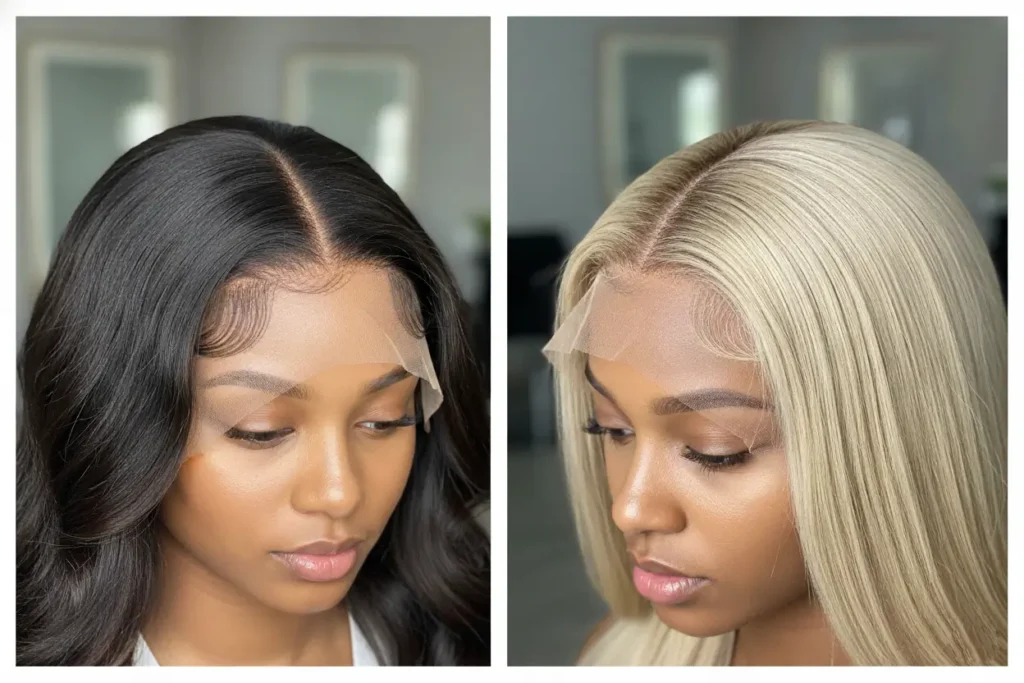
- Color consistency: ΔE measurement against golden sample under D65 light; reject if > defined threshold (e.g., ΔE > 2.0 for blondes).
- Curl pattern retention: standardized wash/air-dry test and 24-hour retention check; photograph against curl jig gauge.
- Odor: qualitative scale and VOC screen; require clean, neutral scent.
- Shedding/tangling: comb-through protocol; record shed count and audible friction notes.
- Lace and ventilation: knot density counts per area; check for over-bleach/yellowing; inspect hairline realism.
- Cap sizing: measure perimeter and ear-to-ear; tolerances ±0.5 cm for standard sizes.
Caution: Don’t accept “factory AQL” at face value. Mandate your own sampling plan and defect taxonomy, and have a third-party inspector verify on-site.
Example sampling plan (pre-shipment)
| Order Size (units) | Sample Size (Level II) | Critical (0.65) | Major (2.5) | Minor (6.5) |
|---|---|---|---|---|
| 500 | 80 | Ac 1 / Re 2 | Ac 5 / Re 6 | Ac 7 / Re 8 |
| 1,200 | 125 | Ac 2 / Re 3 | Ac 7 / Re 8 | Ac 10 / Re 11 |
How do I standardize curl setting, bleaching times, and conditioning to reduce variance?
Processing parameters drive most visible variability. You need locked SOPs, calibrated equipment, and controlled chemistry.
Standardize processing parameters (bleaching time/temperature, dye formulation, perm time, ventilation knot count, conditioning process) and lock them in SOPs with recorded ranges, equipment calibration, and operator sign-offs. Any deviation requires written approval.
- Bleaching and dye SOPs
- Define peroxide % and powder brand/batch, mix ratio, bath temperature range (e.g., 35–40°C), target lift level, max dwell time by hair type/porosity.
- pH monitoring at 5-minute intervals; neutralization time and product spec.
- Shade codes with ΔE tolerance; multi-step toning for ash/platinum to avoid over-lift.
- Record sheet: lot IDs, operator, timestamps, pH/temperature readings, strand tests before full batch.
- Curl setting (perm/steam set)
- Curl rod diameter chart per SKU; wrap tension standard (use torque-limited clamps).
- Processing time matrix by hair type (virgin vs. processed) and fiber type; temperature profile control for steam cabinets.
- Cooling/setting time and humidity range; post-set comb-through test and photographic documentation against golden sample.
- Retention test: 1 wash + 24-hour dry; accept only if curl drop < defined %.
- Conditioning and finishing
- Conditioner type, dilution ratio, contact time, rinse temperature; silicone application limits to prevent buildup.
- Drying method (net/stand), airflow and temperature; anti-frizz treatment spec; trimming standards.
- Odor control: activated carbon storage and purge; reject any residual chemical smell.
- Ventilation/knotting standards
- Knot count per cm² by zone (hairline vs. crown); single/double knot distribution; knot bleaching protocol and target tone.
- Lace inspection for snags, holes, and even tension to avoid premature tear.
- Equipment calibration and maintenance
- Weekly thermometer/pH meter calibration logs; quarterly preventive maintenance on steam cabinets and dye mixers.
- Operator certification by process; retraining after defect spikes.
Processing parameter table (example targets)
| Process | Parameter | Target Range | Control Check |
|---|---|---|---|
| Bleach | Bath temp | 35–40°C | 5-min interval logging |
| Bleach | Dwell time (level 7 lift) | 20–35 min (hair-grade) | Strand test before full run |
| Dye (ash) | ΔE vs. golden sample | ≤2.0 | Spectrophotometer D65 |
| Perm/steam set | Cabinet temp | 85–95°C | PID controller verification |
| Conditioning | Contact time | 5–8 min | Timer sign-off |

Pro Tip: For blonde SKUs, create a separate SOP with tighter ΔE and shorter dwell windows—light shades amplify small process errors.
What SLAs on defect rates, rework, and replacements should I put in my contract?
Contracts should translate your QC expectations into enforceable outcomes. Here’s a practical SLA framework.
Tie supplier payment terms to quality outcomes—reserve 10–20% as a holdback released only after post-arrival QC passes. Set monthly defect targets per SKU, mandate rework/replacements timelines, and link corrective actions to thresholds.
- Payment terms linked to quality
- 80–90% payment upon shipment; 10–20% holdback released only after random post-arrival QC passes (AQL per above) within 10 business days.
- Chargebacks for failures: inspection fees, rework freight, and replacement costs.
- Defect rate SLAs (examples; tune to your market)
- Critical defects: ≤0.3% per shipment; trigger immediate stop-ship and root-cause analysis if exceeded.
- Major defects: ≤2.0% per shipment; if >2.0%, supplier funds rework/replacement within 14 days.
- Minor defects: ≤5.0%; continuous improvement plan if exceeded twice in a quarter.
- Shedding/tangle post-sale returns (30-day): ≤1.0% per SKU.
- Rework and replacement timelines
- Rework decision within 48 hours of claim; replacements dispatched within 7–10 days or expedited air at supplier cost for urgent SKUs.
- RMA consolidation and monthly settlement; define acceptable photo/video evidence standards for retail customers to speed decisions.
- Documentation and enforcement
- Golden sample sign-off annexed to contract per SKU; any spec change requires mutual written amendment.
- Corrective Action Reports (8D) required for any AQL failure; timeline: containment (48h), root cause (7d), permanent corrective action (21d).
- Quarterly performance dashboard: defect taxonomy, SKU-level rates, CAPA status; pricing rebate if KPIs missed for two consecutive months.
- Compliance and lab testing
- Periodic lab tests on random batches: fiber composition verification, heavy metals, formaldehyde, azo dyes, microbial load; supplier bears cost if fail.
- Country-specific standards adherence (e.g., flammability, labeling). Non-compliance equals critical defect.
Caution: SLAs without data are weak. Build a defect taxonomy and ROI-driven QC checklist, track defect rates per SKU and supplier monthly, and enforce corrective actions when thresholds are exceeded.
Conclusion
Consistency when you import wigs from China comes from disciplined documentation, controlled processing, and contractual leverage. Specify detailed technical standards in your POs; require pre-production and golden samples; implement AQL-based inspections at all three checkpoints; standardize bleaching, dye, curl setting, and conditioning in SOPs; trace lots and chemical batches; and lock SLAs and holdbacks into your contract. Do this, and you’ll see fewer returns, tighter color/curl variance, and more repeat customers.
If you want help auditing your current supplier or drafting SOPs and SLAs tailored to your SKUs, contact us for tailored sourcing advice.