
I’ve spent enough time on factory floors and in sourcing meetings to know that “texture matching” is where beautiful installs either succeed or fail—especially for brands selling leave-out looks or partial-lace systems. Buyers tell me the same story: the curl pattern looks right online, but once the unit meets a client’s leave-out, the mismatch in strand feel, luster, and density betrays the install. As a manufacturer or wholesaler, we’re not just matching curls; we’re aligning cuticle behavior, fiber memory, shine, and weight so the transition from bio hair to unit is invisible under real lighting and real humidity.
The fastest way to match wig texture with natural hair is to align three variables: pattern (straight/wavy/curly/coily), strand feel (fine/medium/coarse via yaki, kinky straight, etc.), and density/luster (to mirror the wearer’s volume and shine). For leave-out styling, blends that mirror both curl diameter and strand “hand” (e.g., yaki for relaxed, kinky-curly for coily) transition most cleanly, supported by lace with a pre-plucked, gradually densified hairline and knots tinted to scalp tone. Maintain identical product routines on both hair and wig (edge control, foams/gels suited to coil type), and request supplier texture/lace swatches to validate under varied lighting.
In this guide, I’ll break down seamless blends for leave-out, how I choose density to complement natural volume, the products that consistently fuse edges with coily textures, and how to structure a supplier sampling program that prevents costly mis-buys. I’ll layer in manufacturing notes on fiber selection, processing, and QA checkpoints you can hand straight to your procurement and QC teams.
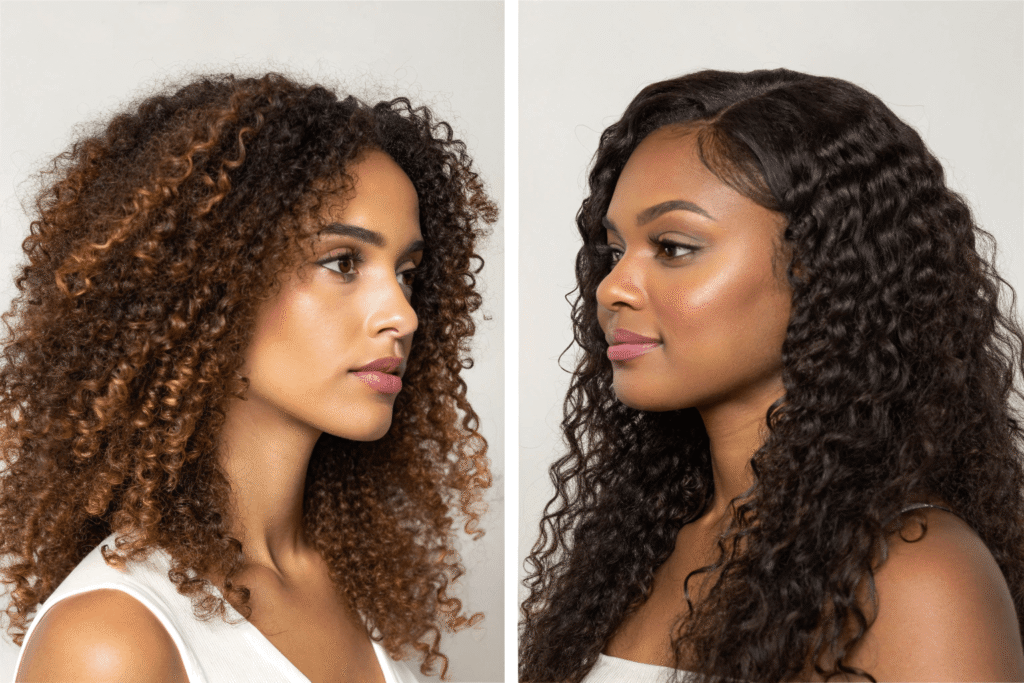
Which blends transition seamlessly from leave-out styling?
When a customer leaves hair out, any mismatch in strand feel, sheen, or curl memory will flash under daylight. I engineer blends to mirror not just the curl pattern but the tactile texture and luster.
My go-to “pattern + strand feel” pairings
- Relaxed or silk-pressed hair: yaki straight (simulates relaxed re-growth with slight micro-crimp), medium luster, medium density 120–130%.
- Blow-dried natural textures (Type 3–4): kinky straight (more tooth than yaki), low-to-medium luster; accepts heat or foam sets for added bend.
- Type 2 wavy: body wave/loose wave with soft cuticle-aligned Remy, low sheen; waves that fall out slightly mimic lived-in bio hair.
- Type 3 curls: match curl diameter (3A, 3B, 3C) and ensure hand-tied coils aren’t overly uniform; low luster to avoid plastic shine contrast.
- Type 4 coils: kinky-curly with tight coil diameter and low sheen; fiber must accept water/gel set to sync with the wearer’s coil spring-back.
Luster and lighting are deal-breakers
- I spec low-to-medium shine for human hair; overly glossy fibers (especially some heat-safe synthetics) will read “wig” next to matte bio hair.
- Always test a strand swatch next to the client’s leave-out under daylight, fluorescent, and warm indoor lighting before bulk buys.
Construction details that help the blend
- Lace-front or full-lace with a pre-plucked gradient hairline and lightly bleached/tinted knots to scalp tone.
- Directional ventilation (reverse-split knots near the hairline) to reduce bulk and mimic natural density graduation.
- Keep return hair (shorts) controlled on wefts to reduce frizz halo near the leave-out.
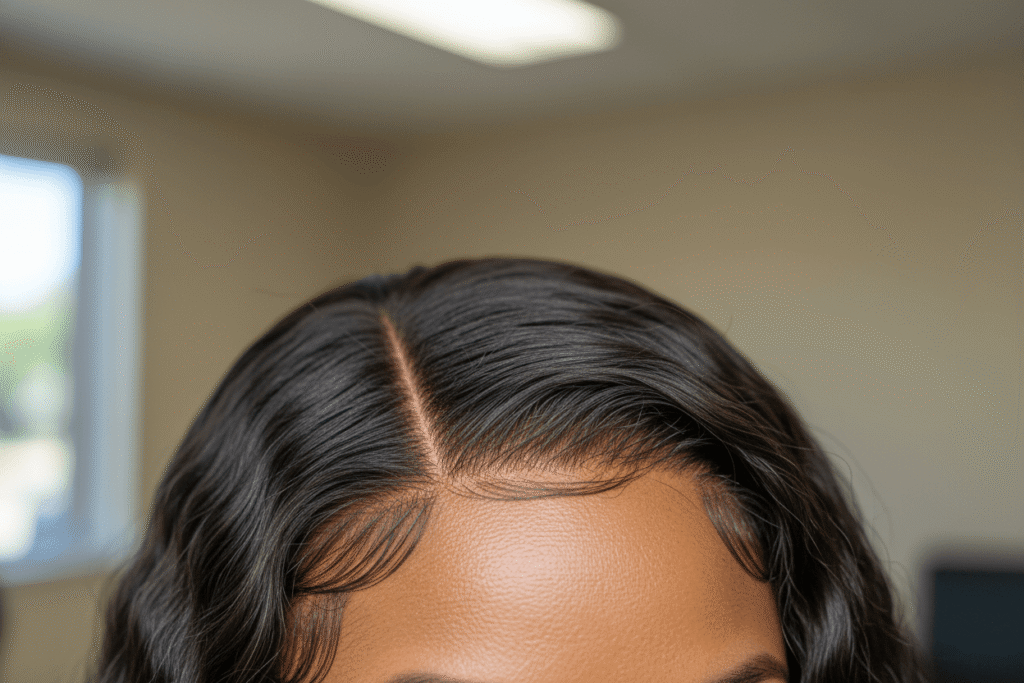
Quick reference: pattern, feel, and luster alignment
| Natural Leave-Out State | Recommended Wig Texture | Strand Feel Match | Luster Target | Notes |
|---|---|---|---|---|
| Relaxed/pressed straight | Yaki straight | Fine–medium | Low–medium | Slight micro-crimp mirrors relaxed hair body |
| Blow-dried natural (3–4) | Kinky straight | Medium–coarse | Low | Textured tooth hides transitions |
| 2A–2C wavy | Loose/body wave | Fine–medium | Low | Soft, irregular waves look most natural |
| 3A–3C curly | Curly (match diameter) | Medium | Low | Avoid uniform factory curls; request steam-set variance |
| 4A–4C coily | Kinky-curly | Coarse | Low | Coil diameter and frizz behavior are critical |
How do I choose density that complements my own volume?
In my experience, density is the most common mismatch after luster. Two clients can share a curl type but need entirely different densities for a seamless blend. I spec density by reading the wearer’s scalp show-through and ponytail thickness, then mapping to cap density and hairline graduation.
Practical density rules I use
- Thin/low-volume bio hair: 90–120% overall; lighter front (pre-plucked) with 10–15% higher density through the crown to avoid see-through in parting.
- Average volume: 120–150% overall; maintain a tapered hairline for realism.
- High-volume/thick bio hair: 150–180% overall; ensure sufficient lower nape density so leave-out doesn’t dwarf the unit.
Don’t forget pattern shrinkage
- Curly and coily textures visually “read” denser due to shrinkage. A 130% curly unit can present like 150% straight; I typically downshift density by one tier for tight coils.
Cap and ventilation choices affect perceived density
- Single-knotted hairlines + staggered spacing create a softer edge without reducing overall mass.
- For machine-wefted backs, I space wefts progressively tighter towards the crown for volume staging that mimics natural growth.
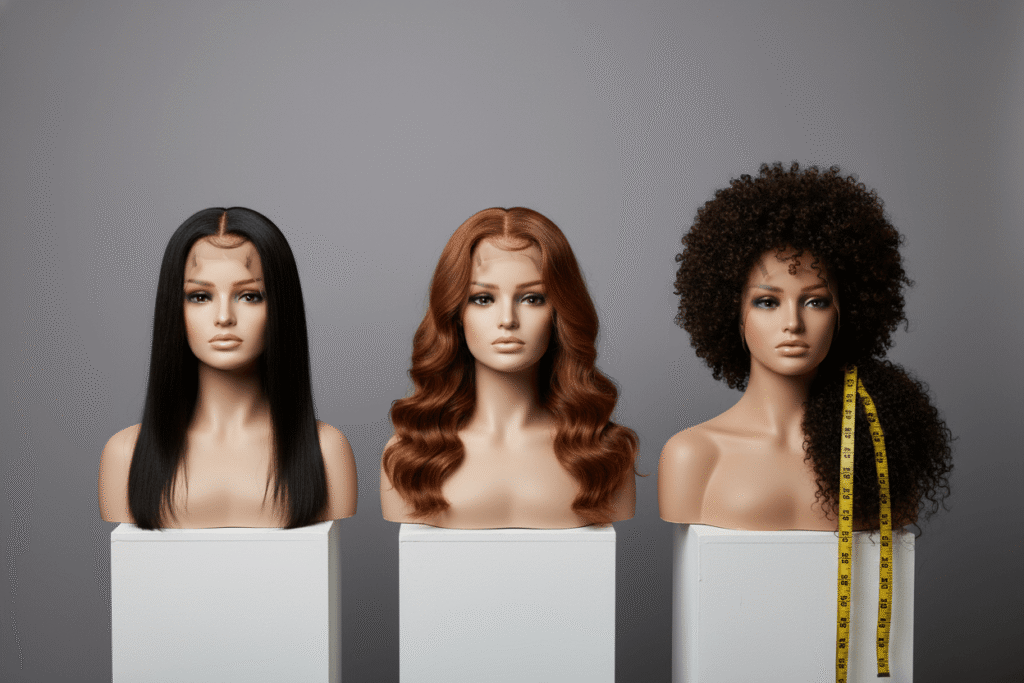
Density selection cheat sheet
| Natural Volume (Ponytail Test) | Visual Scalp Show | Recommended Wig Density | Notes |
|---|---|---|---|
| Thin (≤5 cm circumference) | High | 90–120% | Keep hairline airy; use darker grid lace to avoid shine-through |
| Average (5–7 cm) | Moderate | 120–150% | Most forgiving for leave-out installs |
| Thick (≥7 cm) | Low | 150–180% | Balance with graduated hairline to prevent “helmet” look |
| Very thick + tight coils | Very low | 130–160% (coily) | Downshift for shrinkage; coils read fuller |
What products help me blend edges with coily textures?
For Type 4 edges, product synergy matters more than brand names. I recommend aligning routines across bio hair and unit so both respond similarly to humidity and manipulation.
My edge-blending kit for coily leave-outs
- Hydration base: light mist of water + a small amount of leave-in conditioner on both hair and wig edges to equalize moisture.
- Hold + definition: alcohol-free mousse or setting foam for initial lay; layer a cast-forming gel (flaxseed, carbomer-based) for longer wear.
- Edge control: wax or pomade at the very perimeter; use sparingly to avoid buildup and lace staining.
- Seal + sheen control: a few drops of silicone serum on fingers to tame flyaways without increasing luster mismatch.
Heat-free texture syncing
- Flexi-rods, perm rods, or twist-outs on the wig edge to match the wearer’s coil diameter. Set both leave-out and unit simultaneously with mousse; diffuse cool or air-dry.
- For stubborn mismatches, I’ll steam the wig perimeter over rollers to “teach” the fiber your client’s coil memory without risking heat damage.
Application technique tips
- Work in small edge sections; brush directionally away from lace to protect knots.
- Use a satin wrap for 10–15 minutes to lock the cast, then break the cast lightly with serum-coated fingers.
Can I request texture sampling from my supplier first?
Yes—and you should build sampling into your procurement SOP. I won’t greenlight a new texture or luster line without a documented pre-production sample loop. Here’s the structure my teams use:
Sampling protocol I hand to suppliers
1. Request three items per texture: a 2–3 g hair swatch, a 3×3 cm lace piece (HD or Swiss, color-matched), and a 10–12 inch weft strip to evaluate wefting and return hair.
2. Specify fiber and processing:
- Origin and grade: e.g., Indian temple Remy vs. SEA Remy; no acid bath; cuticle-aligned.
- Curl creation: steam-only parameters (time/temperature), no silicone heavy dip; disclose any yaki/kinky straight micro-crimp method.
3. Require tolerance windows:
- Luster: low 3–4 GU at 60° relative gloss (internal comparative), or supplier’s low/med scale—document target.
- Curl diameter range and spring-back percent after wash.
- Density targets by zone (hairline vs. crown).
4. Testing on our side:
- Wash test: sulfate-free shampoo + air-dry; assess frizz, luster shift, and curl retention.
- Light test: compare swatch against client hair under daylight/fluorescent/warm light.
- Heat test (if relevant): single pass at 160–180°C; check for fiber odor or pattern collapse.
5. Approvals and retention:
- Sign off with photo/video and retain a control swatch. Reference the control in the PO (attach images and measured specs).
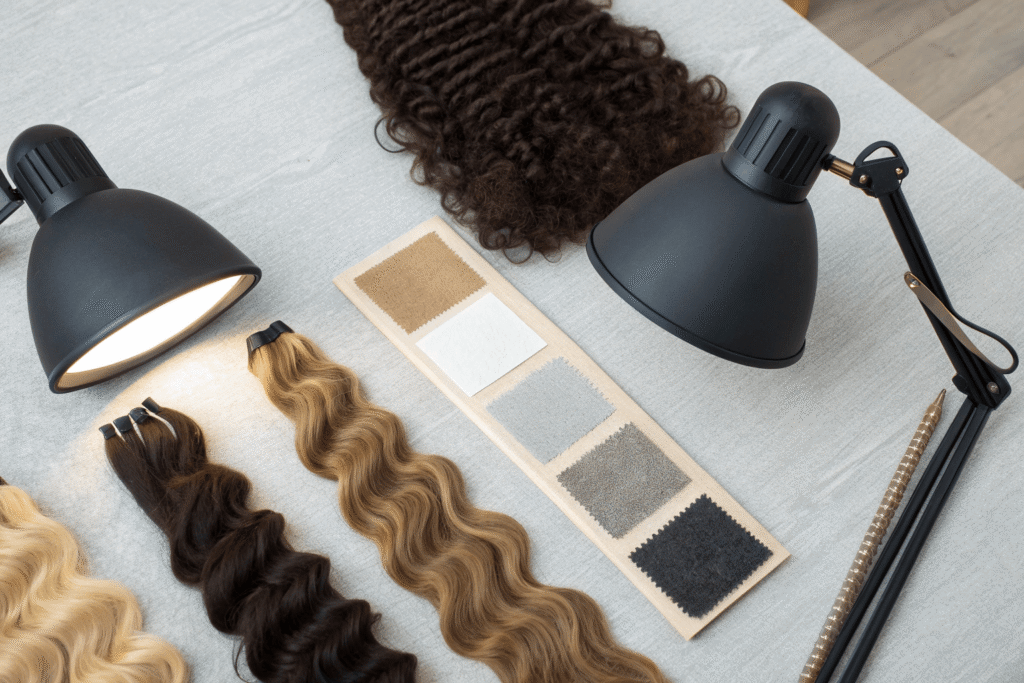
Procurement notes for B2B buyers
- Contractually define “low luster,” density by zone, and acceptable curl deviation. Tie acceptance to the retained control sample.
- For coily textures, insist on steam-curled, cuticle-intact Remy. Avoid acid-processed hair that blends shiny at first but frizzes after two washes.
- If your market is humid, pilot in-market wear tests for 7–10 days before opening POs.
Integrating your notes into production and client fitting
- Choose a wig fiber that mirrors the hair’s pattern and strand feel: match pattern (straight/wavy/curly/coily) and tactile profile (yaki for relaxed, kinky-curly for coily) so the hairline and part read continuous.
- Match density and volume: spec overall density to the wearer’s native volume; avoid drastic contrasts.
- Align luster: keep to low-to-medium shine; avoid glossy synthetics for leave-out installs.
- Construction: lace-front or full-lace with realistic, pre-plucked hairlines and tinted knots for scalp-tone accuracy.
- Blending technique: use heat tools or curl formers that mirror the wig’s curl pattern; edge control for a clean perimeter.
- Verification: test a small hair sample against the wig under multiple light sources for color/texture consistency.
- Customization: steaming, roller sets, twist-outs, or crimping to fine-tune texture post-delivery.
- Environmental fit: factor climate and activity; humidity expands curls—choose fibers and textures that behave like the client’s hair where they live.
- Product continuity: run similar creams, gels, and serums on both bio hair and wig to unify finish and feel.
Conclusion
In my practice, seamless texture matching isn’t a single decision—it’s the alignment of pattern, strand feel, density, and luster, validated by disciplined sampling and realistic wear tests. For leave-out installs, prioritize textures that replicate the client’s strand “hand” (yaki, kinky straight, true kinky-curly), build caps with tapered hairlines and tinted knots, and keep luster low. Choose density by native volume and remember coils read fuller than straight. Finally, formalize supplier texture sampling with measurable specs and retain control swatches tied to your POs. Do this consistently, and your units will disappear into your clients’ leave-outs—under salon lighting and in the real world.