
Choosing the right hair type is one of the biggest drivers of customer satisfaction and repeat orders in the wig business. Mislabeling—especially between “Remy” and “Virgin”—is common in China’s supplier ecosystem, and buyers often rely on marketing grades (7A–13A) that don’t map to any industry standard. If you’re importing wigs from China, you need practical, testable criteria to verify cuticle direction, chemical history, and fiber integrity—before you place volume orders.
Remy hair is defined by aligned cuticles (root-to-tip direction), while Virgin hair is defined by no chemical processing. To verify, combine strand-level cuticle tests (finger-slide, microscopy), durability trials (wash-and-wear), and lab reports (cuticle integrity, silicone content, moisture regain, pH, colorfastness). Request QC photos of bundle root orientation, weft construction, and cuticle microscopy, and insist on third-party test data to confirm “Virgin” claims.
In this guide, we’ll outline practical tests to separate true Remy from aligned non-Remy, confirm Virgin authenticity, specify QC photo requirements for your factory, and list the fiber standards and lab reports to request. We’ll also call out common pitfalls in Chinese sourcing so you can avoid costly mistakes.
What tests can I use to verify if the hair is true Remy or just aligned non-Remy?
Verifying Remy status is about proving cuticle direction and integrity, not donor count or processing. Many factories can “align” non-Remy bundles and mask them with silicone; true Remy will keep consistent directional resistance and remain manageable after repeated washes.
Use a layered approach—directional resistance tests, microscopic cuticle checks, wash/comb trials, and shedding/tangle behavior—to distinguish true Remy from aligned, acid-stripped, or silicone-masked non-Remy.
Practical, low-cost field tests
- Finger-slide cuticle test:
- Run fingers tip-to-root, then root-to-tip.
- True Remy: more resistance going tip-to-root; smoother root-to-tip.
- Stripped or mixed-direction hair: similar resistance both ways or “glassy” slip (heavy silicone).
- Comb-through test after washing:
- Wash with clarifying shampoo to remove coatings; air dry.
- Comb from ends to roots. True Remy resists matting; aligned non-Remy starts to catch and tangle, especially at the nape.
- Sheen and hand-feel after 3–5 washes:
- Silicone-masked non-Remy loses unnatural gloss and feels dry/rough; ends fray.
- Remy retains balanced luster and elasticity.
Confirming cuticle direction under magnification
- Request or perform cuticle microscopy (40–200x). Cuticles should appear as overlapping scales oriented uniformly along the shaft.
- Look for:
- Uniform scale orientation across randomly sampled strands.
- Minimal cuticle erosion (jagged, patchy areas suggest acid baths).
- Consistency across different bundles in the same lot.
Stress and durability indicators
- Tangle stress test:
- Twist and scrunch the bundle lightly, leave overnight, then detangle.
- Remy detangles predictably; mixed-direction hair forms tight knots.
- Heat resilience:
- Light pass with a flat iron at 180–190°C. Remy maintains alignment and smoothness; stripped hair may smell chemical or show uneven response.
Distinguish aligned non-Remy
- Acid bath suspects:
- Equal resistance both directions; “glass” slip initially (silicone), then rapid dullness after washes.
- Cuticle microscopy: flattened/eroded cuticles, bare cortex patches.
- Mixed-direction re-aligned bundles:
- Inconsistent directional resistance across strands; some reverse resistance.
Pro Tip: Always test multiple strands across the bundle; a few properly aligned strands can mask a mixed lot.
How do I confirm Virgin Hair authenticity without chemical processing or acid baths?
“Virgin” means no chemical treatment—no dyes, bleach, perms, or acid cuticle stripping. Confirming Virgin status requires detecting prior chemicals, assessing natural hair behavior, and validating via lab tests.
Combine natural-color inspection, controlled dye tests, pH and residue checks, and third‑party lab analysis (colorfastness, residual chemicals, cuticle integrity) to authenticate Virgin hair claims.
Visual and behavioral cues
- Natural color variation:
- Virgin hair shows subtle, uneven tones and occasional sun-oxidation highlights.
- Uniform, overly consistent tone across the bundle can indicate factory dyeing.
- Oxidation under sunlight:
- Place a sample in indirect sun for 1–2 hours; Virgin hair may slightly warm in tone without brassiness or dye bleed.
- Dye test:
- Apply professional dye to a small strand.
- Virgin hair lifts/pigments uniformly without unexpected undertones (e.g., greenish or reddish casts from previous color).
- Burn test:
- Human hair burns slowly with sulfur/keratin odor and turns to ash.
- Synthetic melts into hard beads with plastic smell. This only confirms human vs synthetic, not Virgin—use in combination with other tests.
Chemical clues and lab verifications
- pH and residue:
- Healthy hair surface pH ~4.5–5.5. Significant deviation suggests chemical treatment.
- Rub a damp strand on white cloth: yellow/brown residue may indicate dye or acid remnants.
- FTIR/GC-MS screening (via third-party labs):
- Identify silicone types (e.g., polydimethylsiloxane), oxidizers, peroxides, or dye molecules.
- Moisture regain:
- Virgin hair typically shows normal regain after desiccation (indicative of intact cuticles); acid-stripped hair may show abnormal moisture behavior.
Wash-and-wear validation protocol
- 3–5 wash cycles with clarifying shampoo, no conditioner on final rinse.
- Observe:
- Sheen stability: Virgin maintains balanced, non-greasy luster.
- Elasticity: Virgin resists breakage when combed wet; heavily processed hair snaps.
- Nape performance: minimal matting compared to acid-processed hair.
Caution: “Single donor” is often claimed but rarely evidenced. Virgin status is about chemical history, not donor count.
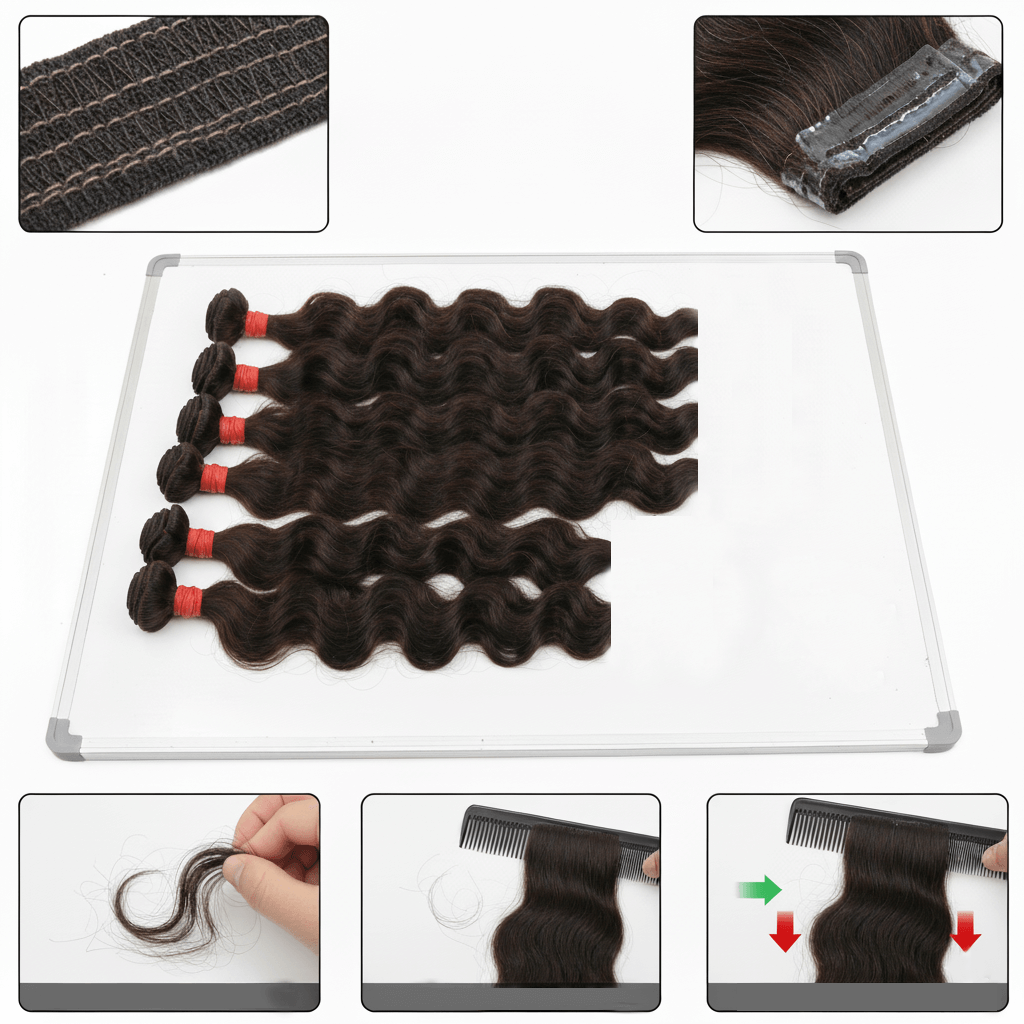
Which bundle cuticle-alignment checks should I ask my supplier to record in QC photos?
Your QC photos should help you audit root orientation, weft construction, and cuticle presence—before the goods ship. Standardize what you want to see and how it’s documented.
Require a fixed photo protocol—root-to-tip markers, directional comb tests, cuticle micro-shots, and weft/short-hair checks—captured with timestamps, lot numbers, and scale references.
QC photo protocol checklist
- Root/tip labeling:
- Photo with colored ties: red at roots, blue at tips—consistent across all bundles.
- Include a visible measuring tape and bundle weight tag (e.g., 100g ±2g).
- Directional comb test:
- Short video: comb glides root-to-tip, shows controlled resistance tip-to-root.
- Show 3–5 random strands pulled and tested on camera.
- Cuticle microscopy:
- 40–200x images showing scale orientation; include a ruler grid for scale.
- Take at least 3 points per bundle: near root, mid-shaft, near tip.
- Weft construction:
- Macro photos of double wefts, stitch density, fold-over endings, reinforcement glue.
- Show shedding test: gentle tug with visible loose hairs count.
- Short-hair content:
- “Spread” photo: hair fanned on a white board; mark flyaways/short fibers.
- Request % short hair estimate (e.g., <10% under 6 cm).
- Consistency across lot:
- Group photos of 10+ bundles from the same lot ID to verify uniformity.
Example QC photo set naming
- FactoryName_LotID_Length_Grade_YYYYMMDD_Sequence.jpg
- Include machine-readable QR or barcode of lot ID in frame.
Pro Tip: Ask for a one-minute “bundle audit” video per lot—labeling roots/tips, quick finger-slide test, comb-through, and weft close-ups in a single take to deter swaps.
What fiber standards or lab reports (cuticle, silicone, moisture, colorfastness) should I request from my factory?
Marketing grades (7A–13A) are not standardized. To import from China with confidence, align your POs to measurable fiber criteria and third-party tests. This is where you turn claims into specs.
Specify testable parameters—cuticle integrity, silicone content, moisture regain, pH, colorfastness, tensile strength—and require independent lab reports tied to lot numbers.
Minimum test suite to include in your PO
- Cuticle integrity and direction:
- Microscopic assessment with photo evidence and notes on erosion percentage.
- Silicone and coating analysis:
- FTIR to identify silicone type; report in % by weight or qualitative absence.
- Moisture regain:
- Measured per standard textile methods; define acceptable range (e.g., 10–13%).
- pH of aqueous extract:
- Target 4.5–5.5; outside range triggers review.
- Colorfastness (for dyed hair):
- Wash fastness, rubbing, and light fastness ratings; no bleeding in standard wash.
- Tensile strength and elongation:
- Min breaking force and % elongation before break (indicative of chemical damage).
- Metal contamination (optional):
- Check for residual metals from processing (particularly if bleaching suspected).
Suggested lab workflow and reporting
- Lot-based testing:
- Randomly sample 5–10 bundles per 1000 pcs; seal and send to a third-party lab.
- Report requirements:
- Lab letterhead, lot ID, photos, methods used (e.g., FTIR, light microscopy), pass/fail against your spec limits.
- Vendor-side QA:
- Factory internal QC should mirror your tests; compare internal vs independent results.
Table: Example import spec vs. test method
| Parameter | Spec / Target | Test Method / Evidence |
|---|---|---|
| Cuticle direction | ≥95% aligned strands | Microscopy images at 3 positions |
| Silicone content | None or <0.5% by weight | FTIR / gravimetric estimation |
| Moisture regain | 10–13% | Standard textile moisture regain |
| pH (aqueous extract) | 4.5–5.5 | pH meter/strips |
| Colorfastness (dyed) | No bleed after 3 washes | ISO/ASTM wash test + photo evidence |
| Tensile strength/elong. | Define per length/texture | Tensile tester results |
Table: What each claim should mean in your PO
| Supplier Claim | Your PO Wording Requirement |
|---|---|
| “Remy” | Documented cuticle direction; microscopy; wash trial pass |
| “Virgin” | No chemical processing; lab confirmation; pH and FTIR pass |
| “Single donor” | Evidence chain or drop the claim; don’t pay premiums blindly |
Caution: Avoid paying for “A-grade” labels. Tie payments and acceptance to lab-backed parameters and QC evidence, not marketing grades.
Additional notes and regional sourcing realities
- Many vendors in China use non-standard grades (7A–13A). Treat them as internal marketing tiers—not quality metrics.
- Acid baths and heavy silicone are common in lower-cost lots. Your 3–5 wash trial is the fastest real-world filter.
- True Remy shows consistent cuticle direction and remains manageable after several washes; reversed or stripped cuticles tangle and feel rough.
- Virgin hair typically has subtle natural color variation and accepts dye uniformly without odd undertones; previously processed hair can reveal unexpected hues when recolored.
Conclusion
When importing wigs from China, the difference between Remy and Virgin boils down to verifiable attributes: cuticle direction and chemical history. Don’t rely on “A-grade” labels—use directional resistance tests, microscopy, wash-and-wear trials, and lab reports (cuticle integrity, silicone content, moisture regain, pH, colorfastness, tensile strength) to confirm claims. Standardize QC photos for root/tip labeling, weft quality, and cuticle micro-shots, and insist on lot-linked third‑party reports. This is how we protect margin, reduce returns, and build a reputation for consistent quality.
If you’d like help drafting import specs, QC photo protocols, or arranging third‑party testing in China, contact us for tailored sourcing advice and lab coordination.