
I spend a lot of time inside factories, on QC lines, and in user testing rooms watching how real customers react after 30–90 minutes of continuous wear. The fastest way to lose repeat business in hot markets isn’t hair quality—it’s cap comfort. If a cap traps heat, causes itch at pressure points, or slides enough to make the wearer adjust it every hour, returns spike and brand trust erodes. In procurement terms, cap construction is the lever that controls day-long comfort, perceived quality, and ultimately your reorder rate.
Cap construction directly determines ventilation and comfort by controlling airflow paths, heat dissipation, and friction against the scalp. Lace-based and open-wefted areas ventilate best; monofilament and hand-tied areas balance softness with moderate airflow; dense liners, PU/silicone grips, and high hair density increase heat retention. Selecting lighter meshes, strategic open zones, proper fit mechanics, and lower hair density in hot zones measurably reduces itch and heat build-up.
In this article, I’ll break down the practical decisions I make when specifying caps for daily-wear lines and hot-climate collections. I’ll compare materials and constructions, share build strategies to cut itch and heat, address whether elastics and combs help or hurt comfort, and outline the QC protocols I use to verify ventilation performance before shipment.
Which cap materials should I select to balance breathability and longevity for daily wear?
When I’m building a daily-wear cap, I optimize across four variables: airflow, skin feel, durability (tensile and abrasion), and maintenance tolerance. No single material wins them all, so I combine zones.
What works in real production
- Lace front (Swiss or HD Swiss) at the hairline: breathable and natural-looking edge; excellent thermal relief where sweat starts first—at the frontal band.
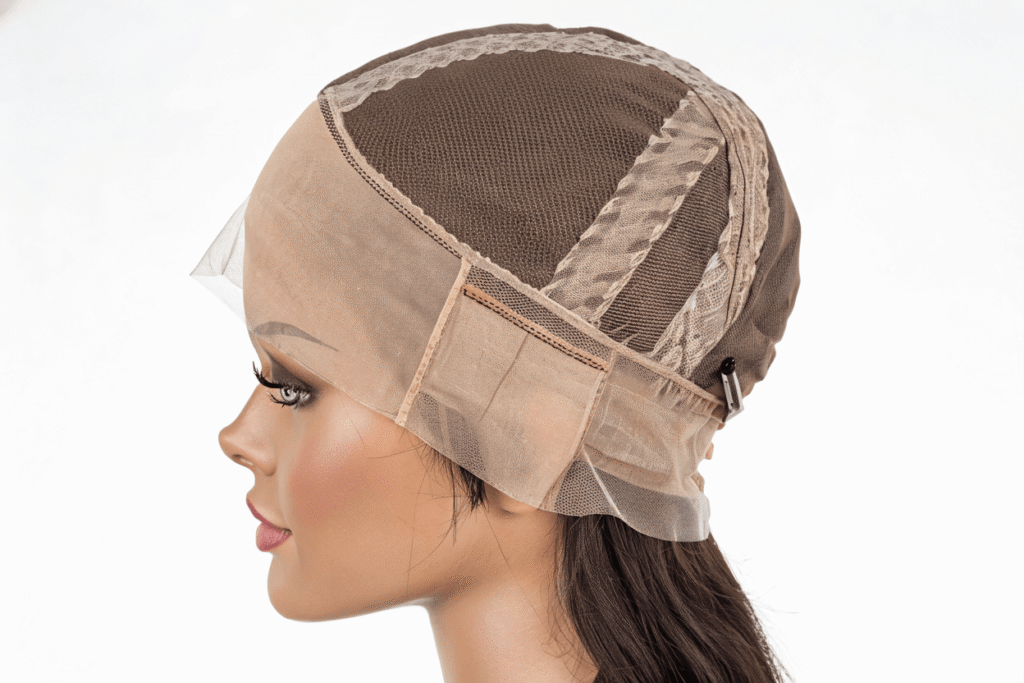
- Full lace zones where heat accumulates (parietal/temporal): full lace or hand-tied lace panels maximize airflow and reduce moisture build-up.
- Monofilament top or part: soft against the scalp and allows multidirectional parting; airflow is moderate versus lace but usually acceptable for daily wear if you keep the mono area constrained (part or partial top rather than full mono top).
- Wefted back and sides with open spacing (“open cap/capless”): improves ventilation and keeps weight down while adding durability and faster drying post-wash.
- PU or silicone only where necessary (front tabs, nape, or ear tabs for adhesion/security): great for grip, but I limit coverage to avoid heat trapping.
Material selection guide (daily-wear orientation)
| Cap Zone | Best-in-class material | Ventilation | Longevity | Notes |
|---|---|---|---|---|
| Hairline | Swiss/HD Swiss lace | High | Moderate | Use 60–80 denier for durability; pre-trim scallop reduces edge fray. |
| Top/Part | Mono part or narrow mono top | Medium | High | Softer feel; keep width ≤3 cm to limit warmth. |
| Crown/Back | Open wefted mesh (spacer mesh) | High | High | Fast-drying, cooler; vary weft spacing by size. |
| Perimeter tabs | Micro PU islands or silicone dots | Low | High | Improves hold; perforate or fenestrate to vent. |
| Full scalp (premium hot-climate line) | Full lace or 100% hand-tied | High | Medium | Superior comfort; train customers on gentle care. |
Key trade-offs:
- Full lace and 100% hand-tied feel the lightest and coolest but require gentler handling and have higher repair rates if users are rough with brushing.
- Monofilament improves comfort and parting realism; keep the mono footprint small in hot climates.
- Wefted (machine-made) constructions are durable and economical but run warmer unless you increase weft gaps (“open cap” spec).
How do I reduce itchiness and heat build-up for my end users in hot climates?
I approach this like a thermal and friction problem: reduce heat generation, increase heat release, and minimize micro-abrasion.
Construction and density
- Use lighter meshes and thinner lace where possible: thinner lace increases airflow and reduces sweat accumulation, especially on the frontal band.
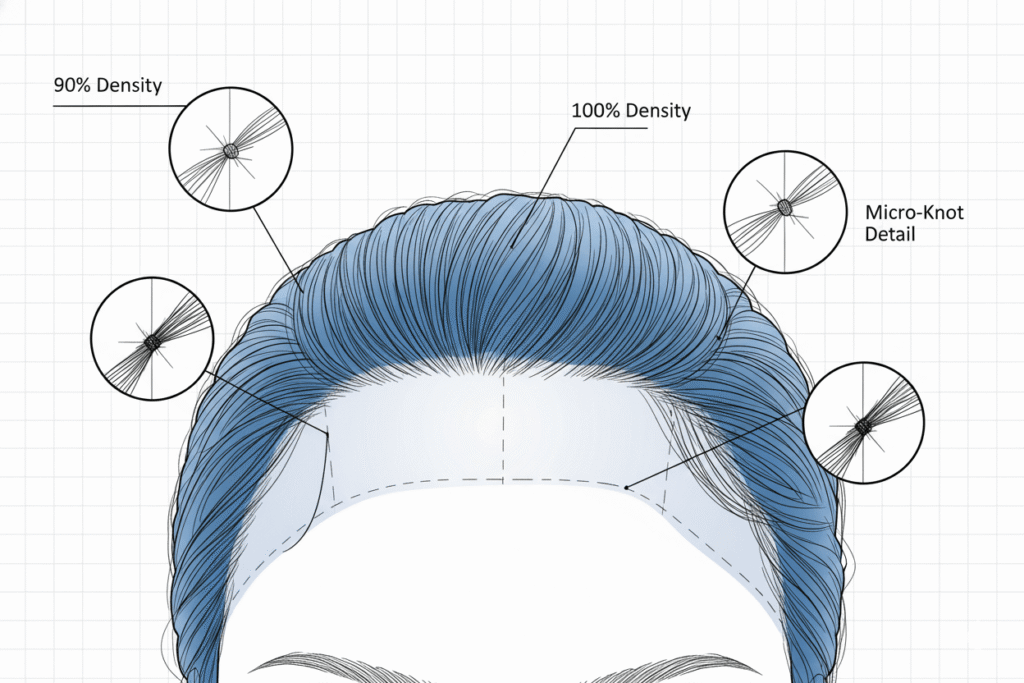
- Lower hair density in heat-prone zones (front 1.5–2 inches, crown apex): high density traps heat regardless of cap type. A front density of 90–100% with tapered knots is cooler than 120–130% blocks.
- Prefer open-cap wefting or partial hand-tied panels: create ventilation corridors across the parietal area.
- Avoid closed fabric liners under the top unless medically necessary.
Surface comfort and friction control
- 100% hand-tied sections reduce seam friction and pressure points compared to heavy weft seams, enhancing perceived lightness.
- Choose soft-touch mono (or double mono for medical lines) where the scalp is sensitive; it’s gentler than coarse meshes.
- Keep PU/silicone grip areas small and perforated; continuous PU strips trap heat. Fenestrations every 6–8 mm improve evaporative release.
Fit mechanics
- Proper fit beats “tight equals secure.” Overly tight caps compress capillary circulation and increase sweating. Calibrate adjustable straps to hold without hotspots.
- Elastic ear-to-ear stabilizers can be swapped for lighter, segmented elastics to maintain position without strangling ventilation.
User-facing accessories and care recommendations
- Recommend breathable liners (bamboo or thin cotton) for high-sweat users; they wick and reduce itch from salt residues.
- Pre-coat lace with skin-safe barrier sprays in ultra-humid markets; reduces friction and improves comfort underneath adhesives.
- Educate on wash cadence in hot climates: more frequent quick cleans of the inner cap (mild detergent or alcohol-free wipes) prevent salt crystal abrasion that causes itch.
Does adding elastic bands or combs affect comfort for my retail customers?
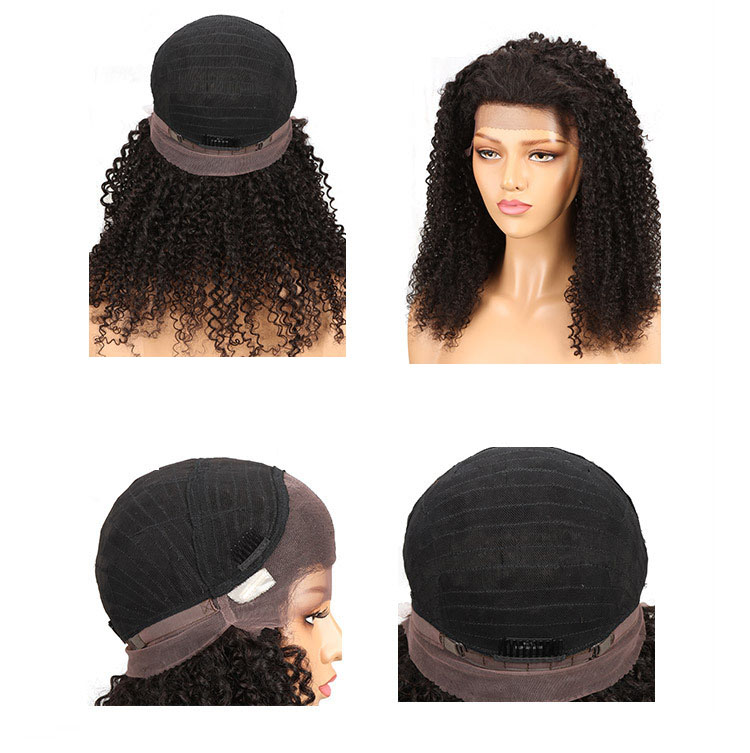
Yes—both security devices change pressure, airflow, and friction. I aim for stability with minimal contact area and smart placement.
Elastic bands
- Pros: stability without adhesive, better edge lay for lace fronts, reduced shifting during activity.
- Cons: can reduce frontal airflow and create a sweat line if too wide or tight.
- My spec: 1.5–2.0 cm soft brushed elastic, segmented or with vented cutouts; mount behind the hairline arc, not directly on it. Offer removable band with three tension settings.
Combs and clips
- Pros: quick anchoring for users with bio hair; great for sports or windy conditions.
- Cons: pressure points and traction risk; metal teeth can irritate, especially in heat.
- My spec: smaller silicone-lined clips with rounded edges; place at temple and nape, avoid crown apex. Provide alternative silicone tabs for customers with alopecia (no-comb option).
Adhesive/grip hybrids
- PU islands with perforations paired with light adhesives give secure fit with less coverage than full PU perimeters—better for heat control.
- Silicone dots or micro-strips inside ear tabs create anti-slip without blocking entire panels.
What QC checks help me verify ventilation performance before shipment?
I treat ventilation as a measurable attribute, not a “feels cool” claim. Here’s the pre-shipment protocol my teams run.
1) Visual and dimensional checks
- Mesh openness: measure lace or spacer-mesh pore size (microscopy or calibrated loupe). Record average pore width and coefficient of variation; reject if below spec.
- Weft spacing: jig-based measurement of inter-weft distance at three rows in each quadrant; tolerance ±0.5 mm from BOM.
- Density mapping: weigh and knot-count sample sections at front/crown/occipital to confirm graded density per size.
2) Airflow and pressure-drop testing
- Bench airflow test: mount cap on a perforated headform connected to a low-pressure fan; measure differential pressure (Pa) at 10, 20, 30 L/min. Lower ΔP indicates better ventilation. Compare against control caps per style.
- Smoke or fog visualization: quick qualitative test to verify airflow corridors at frontal band and parietals.
3) Thermal and moisture tests
- Thermal rise test: place cap on heated headform at 35°C, run fan at fixed flow, log time to equilibrium and ΔT after 10 minutes. Target ΔT ≤ 1.5–2.0°C for hot-climate SKUs.
- Evaporation/dry-time: saturate inner cap with 1 ml water; measure time to 90% dry under 26–28°C, 50% RH. Open-cap should consistently out-dry full mono tops.
4) Comfort risk audit
- Friction sweep: tactile check for seam ridges under fingers and with 10-denier nylon patch; flag any snag points.
- PU/silicone coverage ratio: confirm total non-breathable surface area stays within spec (e.g., ≤8–12% of cap surface for hot-climate lines); verify perforation counts.
- Fit compression: on standardized headforms, measure strap tension at three positions; ensure no point load exceeds target Newton range.
5) Wear simulation
- 30-minute heat soak on human testers or thermal mannequins with sweat simulation; collect quick Likert comfort scores and hot-spot mapping. Small sample (n=6–10) is enough to catch outliers before bulk ship.
Reference quick picks
| Use case | Recommended construction | Notes |
|---|---|---|
| Daily wear, temperate climate | Lace front + mono part + open wefted back | Balanced realism and airflow; durable. |
| Hot climate daily wear | Lace front + partial hand-tied sides or open-cap wefting; low front density | Cooler hairline and parietals; perforated PU tabs only. |
| Sensitive scalp/medical | 100% hand-tied + double mono top (small footprint) | Maximum softness; educate on gentle handling. |
| High activity/sports | Lace front + removable elastic + silicone dots; minimal combs | Stability with ventilation; avoid tight bands. |
| Ultra-natural styling | Full lace or 360 lace with strategic density taper | Best airflow among natural-looking builds; train on maintenance. |
Conclusion
In my experience, ventilation and comfort aren’t afterthoughts—they’re engineered outcomes. Lace fronts and full lace zones drive airflow where it matters, monofilament adds soft realism with moderate breathability, and open wefting keeps daily-wear units cool and durable. Itch and heat are controlled by three levers: lighter meshes, lower density in hot zones, and minimal, perforated grip surfaces. Elastic bands and combs can help if they’re slim, removable, and thoughtfully placed. Finally, treat ventilation like a spec: measure pore size, weft spacing, pressure drop, and thermal rise before you ship. Do this consistently, and you’ll see fewer returns, happier wearers, and stronger repeat orders—especially from hot-climate markets.