
I’ve spent enough time on factory floors to know density isn’t just a marketing label; it’s a supply-chain control point that affects cost, appearance, and batch repeatability. When procurement pushes for 150% and the crown comes out too heavy, customer returns spike. When density drifts during a run, you burn labor hours correcting ventilation and line-parting balance. Real consistency comes from translating knot counts into a controlled mass-per-area process, validating against weight, and maintaining thermal and process stability throughout production.
Density in wigs is calculated by linking knot count per cm² and hair length to total fiber mass per unit area, then mapped to market labels (130%, 150%, 180%). In production, I maintain density via calibrated weights, standardized knotting grids, temperature-normalized measurements, sampling plans, and in-line checks. Balanced frontal/crown densities are achieved with zoned knotting and fiber weight allocation, and accuracy is confirmed by weight-to-density tests before packing.
To make this practical, I’ll walk through the conversion math, the controls we use to keep frontal and crown densities natural, how to set tolerances across cap sizes, and the in-line tests that verify we’re shipping true-to-label. I’ll also embed the lab-grade density practices from manufacturing—calibration, temperature correction, sampling, degassing—because the same discipline applies when hair behaves like a fiber “bulk” rather than a fluid.
How do I convert knot count per cm² into market-friendly density labels (130%, 150%, 180%)?
The conversion model I use on the floor
- Step 1: Define target market label and its mass-per-cap baseline. For 130%, 150%, 180% full-lace caps (M size, 22.5″), I maintain reference net hair mass ranges, e.g., 130% ≈ 95–110 g, 150% ≈ 115–130 g, 180% ≈ 140–160 g for 12–14″ lengths. Longer lengths scale nonlinearly due to taper and waste (add 2–3 g per inch up to 20″).
- Step 2: Translate target mass to area density. Effective ventilated area for a medium full-lace is ~450–520 cm². If 150% is 120 g on 500 cm², area density ≈ 0.24 g/cm².
- Step 3: Convert area density to knot count using fiber-per-knot and length. Typical single-strand knots use 1–2 fibers; double-strand knots use 2–4. For 14″ Indian Remy (≈0.04–0.06 g per 100 strands depending on denier), I set:
- Mass per strand (m_s) measured by gravimetric sampling: weigh 1,000 strands → m_1000, then m_s = m_1000 / 1000.
- Mass per knot (m_k) = strands per knot × m_s.
- Required knots per cm² (K/cm²) = target area density / m_k.
Example:
- Measured m_1000 = 0.5 g for 14″ (so m_s = 0.0005 g).
- Double-strand knot using 2 strands → m_k = 0.001 g.
- Target 0.24 g/cm² → K/cm² ≈ 240 knots/cm². We then distribute knot type (single/double) by zone to hit the average.

Table: Reference mapping from knots/cm² to market labels (14″ Indian Remy, double-strand baseline)
| Market label | Avg knots/cm² (crown) | Avg knots/cm² (frontal) | Net hair mass (M size) |
|---|---|---|---|
| 130% | 180–200 | 160–180 (softer hairline) | 95–110 g |
| 150% | 220–240 | 180–200 | 115–130 g |
| 180% | 260–300 | 200–220 | 140–160 g |
Notes:
- Adjust denier: Southeast Asian coarse fibers require fewer strands per knot to reach the same mass; Eastern European fine fibers require more.
- Adjust by length: At ≥20″, m_s increases slightly with taper—validate with gravimetric sampling per batch.
- Use zone schedules: Hairline minimums, mid-frontal medium, crown full—never run a flat grid across the cap.
Why fluid density practices still matter
In my lab SOP, I borrow from industrial density control:
- Gravimetric methods: Weigh “known-count” strand bundles for true m_s.
- Temperature correction: Fibers absorb ambient moisture; normalize weights at 20–23°C, 45–55% RH. Density varies with temperature/humidity—apply reference normalization similar to thermal compensation in densitometers.
- Calibration: Scales are calibrated with CRMs; knotting grids are checked with calibrated mesh rulers each shift.
What controls keep frontal and crown densities balanced for a natural look?
Zonal density design
- Hairline (0–1.5 cm band): single-strand or single-strand + baby hair, 140–170 K/cm², lower tension to avoid dark line.
- Mid-frontal (1.5–4 cm): single-to-double transition, 170–200 K/cm², staggered V-parting lanes.
- Crown/vertex: double-strand, 220–260 K/cm², spiral distribution to mimic natural growth.
- Nape/temporal: slightly reduced vs crown for mobility.
Process controls that prevent imbalance
- Pre-ventilation layout maps: Printed grids by zone; artisans sign off per section. I reject freestyle grids in production runs.
- Knot type discipline: Supervisors audit 10× loupe samples per tray every 30 minutes; switching knot types without authorization is the #1 cause of dense frontals.
- Fiber denier matching: Mix lots only within ±5% denier; fine fibers visually “read” lighter, so we compensate strands-per-knot rather than pushing knots/cm².
- Degassing/vacuum de-aeration for coatings: On silk/base materials with PU reinforcement, entrained air in coatings affects apparent thickness and stiffness, leading artisans to overcompensate density. Vacuum de-aeration stabilizes base feel, keeping knotting behavior consistent.

Homogeneity and stratification
Borrowing from mixing controls, I manage fiber homogeneity:
- Mixing time and agitation speed: When blending lengths/tones, controlled agitation prevents stratification that causes local density variation.
- Filtration/particle size analog: For bleached knots and pretreated hair, consistent cuticle removal level (avoiding acid bath over-processing) keeps grip uniform, avoiding re-knotting errors that increase local density.
How do I set tolerances for density across sizes S/M/L?
Cap size effect on area and mass
Effective ventilated area expands roughly 6–8% from S (21.5″) to M (22.5″), and 6–8% from M to L (23.5″). I set tolerances on mass and knots/cm² to maintain the same visual density.
Table: Tolerances by cap size (14″ hair, 150% label baseline)
| Cap size | Area factor vs M | Net mass target | Mass tolerance (g) | Knots/cm² tolerance |
|---|---|---|---|---|
| S | -7% | 108–121 g | ±5 g | ±10 K/cm² |
| M | 0% | 115–130 g | ±6 g | ±12 K/cm² |
| L | +7% | 123–139 g | ±7 g | ±12–15 K/cm² |
Rules I apply:
- Maintain visual parity: Knot density tolerance widens slightly for L due to larger area; mass scales with area, not label inflation.
- Zone-proportional scaling: Increase counts mainly in crown and mid-frontal when moving to L; keep hairline band counts constant to avoid unnatural bulk.
- Capability indices: I run SPC (Cp, Cpk) on batch mass and knots/cm² per zone. A Cpk ≥ 1.33 for mass is my release gate; counts per zone must hold Cp ≥ 1.0.
Sampling plans and when to check
- Start-up: First 10 units in a run—100% knot grid audit + mass check.
- In-process: Every 20th unit—random zone microscopy (hairline, crown), weigh.
- End-of-batch: AQL-based sampling; for critical density, I use tightened inspection if prior lot showed drift.
Which in-line tests confirm weight-to-density accuracy before packing?
In-line verification stack
Calibrated mass check:
- Calibrate scales daily with certified weights; record drift.
- Normalize at controlled temperature and RH; apply temperature correction if outside range.
Knot grid imaging:
- Digital microscopy with calibrated field-of-view; count per cm² on predefined zones (hairline, mid-frontal, crown).
Weight-to-density reconciliation:
- Compute expected mass from measured K/cm² and m_k; compare to actual mass.
- Accept if Δ ≤ ±4% (M size); investigate if >5%—often moisture or strand-per-knot deviation.
Moisture and temperature normalization:
- Quick RH test; if RH >60%, apply moisture correction factor based on fiber absorption curves. This mirrors fluid density compensation using reference temperature.
Inline sensors and closed-loop adjustments:
- For continuous ventilating cells, I use vision systems to flag over/under count lanes and prompt artisans to adjust strand pick-up, similar to closed-loop density control that adjusts feed rates in fluids.
Additional controls borrowed from industrial density management
- Calibration traceability: Maintain instrument calibration records (scales, microscopes) with multi-point calibration to avoid nonlinearity issues.
- Degassing for adhesives: Vacuum de-aeration reduces apparent thickness variability; consistent base tension lowers rework that skews local density.
- Documentation: Record count grids, weights, environmental conditions, and operator IDs. This traceability shortens root-cause analysis on density complaints.
Pass/Fail gates before packing
- Mass within tolerance table by size and label.
- Zone count within band:
- Hairline: target ±8 K/cm²
- Mid-frontal: ±10 K/cm²
- Crown: ±12 K/cm²
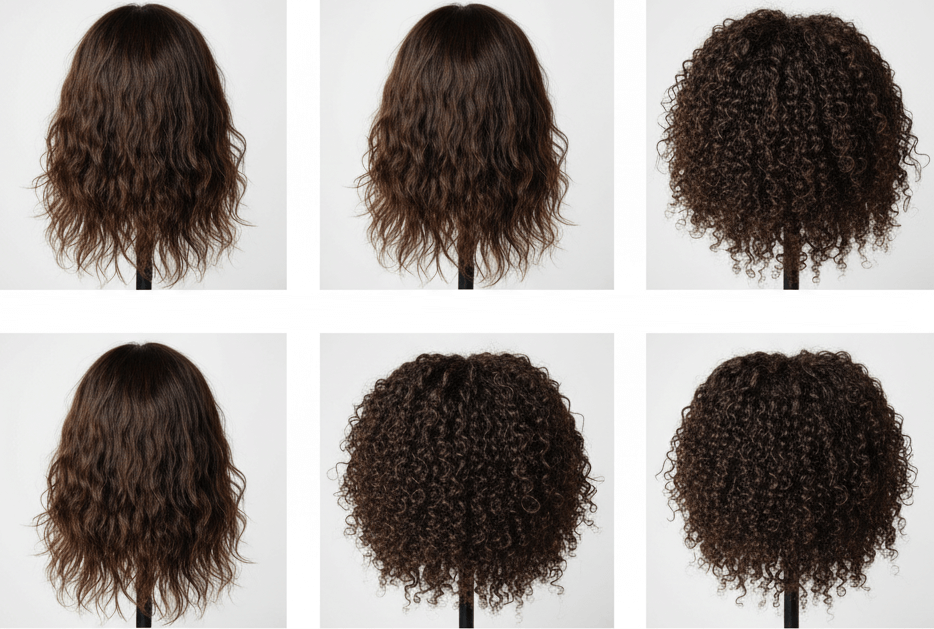
- Visual audit: Balance of frontal softness vs crown fullness; reject “helmet” look even if numbers pass—numbers must serve aesthetics.
Conclusion
In my experience, treating wig density like a disciplined manufacturing parameter—grounded in mass-per-area math, temperature-normalized measurements, and zoned knotting—eliminates most label disputes and visual inconsistencies. I convert knot counts to 130/150/180% using gravimetric strand weights, maintain balance with zone maps and denier-aware knotting, set size-based tolerances that scale with area, and validate each unit with weight-to-density reconciliation. Borrowing best practices from industrial density control—calibration, temperature compensation, sampling plans, closed-loop monitoring—keeps production stable and the final look natural, batch after batch.