
Importers lose margin fastest when material claims don’t match reality. Whether you’re buying stock units in Xuchang or custom lace fronts in Qingdao, knowing how to tell human hair from synthetic—and spotting blends—is essential for pricing, compliance, and customer satisfaction. I’ve audited hundreds of wig consignments in China; the fastest way to protect your order is to use a layered verification approach before final payment.
To tell if a wig is human hair or synthetic when importing from China, combine non-destructive checks (shine, static, fiber uniformity, water absorption) with controlled micro-tests (low-heat tolerance, strand-pluck cuticle check, microscopic imaging, and—if feasible—a tiny burn or solvent test). Run these on multiple spots to catch mixed-fiber construction, then document results with photos/video for supplier accountability.
Below, I’ll show practical, import-ready methods you can apply during factory visits, third-party inspections, or sample reviews—plus how to verify Remy vs. non-Remy claims and avoid costly mistakes with Chinese suppliers.

How can I quickly test if my wig is real human hair without damaging it?
When you’re at a factory, trading office, or QC checkpoint, you need tests you can perform fast and safely. Start with non-destructive indicators, then escalate only if needed.
Use a rapid “no-damage” stack—shine/static check, water absorption, low-heat tolerance at 160–180°C, and a strand-pluck cuticle feel—to screen authenticity within minutes. Document with close-up photos and a thermometer reading.
The quick, non-destructive stack
- Visual sheen and color depth
- Human hair: natural, varied luster; reflections aren’t uniformly glassy. Slight tonal variation strand-to-strand.
- Synthetic: uniform, glossy shine; color looks flatter or “plastic-like” under bright light.
- Static test
- Gently comb and shake. Synthetic fibers build static easily and cling; human hair is less staticky.
- Water absorption
- Mist and weigh feel by hand. Human hair absorbs water, feels heavier, may frizz slightly; synthetic sheds droplets and keeps its set shape.
- Low-heat tolerance (controlled)
- With a temperature-controlled flat iron at 160–180°C, touch a small hidden section for 2–3 seconds.
- Human hair: no melting, tolerates heat; natural odor only at higher temps.
- Synthetic: may deform, curl, or slightly stick; chemical scent may appear. Heat-resistant synthetics can tolerate ~160°C but often still show uniformity and static in other checks.
Pro Tip: Bring a pocket IR thermometer and a travel-size mist bottle to factory audits. A 5-minute routine can prevent a five-figure dispute.
Strand-pluck feel (cuticle hint)
Pluck a single strand and run fingers from root to tip, then tip to root.
- Human hair: faint “drag” going from tip to root due to cuticle scale direction.
- Synthetic: uniformly smooth both ways.
Caution: Some human hair is acid-washed to remove/flatten cuticles, reducing the “drag” feel—so don’t rely on this test alone.
What fiber clues should I look for to spot synthetic wigs during inspection?
Once you suspect synthetics, look for repeatable fiber-level signatures that don’t require burning or dyeing.
Synthetic wigs show a cluster of tells—uniform diameter, high gloss, higher static, quick water shedding, and smooth surface under magnification. Heat-resistant synthetics may pass a heat test but still fail cuticle and microscopy checks.
Visual and tactile diagnostics
- Uniformity: Synthetics are strikingly consistent in thickness and surface; human hair varies along the shaft.
- Sheen: Synthetics often reflect light evenly; human hair shows multi-directional, softer reflection.
- Density and hand feel: Human hair feels denser and slightly cool/firm; synthetics feel lighter and more slippery.
Under magnification
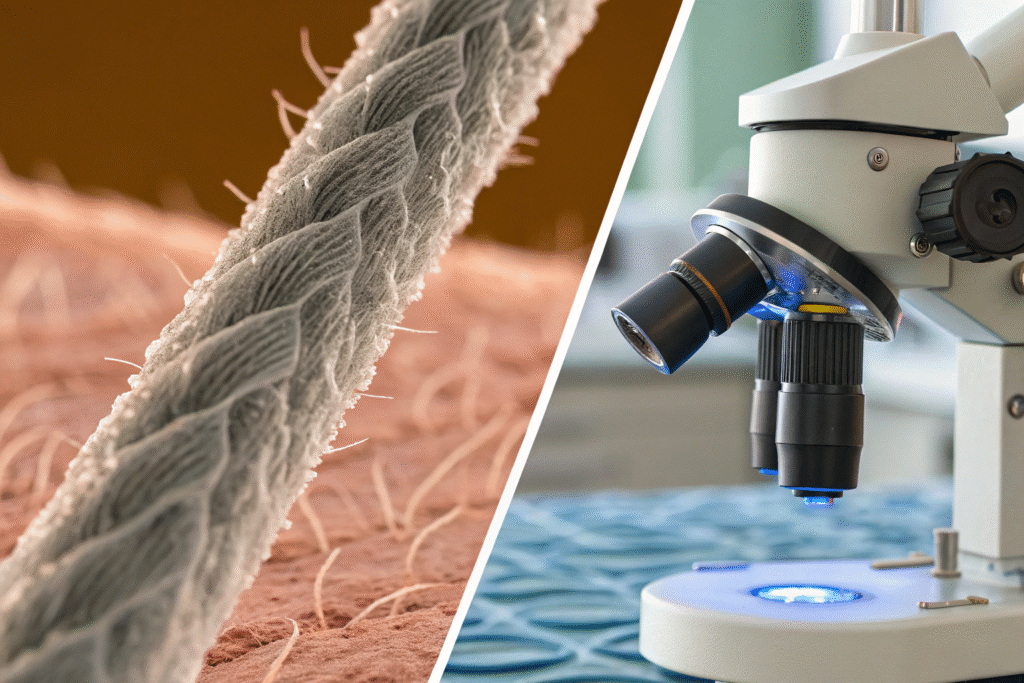
With a 60–120× pocket microscope or phone macro lens:
- Human hair: overlapping cuticle scales visible; some strands show a medulla (central core).
- Synthetic: featureless, smooth cylinder; no cuticle scales.
Solvent spot-check (minimize damage)
- Dab acetone or high-strength alcohol on a hidden strand end.
- Human hair: no softening/clouding.
- Certain synthetics: surface softens or clouds.
Note: Always isolate a few millimeters from a trimmed end.
Quick reference table: primary indicators
| Indicator | Human Hair | Synthetic Fiber |
|---|---|---|
| Shine | Natural, varied | Uniform, glassy |
| Static | Lower | Higher |
| Water | Absorbs, gets heavier | Sheds, shape holds |
| Heat (160–180°C) | Tolerates | May deform (unless heat-resistant) |
| Feel | Denser, cooler | Lighter, slippery |
| Microscopy | Cuticle scales present | Smooth, no cuticles |
| Solvent | No effect | Can soften/cloud |
Caution: Heat-resistant synthetics (e.g., modified fibers) can pass basic heat tests. Always combine with cuticle/microscopy checks.
Do burn, cuticle, and knot tests reliably prove my wig is human hair?
These traditional tests are useful but not foolproof. Suppliers in China know buyers use them and sometimes engineer around them. Use them as part of a multi-test protocol.
Burn and cuticle tests are directional, not definitive—blends, coatings, and heat-resistant fibers can skew results. Test multiple spots, and back up with microscopy and dye/bleach trials on cut wefts or sample bundles.
Burn test (last resort, controlled)
- Human hair: burns slowly, smells like burning feathers/keratin, turns to ash.
- Synthetic: melts/curls, forms hard beads, chemical odor.
Risks and caveats: - Blends can ash and bead in the same sample.
- Coatings (silicone) can mask odor/behavior.
- Perform only on tiny cut strands over a non-flammable tray; record video.
Cuticle test
- Fingertip “drag” and microscopy are strong indicators of human hair.
- Acid-washed non-Remy hair may lose detectable cuticles—may still be human but lower grade.
- For lace knotted pieces: examine hair direction at knots; inconsistent directionality can indicate non-Remy or mixed stock, not necessarily synthetic.
Dye/bleach behavior (sample swatch)
- Human hair: accepts oxidative dyes and can be lightened; results more even.
- Synthetic (standard): resists oxidative dyes; may not take color or appears patchy.
- Heat-resistant synthetics won’t bleach like human hair.
Mixed-fiber vigilance
Chinese factories often blend to hit price points: 70–90% human with 10–30% synthetic in volume zones; top layers may be human while lower wefts are synthetic.
Pro Tip: Pull strands from crown, mid-weft, nape, and near ear tabs. Run two tests per location (e.g., water + low heat; microscopy + solvent). Photograph every site.
Reliability matrix
| Test | What it proves | Reliability | Notes |
|---|---|---|---|
| Burn | Keratin vs thermoplastic | High for pure materials; medium for blends | Use as corroboration |
| Cuticle feel | Presence/direction of cuticles | Medium | Acid-wash can reduce signal |
| Microscopy | Cuticles/medulla presence | High | Best non-destructive proof |
| Low-heat | Thermal behavior | Medium | Heat-resistant synthetics exist |
| Water/static/sheens | Fiber behavior | Medium | Quick screen only |
| Dye/bleach | Chemical receptivity | High on cut samples | Not for finished units unless allowed |
| Solvent | Polymer sensitivity | Medium | Fiber-dependent |
How do I verify Remy vs non-Remy hair when sourcing from Chinese suppliers?
“Human hair” isn’t a quality grade by itself. Remy (aligned cuticles, same direction) commands higher prices and better longevity. Many disputes I see are not about human vs synthetic—but Remy vs non-Remy or acid-processed hair.
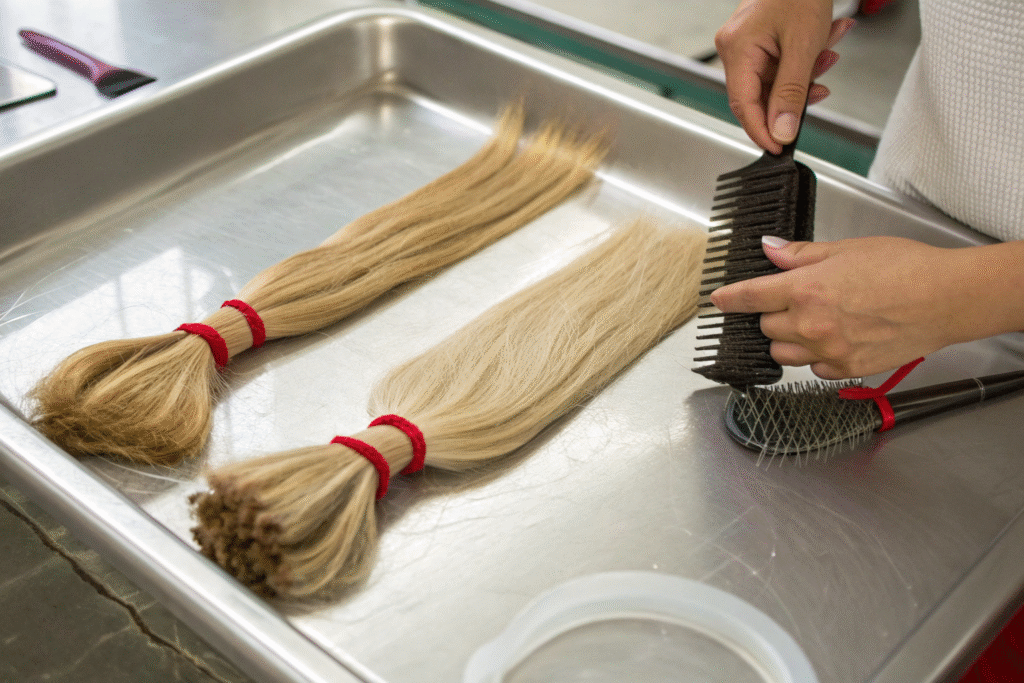
To verify Remy claims, confirm cuticle presence and alignment, root-tip direction consistency across multiple wefts, minimal matting after wash tests, and even dye response. Contract for sampling from random wefts and require traceable lot labeling.
Practical verification steps
Root-tip alignment audit
- Request a bundle with ties at the root end.
- Under magnification, check cuticle orientation on multiple strands—drag test should feel smoother root-to-tip than tip-to-root.
- Mix a few bundles lightly; shake. Remy tangles far less than non-Remy.
Wash/comb test (sample bundle)
- Soak in lukewarm water with mild shampoo, air dry, then comb from ends upward.
- Remy: low matting, maintains direction, minimal friction.
- Non-Remy/acid-washed: higher friction, tendency to tangle.
Dye lift uniformity
- Apply a small 20-volume developer + lightener test on a clipped sample.
- Remy: lifts more evenly; non-Remy mixed-origin strands lift inconsistently.
Microscopy + density
- Remy should retain intact cuticles; acid-washed hair shows thinned/absent cuticles and sometimes etched surfaces.
Knot inspection (for lace products)
- Consistent root orientation at knots indicates directionally aligned input stock; mixed direction suggests non-Remy.
Commercial controls with Chinese suppliers
- Specification sheet
- Define “100% human hair, Remy, cuticle-aligned, no synthetic fibers; silicone coating below X% by weight; heat tolerance 180–200°C.”
- Sampling protocol
- Inspector to pull random strands from at least 5% of wefts per unit size or 10 units per lot, whichever is greater.
- QC checkpoints
- Pre-production sample (PPS), during production (DUPRO), and pre-shipment inspection with photo/video of tests.
- Traceability
- Lot/batch IDs on inner cartons; require C/O (country of origin) and internal source declarations.
- Penalties
- Include material-substitution penalty and right to third-party lab verification at supplier’s cost if failed.
Caution: “Remy” and “virgin” are overused marketing terms. Insist on objective attributes: cuticle intact, aligned, single-donor vs multi-donor, silicone treatment disclosure, and allowable blend tolerance (ideally 0% for premium SKUs).
Regional and supply insights in China
- Xuchang (Henan): Large-scale processing; competitive pricing; greater risk of acid-washed non-Remy marketed as Remy if specs/QC are loose.
- Qingdao (Shandong): Strong in lace work and premium SKUs; higher prices; better transparency among established exporters.
Conclusion
If you’re importing wigs from China, rely on a layered verification process, not a single test. Start with non-destructive screens (shine, static, water absorption, low-heat tolerance), then confirm with microscopy and selective dye/solvent checks. For Remy claims, focus on cuticle presence and alignment, root-tip consistency, and wash/dye performance—backed by a tight spec, sampling plan, and enforceable QC milestones. Mixed-fiber wigs are common; always test multiple zones and keep photo/video records.
Need a hands-on protocol or a supplier audit checklist for your next order? Contact us for tailored sourcing advice and third-party inspection templates that protect your margins when you import from China.