
Importing wigs from China can be highly profitable, but only if you control craftsmanship quality. Buyers often focus on price and overlook subtle technical markers—lace type, knotting density, hair direction, weft strength—that determine realism, durability, and customer satisfaction. A rigorous, repeatable QC process prevents returns and protects your brand.
To inspect wig craftsmanship from Chinese suppliers, verify hair origin and grade (cuticle alignment, remy status), evaluate lace and knotting (type, density, knot size), test shedding/tangling via controlled pull-comb methods, assess bleaching and dyeing tolerance, and implement AQL sampling before shipment with documented tolerances for weight, length, and color.
Below, I break down exactly what to check, how to test, and which AQL methods work best for wig QC—whether you’re auditing samples or running pre-shipment inspections.
How do I evaluate lace type, knotting density, and hair direction during QC?
When we audit lace wigs, the realism and longevity hinge on the lace substrate and handwork quality. Start with lace material, then assess knotting density and directionality to ensure ventilation is uniform and styling behaves naturally.
Evaluate lace (HD, Swiss, French) for mesh uniformity and tear resistance; check knot size and spacing for realism vs durability; verify hair direction and cuticle alignment to avoid reverse-rooting and excess tangling.
Lace Material Evaluation (HD, Swiss, French)
- HD lace: Ultra-fine, most undetectable on-camera; lower tear resistance. Good for premium fronts/closures, less forgiving for daily wear.
- Swiss lace: Balanced softness and durability; common for mid-range lace fronts.
- French lace: Stronger, slightly coarser; ideal for full lace caps requiring durability.
- Checks:
- Mesh uniformity: Hold to light; look for consistent hole size and even weave.
- Tear resistance: Gentle stretch test at edges; HD should flex but not deform; Swiss/French should resist tearing.
- Color match: Request lace shades (light/medium/dark/brown) aligned to your target skin tones.
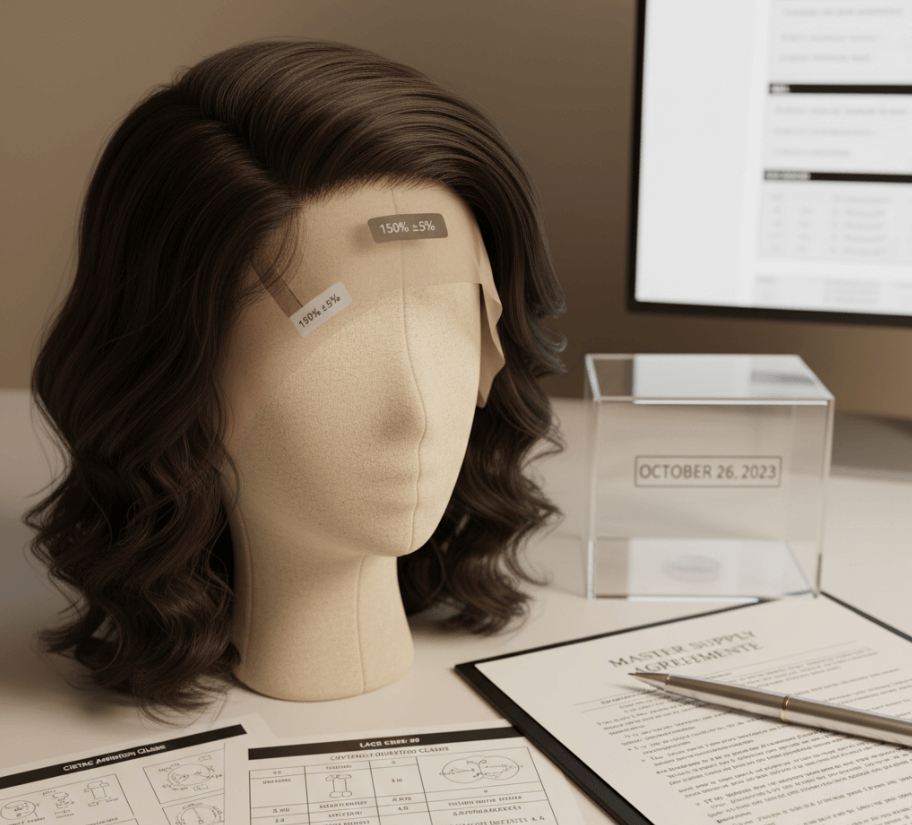
Pro Tip: Require suppliers to state lace GSM and shade codes per lot in the packing list. Inconsistent lace weight often correlates with tearing issues and uneven knot hold.
Knotting Density and Knot Quality
- Density mapping: Verify target density (e.g., 130%, 150%, 180%) is achieved uniformly—front hairline typically tapers lower for natural transition.
- Knot size:
- Single knots: More natural, less durable; ideal for hairline up to 1–2 cm.
- Double knots: Stronger, slightly visible; better beyond the hairline zone.
- Spacing: Uniform rows, consistent distance between knots; avoid clustering that creates “plugging.”
- Checks:
- Under magnification (5–10x), count knots per cm² at hairline and crown; record variance.
- Inspect for bleached knots uniformity; uneven bleaching yields spotted “polka-dot” scalp effect.
Caution: Over-bleached knots weaken hair retention dramatically. If you specify bleached knots, cap the bleaching level and require tensile retention tests on the hairline strip.
Hair Direction and Ventilation Alignment
- Directionality: Confirm the ventilated angle matches intended style (free-part, middle-part, side-part). Misaligned direction causes unnatural lay and lift.
- Root direction: Perform a slide test—hair should feel smooth root-to-tip and rough tip-to-root. Reverse-rooted strands increase friction and tangling.
- Flow test: Wet, comb, and air-dry; observe natural fall. If sections lift or splay against intended direction, ventilation is inconsistent.
What checklists should I use to assess weft strength, ventilation, and parting lines?
A structured checklist reduces subjectivity and helps train factory QC teams. Weft strength ensures longevity; ventilation and parting lines drive realism and styling flexibility.
Use a standardized checklist covering stitching density, return hairs, stress point reinforcement, ventilation uniformity, and parting alignment; document pass/fail thresholds with photos per lot.
Weft Strength and Stitching Checklist
- Stitching density: Target 6–10 stitches/cm for machine wefts; record three sample points per weft.
- Tightness and uniformity: No skipped stitches or waviness; tension should be even along the band.
- Return hairs: Minimal short “beards” below weft; excessive returns increase itch and shedding risk.
- Bonding: If glue-reinforced, check for clean application—no brittle beads or flaking.
- Shedding risk: Light tug test—pull 10 times with 1–1.5 kgf on weft edge; count lost strands.
Ventilation and Cap Construction Checklist
- Ventilation density: Measure hair per unit area at hairline, crown, nape; permissible variance ±10% from spec.
- Symmetry: Left/right ear tabs mirror; crown ventilation radiates evenly.
- Reinforcement: Check stress points (ears/nape/crown) for extra stitching or taping.
- Adjustable straps: Smooth operation, secure hooks; test five cycles of adjustment.
Parting Lines and Scalp Realism
- Free-part zones: Confirm knot direction supports multi-directional styling.
- Pre-defined parts: Inspect the demarcation—no visible grid consistency breaks.
- Scalp tint: Lace tint or silk top color uniformity; avoid patchy dye or yellowing.
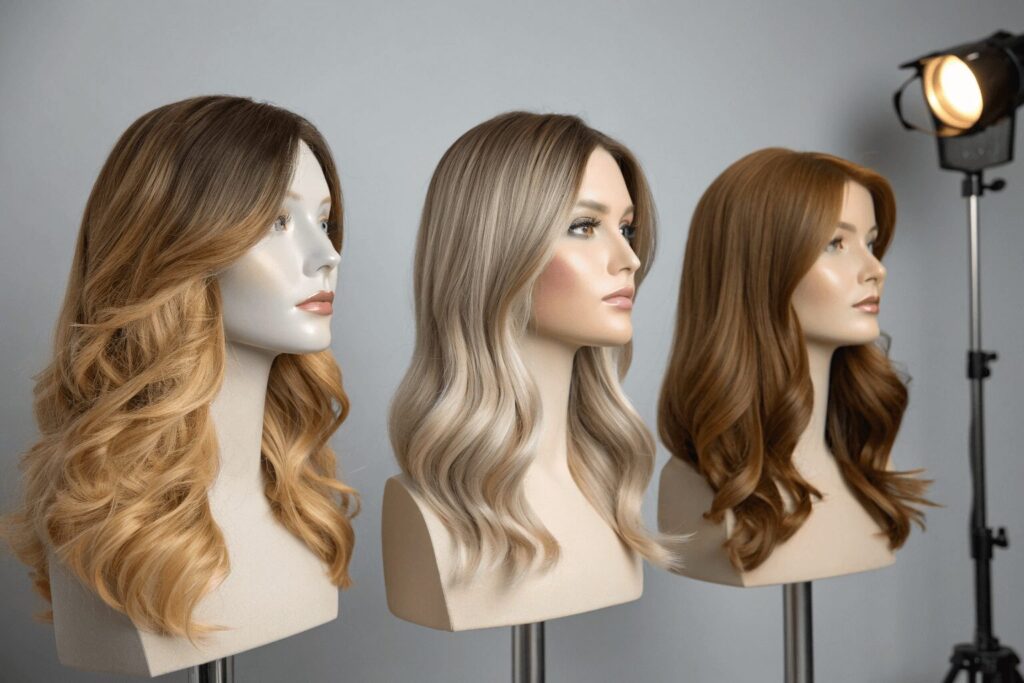
Pro Tip: Include a photo map in your checklist—a grid reference of the cap (front hairline, temples, crown, nape) and require suppliers to submit macro photos per cell for every lot.
How can I test bleaching quality, pre-plucked hairlines, and baby hair finishing?
Processing and finishing define the wig’s realism. Bleaching quality must achieve natural scalp without compromising strength; pre-plucked hairlines and baby hair should look subtle, not sparse or frizzy.
Run small-area bleach tests, inspect uniformity and fiber integrity, quantify hairline tapering, and verify baby hair finishing consistency; avoid over-processing that weakens knots or roughens cuticles.
Bleaching Quality Tests
- Spot test: On a hidden 2 cm² area, apply controlled bleach for a standardized time (e.g., 15 minutes at pH ~9–10), rinse, neutralize, and dry; examine:
- Knot visibility reduction without breaking.
- Color uniformity—no orange/brown hotspots.
- Post-bleach tensile: Gentle pull to ensure retention hasn’t dropped dramatically.
- Over-processing detection:
- Rubberiness, sulfuric odor, or brittle breakage indicate excessive chemical exposure.
- Use blacklight to spot uneven processing artifacts.
Pre-Plucked Hairline Assessment
- Taper profile: Hairline should gradually increase density from edge inward over 1–2 cm; no harsh step change.
- Symmetry: Balanced left-right plucking; avoid bald spots or over-thinning in temples.
- Edge integrity: Lace edge free from frays; plucked areas should not show loose knots.
Baby Hair Finishing
- Length uniformity: Typically 1–2 inches, consistent throughout the hairline.
- Direction and texture: Baby hairs should lay naturally with minimal flyaway; test with light water or styling cream.
- Integration: No obvious demarcation between baby hair and main strands; density should be subtle.
Caution: If you sell to customers who further customize, specify “lightly pre-plucked” to protect knot integrity during end-user styling.
Which AQL sampling methods help me validate wig craftsmanship before shipment?
Acceptable Quality Level (AQL) sampling helps you statistically validate lot quality without checking every unit. For wigs, combine cosmetic checks with functional tests and enforce measurable tolerances.
Use ANSI/ASQ Z1.4 or ISO 2859-1 with General Inspection Level II, common AQLs of 0.65–1.0 for major defects and 2.5 for minor; add special tests (shed, weight, length accuracy) and require per-lot photo/video evidence.
Suggested AQL Framework for Wigs
- Standard: ISO 2859-1 (equiv. ANSI/ASQ Z1.4)
- Inspection level: General II (increase to III for new suppliers)
- Lot size: Determine sample size from standard tables; e.g., lot of 500 → code letter L → sample size 200 (example; verify with table).
Table: Example Defect Classifications and Tolerances
| Defect Type | Classification | Example Criteria | AQL Suggestion |
|---|---|---|---|
| Lace tear/fray | Major | Visible tear, frayed edge >3 mm | 1.0 |
| Excess shedding | Major | >15 strands lost in standard pull-comb test | 1.0 |
| Wrong density mapping | Major | >15% variance from specified density | 0.65–1.0 |
| Knot visibility spots | Minor | Uneven bleach causing visible dots in 1 cm² | 2.5 |
| Color inconsistency | Major | ΔE*ab > 3 compared to approved sample | 1.0 |
| Length/weight variance | Minor | Length ±1 cm, weight ±5% beyond spec | 2.5 |
| Wrong lace shade | Major | Shade mismatch vs PO/spec | 1.0 |
| Reverse-rooted hair | Major | Fails slide test on random sample units | 0.65–1.0 |
Pro Tip: Require suppliers to add a QC sticker per unit with QR-linked photos and measurements (density zone shots, cap interior, hairline macro, scale weight, length ruler).
Functional Tests Within AQL Sampling
- Pull-comb shedding test: 10 pulls with wide-tooth comb; record strands lost; reject if average exceeds threshold.
- Heat tolerance:
- Human hair: Style at 160–180°C for 10 seconds; check fiber integrity, no melting or excessive odor.
- Synthetic blends: Verify stated heat resistance; many HD fibers cap at 120–150°C.
- Wash and return pattern:
- Human hair: Shampoo/condition, air-dry; should return to natural pattern without matting.
- Weight and length accuracy:
- Weight: Scale to ±5% tolerance (specify exact grams per size).
- Length: Measure stretched length; tolerance ±1 cm from PO spec.
Table: Supplier Evidence Pack Requirements
| Evidence Type | Minimum Standard |
|---|---|
| Macro photos | Hairline, lace mesh, crown, nape |
| Video comb test | 30–60 seconds per batch subset |
| Weight & length logs | CSV with unit ID, grams, length in cm |
| Lace type declaration | Material (HD/Swiss/French), shade code |
| Processing records | Bleach/dye details, temperature/time |
Advanced QC: Hair Origin, Grade, and Integrity Tests
Hair origin and grade often determine long-term performance. Mixed batches, coated fibers, or reverse-rooting lead to customer complaints. We validate these with tactile, chemical, and visual tests.
Verify remy status and cuticle alignment, detect silicone coatings, and confirm dyeing/bleaching tolerance; combine gentle pull and comb tests with heat/water trials to assess durability.
Verify Hair Origin and Grade
- Remy status: Cuticles aligned root-to-tip; slide test should feel smooth downward, rough upward.
- Batch consistency: Compare sheen, texture, and color undertone across 5–10 units; variance suggests mixing sources.
- Shine and odor: Natural hair has soft sheen and neutral odor; excessive gloss or strong chemical smell can indicate coating or synthetic blend.
Detect Coatings and Blends
- Blacklight test: Coated fibers may fluoresce differently; use as a screening indicator.
- Alcohol swab: Wipe a small section; residue or sudden dulling suggests silicone coating masking defects.
- Dyeing tolerance: Perform small-area dye test; uneven uptake or brittleness indicates over-processed or blended fibers.
Durability Tests
- Gentle pull and comb test: Quantify strands lost under light stress; set a pass threshold (e.g., ≤10 strands per test).
- Heat and water test:
- Human hair should tolerate moderate heat styling and return to pattern after washing.
- Watch for matting or frizz post-wash—signs of cuticle damage or reverse-rooting.
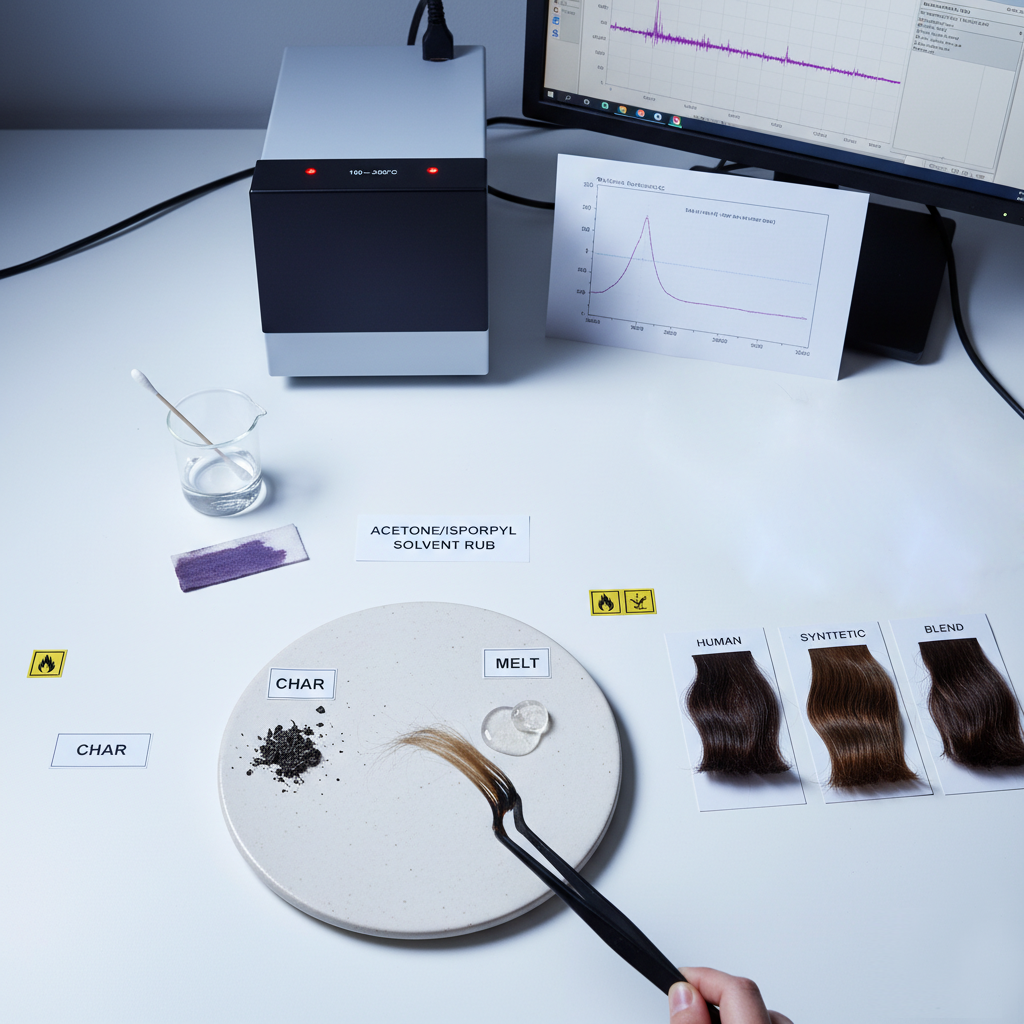
Caution: Some suppliers blend animal or synthetic fibers to hit price points. Always perform blend checks and specify consequences (price adjustment or rejection) in contracts.
Conclusion
Craftsmanship QC for wigs imported from China isn’t just about “looking good”—it’s a discipline. By evaluating lace type and durability, quantifying knotting density, verifying hair direction and remy status, testing shedding and heat/wash performance, and enforcing AQL sampling with measurable tolerances, you can consistently deliver premium products and avoid costly returns.
If you need help building a supplier-specific checklist or setting AQL plans for wig imports from China, contact us for tailored sourcing advice and on-the-ground inspection support.