
Importing wigs from China is attractive because of breadth of styles, scalable capacity, and globally competitive pricing. But your first constraint is almost always the MOQ. Get it wrong and you’ll either tie up cash in slow-moving SKUs or miss pricing tiers and lead-time windows. In this guide, I’ll break down how MOQs work across synthetic wigs, human hair wigs, and hair bundles, how mixed orders and customization change the math, and how to negotiate lower MOQs without compromising quality.
Typical MOQs for wigs from China range from 1–50 pieces for stock synthetic wigs, 20–100 pieces for human hair wigs, and 50–200 pieces per specification for ODM/OEM custom runs. Many factories allow mixing lengths/colors/densities to reach a total MOQ, while private-label packaging carries separate MOQs of 100–500 units.
If you’re testing a new market, start with paid samples and a pilot MOQ (10–20 units), then scale into standard tiers (often 50–100+) for better pricing. Below, I’ll walk you through the practical realities we see daily in sourcing and factory scheduling.
How Do MOQs Differ for Synthetic Wigs, Human Hair Wigs, and Hair Bundles?
Factories set MOQs based on material cost, production complexity, and batch efficiencies. Synthetic hair uses stable inputs and automated processes; human hair requires more manual work and stricter grading; bundles can be more flexible depending on sourcing.
Synthetic stock wigs often start at 10–50 pieces per style/color; human hair wigs commonly run 20–100 pieces depending on grade and cap; bundles can be lower per SKU but higher in total value.
Typical MOQ ranges by category
- Synthetic wigs (stock/standard): 10–50 pieces per style or color; some ready-to-ship as low as 1–5 pieces with limited options.
- Human hair wigs: 20–100 pieces, influenced by hair grade (e.g., Remy, virgin), lace type (HD, Swiss), and cap construction (lace front, 360, full lace).
- Hair bundles/wefts: Often 10–50 bundles per texture/length, but suppliers may allow variety packs to hit a total MOQ (e.g., 10–20 bundles each across 3–5 lengths).
Pro Tip: Best pricing typically starts at 100+ total units for wigs or 100–300 bundles across mixed lengths and textures. Factories plan dyeing/ventilating batches to minimize wastage—your MOQ is their minimum economic batch.
What drives higher MOQs?
- Human hair sourcing constraints: Consistent color lots and grade matching require larger batches.
- Cap construction complexity: Full lace and HD lace have lower yield and higher labor, prompting higher MOQs.
- Color work: Specialty tones (ash blondes, multi-tone balayage) and pre-lightened bases increase scrap risk.
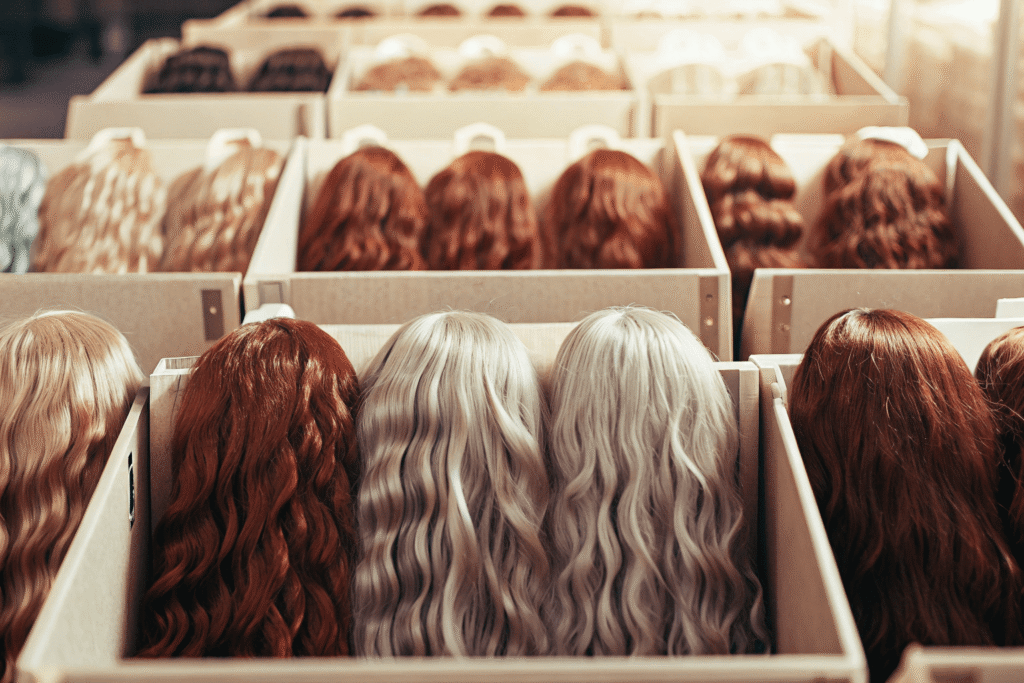
Can I Mix Styles, Colors, and Cap Sizes to Meet the MOQ and Test the Market?
Most suppliers will let you mix SKUs to reach a total MOQ. This is how small brands test what sells without overcommitting to a single style.
Mixed-order allowances are common—factories often accept a total MOQ across lengths, colors, densities, or textures, with micro-MOQs per variant (e.g., 3–5 pieces).
Common mixing rules
- Synthetic wigs: Total MOQ 50 units, with at least 5 pieces per color/length.
- Human hair wigs: Total MOQ 20–50 units, with 2–5 pieces per cap size or density.
- Hair bundles: Total MOQ 50–100 bundles across 3–5 lengths; closures/frontals may have separate micro-MOQs (e.g., 5–10 pieces per lace size).
Caution: Not everything is mixable. Factories often require minimums “per specification.” For example, “50–200 per lace type and color” is common for OEM/ODM.
Practical mixing patterns to test the market
- Lace front (13×4) mix: 10 units per length (12/14/16/18/20”) across natural color, two densities (150/180), total 50 units.
- New brand pilot: 4 styles x 3 colors x 2 cap sizes = 24 units; negotiate a 20–30 unit pilot MOQ with a small surcharge.
Table: Typical mixing allowances by category
| Category | Total MOQ (typical) | Micro-MOQ per variant | Notes |
|---|---|---|---|
| Synthetic stock | 10–50 | 3–5 per color/length | Ready-to-ship can be 1–5 per SKU |
| Human hair wigs | 20–100 | 2–5 per cap/density/color | Higher for HD lace or full lace |
| Hair bundles | 50–100 bundles | 10–20 per length/texture | Closures/frontals: 5–10 per size |
How Do Custom Labels, Packaging, and New Styles Affect the MOQ and Lead Time?
Customization introduces separate MOQs for accessories and adds pre-production lead time. Plan for artwork, sampling, and batch runs.
Private-label boxes, tags, and silk bags typically carry 100–500 unit MOQs and add 7–25 days to lead time; new wig styles or lace specs can push MOQs to 50–200 per specification and extend production by 10–30 days.
Private label and packaging
- Boxes: 200–500 units MOQ is common; unit cost drops significantly at 1,000+.
- Hangtags/inserts: 100–300 units MOQ; digital print is more flexible.
- Satin/silk bags: 100–300 units MOQ depending on fabric and print method.
- Label application: Usually a per-unit fee; some factories include it above certain volumes.
Lead time impact:
- Printing/packaging: 7–15 days after artwork approval (faster for digital prints).
- Custom molds (rare for wigs, more for display stands): 15–30 days.
New styles and OEM/ODM specifications
- New cap size or lace type (e.g., HD lace): MOQ 50–200 per spec to run economically; add 10–20 days for material scheduling.
- Custom colorways: Requires lab dips or swatches; 7–10 days for approval; higher scrap risk can push MOQs up.
- Custom curl patterns: Additional setting time; factories may require 50–100 units to justify tooling/fixtures.
Table: Customization impact on MOQ and lead time
| Customization | Added MOQ (typical) | Lead Time Impact |
|---|---|---|
| Printed boxes | 200–500 units | +7–15 days |
| Hangtags/inserts | 100–300 units | +5–10 days |
| Satin/silk bags | 100–300 units | +7–15 days |
| New lace type/cap spec | 50–200 per spec | +10–20 days |
| Custom colorway | Batch-size dependent | +7–15 days (lab dips) |
Pro Tip: Split orders into two waves—first ship bulk wigs in generic packaging (lower MOQ/faster), then top-up with branded packaging once artwork is approved. This keeps cash moving and reduces launch delays.
What Strategies Can I Use to Negotiate Lower MOQs Without Sacrificing Quality?
Factories care about throughput, predictability, and waste. If you help them plan batches and reduce risk, you can often secure lower MOQs—even as a first-time buyer.
Use pilot orders, off-peak scheduling, SKU consolidation, and modest surcharges to lower MOQs. Always protect quality with clear specs, AQL inspections, and pre-shipment testing.
Practical negotiation levers
- Pilot MOQ with roadmap: Propose 10–20 units now with a written follow-up plan (e.g., 50 units in 60 days if KPIs met).
- Off-peak production: Ask for slow-season windows to fit into idle capacity; many factories relax MOQs then.
- Consolidate SKUs: Fewer specs (same lace type/color/length clusters) = lower batch complexity.
- Accept longer lead time: Let the factory slot your order behind larger runs—often worth a 10–20% MOQ reduction.
- Pay a small surcharge: A 3–8% surcharge can offset setup costs for sub-MOQ batches.
- Take slow-moving stock/remnants: Great for testing; MOQs can drop to 1–5 pieces for ready-to-ship.
- Supplier’s materials: Choose in-stock lace, caps, and color fibers to avoid supplier MOQs on inputs.
- Multi-month blanket PO: Commit to total volume (e.g., 150 units over 3 months) with releases of 30–50; factories often accept lower per-release MOQs.
Maintain quality while going lower on MOQ
- Samples first: Always buy 1–3 paid samples for verification before bulk.
- Spec sheets: Lock down cap construction, lace type, hair grade, density, color code, and acceptable color variance.
- AQL inspections: Use ANSI/ASQ Z1.4 or ISO 2859-1 with 2.5 major/4.0 minor as a baseline; add lace knot strength and shed/tangle checks.
- Color and curl controls: Approve lab dips and curl set samples in writing.
Caution: If a factory agrees to unusually low MOQs at rock-bottom prices, pressure tends to show up in hair grade substitution, density shortfalls, or lace quality. Price sanity checks and third-party QC are your safety net.
Quick Reference: Typical MOQ Scenarios
- Synthetic stock wigs: 10–50 per style/color; ready-to-ship 1–5 pieces with limited selection.
- Human hair wigs: 20–100 depending on grade and cap construction; HD lace/full lace on the higher end.
- ODM/OEM custom specs: 50–200 per specification (lace type, cap, custom color).
- Private label packaging: Separate MOQs of 100–500 units for boxes/tags/bags.
- Mixed orders: Common—combine lengths/colors/densities to hit a total MOQ with 2–5 piece micro-MOQs per variant.
- First order pilots: Negotiate 10–20 pieces with a scale-up plan.
Conclusion: Navigating Wig MOQs When You Import from China
The typical minimum order quantity for importing wigs from China spans from single-digit pieces for ready-to-ship stock to 50–200 per specification for true OEM runs. Your best path is to start with samples, use a pilot MOQ to validate demand, and leverage mixing rules, off-peak timing, and SKU consolidation to keep risk low while protecting quality. When you’re ready to scale, step into 50–100+ unit tiers for better economics and smoother factory scheduling.
If you’d like help structuring a pilot order, negotiating realistic MOQs, or setting up QC and packaging, contact us for tailored sourcing advice—our team can optimize your first run and set you up for scalable growth.