
When I first started trying synthetic wigs, the cap types confused me more than the colors and cuts. I’d put a style in my cart, then realize I didn’t know why one version cost $80 and the “same” style in a different cap cost $200. After testing dozens and talking with stylists and wig shop owners, I realized the cap is the foundation—it determines how natural the hairline looks, how you can part it, how cool it feels, and how long it will last.
The best synthetic wig cap for beginners balances budget, realism, and comfort. Basic cap (machine-sewn wefts) is most affordable and durable; lace front adds a natural-looking hairline for off-the-face styles; monofilament (part or top) delivers the most realistic scalp and multidirectional parting. Start with a basic cap for value, upgrade to lace front for hairline realism, and choose monofilament (part or top) if you change your part often or want natural movement on top.
In this guide, I’ll break down how to pick between basic, lace front, and monofilament caps based on your budget and realism goals, which caps are best for salon customization and parting, how cap materials affect comfort for sensitive scalps, and which caps make sense if you’re building a wholesale assortment. I’ll share what’s worked for me, where beginners tend to overspend, and the upgrades that genuinely make a difference.
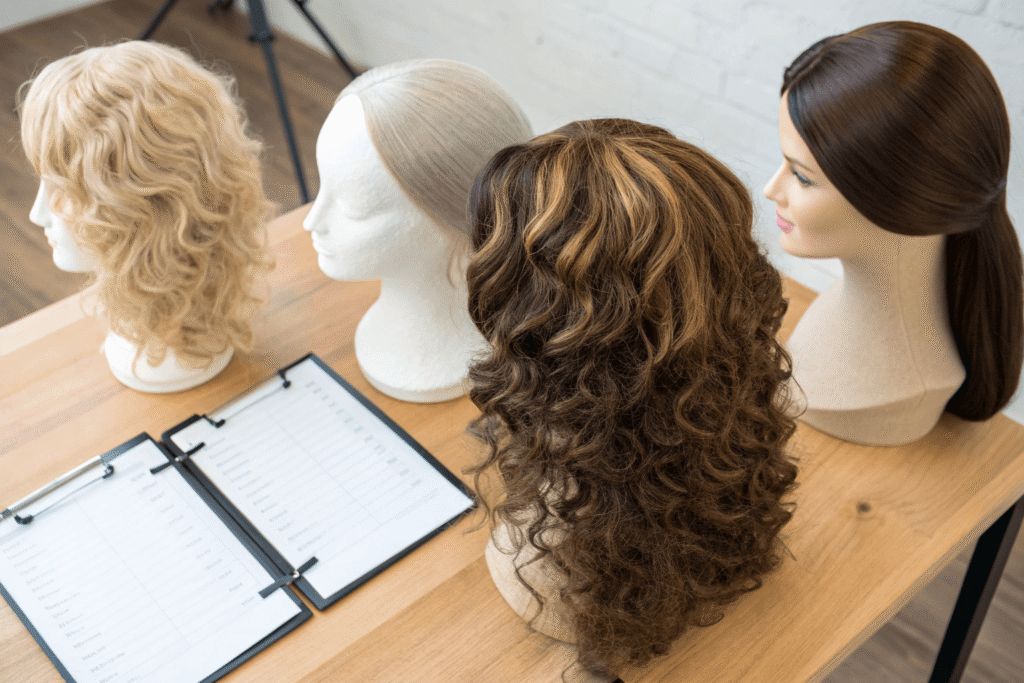
How do I decide between basic cap, lace front, and mono based on budget and realism?
Here’s what I’ve learned after wearing and fitting these for clients: your ideal cap type depends on what you want to “look” real (the hairline, the part, or both), how much styling versatility you actually use day-to-day, and your budget. Most beginners don’t need every premium feature at once.
What each cap does best (in plain English)
- Basic cap (also called open weft/capless): Machine-sewn wefts with permatease at the crown. Lowest price, highest durability, great airflow. Looks least like a real scalp when you part widely.
- Lace front: Sheer lace along the front hairline with hand-tied fibers. Best for a natural hairline and off-the-face styling. Lace is delicate; handle gently.
- Monofilament (mono): Hand-tied fibers on a sheer mesh that mimics scalp. Mono part gives realism along a defined part line; mono top covers the whole top for multidirectional parting and the most realistic “scalp on top.”
Quick comparison: cost vs realism vs styling
| Cap Type | Typical Price Range | Realism Focus | Parting Versatility | Durability | Best For |
|---|---|---|---|---|---|
| Basic cap (wefted + permatease) | $60–$130 | Volume, not scalp | Fixed/generalized; not a true part | High | First wig, tight budgets, daily wear |
| Lace front (wefted sides/back) | $120–$220 | Hairline realism | Front hairline styling; parting depends on top | Moderate | Off-the-face looks, natural hairline |
| Monofilament part | $150–$260 | Realistic part line | Part along defined mono area | Moderate | Natural part without full mono cost |
| Monofilament top | $220–$350+ | Realistic scalp on top | Part anywhere on top | Moderate | Frequent restyling, natural movement |
| Lace front + mono top (combo) | $260–$450+ | Hairline + scalp realism | Max versatility | Moderate | Premium, realism from hairline to crown |
| Double monofilament top | $280–$500+ | Realistic and extra soft | Part anywhere on top | Moderate | Sensitive scalps, medical hair loss |
Notes from experience:
- Basic caps are lighter than you might expect and tough as nails. The trade-off is visible wefting if you lift hair or try deep parts.
- Lace fronts shine in photos and in person when you brush hair off the face. Adhesive can help but isn’t always required if the fit is right.
- Mono tops feel the most “real” at the scalp when someone looks down at your part.
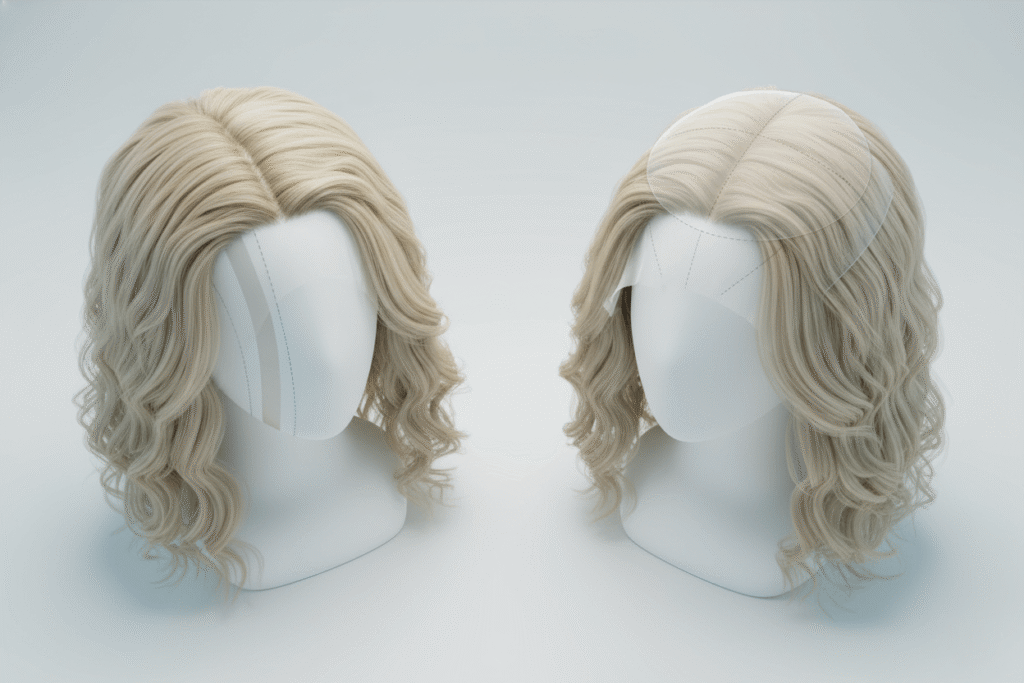
When to start simple, when to upgrade
- Start with basic cap if: you’re price-conscious, don’t change your part often, and want easy maintenance.
- Upgrade to lace front if: your priority is a believable hairline and you like tucking hair behind the ears or wearing it back.
- Choose mono part if: you like a defined side or center part and want scalp realism just there.
- Choose mono top if: you switch parts frequently, prefer natural lift and movement on top, or you’re picky about scalp realism.
Pro tip: If you can only afford one upgrade, pick based on your style habit:
- Wear hair away from your face? Lace front.
- Keep hair forward but care about the part? Mono part/top.
Which cap is best for salon customization and parting versatility?
As a stylist, I look for caps that can handle light customization (thinning, soft layering, knot tinting on lace) without compromising structure. Synthetic fiber itself limits hot-tool use unless it’s heat-friendly, but cap construction determines where you can manipulate the hairline and part.
Parting freedom: mono part vs mono top
- Monofilament part:
- Realistic part along a fixed track (usually 1–2 inches wide).
- Great for consistent side or center part wearers.
- More budget-friendly than full mono.
- Monofilament top:
- Part anywhere on the top: center, deep side, zig-zag.
- Easiest to tweak at the salon for crown cowlicks or subtle lift.
- My pick for clients who change styles or need the most believable “scalp.”
Hairline realism: lace front options
- Standard lace front (temple-to-temple):
- Best for off-the-face styling, tucks, and windproof believability.
- Delicate edge; avoid over-plucking—light tweezing is okay, but synthetic knots are tighter than human hair wigs.
- Extended lace fronts (ear-to-ear or mini lace):
- Ear-to-ear is more advanced and delicate; looks great for ponytails.
- Mini lace fronts (just at the center) reduce cost while improving hairline realism where it counts most.
What I do in the chair
- For basic caps: I keep customizations minimal—tip thinning and soft face framing. Avoid deep parts; use permatease strategically for volume.
- For lace fronts: I gently trim the lace to fit the client’s hairline, tint knots lightly if needed, and teach placement without stretching the lace.
- For mono tops: I set new parts with water and cool air, then use light steam (if fiber allows) to reset direction. No heavy heat unless heat-friendly.
Heat-friendly vs standard synthetic for styling
- Standard synthetic:
- Holds style out of the box. Lowest maintenance.
- Avoid hot tools; use cool-setting blow-dry with a diffuser to direct fibers.
- Heat-friendly synthetic:
- Allows low-heat restyling (typically up to 275–300°F / 135–150°C).
- Requires more upkeep and wears faster with heat use.
Recommendation: Only choose heat-friendly if you truly plan to restyle. Otherwise, standard synthetic is easier and lasts longer.
How do cap materials affect comfort for sensitive scalps and long wear?
Comfort comes down to breathability, softness, weight, and how secure the cap feels without irritating your skin.
Breathability and weight
- Basic cap (open wefted):
- Most airflow; great for hot climates and long wear.
- Lightest overall feel.
- Lace front:
- Lace itself is breathable, but comfort depends on the rest of the cap (often wefted).
- The lace edge can feel scratchy; a wig grip or trimmed lace edge helps.
- Monofilament:
- Full mono top can feel warmer because it’s a solid top panel.
- Mono part is a good compromise—realism without covering the entire top.
Security and adhesives
- You don’t always need glue or tape for lace fronts—many stay secure with proper sizing, ear tabs, and adjustable nape straps.
- If using adhesive:
- Use a skin-safe, water-based adhesive or medical-grade tape.
- Apply scalp protector if you’re sensitive.
- Remove adhesive gently to protect the lace and your skin.
Sensitive scalp tips (including double monofilament)
- Double monofilament:
- A soft extra layer over the knots makes it the gentlest option.
- Ideal if you’re dealing with medical hair loss or post-treatment sensitivity.
- Comfort add-ons:
- Silicone-lined ear tabs or napes for grip without irritation.
- Bamboo or silk wig liners to reduce friction and wick sweat.
- Avoid rough seams: basic caps vary—choose models with covered seams and soft velvet ear tabs if you’re sensitive.
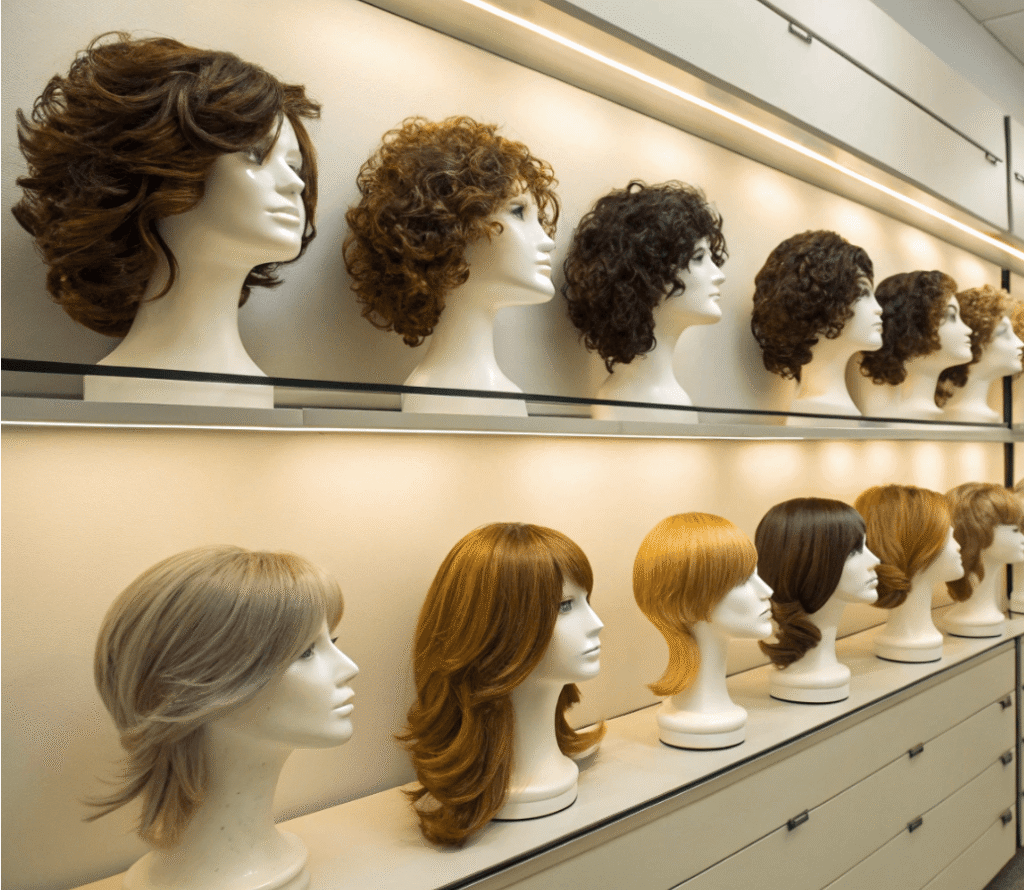
What cap options make the most sense for my wholesale assortment?
If you’re buying for a boutique or ecommerce shop, your mix should cover clear beginner needs first, then offer logical upgrades. I’ve built assortments that minimize returns and maximize shopper satisfaction by segmenting into three tiers: value, mid, and premium.
Core SKUs for beginners (value tier)
- 40–50% Basic cap, standard synthetic:
- Short to medium lengths (less tangling, longer life).
- Natural densities and everyday colors.
- Reason: lowest return rate, best margins, easiest education.
- 20–25% Lace front + wefted sides/back:
- Focus on bob to lob lengths; these sell fast for first lace adopters.
- Carry a few shades with soft, pre-cut lace lines (beginner-friendly).
Add-ons for premium shoppers (mid and premium tiers)
- 15–20% Monofilament part:
- Your realism-per-dollar workhorse.
- Offer in your top sellers (1–3 shapes).
- 10–15% Monofilament top (with or without lace front):
- Include at least one lace front + mono top combo for shoppers who want both hairline and scalp realism.
- Add a small selection of double mono for sensitive scalps and medical hair loss clientele.
Inventory strategy by price tier (example matrix)
| Tier | Cap Types | Price Band | Why Carry It | Notes |
|---|---|---|---|---|
| Value | Basic cap (open weft) | $60–$130 | Entry price, durable, lowest returns | Stock popular lengths/colors heavily |
| Mid | Lace front (wefted back), Mono part | $120–$260 | Realism upgrades that beginners actually use | Educate on lace care; mono part is upsell |
| Premium | Mono top, Lace front + mono top, Double mono | $260–$500+ | Maximum realism and comfort | Lower volume, higher AOV; ideal for appointments |
What I watch in sales data:
- First-time buyers convert fastest on basic cap and lace front; they upgrade to mono on their second purchase.
- Mono part outperforms mono top when price sensitivity is high, but mono top drives repeat loyalty.
- Keep heat-friendly SKUs limited unless your clientele specifically asks; standard synthetic wins on longevity and ease.
Extra guidance for beginners: FAQs and quick picks
Which cap should I buy first?
- On a budget or unsure? Basic cap.
- Want to wear hair off your face? Lace front.
- Care most about the part looking like scalp? Mono part.
- Want both hairline and scalp realism with maximum styling freedom? Lace front + mono top.
Do I need adhesive for a lace front?
- Not necessarily. If the cap size fits and has good ear tabs and straps, you can skip glue. Use adhesive only for extra security or very active days.
How long do these caps last?
- Basic cap: Often the longest due to sturdy construction.
- Lace front: The lace is delicate—handle gently to avoid tears.
- Monofilament: Hand-tied areas need gentle care; avoid snagging with brushes.
Can I change the part on a basic cap?
- Not truly. You can “suggest” a part using water and gentle combing, but the scalp won’t look realistic, and wefts may show if you go too deep.
Pros and cons at a glance
| Cap Type | Pros | Cons |
|---|---|---|
| Basic cap | Lowest cost, durable, breathable, light | Least realistic scalp, limited parting, visible wefts if lifted |
| Lace front | Natural hairline, off-the-face styling, photo-friendly | Delicate lace, learning curve, may need adhesive, moderate cost |
| Mono part | Realistic part line, good value realism | Part limited to mono track, slightly warmer than basic |
| Mono top | Part anywhere, most realistic scalp on top, natural movement | Higher cost, warmer top, gentle handling required |
| Double mono top | Softest on scalp, medical-friendly, realistic | Premium price, warmest of the group |
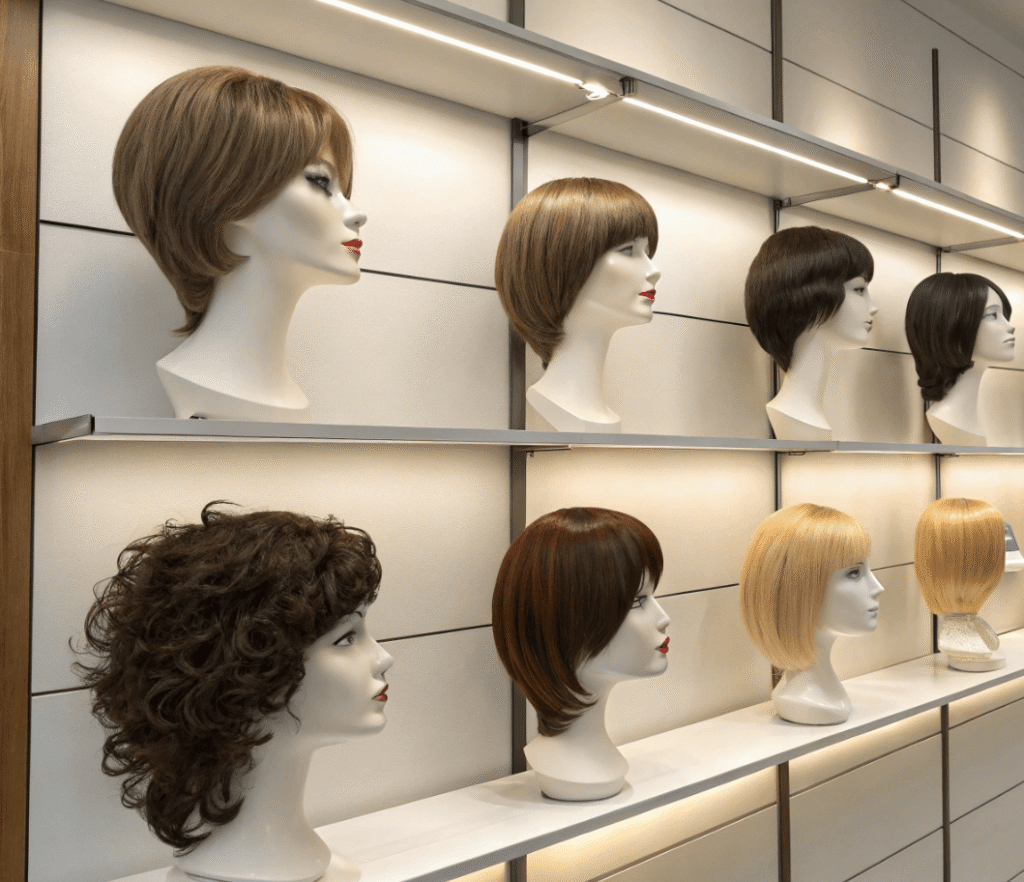
Care tips that extend lifespan (learned the hard way)
- Detangle from ends up before washing; use a wide-tooth comb only on synthetic.
- Wash every 6–10 wears (or when product builds up). Cooler water, synthetic-safe shampoo, and conditioner.
- Air dry on a stand; avoid heat unless fiber is heat-friendly.
- With lace fronts, pat dry the lace and never yank at the edge. Remove adhesive with the right solvent.
- Store on a stand out of direct sunlight to preserve color.
Real-world starter combinations I recommend
- Budget everyday wear: Basic cap bob or lob in standard synthetic. Minimal fuss, long-lasting.
- Natural hairline without big spend: Lace front + wefted back in a shoulder-length style.
- Parting realism with value: Mono part bob with a soft side part.
- Ultimate realism: Lace front + mono top in a mid-length with natural density.
Conclusion
If I could hand you one piece of beginner advice, it’s this: buy the cap that supports the way you actually wear your hair, not the fanciest feature list. For most first-time buyers, a basic cap is the smart starting point—affordable, breathable, and durable. When you’re ready for upgrades, choose a lace front if you love off-the-face styling, or a monofilament part/top if a believable scalp and flexible parting are your must-haves. Based on my experience, if realism is your top priority and your budget allows, a lace front + mono top combo is the one I’d start with.
You’ve got great options at every price. Pick the cap that fits your lifestyle today, and you can always step up features as your confidence grows. I’m rooting for you to find a wig that feels comfortable, looks natural, and makes getting ready effortless.