
How do I evaluate heat-set polymers and flame-retardant additives for my SKUs?
I’ve spent enough time on factory floors and in formulation meetings to know that “heat-resistant” synthetic wigs are not created equal. Procurement teams often assume it’s a simple fiber spec—Kanekalon, Toyokalon, or “hi-heat”—but the reality is a layered recipe of base polymer, heat-set chemistry, flame-retardants, stabilizers, and surface coatings. The pain points I see most: SKUs that claim 180–200°C styling tolerance but yellow, off-gas, or relax curls after a few cycles; inconsistent heat response across batches; and vague additive disclosures from suppliers that leave compliance teams exposed.
Heat resistance in synthetic wigs is achieved by combining high-Tg base polymers (modified polyester, polyamide, PPS, PEI blends) with flame-retardant packages (typically phosphorus-based), crosslinking agents, thermal-stable silicone coatings, and stabilizers (antioxidants, UV). These additives lift softening points, reduce thermal deformation, and manage ignition risk while maintaining handfeel and curl memory. Proper evaluation requires lab testing for DSC/TGA, heat-set recovery, VOC/odor, and regulatory compliance, backed by supplier technical files with full additive disclosure.
Below, I’ll share how I evaluate heat-set polymers and additive packages, which formulations balance curl retention with styling temperature, what to watch for on odor and wearer safety, and exactly which documents to request from suppliers to protect your brand and your customers.
The additive toolbox for heat-resistant synthetic wigs
Base polymers that carry heat
- Modified polyester or polyamide (nylon) grades are common for 160–200°C styling windows; they’re tuned for higher glass transition (Tg) and better heat distortion resistance.
- Kanekalon and Toyokalon families can be engineered in heat-resistant grades that accept low-to-medium heat; Kanekalon FUTURA-type fibers are positioned to mimic human hair with controlled heat tolerance.
- For high-heat SKUs (approaching 200°C), I look at blends or copolymers with polyphenylene sulfide (PPS) or polyetherimide (PEI) to push Tg/melting points higher without embrittling the fiber.
Additives that make the difference
- Flame-retardants: Phosphorus-based systems (e.g., phosphate/phosphinate/phosphonate) are preferred to reduce softening and ignition during heat exposure. Some legacy systems used brominated epoxy FRs; I push suppliers toward halogen-free where performance allows to minimize odor and regulatory friction.
- Crosslinkers: Low-level crosslinking in the polymer matrix increases dimensional stability and raises softening points, improving curl memory after heat cycles.
- Silicone-based coatings: Thermal-stable silicones reduce friction, distribute heat during styling, and help the fiber “release” from hot tools without flattening or sticking.
- Ceramic-infused micro-coatings: Fine ceramic fillers improve heat distribution and reduce localized hot spots that cause gloss loss or kinking.
- Stabilizers: Hindered phenolic antioxidants limit chain scission and discoloration over repeated heat cycles; UV stabilizers prevent photo-oxidation that otherwise weakens fibers when heat and light combine.
- Fillers: Mica or talc can improve heat distortion resistance and dimensional stability; the trade-off is potential stiffness or reduced luster if loading is high.
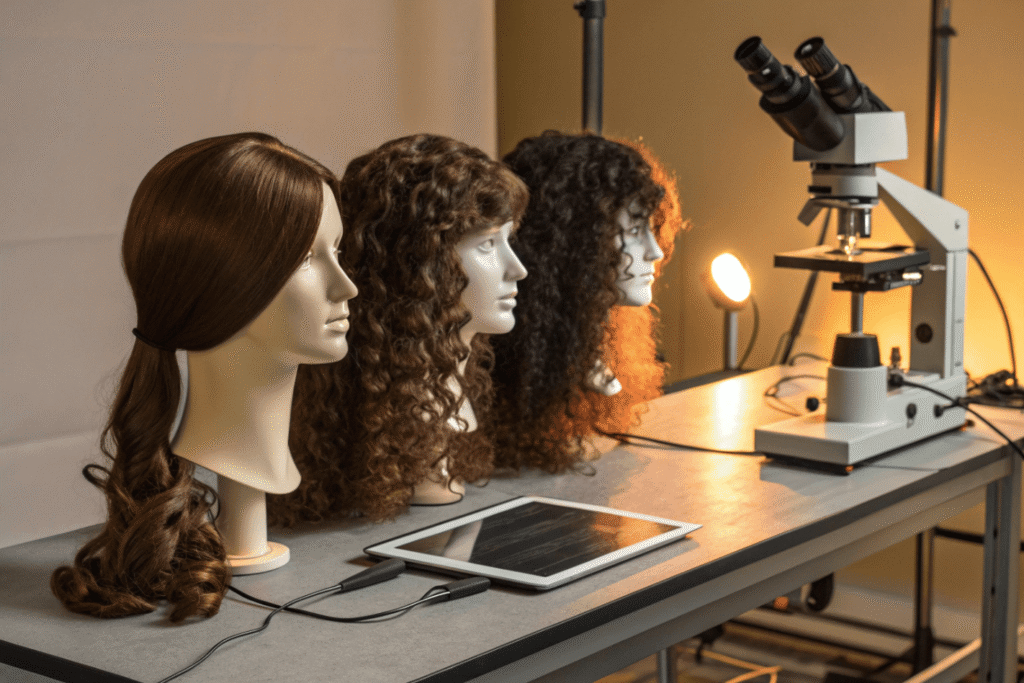
Which formulations balance curl retention with styling temperature?
Balancing curl retention with styling temperature is about pairing the right base polymer with a stabilizer/coating system that supports repeated heat-set cycles without plastic flow or oxidative yellowing. In my experience:
- For 160–180°C styling: Modified polyester or polyamide with phosphorus-based FR, hindered phenols, and a thin silicone topcoat gives excellent curl fix and resets with minimal odor. Add low-loading mica for dimensional stability if the style requires tighter curl memory.
- For 180–200°C styling: PPS- or PEI-blended fibers offer higher Tg, but they require careful crosslinker dosing and a robust antioxidant package to prevent embrittlement. Ceramic micro-coatings help maintain surface integrity under higher tool temps.
- For low-to-medium heat SKUs (Kanekalon/Toyokalon grades): Optimize the silicone system and UV stabilizers; keep FR halogen-free where possible to reduce odor and comply with stricter markets.
Practical test plan I use for curl memory
- Heat-set cycle: 170°C, 180°C, 200°C, each for 10–15 seconds, three cycles per temperature on test tresses.
- Recovery metrics: Curl retention (%), elastic recovery angle, and creep over 24 hours at 25°C/50% RH and 40°C/50% RH.
- Surface assessment: Gloss change (60° gloss), fiber stick-slip on iron plate, and micro-melt spots via microscopy.
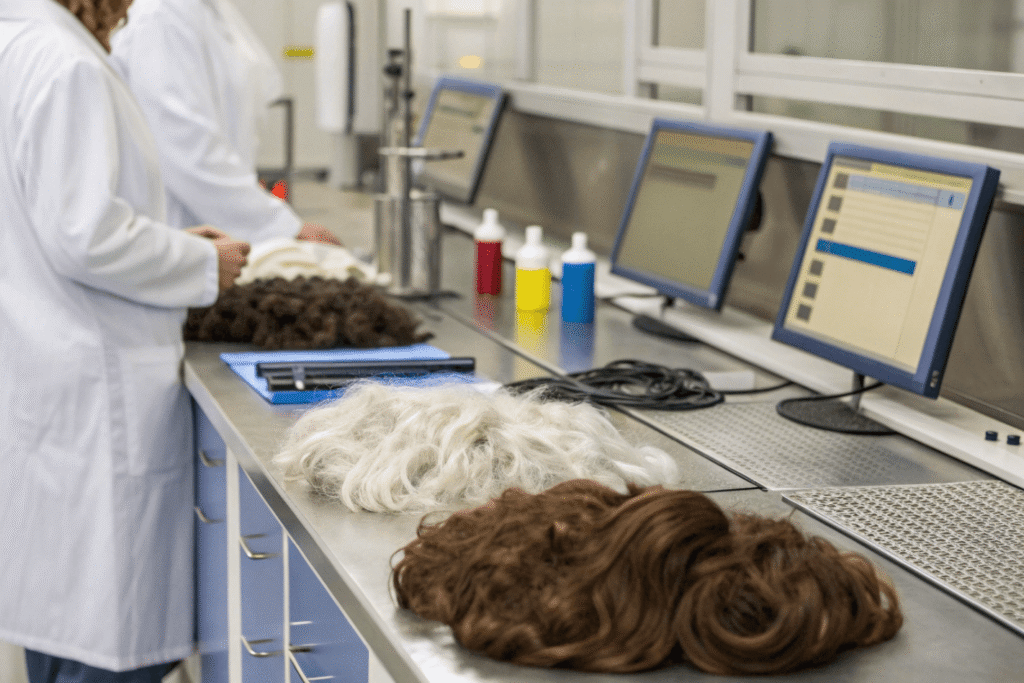
Trade-off table: Styling temperature vs performance
| Target styling temp | Recommended polymer system | Key additives/coatings | Curl retention | Odor risk | Handfeel/appearance |
|---|---|---|---|---|---|
| 160–170°C | Modified polyester/polyamide | Phosphorus FR + hindered phenols + silicone | High | Low | Soft, natural luster |
| 175–185°C | Modified polyester/polyamide + low mica | Phosphorus FR + silicone + UV stabilizers | High | Low–moderate | Slightly firmer hand |
| 185–200°C | PPS/PEI blends | Crosslinkers + antioxidants + ceramic micro-coatings | High (with cycle control) | Moderate | Can skew to matte; needs finishing |
| ≤160°C (Kanekalon/Toyokalon) | Heat-resistant grades | Silicone + UV + minimal FR | Moderate | Low | Very natural handfeel |
How do additives impact compliance, odor, and wearer safety?
This is where many brands get burned—literally and figuratively. Heat-resistance claims intersect with chemical safety, emissions, and regional regulations.
Compliance considerations
- Halogenated FRs: Brominated systems can complicate RoHS/REACH documentation and trigger consumer perception issues. I favor phosphorus-based FRs to streamline EU compliance and reduce potential SVHC flags.
- VOC emissions: When heated, synthetic fibers can emit VOCs; I commission emissions testing (ISO 16000 or ASTM D6196 adapted for heated tress chambers) at 160–200°C to document profiles and set internal limits.
- Heavy metals and SVHC: Ensure pigments and fillers meet EN 71-3 (for safer wig accessories), REACH Annex XVII, and California Proposition 65 where applicable.
Odor and user experience
- Odor often correlates with halogenated FRs, residual monomers, and insufficient stabilization. Silicone topcoats can mask minor odors but don’t fix root causes.
- Antioxidants (hindered phenols) and UV stabilizers reduce yellowing and oxidative smells during repeated heat cycles.
- Crosslinking must be controlled—over-crosslinked fibers can smell “chemical” when heated and feel brittle after styling.
Wearer safety checkpoints I mandate
- Contact irritation: Patch test fibers/caps per ISO 10993-5/-10 analogs for consumer products; check for residual catalysts or ammonia-like off-gassing.
- Thermal behavior: DSC to confirm Tg and melt transitions; TGA to assess onset of thermal decomposition. Avoid fibers that soften sharply just below claimed styling temps.
- Flammability: Test per 16 CFR 1610 or ISO 3795. FR should delay ignition without producing excessive smoke or corrosive gases.
Compliance/odor impact matrix
| Additive choice | Compliance complexity | Odor potential under heat | Safety notes |
|---|---|---|---|
| Phosphorus-based FR | Low–moderate (generally favorable) | Low | Good ignition delay; monitor total phosphorus for eco-labels |
| Brominated epoxy FR | High (REACH/consumer perception) | Moderate–high | Possible corrosive smoke; strong documentation needed |
| Silicone coatings | Low | Very low | Improves tool glide; watch for build-up affecting handfeel |
| Ceramic micro-coatings | Low | Very low | Enhances thermal spread; may reduce gloss |
| Hindered phenol antioxidants | Low | Low | Prevents chain scission; balance to avoid yellowing |
| UV stabilizers | Low | Low | Critical for outdoor use and photo-thermal stability |
| Mica/talc fillers | Low | Very low | May stiffen fiber at higher loadings |
What supplier documentation should I request for additive disclosure?
When I onboard a fiber supplier or audit a wig factory, I ask for a structured technical file. If they can’t produce it, I treat heat-resistance claims as marketing until proven otherwise.
Core documents to request
- Full additive disclosure: CAS numbers, functional class (FR, antioxidant, UV, crosslinker, coating), typical loading ranges (% by weight).
- Polymer base spec: Resin family (polyester, polyamide, PPS, PEI blend), Tg, melting point, and heat distortion temperature (HDT).
- Thermal data: DSC and TGA curves for the exact grade used in your SKU; include test conditions.
- Flammability reports: 16 CFR 1610 or equivalent, with FR system identified (halogen-free vs brominated).
- VOC/emissions report: Heated emissions profile at 160–200°C from an accredited lab.
- Regulatory statements: REACH SVHC screening, RoHS, Proposition 65, and any halogen declarations.
- Surface treatment details: Type of silicone, ceramic, or other coatings; application method; add-on weight.
- Stability testing: Heat-set cycle testing data (curl retention, color shift, gloss change) across 3–5 cycles.
- Change control: Written agreement that any additive or supplier changes trigger notification and requalification.
Qualification checklist I give to suppliers
| Document | Required? | Notes |
|---|---|---|
| Technical data sheet (TDS) with Tg/HDT | Yes | SKU-specific, not generic brochure |
| Safety data sheet (SDS) | Yes | Fiber grade plus coating system |
| Additive list with CAS and loading | Yes | Include FR type (phosphorus vs brominated) |
| DSC/TGA reports | Yes | Run on production lot, not pilot |
| Flammability test certificate | Yes | 16 CFR 1610 or ISO equivalent |
| VOC/emissions test | Yes | At target styling temps |
| Colorfastness and UV stability | Yes | Post-heat cycle color shift ΔE |
| Odor assessment protocol | Optional but recommended | Instrumental plus panel |
| Change control agreement | Yes | Mandatory for brand protection |
Conclusion
Heat-resistant synthetic wigs are a chemistry stack, not a single spec. I get reliable performance by pairing the right base polymer (modified polyester/polyamide for 160–180°C; PPS/PEI blends for 180–200°C) with phosphorus-based flame retardants, controlled crosslinking, thermal-stable silicone or ceramic micro-coatings, and robust antioxidant/UV stabilization. On the business side, I protect SKUs and brand reputation through disciplined testing—DSC/TGA, heat-set recovery, flammability, VOCs—and by demanding full additive disclosure and change control from suppliers. Do that, and you’ll deliver fibers that style consistently, hold curl, minimize odor, and clear compliance in your key markets.