
Importing wigs from China can be highly profitable—but only if you manage quality rigorously. The wig supply chain spans raw hair collection, chemical processing, dyeing, ventilation, cap construction, and packing. Any weak link shows up as shedding, tangling, lace defects, color mismatch, or caps that don’t fit. As someone who audits factories in Xuchang, Qingdao, and Juancheng, I’ve seen the same issues repeat across suppliers and batches.
The most common wig quality issues when you import from China are fiber inconsistency (mixed Remy/non-Remy or synthetic blends), shedding and tangling from poor wefting or knotting, color mismatch due to unstable dyeing, cap and lace defects, incorrect density and hair direction, chemical residues causing odor/irritation, exaggerated heat-resistance claims, measurement inaccuracies, and packaging/transit damage (creases, lace deformation, moisture).
Below, I break down why you see these issues, how to detect them before buying, what’s often mislabeled or hidden, and how to control packaging and odor/color problems at the factory QC stage.

Why do I see shedding, tangling, and matting in my wig shipments?
These defects typically trace back to hair sourcing, cuticle alignment, and how the hair is fixed to the cap or weft. In lower-cost builds, factories compensate with heavy chemical processing, which looks good out of the box but fails quickly after washing or heat styling.
Shedding, tangling, and matting come from mixed-quality fibers, non-Remy or acid-peeled hair, weak wefting/knotting, and poor cuticle alignment. Stable performance requires aligned cuticles, tight wefts, strong knots, and controlled chemical processing.
- Fiber inconsistency: Batches often mix different origins and grades. Within a single unit you’ll see uneven texture/shine; strands behave differently when combed or heat-styled.
- Cuticle alignment and Remy status: Non-Remy hair has misaligned cuticles that snag and knot. To mask this, some plants acid-etch the cuticle, then silicone-coat. After 3–5 washes, silicone rinses off and matting accelerates.
- Wefting and knotting: Low stitch-per-inch (SPI) and loose double-wefting cause immediate shedding. On lace, single knots without reinforcement shed faster; poor ventilation direction creates friction points that tangle at the nape.
- Processing overkill: Aggressive bleaching to reach 613, strong oxidative dyes, and high-alkali relaxers weaken the shaft—leading to breakage and frizz.
On-site checks we run:
- Weft pull test (10 strokes with a fine-tooth comb; loss >10 strands/side is a fail).
- Wash test (shampoo + conditioner + air-dry). If hair felts or the water turns yellow/brown, expect silicone leach or unstable dye.
- Nape friction test (rub against cotton T-shirt 30 seconds). Immediate matting indicates misaligned cuticles or over-processing.
How can I spot inconsistent density, lace defects, and poor knot bleaching before buying?
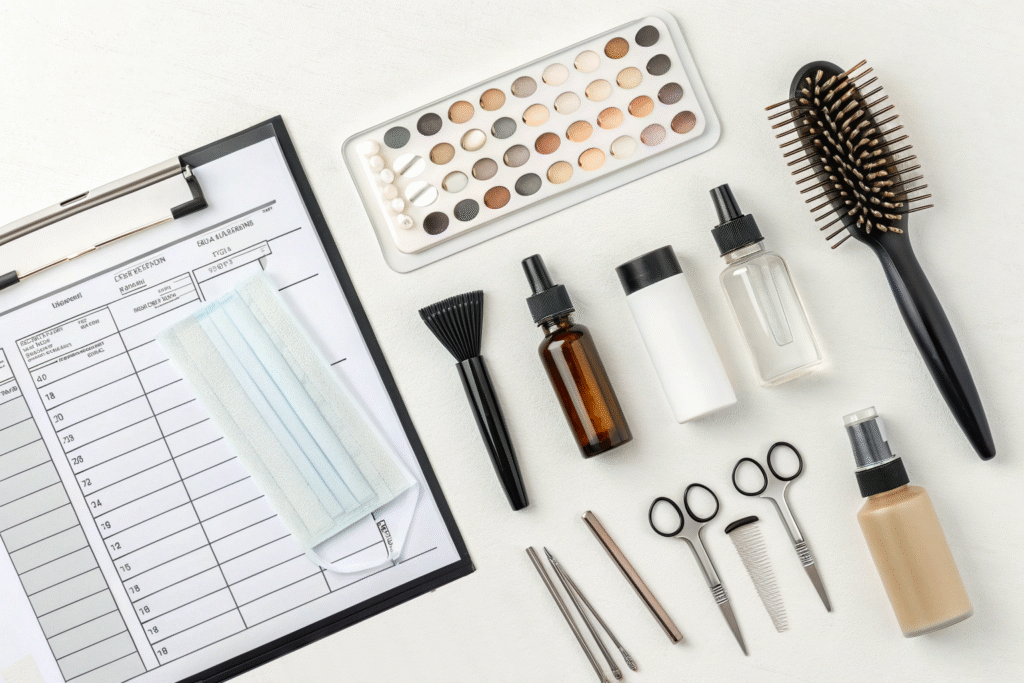
Pre-shipment inspection (PSI) and golden samples are vital. Many issues are visible with a light, a ruler, and a trained eye—before they hit your warehouse.
Standardize density maps, lace specs, and knot standards in a written QC sheet, then verify them with AQL sampling, backlighting, and simple mechanical tests at the factory.
Density and hair direction
- Density map: Specify grams per zone (front hairline, top/crown, sides, nape). For a 150% density 13×4 frontal, define: hairline 60–80% graduated, crown 120–130%, rest 150%. Ask for measured net weights per size.
- Direction and parting: Wrong ventilation direction creates bulky crowns or visible tracks. Check part lines under backlight; look for gaps or tufting.
- Visual symmetry: Place on a mannequin and photo from 4 angles; asymmetry or bald spots indicate uneven ventilation or QC drift.
Lace and knotwork
- Lace defects: Thick/scratchy lace, uneven lace tint, warped grids, or off-square mesh. Tug test the lace edge: if it distorts easily, the lace is too soft or poorly heat-set.
- Knot bleaching: Over-bleaching weakens knots; under-bleaching leaves visible dots. Define a “brown dot” tolerance (e.g., knots must be ≤0.3 mm, color Delta E <3 vs. scalp swatch). Use a magnifier to count unbleached knots per cm².
- Ear tabs and seams: Weak ear tabs cause lifting; inspect stitching density (min 8–10 SPI) and bar-tacks at stress points.
Field-ready inspection routine
- Backlight table check for lace grid uniformity and ventilation spacing.
- Tensile test: Light 1–2 lb pull on ear tabs and temple seams for 3 seconds. No popping stitches allowed.
- Weight check: Digital scale tolerance ±3% per SKU.
- Try-on fit on size-graded mannequin heads (S/M/L) to flag cap shrinkage or loose fits.
Pro Tip: Include a knot bleaching SOP—time, developer volume, neutralization steps—to keep batches consistent across lines and shifts.
Are mixed fibers and mislabeled hair grades a frequent problem I should check?
Yes. Mixed fibers (human + synthetic) and misleading grades (“10A/12A/13A”) are frequent in low-to-mid tiers. Some blends are intentional for cost/shine; others are undisclosed to hit price points.
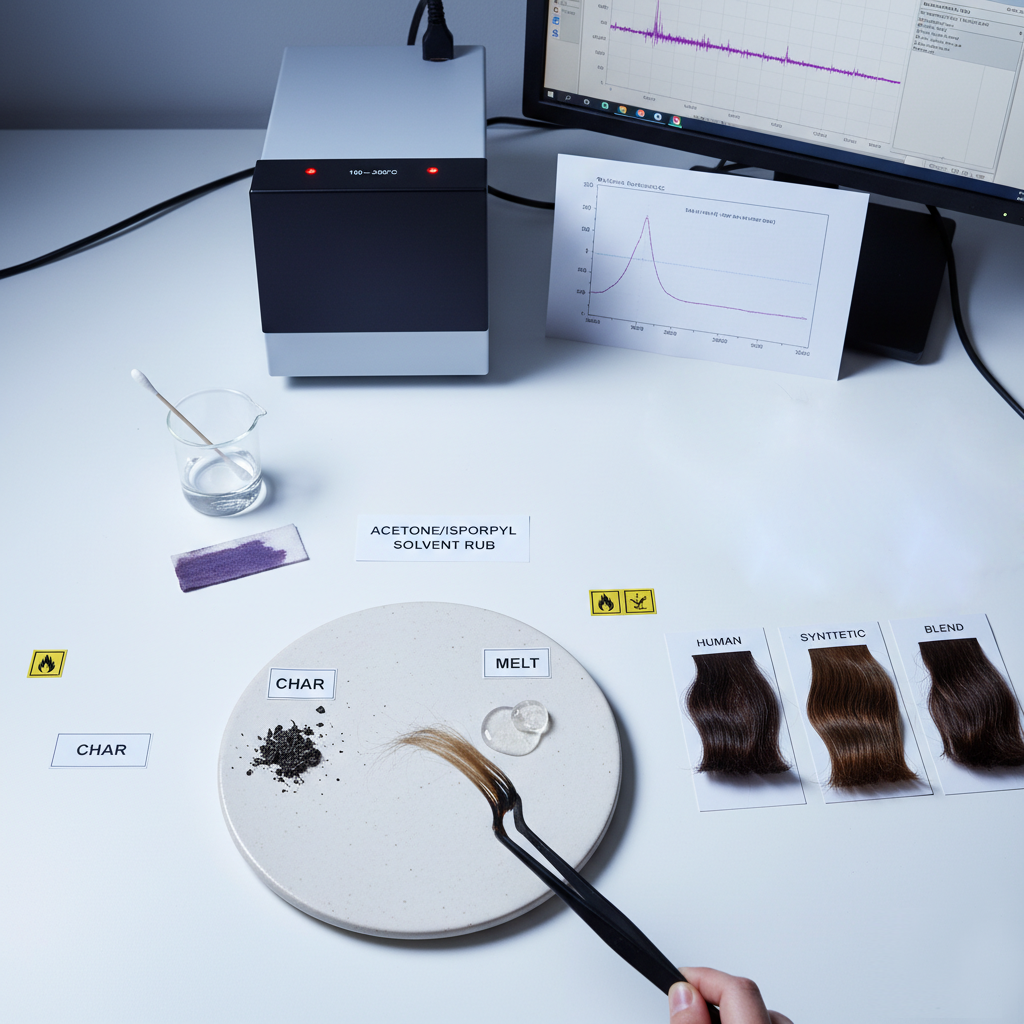
Assume claims are optimistic. Verify fiber identity and grade with lab tests (burn, solvent, FTIR), heat-styling trials, and supply-chain documentation; write penalties for mislabeling into the PO.
What to look for
- Human/synthetic blends: Synthetic adds uniform shine and shape retention; it also melts or frizzes at salon temps. Low-melt fibers (PVC, low-grade PET) deform at 150–170°C.
- “Remy/virgin” claims: True virgin hair is rare at scale. Many pieces are dyed, relaxed, or acid-washed. Remy means aligned cuticles—confirm with microscopy or directional slip test (smooth root-to-tip, rougher tip-to-root).
- Grade inflation: “A” scales are not standardized. Define grade by measurable criteria: cuticle presence, chemical history, bundle weight tolerance, and single/double-drawn ratio.
Quick verification methods
- Burn test: Human hair chars, smells like keratin; synthetics ball/melt and smell chemical. Not definitive alone but useful screening.
- FTIR or DSC lab test: Confirms polymer type and melting behavior for synthetics; very effective for blend detection.
- Heat test: Flat iron at 180–200°C on a hidden strand. Melting, stickiness, or instant frizz suggests synthetic contamination or low-heat fibers.
- Solvent rub: Acetone/isopropyl on a cotton swab; dye lift indicates surface coating or unstable color.
- Residue check: Soak a small tuft in warm water with mild shampoo; slippery feel and rainbow sheen after rinse indicates silicone-heavy coating.
Caution: If a supplier resists third-party testing or will not sign a no-mix clause with financial penalties, expect higher risk of blended fiber substitution.
What packaging, odor, and color mismatch issues should I watch in factory QC?
Transit amplifies factory shortcuts. Poor boxes, moisture, and unstable dyes lead to creasing, mildew odor, and color shift between batches.
Specify moisture-safe packaging, color tolerances, and odor thresholds. Verify with controlled wash tests, humidity exposure, and colorimetry before shipment.
Color control and dye stability
- Batch color variance: Demand master swatches and measure Delta E ≤2.0 under D65 lighting on a spectro. For popular tones (1B, 2, 4, 613, ashy blends), lock formulas and fix developer volumes/times.
- Patchiness/banding: Caused by uneven bleaching or dye penetration. Comb wet hair over white towel after wash; stripes indicate inconsistent lift.
- Fading: UV and alkaline shampoos accelerate fade on poorly fixed dyes. Run a 5-wash test plus UV exposure (24 hrs) on golden samples; reject if ΔE >3.
Odor and chemical residues
- Strong odors: Often from residual thioglycolates, high-alkali neutralization, or storage in damp rooms. Require post-process neutralization and a 24–48 hr airing stage.
- Safety: For EU/US markets, set limits for free formaldehyde and banned azo dyes; include testing in your PSI.
Packaging and transit protection
- Inner packaging: Wig form or net, silica gel desiccant (≥5 g), breathable bag, and a rigid insert to protect the lace front.
- Outer packaging: Crush-resistant boxes (ECT 44+), moisture barrier (PE liner or VCI bag), and humidity indicator cards (HIC). Pallets should be film-wrapped with top covers.
- Mold/mildew prevention: Require ≤65% RH storage, moisture meters on warehouse floor, and container desiccants for ocean freight.
Table: Common Defects and Root Causes
| Defect | Likely Root Cause | Quick Factory Test |
|---|---|---|
| Shedding | Low SPI, weak glue, single knots | Comb test 10 strokes/side |
| Tangling/matting | Non-Remy, acid-peeled, misaligned cuticles | Nape friction + wash test |
| Color mismatch | Inconsistent dye recipes, poor fixation | Spectro ΔE check under D65 |
| Lace visible/rough | Thick lace, poor tint, large knots | Backlight + knot count + touch test |
| Odor/irritation | Residual chemicals, damp storage | Sniff test + pH strip + lab panel |
| Cap too small/large | Pattern shrinkage, measurement drift | Fit test on graded heads + tape check |
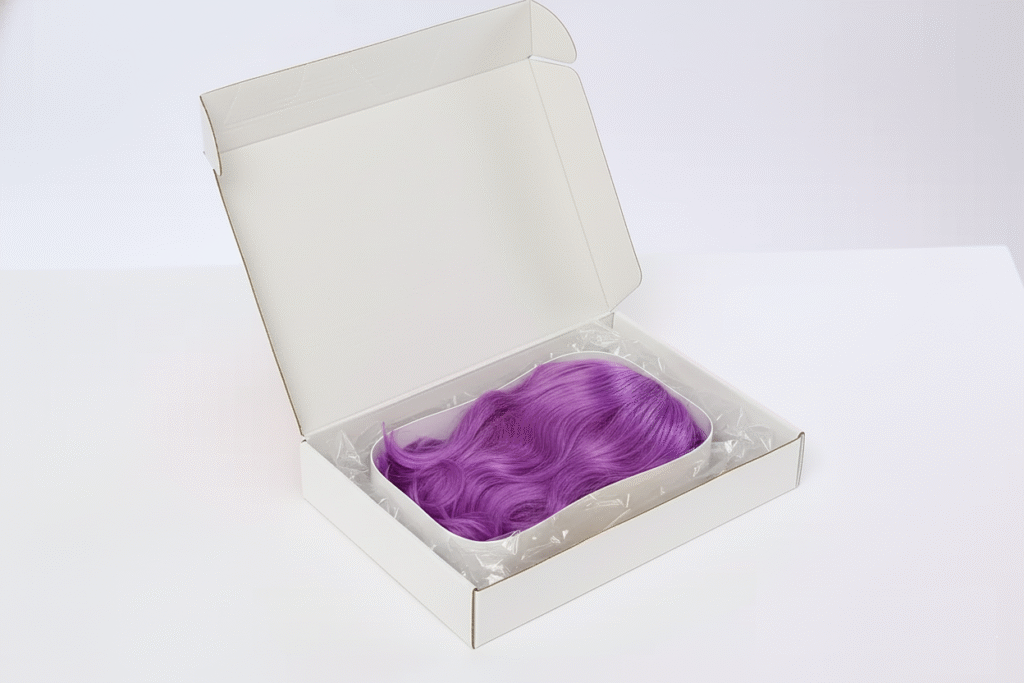
Pro Tip: Add a “transit simulation” to PSI—carton drop test (ISTA 1A) and 48-hour 75% RH exposure. It costs little and prevents most packaging claims.
Regional and procedural nuances that matter
Table: Regional Lead-Time and Risk Signals (Typical)
| Region (China) | Typical Products | Lead Time (bulk) | Common Risks |
|---|---|---|---|
| Xuchang (Henan) | Human hair, frontals/closures | 15–30 days | Batch mixing, grade inflation |
| Qingdao (Shandong) | 613 blondes, colored units | 20–35 days | Over-bleach brittleness, color drift |
| Juancheng (Shandong) | Economical synthetics | 12–25 days | Heat resistance overstated, shine high |
Caution: Rushed peak-season orders (pre-holiday, prom, festival periods) correlate with density inconsistency and knot bleaching errors. Lock capacity early and enforce PSIs.
Putting it into practice: What to write in your PO/QC checklist
- Materials: 100% human hair, no synthetic blends; Remy aligned cuticles; no acid peeling. Penalty clause for non-conformance.
- Density map: Gram targets per zone; net wig weight tolerance ±3%.
- Lace: HD Swiss lace 50–60 gsm, tint #X, knot size ≤0.3 mm, bleach standard SOP attached.
- Wefting/ventilation: SPI ≥10; double weft; knots reinforced at stress points.
- Measurements: Cap circumference, ear-to-ear, front-to-nape ±0.5 cm.
- Color: ΔE ≤2.0 against master; 5-wash/UV stability test required.
- Safety: Formaldehyde, azo, heavy metals per target market standard.
- Packaging: Desiccant, HIC, crush test, lace protector insert.
- Inspection: AQL II 2.5/4.0, with functional tests listed above.
- Samples: Golden sample sealed and co-signed; production must match.
Conclusion
When importing wigs from China, the recurring quality issues—shedding, tangling, fiber inconsistency, color mismatch, lace and cap defects, chemical odors, exaggerated heat claims, measurement drift, and packaging damage—are predictable and preventable. The cure is a tight specification plus factory-floor verification: aligned cuticles, robust wefting/knotting, controlled dyeing, measurable density/fit, safe chemistry, and moisture-safe packaging. If you want help drafting a bulletproof QC checklist or auditing suppliers before your next order, contact us for tailored sourcing advice and inspection support.