
I’ve spent years balancing factory realities with brand ambitions, and MOQ is one of those topics that can make or break a launch. In synthetic wig manufacturing, MOQs exist to protect setup costs—fiber procurement, dye-lot batching, cap tooling, and staffing for hand-tied sections—while allowing brands to maintain healthy inventory turns. For procurement teams, the challenge is negotiating MOQs that won’t choke cash flow or balloon storage, especially when colorways and cap sizes multiply SKUs fast.
Most factories set MOQs for custom synthetic wigs between 50 and 200 units per style, and the MOQ often applies per color and cap size variant. Complex designs (lace fronts, hand-tied, heat-resistant fibers) push MOQs higher due to labor and batch-dye constraints. Suppliers may reduce MOQs when you use stock base caps with custom colors/lengths or commit to multi-style contracts, but expect higher unit prices below standard MOQs.
Let me break down how I approach MOQ negotiation by color/style/cap size, how to choose batch sizes that reduce unit cost without bloating inventory, when and how you can mix styles within a single run, and how to set sample-to-mass ratios for new launches.
How do I negotiate MOQs by color, style, and cap size with my supplier?
What factories are optimizing
- Dye-lot stability: Synthetic fibers (especially heat-resistant) require batch dyeing; small runs can cause shade drift and higher scrap.
- Cap line efficiency: Changing cap sizes or lace specs resets machines and QC fixtures.
- Labor allocation: Hand-tied fronts/closures need steady station loading to maintain quality and cost.
My negotiation framework
Anchor to shared components.
- Lead with a stock base cap (same mesh, ear tabs, nape) across multiple SKUs, then vary color and length. Factories commonly reduce MOQ when the cap is standard and only color/length varies.
Separate “color MOQ” from “style MOQ.”
- Propose a style-level MOQ (e.g., 150 units) and distribute it across 3 colors (e.g., 60/60/30) to meet dye-lot minimums. You’ll often get a lower per-color MOQ if the total style MOQ holds.
Cap size bundling.
- Bundle S/M/L under one run with a shared cap pattern. Negotiate a ratio (e.g., 20% S, 60% M, 20% L) and accept ±5% tolerance to keep the line moving.
Complexity premiums.
- For lace fronts or partial hand-tied sections, accept a higher MOQ or a surcharge on sub-MOQ quantities. Show your 6–12 month forecast to justify a phased schedule.
Staggered delivery under one PO.
- Place one production order to meet the factory’s MOQ, then schedule releases (e.g., 60/40 split over 60–90 days). This eases inventory pressure without fragmenting production.
Price tiers and transparency.
- Ask for a three-tier unit price (below MOQ, at MOQ, above MOQ). You’ll understand the cost curve and where consolidation makes sense.

Typical MOQ patterns I see
- Base cap + custom color: 50–100 units total, with 20–40 units per color if dye-lot can be shared across shades.
- Fully bespoke cap construction: 150–200 units per style; per color minimums enforced (often 50+ per shade).
- Heat-resistant fibers: Higher MOQs (80–150 per color) due to batch dyeing and fiber availability.
Which batch sizes reduce unit cost while keeping inventory risk low?
The economics in practice
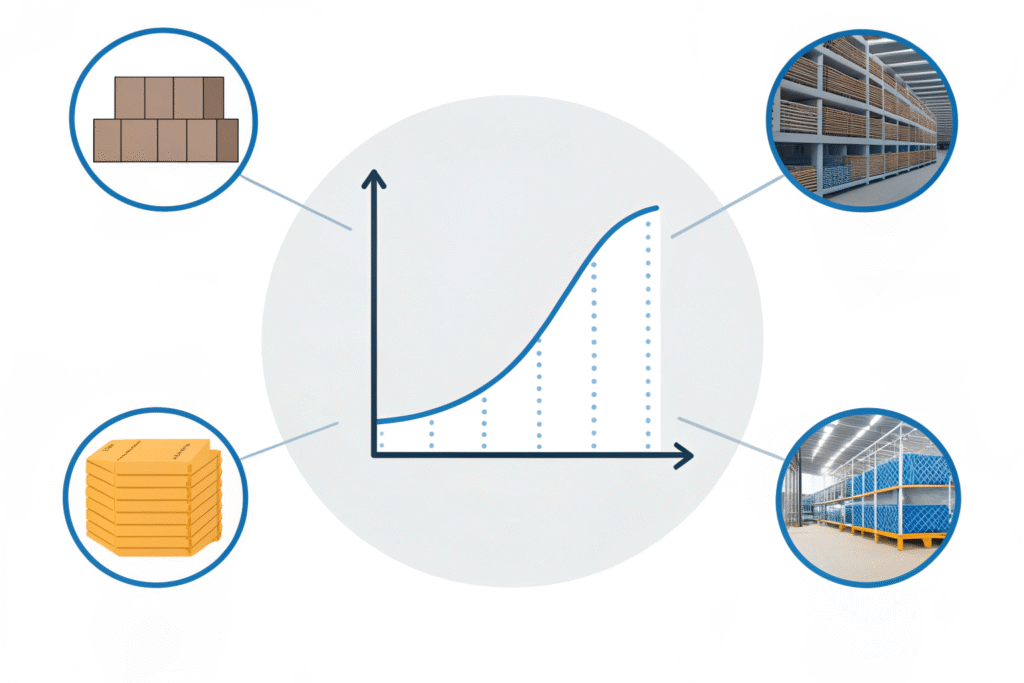
Unit cost drops as you cross thresholds tied to:
- Fiber procurement brackets (price breaks at 50, 100, 200 kg equivalents).
- Dye-lot efficiency (minimum lot size per color; fewer shade variances per run).
- Setup amortization (cap tooling, lace cutting dies, QC fixtures).
If you buy too small, you pay a setup premium. If you buy too large, you pay in storage, obsolescence, and markdowns.
Batch-size guidance by complexity
- Standard machine-made caps, solid colors: 80–120 units per color hits the sweet spot—enough to improve dye-lot consistency and spread setup cost, but not so large you sit on inventory.
- Lace front or partial hand-tied: 120–180 units per style, distributed across 2–3 colors. Keeps stations loaded and reduces labor variance.
- Heat-resistant fibers: Target 100–150 units per color, or consolidate colors into adjacent shades in the same family to leverage dye-lot batching.
Inventory risk controls
- Use rolling releases: Produce 150 units, ship 90 now, 60 later; QC the first batch to catch issues before the remainder ships.
- Color portfolio discipline: Start with 2 core shades + 1 fashion shade. Expand only after sell-through data supports it.
- Cap size ratio planning: Lock ratios off historical data; avoid over-indexing on Small without proof.
Example batch-size table (indicative)
| Configuration | Recommended Batch Size | Unit Cost Impact | Inventory Risk |
|---|---|---|---|
| Stock cap + solid color | 80–120 per color | Moderate decrease | Low–moderate |
| Lace front, partial hand-tied | 120–180 per style | Noticeable decrease | Moderate |
| Heat-resistant fiber, fashion shade | 100–150 per color | Decrease if batched | Moderate–high |
| Fully bespoke cap construction | 150–200 per style | Best at higher volumes | Higher (SKU-specific) |
Can I mix styles within a production run to meet my MOQ?
Yes—but you need to define “mixing” around shared manufacturing assets.
What typically qualifies for mixing
- Same base cap construction: You can run Bob, Body Wave, and Straight variants if the cap is identical. You mix fiber color/length/texture while maintaining cap uniformity.
- Shared lace and seam specs: If lace width and ventilating density are consistent, factories can switch hair texture/colors with minimal downtime.
- Component pooling: Same ear tabs, combs, and labels across SKUs.
What usually doesn’t qualify
- Different cap patterns or lace geometries: Switching from T-part to 13×4 lace front often triggers new setup and separate MOQs.
- Hand-tied vs machine wefted transitions: Mixing those in one run reduces line efficiency and QC predictability.
Practical mixing structures
- “Family run” model: 200 units total across 3 styles that share the cap—e.g., 80 Straight, 60 Body Wave, 60 Curly—plus 3 colors each with per-color minimums (e.g., 30 per shade).
- Color-block batching: Produce all blacks and browns first to hit dye-lot minimums; follow with fashion shades as a secondary sub-run under the same PO.
Mixing feasibility matrix
| Shared Asset | Mix Allowed | Notes |
|---|---|---|
| Base cap (stock) | Yes | Easiest path to lower MOQ |
| Lace width/density | Yes | Keep ventilating SOP consistent |
| Cap pattern (bespoke) | Limited | Usually separate MOQ per pattern |
| Fiber type (standard) | Yes | Dye-lot planning required |
| Fiber type (heat-resistant) | Limited | Higher per-color MOQ due to dyeing |
How do I set sample-to-mass ratios for new launches?
Sample program design
- Prototype count: 1–5 units per style/color/cap size at higher per-unit cost. This validates fiber handfeel, lace lay, ventilating density, and cap fit.
- Iteration cadence: Expect 1–2 rounds (Version A, Version B) with detailed QC feedback before greenlighting mass production.
Ratios I use for risk-managed launches
- Simple styles on stock caps: 3–5 samples per color, then 60–100 units per color in the first mass run.
- Lace front, partial hand-tied: 5–8 samples per color (include extreme cap sizes), then 100–150 units per style split across colors.
- Fashion colors or heat-resistant fibers: 5–8 samples per shade, then 80–120 units for the first run; keep a reorder trigger at 50% sell-through.
Sample-to-mass planning table
| Launch Type | Samples per SKU | First Mass Run per SKU | Notes |
|---|---|---|---|
| Stock cap, standard color | 3–5 | 60–100 | Fast path; confirm shade tolerance |
| Lace front, partial hand-tied | 5–8 | 100–150 | Validate lace lay + ventilating QC |
| Heat-resistant, fashion shades | 5–8 | 80–120 | Dye-lot consistency is critical |
Operational tips
- Size-fitting samples: Always include S/M/L in the sample round to catch temple and nape tension issues early.
- Golden sample: Lock a signed “golden sample” for factory QC reference—reduces drift across runs.
- Staggered deliveries: Use one PO to meet MOQ, but schedule shipments post-sample sign-off to maintain cash flow.
Conclusion
In my experience, MOQs for custom synthetic wigs typically sit between 50 and 200 units per style, and they usually apply per color and cap size. The fastest path to workable MOQs is consolidating around stock base caps, planning dye-lot-friendly color batches, and negotiating staggered deliveries under a single PO. When complexity rises—lace fronts, hand-tied sections, heat-resistant fibers—accept higher MOQs or surcharges for sub-MOQ runs, and offset risk with disciplined sample programs and component sharing. If you build multi-style contracts and present credible 6–12 month forecasts, most suppliers will flex on MOQs—and you’ll keep unit costs down without overexposing inventory.