
Importing wigs from China is a logistics balancing act: speed versus cost, risk versus control, and carton volume versus weight. Because wigs vary widely—human hair lace units, synthetic fashion wigs, closures/frontals—the right shipping method shifts with order size, SKU mix, margin, and destination customs complexity. Choosing well can improve cash flow, reduce stockouts, and protect unit economics.
The most common shipping methods for importing wigs from China are express couriers (DHL/FedEx/UPS) for small and high-value shipments (3–7 days), air freight for mid-size consignments (7–14 days), sea freight (including LCL and FCL) for large volumes (20–40+ days), and rail for Europe as a middle-ground on transit/cost. Many wig importers also use hybrid strategies—air for urgent SKUs, sea for base stock—and door-to-door DDP services where customs are complex.
Below, I’ll break down how to choose, what transit times and costs to expect for different markets, how to optimize packaging and CBM to avoid volumetric charges, and how to decide between DDP and FOB with a clear landed cost formula.
How do I choose between air freight, sea freight, rail, and express for my wig shipments?
Choosing the right mode starts with shipment profile: weight, CBM, urgency, SKU value, and destination customs. Wigs—especially human hair lace wigs—often have a high value-to-weight ratio, making volumetric rules crucial.
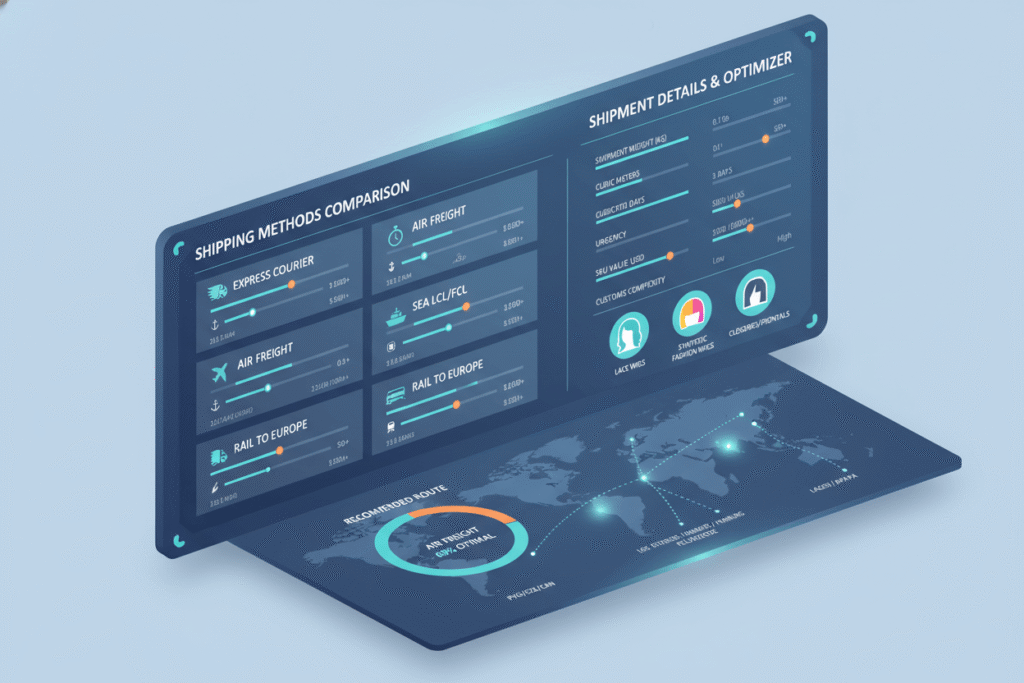
Use express for small/high-value or test orders; air freight for mid-size urgent replenishment; sea LCL/FCL for bulk/base stock; and rail for Europe when you need faster-than-sea but cheaper-than-air. Hybridize to balance cost and availability.
Mode selection framework
- Express (DHL/FedEx/UPS):
- Best for: 1–300 kg actual weight, small cartons, high-value lace wigs, samples, influencer drops, urgent replacements.
- Pros: 3–7 days door-to-door, tight tracking, simplified customs handling.
- Cons: Highest per-kilo cost, strict dimensional weight rules.
- Air Freight (airport-to-airport or door):
- Best for: 200–2,000 kg consolidated shipments, promotions/seasonal spikes, when speed matters but express is too expensive.
- Pros: 5–10 days air time + 2–5 days ground handling; lower per-kilo than express at scale.
- Cons: Requires freight forwarder; airport/terminal fees and customs add complexity.
- Sea Freight:
- LCL: Ideal for 1–12 CBM when you can’t fill a container. Cost-effective for base stock with moderate volumes.
- FCL (20’/40′): Optimal beyond ~12–15 CBM; minimizes handling risk and per-unit cost.
- Transit: 20–40+ days port-to-port; add origin/destination handling and customs.
- Pros: Lowest unit cost, best for planned cycles and stable demand.
- Rail (China–Europe):
- Best for: Mid-volume shipments to EU/UK when 12–25 days is acceptable and air is too pricey.
- Pros: Balanced speed/cost; relatively predictable schedules.
- Cons: Not available to US/Africa; requires good consolidation and customs coordination.
Typical use cases for wigs
- High-value lace wigs, small test orders: Express DDP.
- Seasonal promo replenishment to US/EU: Air freight door-to-door.
- Wholesale bulk to US/Nigeria with long horizons: Sea FCL.
- Multi-supplier consolidation: LCL via a forwarder with buyer’s consolidation service.
Pro Tip: Ask your forwarder for “air consolidation” rates from PVG/SZX/CAN on Tuesdays/Fridays—wig lanes often benefit from lower block space prices midweek.
What transit times and costs should I expect for wigs to the US versus Nigeria?
Transit times and total cost vary by lane, port infrastructure, and customs efficiency. The US has predictable services; Nigeria offers door-to-door DDP solutions that bypass clearance friction for small/medium consignments.
Expect faster, more predictable services to the US (express 3–5 days; air 7–12; sea 20–35). Nigeria typically runs express 5–9 days, air 8–15, sea 35–60+. DDP is common to Nigeria for small/medium shipments to avoid customs delays.
Typical transit times (ex-China hubs: Qingdao, Xuchang via Zhengzhou, Guangzhou, Shenzhen)
- To United States:
- Express (DHL/FedEx/UPS): 3–7 days door.
- Air freight (door): 7–14 days total.
- Sea LCL: 25–40 days door (port-to-port ~18–28 to West Coast, ~28–40 to East Coast).
- Sea FCL: 20–35 days port-to-port; add 5–8 days for handling.
- To Nigeria (e.g., Lagos):
- Express: 5–9 days door (subject to local delivery and KYC).
- Air freight (door): 8–15 days total depending on clearance.
- Sea LCL/FCL: 35–60+ days door; congestion can add 1–3 weeks.
Cost benchmarks (illustrative, actual quotes vary weekly)
- Express small parcel (5–30 kg): USD 7–15/kg to US; USD 10–18/kg to Nigeria.
- Air freight consolidated (200–500 kg chargeable): USD 4–8/kg to US; USD 6–10/kg to Nigeria (plus origin/destination fees).
- Sea LCL: USD 30–80 per CBM freight to US; USD 60–120 per CBM to Nigeria, plus origin THC, docs, destination D/O, customs, delivery.
- Sea FCL (20’): USD 1,200–2,500 to US West Coast; USD 1,800–3,500 to US East Coast; USD 2,500–4,500 to Lagos, fluctuating by season.
Caution: Rates swing with fuel, capacity, and seasonality (Q4 peak, China holidays). Always lock rates with validity windows and ask for all-in door quotes including surcharges (GRI, war risk, PSS).
Table: Transit time and cost comparison (indicative)
| Mode | US Transit (door) | Nigeria Transit (door) | Cost Profile (per kg/CBM) | Best For |
|---|---|---|---|---|
| Express | 3–7 days | 5–9 days | High (USD 7–18/kg) | Small, high-value, urgent |
| Air Freight | 7–14 days | 8–15 days | Medium (USD 4–10/kg + fees) | Mid-volume, promo replenishment |
| Sea LCL | 25–40 days | 35–60+ days | Low (USD 30–120/CBM + fees) | Moderate volumes, planned base stock |
| Sea FCL | 25–40 days | 35–60+ days | Lowest per unit | Large volume, stable cycles |
| Rail (EU) | 12–25 days | N/A | Medium | EU mid-volume |
How can I optimize my wig packaging and carton CBM to reduce freight and avoid volumetric charges?
Wigs are light but bulky. If you ignore dimensional (volumetric) weight, your per-piece shipping cost will spike—especially on express and air. Smart packing and CBM control can cut logistics cost by 10–30%.
Minimize volumetric weight by compressing inner packs, right-sizing master cartons, and targeting optimal carton densities (e.g., 8–12 kg actual with ≤0.06–0.08 CBM). For air/express, design cartons to keep chargeable weight close to actual weight.
Understand chargeable weight
- Express volumetric formula: (L × W × H in cm) / 5,000.
- Air freight volumetric: (L × W × H in cm) / 6,000 (sometimes 5,000 with certain carriers).
- Chargeable weight = max(actual kg, volumetric kg).
Example:
- Carton A: 60×40×40 cm = 96,000 cm³.
- Express volumetric = 96,000/5,000 = 19.2 kg.
- If actual weight is 10 kg, you pay for ~19.2 kg.
Packaging tactics for wigs
- Compress inner poly bags (remove air, fold caps flat) and avoid decorative boxes unless retail-ready.
- Standardize master carton sizes to reduce void:
- Common targets: 55×35×35 cm (~0.067 CBM), 12 kg actual; or 50×30×30 cm (~0.045 CBM), 9–10 kg actual.
- Use thin but sturdy carton walls (K=K or K=A corrugate) to survive stacking while limiting dimensional growth.
- Pack SKUs by density:
- Synthetic short wigs: higher packing density (more units per CBM).
- Long human hair lace wigs with pre-styled curls: lower density; pack carefully to avoid deformation.
Table: Carton design scenarios (express/air)
| Carton Size (cm) | CBM | Volumetric (Express) | Volumetric (Air) | Suggested Actual Weight | Notes |
|---|---|---|---|---|---|
| 50×30×30 | 0.045 | 9.0 kg | 7.5 kg | 9–10 kg | Balanced chargeable weight |
| 55×35×35 | 0.067 | 13.4 kg | 11.2 kg | 11–13 kg | Good for mixed wigs |
| 60×40×40 | 0.096 | 19.2 kg | 16.0 kg | 14–16 kg | Risk of volumetric excess on express |
Pro Tip: Ask your supplier to provide “packing lists with dimensions and weights per carton” before booking. Your forwarder can model chargeable weight and recommend repacking to save cost.
Caution: Over-compression can deform lace fronts and hairlines; specify “no crush” zones and use insert cards or cap supports for premium SKUs.
For sea freight (CBM optimization)
- LCL: Aim for stable, stackable cartons to reduce damage; palletize by destination label and keep carton heights ≤110 cm when palletized.
- FCL: If you’re near a full container, consider upsizing to FCL to avoid LCL consolidation/deconsolidation handling and reduce loss/damage risk.
Should I ship DDP or FOB for wigs, and how do I calculate the landed cost per piece?
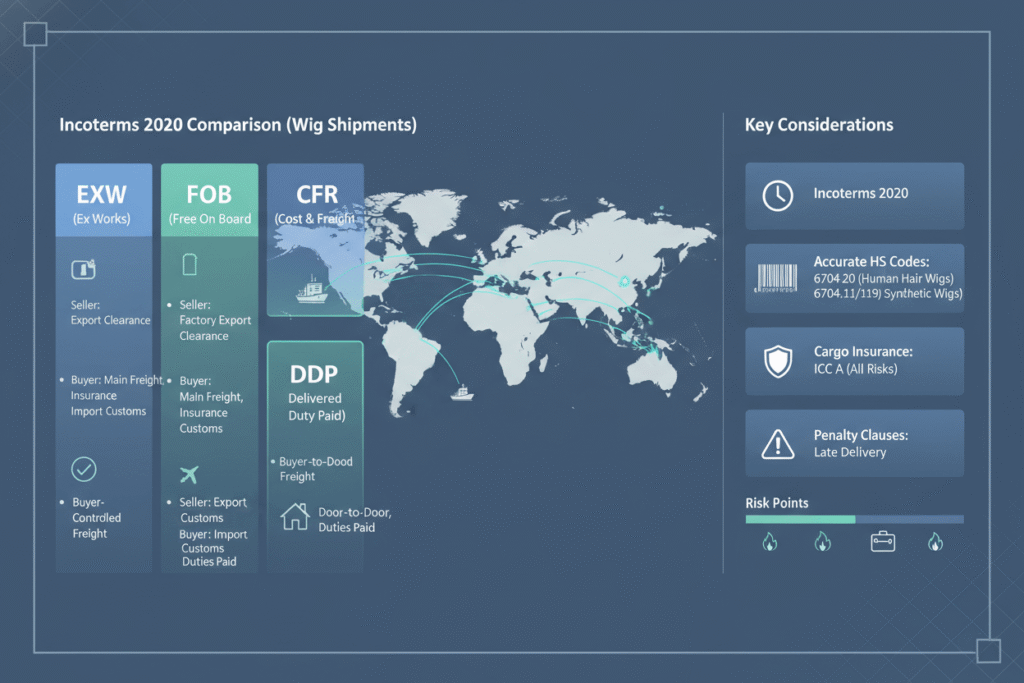
Your trade term dictates control, risk, and who handles customs. DDP can simplify the process—especially for Nigeria and some African/LatAm destinations—but requires trust in the forwarder’s compliance. FOB keeps you in control of freight and clearance, which matters for US importers wanting predictable landed cost.
Choose DDP for small/medium shipments to complex destinations; choose FOB for larger volumes and transparent cost control. Calculate landed cost per piece by summing product cost, international freight, origin/destination fees, duties/taxes, and last-mile—then divide by units.
DDP vs. FOB for wigs
- DDP (Delivered Duty Paid):
- Pros: Door-to-door simplicity; forwarder handles customs, duties, VAT; fewer delays; predictable total.
- Cons: Less transparency; potential compliance risk; sometimes higher margin baked into “all-in” rates.
- Best for: Express/air small to medium shipments to Nigeria and other complex markets; e-commerce launches.
- FOB (Free On Board):
- Pros: You control freight choice/rates; clearer cost breakdown; better for FCL/LCL with volume.
- Cons: You handle customs, taxes, delivery; more admin.
- Best for: US importers with established brokers; large sea shipments; when optimizing multi-lane logistics.
Landed cost per piece formula
Landed Cost per Piece =
(Product Unit Cost) + (International Freight + Origin/Destination Fees + Insurance) / Units
- (Duties + Taxes + Customs/Brokerage) / Units
- (Final Mile Delivery / Units)
Breakdown:
- Product Unit Cost: Ex-works or FOB item price.
- International Freight: Express per kg, air per chargeable kg, sea per CBM/FCL allocation.
- Origin Fees: Export docs, pickup, terminal handling.
- Destination Fees: THC, delivery order, customs exam, ISF (US), broker fees, local delivery.
- Duties/Taxes:
- Use HS code (common wigs: 6704.19.00 variations). Duty rates differ by material and country.
- US: Many synthetic wigs have low-to-moderate duty; human hair products may vary—confirm with your broker.
- Nigeria: Import duty + VAT + levy; DDP providers often include these in the door price.
- Insurance: 0.3–0.6% of cargo value (optional but recommended for sea).
Example (express to US):
- 600 synthetic wigs; unit cost $22.
- Volume 4.5 CBM; LCL freight $55/CBM → $247.5.
- Origin/dest fees, customs, delivery total $1,050.
- Duty 8% (illustrative) on $13,200 → $1,056.
- Landed cost per piece = $22 + (($247.5 + $1,050)/600) + ($1,056/600)
= $22 + $2.16 + $1.76 = $25.92.
- 100 premium lace wigs; unit cost $85.
- Cartons chargeable weight totals 60 kg; express rate $9/kg → $540.
- Origin/dest fees minimal (built into express).
- Duty 4% (illustrative) → on $8,500 goods = $340.
- Final mile: included in express.
- Landed cost per piece = $85 + ($540/100) + ($340/100) = $85 + $5.40 + $3.40 = $93.80.
Example (sea LCL to US):
Pro Tip: Build a simple spreadsheet with inputs for rate per kg/CBM, chargeable weight, fees, and duty rate by HS code. Update weekly for air/express and monthly for sea.
Caution: Ensure the HS classification matches wig material (human hair vs. synthetic). Misclassification can lead to fines or delays.
Conclusion
When importing wigs from China, the most common shipping methods are express for small and high-value units, air freight for mid-size and time-sensitive replenishment, and sea LCL/FCL for bulk base stock; rail is a smart alternative for Europe. US lanes are fast and predictable, while Nigeria often favors DDP for smoother customs. To protect margins, optimize packaging to minimize volumetric weight, and calculate landed cost per piece with a clear formula that includes freight, fees, and duties.
If you want help modeling rates, carton CBM, and trade terms for your specific wig SKUs and destinations, contact us for tailored sourcing and logistics advice.