
I spend a lot of my week helping brand owners and procurement teams translate salon realities into SKUs that actually sell through. The pain points are consistent: products that don’t match local installation skills, margins eroded by high maintenance returns, and confusion around which constructions deserve inventory space. In a category where “Remy” is overused and install time dictates labor cost, getting the right mix of methods and cap types isn’t just merchandising—it’s risk management.
The most common types of hair extensions are clip-ins, halo, tape-ins, sew-ins (weave), fusion/keratin bonds, and micro-link (micro-bead); the most common wig formats are lace front, full lace, 360 lace, and partial units like U-part and toppers. Clip-ins/halo are temporary; tape-ins and sew-ins are semi-permanent; fusion and micro-links are long-wear; and for wigs, lace placement (front, full, 360) determines realism, styling freedom, and price.
In this article, I’ll map the core methods and wig types you’ll encounter in manufacturing and wholesale catalogs, then answer four decision-focused questions I get from buyers: how to choose among clip-ins, tape-ins, micro-beads, and PU wefts; which keratin tips fit local installer skill and budget; when to stock machine vs hand-tied wefts for margin; and how to prioritize lace front, full lace, and toppers for mainstream demand. I’ll weave in processing, hair origin, and QC checkpoints so you can source with confidence.
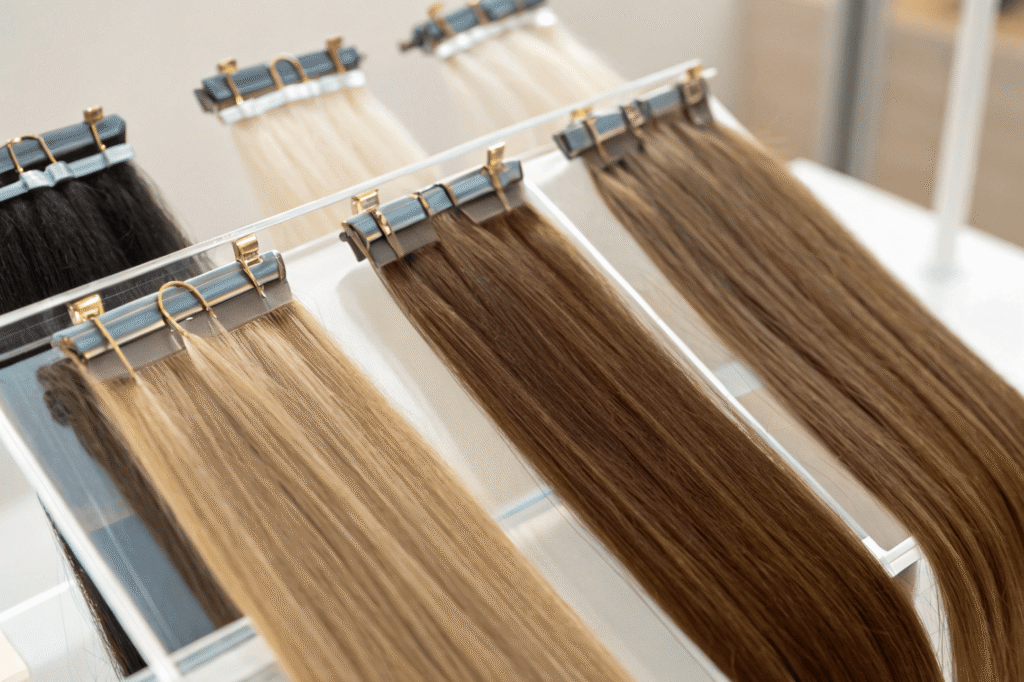
How do I choose between clip-ins, tape-ins, micro-beads, and PU wefts for my customers?
Start with client use-case, stylist skill, and service model
In my experience, the winning mix depends on how your customers monetize time in chair, their clients’ hair density, and maintenance appetite.
- Clip-ins: Retailable, beginner-friendly, zero-salon-install. Best for DTC volume, influencer kits, and seasonal spikes. Works with medium to thick hair for cover; finer hair requires lighter weft bases and matte-coated clips.
- Tape-ins: Fast salon service (1–1.5 hours), flat lay for fine hair, 6–8 week move-ups. High rebooking potential, but requires adhesive training and solvent removal protocol to protect cuticles.
- Micro-beads (micro-links/rings): Glue- and heat-free, strand-by-strand fullness, movable with growth. Great for stylists trained on tension control and bead placement. Higher chair time than tape-ins; good for reusable hair SKUs.
- PU wefts (thin, polyurethane-coated wefts): Often installed with beads or adhesive for ultra-flat rows. Ideal for fine hair; compatible with beaded row methods (a rising trend). Requires clean PU edging and low-shed stitching.

Product/installation matrix
| Customer profile | Primary concerns | Method fit | Hair spec recommendations |
|---|---|---|---|
| Fine/fragile hair clients | Flat lay, minimal bulk | Tape-ins, PU wefts | Double-drawn Remy, 18–20″ with low-density options; solvent-safe adhesive; thin PU |
| Active clients, low-maintenance | Fast install/move-up | Tape-ins | Pre-taped, medical-grade adhesive; consistent tape width; steam-textured patterns for blend |
| DIY/first-time users | Zero-commitment | Clip-ins | Soft lace or silicone-backed clips; lighter grams per set; matte base to reduce shine |
| Reusability, no heat/glue | Refit and longevity | Micro-beads, PU beaded rows | Silicone-lined beads; strong cuticle-aligned strands; reinforced tips/weft stitching |
Supply-chain and QC notes
- Clip-ins: Specify stainless steel, pressure-tested clips; inspect stitching tension to prevent weft lift. Offer multiple base shades to hide hardware.
- Tape-ins: Demand tape uniformity (thickness 0.7–0.9 mm) and medical-grade adhesive with controlled peel force; QA test for slippage after 24h under 37°C/80% RH.
- Micro-beads: Source silicone-lined beads that withstand >15 open/close cycles; colorfast coatings. Strand tip diameter matched to bead ID to reduce slip.
- PU wefts: PU edge should be flexible, 0.5–0.8 mm to prevent cracking. Check shedding under 10N pull test over 30 cm.
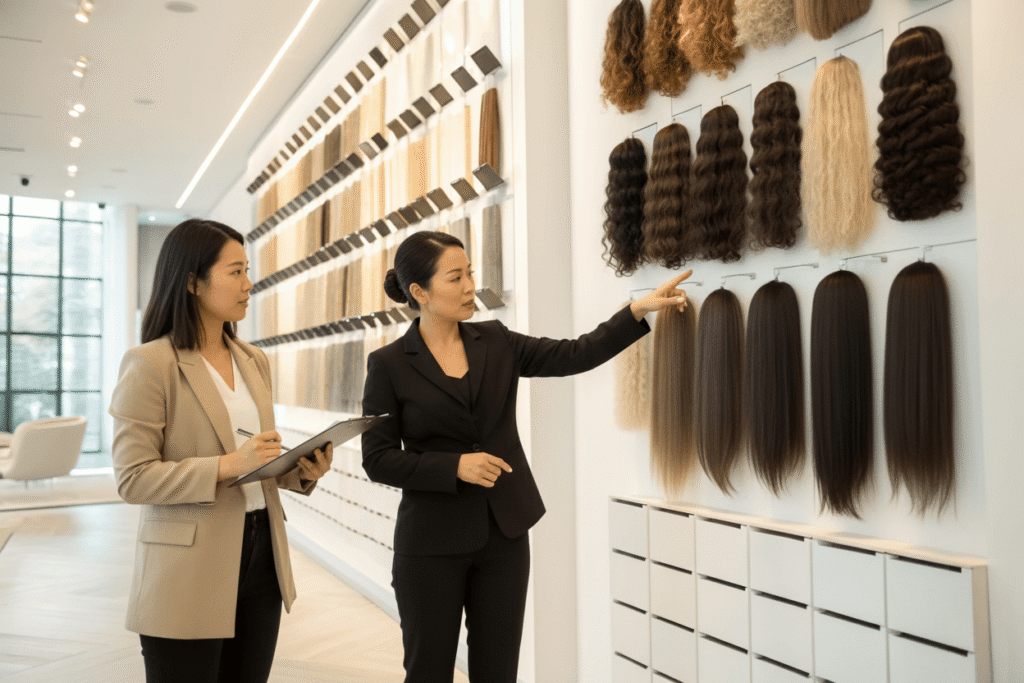
Which keratin tips (I-tip/U-tip/K-tip) fit my market’s installation skills and budgets?
Understand the tip geometries and tooling
- U-tip (nail tip, hot fusion): Pre-bonded keratin in a U-shape applied with a heat fusion tool. Faster for techs, great encapsulation, smallest learning curve. Not suited for heat-averse salons.
- I-tip (cold fusion with micro-beads): Cylindrical tip inserted into a micro-bead, clamped without heat. Best where heat or adhesive is discouraged; highly reusable but demands precise sectioning and bead work.
- K-tip (flat/k-keratin, hot fusion): Flatter pre-bond panel for ultra-flat bonds and customized sizes. Highest skill requirement; great for concealed installs, premium services.
Match to installer ecosystem and service economics
- Markets with robust salon training and higher ticket sizes (e.g., metro US/EU cities): K-tip or U-tip thrive, with premium Remy/virgin bundles to justify labor.
- Price-sensitive markets or mobile stylists: I-tip with beads offers lower tool investment and easier re-installs; hair can be reused across move-ups, improving client ROI.
- Medical/heat-sensitive clientele: I-tip favored to avoid heat exposure.
Tip spec and keratin quality
- Keratin composition: Aim for high-purity Italian keratin (thermoplastic, 70–90°C softening point) vs low-grade resin. Check brittleness after 1,000 comb strokes and oil exposure.
- Tip dimensions: Consistent 0.8–1.0 g per strand for standard lines; offer 0.5 g for fine-hair markets. Tip roundness tolerance ±0.1 mm for I-tips to avoid bead mismatch.
- Strand alignment: Ensure true Remy cuticle alignment; avoid acid-peeled fibers that weaken bond anchoring.

When do I stock machine wefts vs hand-tied wefts for better margins?
Manufacturing differences that impact cost and performance
- Machine wefts: Weft stitch created by industrial sewing; thicker return, robust, can be cut. Higher grams per meter and lower COGS. Best for volume and textured hair markets (Afro, SEA textures).
- Hand-tied wefts: Slim, micro-stitched by hand, minimal bulk, cannot be cut without unraveling. Higher labor input, premium MSRP, best for fine-hair clients and invisible row methods.
Margin logic and channel fit
- Salons specializing in beaded rows/invisible methods: Hand-tied commands premium service fees (+$150–$400) and lower bulk on the head; stock limited shade ranges with consistent root shadowing.
- Beauty supply and online DTC: Machine wefts drive AOV with lower returns; durable for DIY sew-ins and stylists who cut tracks. Offer multiple widths per bundle for flexibility.
Practical stocking rule-of-thumb
- If >60% of your pro accounts perform beaded row installs or cater to fine hair: Weight inventory toward hand-tied (60/40 hand-tied to machine).
- If your market leans sew-in/weave, cost-sensitive, or textured: Favor machine wefts (70/30 machine to hand-tied).
QC checkpoints that protect your margin
- Machine wefts: Double-needle lock stitching; tensile test to >20N before shed. Allowable shed rate <2% after 500 brush strokes.
- Hand-tied wefts: Check knot density uniformity and micro-return length; pre-seal edges with flexible adhesive; educate buyers on no-cut policy and provide pre-cut micro-weft sets to reduce errors.
Table: Weft selection quick compare
| Attribute | Machine Weft | Hand-Tied Weft |
|---|---|---|
| Cost of goods | Low–medium | High |
| Bulk on scalp | Medium | Low |
| Cuttable | Yes | No (unless pre-cut/micro) |
| Best for | Sew-in, high-density installs, textured hair | Beaded rows, fine hair, ultra-flat looks |
| Typical margin | Moderate, high volume | High per-unit, niche premium |
| Return risks | Shedding if stitch poor | Unraveling if cut; educate installers |
Should I carry full lace, lace front, or toppers to cover mainstream demands?
Define demand by wearer intent and cap tolerance
- Lace front wigs: Natural hairline with wefted cap elsewhere; fastest-growing mainstream segment due to balance of realism and price. Ideal for fashion wearers and first-time buyers.
- Full lace wigs: Hand-tied across the cap; maximum parting and updo flexibility. Best for advanced users, medical hair loss, and premium salons; higher maintenance and price.
- 360 lace wigs: Lace around perimeter for ponytails, with wefts in center. Middle ground for upstyles without full lace cost.
- Toppers/U-part pieces: Partial coverage for thinning at crown or part; lighter, cooler, and less commitment. Strong repeat purchase in 35+ female segment and medical channels.
Stocking strategy by channel
- Retail/DTC mainstream: 50–60% lace front, 20–25% toppers/U-part, 10–15% 360 lace, 5–10% full lace.
- Medical/specialty boutiques: 40% toppers/mono-top, 30% full lace or fully hand-tied mono caps, 20% lace front, 10% 360 lace.
- Salon partners: Lace front for quick transformations; offer custom orders for full lace and medical mono.
Cap construction and material considerations
- Lace spec: Swiss or HD lace for hairlines (denier and mesh size consistent); pre-bleached knots under QC to avoid over-processing breakage.
- Ventilation technique: Single-knotting at hairline, double elsewhere for durability. Density mapping: lighter at front (100–120%) and heavier mid-back (130–150%) for realism.
- Hair origin: For lighter colors (level 8+), consider SEA/Chinese hair lightly steam-processed, or ethically sourced European blends for premium lines. Avoid harsh acid baths; rely on cuticle-aligned Remy with controlled steam texturing for longevity.

Common Types of Hair Extensions and Wigs
Overview
I organize the category by attachment and cap construction. Extensions range from temporary (clip-in, halo) to semi-permanent (tape-in, sew-in) and long-wear (fusion/keratin, micro-link). Wigs are defined by lace placement (lace front, full lace, 360 lace) and cap type (wefted, mono, hand-tied).
Main Hair Extension Methods
- Clip-in extensions: Temporary wefts with clips for instant length/volume; remove daily.
- Halo extensions: Single weft on an invisible wire; fast, non-damaging volume.
- Tape-in extensions: Thin, adhesive wefts near roots; flat look, 6–8 week maintenance.
- Sew-in (weave) extensions: Wefts sewn onto cornrows; secure, ideal for thick/textured hair.
- Fusion (keratin-bond) extensions: Heated keratin tips; natural movement, months of wear.
- Micro-link (micro-bead) extensions: Strands attached with beads; readjustable as hair grows.
Human Hair vs Synthetic Hair
- Human hair: Heat-stylable, colorable, longer lifespan; higher cost. Specify cuticle-aligned Remy or single-donor for premium lines; avoid acid-peeled fibers for longevity.
- Synthetic: Cost-effective, pre-styled, lower maintenance; limited heat tolerance. Heat-friendly fibers (HF) can bridge the gap but still have shorter lifespans.
Key Wig Categories by Lace
- Lace front wigs: Lace at front hairline; natural edge at accessible price.
- Full lace wigs: Entire cap lace; part anywhere, updos, most realistic.
- 360 lace wigs: Lace around perimeter; ponytail-friendly, durable center.
Common Wig Cap Constructions
- Basic/capless (open-wefted): Lightweight, budget-friendly.
- Monofilament top/part: Realistic scalp at part; comfort for sensitive scalps.
- Hand-tied/full lace: Individually knotted hairs; maximum realism and comfort.
Table: At-a-glance comparison
| Category | Type | Wear time | Main pros | Trade-offs |
|---|---|---|---|---|
| Extension | Clip-in | Daily on/off | Fast, DIY | Must remove; bulk if over-grammed |
| Extension | Halo | Daily on/off | No clips/adhesive | Limited crown styling |
| Extension | Tape-in | 6–8 weeks | Flat, fine-hair friendly | Adhesive maintenance |
| Extension | Sew-in | Weeks–months | Very secure | Tension; pro install |
| Extension | Fusion | Months | Natural movement | Time/cost; pro removal |
| Extension | Micro-link | Months with move-ups | No heat/glue, reusable | Slippage if poorly installed |
| Wig | Lace front | Reusable | Natural hairline, value | Parting limits vs full lace |
| Wig | Full lace | Reusable | Part anywhere; updos | Highest cost/maintenance |
| Wig | 360 lace | Reusable | Ponytails + structure | Less center part freedom |
Conclusion
In today’s hair market, the right SKU mix is about aligning product engineering with service realities. I recommend stocking clip-ins and halos for DTC velocity, tape-ins and PU wefts for fine-hair, fast-turn salon services, and micro-beads for reuse-focused pros. Match keratin tip types to installer skill and client heat tolerance: U-tip for speed, I-tip for no-heat flexibility, K-tip for premium flat bonds. For wefts, drive volume with machine wefts and capture high-margin services with hand-tied in curated shades and pre-cut sets. On the wig side, lead with lace front for mainstream, support medical and premium with hand-tied/full lace, and never ignore toppers—their repeat purchase rate stabilizes cash flow. Back all of this with strict QC on adhesives, stitching, lace, and keratin, and you’ll reduce returns, protect margins, and build repeatable sell-through across channels.