
I’ve spent enough time on factory floors—from Qingdao to Chennai—to know that automation in wig production isn’t about buying the shiniest machine. It’s about throughput without compromising hair integrity, stable quality across mixed SKUs, and de-risking a labor-dependent process. When a procurement team asks me where to start, I look at their hair mix (virgin/Remy vs. processed), their cap architectures (lace, mono, PU, silk top), and where rejects are silently taxing margin: weft breaks, cap size drift, color variance, or ventilation inconsistency.
The fastest wins come from automating repeatable, tension-sensitive steps (wefting, cap forming, dye control) and augmenting labor-heavy tasks (ventilation, hair punching) with CNC and vision-guided systems. I prioritize programmable wefting lines with closed-loop tension control, CNC lace cutting, and machine-vision QC. For higher complexity SKUs, robotic hair insertion and CNC ventilation unlock step-change productivity.
Here’s how I structure automation decisions for wig manufacturers, wholesalers, and brand owners: first, stabilize the backbone (wefts, caps, dye), then digitize patterns and QC, and finally scale selective robotics (ventilation, punching) where SKU volume justifies capex. I’ll break down the machines that actually move the needle, how semi-automation reduces bulk-order defects, the ROI math on advanced cells, and how to map the tech to your MOQ and product mix.
Which wefting, stitching, and cap-forming machines improve my throughput?
High-throughput wefting with programmable control
In my experience, automated wefting machines with servo-driven stitch heads and closed-loop hair tension control deliver the most immediate throughput gains. I specify machines with:
- Programmable stitch patterns (zig-zag, triple lock) for durability on both Remy and acid-processed hair.
- Real-time yarn/hair feed tension sensors to minimize breakage and reduce flyaway—critical for cuticle-aligned wefts.
- Quick-change guides to switch from single to double weft without re-tooling.
Result: 20–35% cycle time reduction versus manual or legacy semi-auto heads, and fewer reworks on high-density bundles.
Robotic hair punching for wefts, toupees, and PU bases
Robotic hair punching systems standardize density and angle on PU/mono bases and machine-made wefts. With vision guidance, they maintain uniform insertion even on contoured sections. I use them to:
- Pre-perforate bases to consistent diameters.
- Insert hair at pre-set angles to mimic crown swirls and parting flow.
- Reduce operator fatigue on large runs (toupees, partials).
Expect 2–3x throughput over manual punching with tighter density tolerance (±5–7%), which downstream reduces ventilation correction.
CNC cap forming: lace cutting and 3D pattern accuracy
CNC fabric cutters and laser systems are low-drama, high-return upgrades:
- Digitally cut lace/mesh panels to CAD patterns, reducing material waste by 5–12%.
- Repeatable seam allowances stabilize cap sizes; fewer “tight” or “loose” caps after sewing.
- Laser edges on certain meshes reduce fray, speeding assembly.
I pair cutting with simple forming jigs and ultrasonic welding for elastic/labels where needle damage is a risk on delicate lace.
Stitching cells with vision and cobots
Collaborative robots (cobots) with vision guidance reliably handle:
- Panel pick-and-place into jigs.
- Pre-alignment of ear tabs/elastic before operator stitching.
- Consistent label/size tag placement via ultrasonic welding.
This hybrid approach raises operator productivity 15–25% without compromising delicate materials.
How do semi-automation and digital patterning reduce defects in bulk orders?
Digital patterning and CNC cutting
When I digitize cap patterns (S/M/L, custom SKUs), CNC cutters eliminate drift from manual tracing. Predictable seam allowances translate to stable headfit and fewer remakes. On monthly runs >2,000 caps, I routinely see:
- Scrap reduction: 5–10% on Swiss lace and HD meshes.
- Fit-related returns down by 20–30% due to consistent circumference and temple-to-temple spans.
Semi-automated ventilation and hair insertion
CNC ventilation machines don’t replace artisans entirely, but they standardize:
- Knot counts per grid section.
- Knot type selection (single, double, split) by zone.
- Hair angle for crown/part hairline realism.
I position these as pre-ventilation or bulk zone ventilators and reserve delicate hairlines for senior ventilators. Defect reduction shows up as fewer “thin zone” complaints and faster QA pass rates.
Machine-vision quality inspection
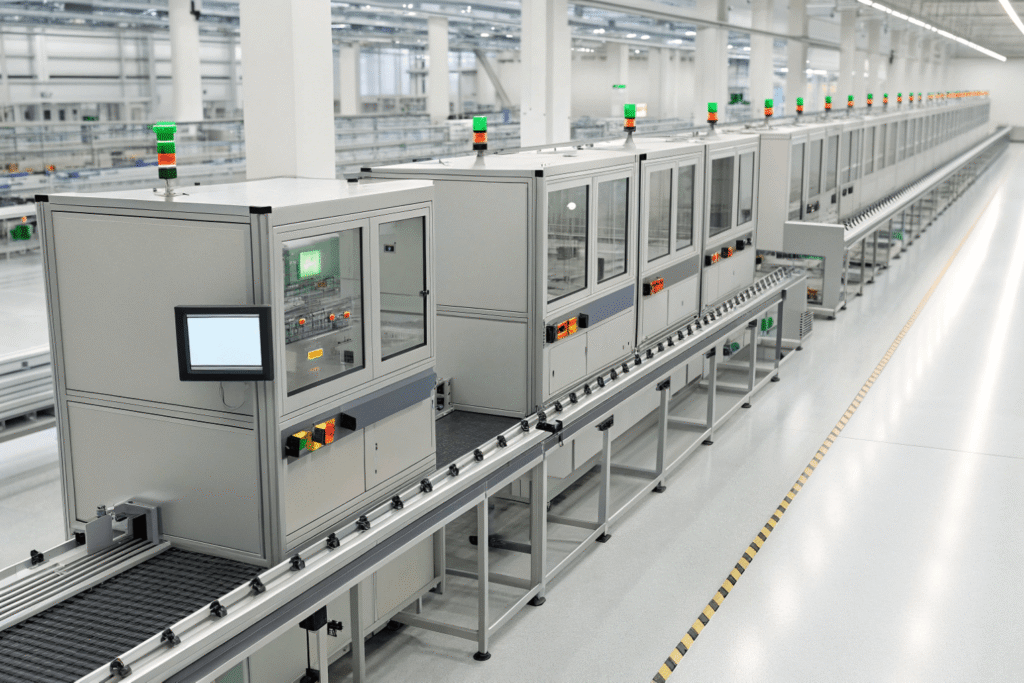
Inline cameras with AI models inspect:
- Knot integrity and density uniformity on lace.
- Lace defects (snags, runs) pre-assembly.
- Color variance across batches (paired with inline spectrophotometers on dye lines).
Real-time reject gating prevents bad panels entering assembly, protecting labor from being wasted on doomed parts.
Color processing with automated dye lines
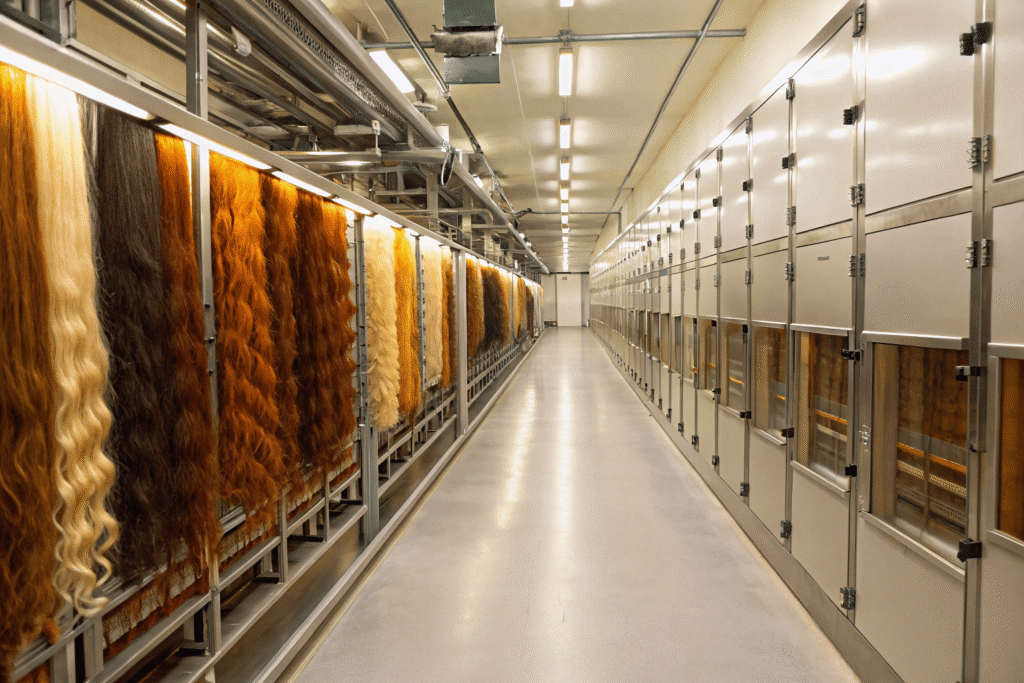
Automated dyeing with batch controllers and inline spectrophotometers keeps tonal targets consistent across hair origins (India, SEA, South America). I lock recipes to hair porosity and prior processing (steam vs. acid bath), tracking:
- Soak time, pH, temperature curves per lot.
- Delta E thresholds for acceptance.
This stabilizes color across multi-vendor sourcing—critical for wholesalers blending lots.
What ROI can I expect from automated ventilation or heat-setting lines?
ROI framework I use
- Baseline current takt time, rework rate, scrap, and labor cost by step.
- Quantify demand volatility (SKU count, colorways) and changeover losses.
- Include hair-loss/shed reduction benefits (wefts, ventilated knots) as warranty/returns cost avoided.
CNC ventilation/robotic hair insertion
- Throughput: 2–5x over manual for bulk zones; up to 10x on uniform-density toupees.
- Labor shift: Reallocate artisans to hairline/temple finesse while machines handle fields.
- Quality: Density tolerance improves from ±15% to ±5–7%; fewer reworks.
- Payback: 12–24 months at 1,500–3,000 units/month with >50% of SKUs sharing base patterns.
Heat-setting/steam lines for style memory
Automated heat-setting tunnels (for curls/waves) with recipe control:
- Cut cycle times by 30–40% versus manual steaming.
- Reduce pattern relaxation post-ship; fewer returns for “flat curls.”
- Payback: 9–18 months when 40%+ of portfolio uses standardized curl patterns.
Automated wefting cells
- Output uplift: 20–35% with lower breakage.
- Warranty reduction: better stitch integrity reduces shedding claims.
- Payback: often <12 months at 2–3 production shifts.
Dye line automation with inline color control
- Re-dye/rework reduction: 25–50%.
- Scrap avoidance on high-lift blondes and ashy tones (where porosity swings).
- Payback: 12–18 months assuming monthly >1–2 tons processed.
Illustrative ROI comparison
| Cell/Line | Throughput gain | Rework reduction | Typical payback |
|---|---|---|---|
| CNC ventilation / hair insertion | 2–5x | 20–30% | 12–24 months |
| Heat-setting tunnel (steam/IR) | 30–40% faster | 15–25% | 9–18 months |
| Programmable wefting line | 20–35% | 10–20% | 9–12 months |
| CNC lace cutting + MES traceability | n/a | 5–12% scrap | 6–12 months |
| Machine-vision QC | n/a | 20–40% early reject | 6–15 months |
Note: Ranges assume mixed human hair (India/SEA) with Remy focus and moderate SKU complexity.
How do I align automation choices with my MOQ and product mix?
Map automation to SKU stability and demand repeatability
- Low MOQ, high customization (boutique/luxury): prioritize digital patterning, CNC cutting, and MES traceability. Add semi-automation (cobots for handling; ultrasonic for labels) to protect craftsmanship without locking into high-capex cells.
- Medium MOQ, moderate repetition (regional brands/wholesalers): add programmable wefting, robotic punching for toupees, and automated dye control. Consider partial CNC ventilation on repeated base patterns.
- High MOQ, standardized SKUs (mass channels/private label): justify full CNC ventilation cells, heat-setting tunnels, and conveyorized assembly with machine vision.
Use digital twins and MES to orchestrate flow
I deploy MES with digital twins to:
- Tie hair batch traceability (origin, processing history) to process parameters in ventilating, dyeing, and stitching.
- Optimize scheduling by clustering SKUs with shared ventilation patterns/cap sizes to reduce changeovers.
- Capture recipe “locks” so color and curl patterns are reproducible across lots.
Forecasting and configuration to reduce changeover losses
AI-driven demand forecasting and SKU configuration tools let me pre-stage:
- Ventilation patterns and density maps per size.
- Cap component kits by color mix.
- Weft stitch settings libraries by hair grade.
Outcome: shorter changeovers, less idle time, and consistent quality across mixed PO waves.
Practical alignment checklist
- If monthly volume per base pattern >300 units: evaluate CNC ventilation.
- If color complaints >5%: implement automated dye control with inline spectro.
- If cap fit returns >3%: digitize patterns + CNC cut; add vision QC on seam allowances.
- If weft shedding claims >4%: move to programmable wefting with tension control.
Technology-to-need matrix
| Bottleneck/Goal | Best-fit automation | Notes |
|---|---|---|
| Inconsistent cap fit | CNC cutting + digital patterns | Reduces size drift and lace waste |
| High labor on ventilation | CNC ventilation / robotic insertion | Reserve hairlines for artisans |
| Weft breakage/shedding | Servo wefting + tension monitoring | Lower warranty exposure |
| Color variance across lots | Automated dye line + spectrophotometer | Lock recipes by origin/porosity |
| Lace damage from needles | Ultrasonic welding for elastics/labels | Protects delicate meshes |
| Ergonomics and throughput | Cobots with vision for handling/assembly | Safe, flexible cells |
| Final QC misses | Machine-vision inspection | Real-time reject routing |
Embedded insights from my floor implementations
- CNC ventilation machines materially lift speed and consistency versus manual knotting; I deploy them for bulk zones and reserve hairlines for human finesse.
- Robotic hair punching is my go-to for uniform density on PU/toupees; it slashes base perforation time.
- Automated wefting with programmable stitches and tension control is the first capex I recommend for durability and output.
- CNC lace/mesh cutting (including laser) gives precise cap shapes and trims waste—quietly powerful for margin.
- Automated dye lines with inline spectrophotometers standardize tones across mixed-origin lots—crucial for wholesalers.
- Machine vision catches knot and lace defects early; real-time rejection saves hours downstream.
- Cobots with vision improve ergonomics and consistency for hair placement and cap assembly without over-automating.
- Digital twins and MES maintain batch traceability and stabilize parameters across ventilating/dyeing/stitching.
- Ultrasonic welding/heat-bonding avoids needle damage on lace for elastics and labels.
- AI-led demand forecasting and configuration shrink changeovers by pre-aligning patterns, sizes, and color mixes.
Conclusion
Automation in wig manufacturing pays when it targets repeatable, tension- and pattern-sensitive steps and augments human craftsmanship where it matters most. I start with programmable wefting, CNC cutting, dye-line control, and machine vision to stabilize throughput and quality. Then, as SKUs consolidate and volumes repeat, I layer in CNC ventilation and robotic punching, plus heat-setting tunnels for style memory. Tie it all together with MES, digital twins, and forecasting so every hair batch, stitch profile, and color recipe is traceable and repeatable. That’s how I convert labor volatility into predictable margin—without sacrificing the look and feel that keep your buyers reordering.