
I’ve sat across procurement teams negotiating quarterly buys and I’ve stood inside ventilating rooms watching caps get filled row by row. Density is one of those deceptively simple specs that can make or break your sell-through, your return rate, and even your brand positioning. Buyers want realism without bulk, glam without heat, and consistency without surprises. When density isn’t standardized or matched correctly to cap size, length, and texture, you’ll see complaints about shedding, heaviness, and “helmet hair” spike fast.
130% and 150% densities dominate for daily wear because they look natural, feel breathable, and price out well. 180% and 200% densities sell when the brief calls for volume, length, or show-stopping looks—but they’re not the bread-and-butter of repeat purchases. The trick is stocking by region and texture, aligning density to cap geometry, and standardizing how you measure and label density so customers get what they expect every time.
In this article, I’ll outline the density tiers that consistently move in the commercial market, the specific density mixes I recommend for U.S. and Nigerian buyers, how I match density to cap size and hair texture to keep looks natural, and which density-construction choices reduce shedding risk without sacrificing realistic volume. I’ll close with a simple standardization framework so your density labels match the hair you ship—every batch, every PO.
Which density ranges should I stock for U.S. and Nigerian buyers to maximize sell-through?
What actually sells, not just what’s marketed
From my order books and post-shipment analytics, 130% and 150% densities are the workhorses across both markets. 180% is your “step-up” density for length (20”+) and curly/kinky textures, and 200% earns its keep in seasonal spikes, influencer-driven drops, and salon customization programs.
- U.S. market (mixed climates, strong e-comm returns culture, daily-wear emphasis)
- Core: 130% (short–medium, straight/wavy), 150% (medium–long, straight/wavy/loose curl)
- Volume tier: 180% (20”+ straight/wavy; 16”+ for curly/kinky)
- Fashion tier: 200% for glam looks, installs, and custom color projects
- Cap mix: Lace front and 13×4/13×6 HD lace sell best in 130–180%; full lace and 360s in 150–180% for styling flexibility
- Nigerian market (high heat, social/event-driven styling, strong salon install culture)
- Core: 150% (short–long, straight/wavy), 180% (curly/kinky and 18”+ straight/wavy)
- Entry/lightweight: 130% in bob cuts, short styles for daily wear in hot weather
- Glam tier: 200% for celebratory seasons, bridal, photoshoots
- Cap mix: Lace front and 13×4/13×6 dominate; full lace in 150–180% for versatile parting and updos
Recommended stocking matrix (by share of units)
- United States
- 130%: 35–40%
- 150%: 35–40%
- 180%: 15–20%
- 200%: 5–10%
- Nigeria
- 130%: 15–20%
- 150%: 40–45%
- 180%: 25–30%
- 200%: 5–10%
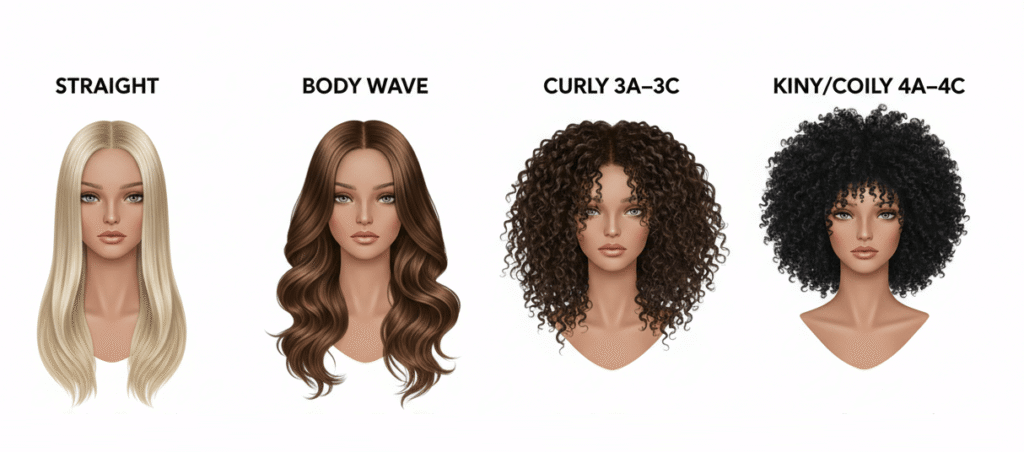
Length and texture adjustments
- Length rule of thumb: As length increases, perceived fullness decreases at the ends; bump density up one tier for 20”+ in straight/wavy.
- Texture rule of thumb: Curly and kinky coils absorb density visually; treat a curly 150% like a straight 130% in appearance. Plan inventory accordingly.
How do I match density to cap size and hair texture for a natural look?
Cap geometry matters
Cap area drives how “spread out” your hair mass is. A 150% on a 13×6 lace front will present fuller at the hairline and part than the same mass on a larger full lace cap if you don’t adjust ventilating rates. I calibrate density using cap area and target grams per square centimeter, not just a label.
- Lace front (13×4/13×6): Natural hairline requires graduated front (60–80% frontal zone), building to 100% of labeled density by 2–3 cm behind the hairline.
- Full lace: Even distribution can look wiggy; I keep perimeter 10–15% lighter and increase density toward crown/occipital to mimic bio hair growth.
- 360/with bundles: Match bundle weft density to the lace top; avoid over-stuffing tracks at the nape which causes bulk and poor flip-up behavior.
Texture-specific pairing
- Straight: Looks fuller at lower densities. Natural daily looks: 130–150%. Long sleek looks (22”+): 150–180% to maintain end fullness.
- Body/loose wave: 150% lands most naturally; go 180% when layering or heavy styling is planned.
- Curly (3A–3C): 150% for 12–16”, 180% beyond 16” to keep silhouette balanced.
- Kinky/coily (4A–4C): 150% for short cropped looks; 180% for medium–long. Graduated hairline is essential to avoid boxy outlines.
Quick pairing table
| Cap style | Typical head size | Straight | Wavy | Curly | Kinky/Coily |
|---|---|---|---|---|---|
| 13×4 lace front | S/M | 130–150% | 150% | 150–180% | 150–180% |
| 13×6 lace front | M/L | 130–150% | 150% | 150–180% | 180% |
| Full lace | M | 150% | 150–180% | 180% | 180% |
| 360 lace + bundles | M/L | 150% | 150–180% | 180% | 180–200% (event looks) |
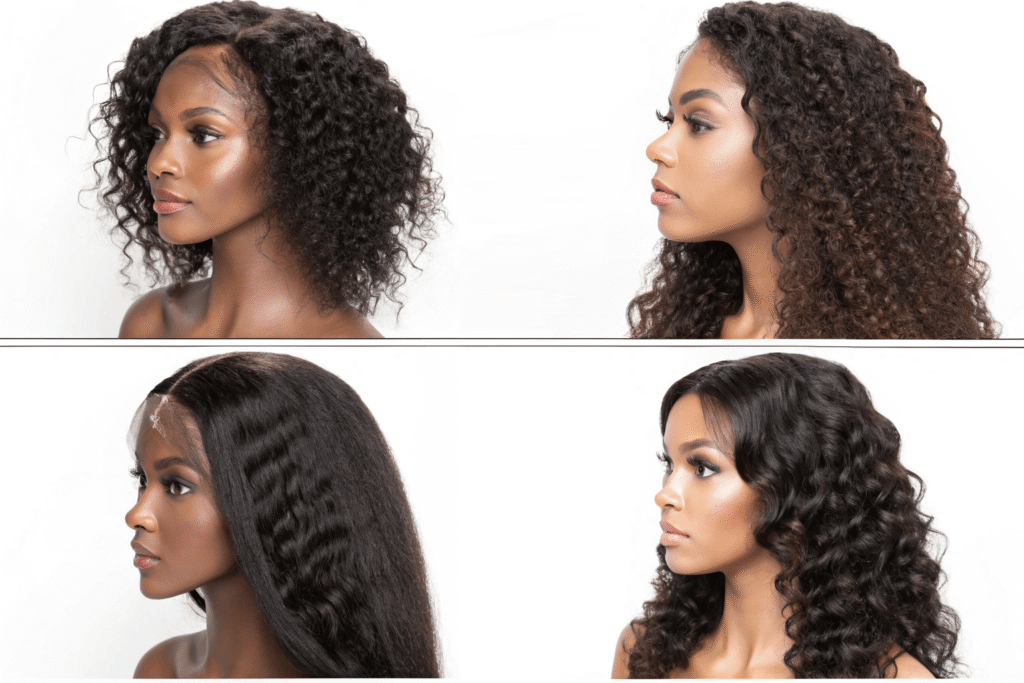
What density options reduce shedding while keeping volume realistic?
Shedding complaints often trace back to construction choices more than headline density. I focus on three levers: hair quality, knotting technique, and where I “place” the mass.
Construction and processing choices
- Hair quality and cuticle: True Remy with intact cuticle, aligned from single/limited donors, reduces friction and slippage. Avoid heavy acid baths that thin cuticles—high initial “puff” at 180–200% can mask fragility, then shed.
- Knotting: Use single knots at the hairline (for realism), double knots elsewhere for retention. Bleach knots minimally and only in the top 1–1.5 cm to preserve knot strength.
- Ventilation rates: Instead of cramming hairline with thick knots to simulate density, keep a graduated line and add mass 2–4 cm behind the hairline. It reads full without compromising knot life.
- Wefting: For machine wefts, apply thin, flexible glue lines and avoid over-folded returns. Tight, clean stitching reduces shedding at the track.
- Length mix: Blend 2–3 neighboring lengths (e.g., 16/18/20) to build bulk without fat, blunt ends; this reduces the temptation to over-densify.
Practical density ranges that balance retention and realism
- Daily wear straight/wavy (12–18”): 130–150% with double knots behind hairline offers the lowest shedding risk.
- Long sleek (20–26”): 150–180% but reinforce T-zone (temples to temple) with slightly tighter knotting, not more hair per knot.
- Curly/kinky: 150–180% with steam-set texture over chemical perming; steam processing holds pattern with less fiber damage, reducing breakage-based shedding.
QC checkpoints to cut shedding at the source
- Pull test: 10 pulls across hairline, crown, and nape; allowable loss ≤3 strands per test point for premium lines.
- Soak test: 10-minute lukewarm soak then detangle; monitor if shedding spikes when wet—signals over-bleached knots or cuticle damage.
- Brush-path audit: Define standard brush path and count fall-out after 50 strokes; log per batch.
How can I standardize density measurements to avoid customer complaints?
This is where most brands lose trust. “150%” should not be a vibe—it must be a documented mass and placement standard that your factory, your CS team, and your customers can all align on.
My density standardization framework
1) Define density by net hair mass per size
- Use grams allocated to cap size, length, and texture.
- Example baseline for M cap, straight, 16”:
- 130% = ~120–130 g hair on lace region or ~150–160 g total including wefts
- 150% = ~150–160 g hair on lace or ~180–200 g total
- 180% = ~180–190 g hair on lace or ~220–240 g total
- 200% = ~210–220 g hair on lace or ~250–270 g total
- Publish tolerances: ±5% weight variance per unit; anything beyond is “off-grade.”
2) Normalize by cap area
- Record lace area in cm² and set target grams/cm² by zone:
- Hairline zone: 0.18–0.22 g/cm²
- Top/crown: 0.24–0.28 g/cm²
- Back/nape: 0.22–0.26 g/cm²
- This prevents “same weight, different look” when switching between 13×4 and 13×6 or full lace.
3) Zone mapping for realism
- Document a density map with 3 zones: hairline, mid-top, back.
- Set knot type and hair length per zone (e.g., hairline single knots 12–14”, mid-top double knots 14–16”).
4) Texture correction factors
- Apply visual fullness multipliers so straight vs. curly read consistently:
- Straight reference = 1.00
- Body/loose wave = 1.05
- Curly (3A–3C) = 1.15
- Kinky/coily (4A–4C) = 1.25
- Use these to translate the same “labeled density” to the right grams per texture.
5) Label transparency
- Print on spec card: cap type/size, total hair grams, lace area, zone map, texture factor, tolerance.
- Train CS to explain: “Our 150% on 13×6 includes 190 g total hair with a graduated hairline at 75% zone density.”
Simple SOP you can implement immediately
- Incoming QC: Weigh every 10th unit; if two consecutive fails occur, 100% weigh-check the lot.
- Pre-shipment: Photo the zone map card with the unit and record actual weight.
- Post-sales: If a return cites “too thin,” compare actual grams and zone map to label. If within tolerance, offer a restyle/ventilation add-on; if not, fast-track replacement.
Reference table: density by length (M cap, straight baseline)
| Labeled density | 12–14” | 16–18” | 20–22” | 24–26” |
|---|---|---|---|---|
| 130% | 140–150 g | 150–160 g | 170–180 g | 190–200 g |
| 150% | 170–180 g | 180–200 g | 200–220 g | 220–240 g |
| 180% | 200–210 g | 210–230 g | 240–260 g | 260–280 g |
| 200% | 220–240 g | 240–260 g | 270–290 g | 300–320 g |
Note: Adjust +10–15% for curly/kinky textures to maintain perceived fullness; adjust +5–8% for 13×6 vs 13×4 due to larger lace area.
Conclusion
I keep 130% and 150% as my commercial backbone because they deliver natural aesthetics, breathable comfort, and predictable margins. I scale to 180% for long lengths and textured styles where visual mass matters, and I reserve 200% for glam or custom work. Matching density to cap geometry and texture prevents the “too thick up front, thin at the ends” complaint, while smarter construction (quality Remy, disciplined knotting, steam texture) cuts shedding without sacrificing volume. Finally, standardizing density with grams, zone maps, and tolerances aligns your factory and your customers—so “150%” means the same thing on every PO, every market, every time.