
I’ve worked with Kanekalon across OEM wig lines, fashion-color runs, and value-engineered private labels, and I’ve learned why this fiber keeps winning purchase orders. When buyers ask me how to balance realism, durability, and cost at scale, Kanekalon consistently sits in the sweet spot—especially when human-hair budgets or lead times won’t cooperate. I also understand the pressure: distributors want fewer returns, consistent hand-feel, and styles that hold up through retail handling and customer use.
Kanekalon is a modacrylic fiber (primarily acrylonitrile and vinyl chloride) engineered to mimic human hair’s texture, luster, and movement; it’s preferred because it is lightweight yet durable, holds style memory, offers broad color ranges, resists frizz via low moisture absorption, often carries flame-retardant properties, and delivers consistent quality at a cost that supports mass-market margins.
In this guide, I’ll unpack how I evaluate Kanekalon variants (softness, memory, heat tolerance), what documents to request to verify origin and safety, how I price Kanekalon wigs for wholesale profitability, and the care instructions I include to reduce returns. I’ll also call out pitfalls I’ve seen—like mixing heat-friendly with standard fibers in one unit—and how to avoid them.
How do I compare Kanekalon variants for softness, memory, and heat tolerance?
Kanekalon isn’t a single fiber spec—it’s a family of modacrylics optimized for different use cases. When I sample from mills or pre-dyed stock, I score three attributes: hand-feel (softness), style memory, and heat tolerance. I run simple, reproducible tests so my team can compare apples-to-apples.
1) Softness (hand-feel and luster)
- What I look for: a silky, skin-friendly hand with a low-to-medium, human-hair-like sheen. Excess shine usually signals lower-grade synthetics or over-silicone finishing that will wash off.
- Quick test: rub a hank across the inner wrist and along lace edges—harshness here predicts complaints. Check squeakiness when fingers slide down the strand—excess squeak can mean over-dry filament.
2) Style memory (curl retention and “snap-back”)
- Why it matters: Kanekalon’s chemistry gives it excellent memory; this is why pre-styled units hold their shape in the box and after shipping.
- Quick test: hot-water set a curl at 85–90°C for 15 seconds, air-cool, then comb 20 strokes. High-memory variants rebound to ~80–90% curl diameter. Low-memory fibers relax quickly and require re-setting.
3) Heat tolerance (traditional vs heat-friendly variants)
- Baseline Kanekalon: tolerates only low heat (avoid irons); great for pre-set styles.
- Heat-resistant variants: safely style at ~120–150°C (248–302°F). Always validate lot-by-lot; I’ve seen ±10–15°C swing depending on denier and finish.
- Red flag: mixing heat-friendly and standard fibers in one wig leads to melting points inside a single unit—guaranteed returns.
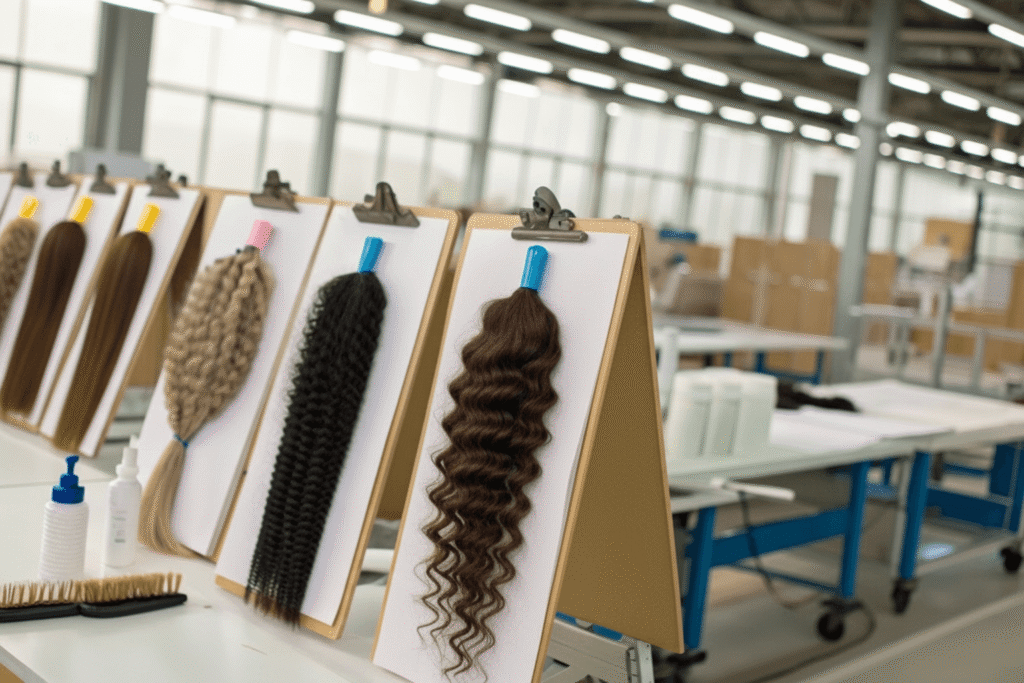
Practical comparison table (what matters in production)
| Attribute | Standard Kanekalon (modacrylic) | Heat-Resistant Kanekalon (HR modacrylic blends) | Lower-grade synthetics (PVC/toy-grade) |
|---|---|---|---|
| Softness/hand | Soft, silky, low-medium sheen | Slightly firmer hand, still soft | Waxy or squeaky, high shine |
| Style memory | Excellent “pre-set and hold” | Good, but relaxes with repeated heat | Poor; styles collapse quickly |
| Heat tolerance | Low; avoid irons | Moderate; 120–150°C with testing | Very low; warps/melts |
| Tangle behavior | Low-moderate with proper denier | Low with proper finishing | High, especially at nape |
| Safety | Often flame-retardant | Often flame-retardant | Rarely flame-retardant |
| Cost | Mid | Mid-high | Low |
Buyer guardrails I use
- Ask for denier and cross-section: fine denier (e.g., 20–30D) improves realism and softness; too fine raises frizz risk if finishing is poor.
- Confirm finish chemistry: heavy silicone masks problems short-term; I prefer balanced finishing plus antistatic treatment.
- Conduct nape-friction test: 200 brush strokes plus sweater-rub on a mannequin; evaluate tangle and fuzzing at the nape where fibers abrade most.
Which certifications or origin documents should I request for Kanekalon?
Most Kanekalon entering wig supply chains originates from Kaneka-developed formulations produced in Asia, then drawn, dyed, and finished by fiber spinners and wig factories. Documentation protects your brand and smooths customs.
Core documents I request
- Material Safety Data Sheet (MSDS/SDS): Should list modacrylic composition (acrylonitrile/vinyl chloride copolymer), additives, and handling.
- Flame-retardant compliance: Test reports to EN ISO 6941/ISO 15025 or equivalent; some markets accept NFPA 701 or GB/T standards for FR textiles.
- REACH and RoHS statements: Confirms absence of restricted substances, heavy metals, and certain plasticizers.
- Colorfastness test results: ISO 105 series (wash, perspiration, rubbing). Pre-dyed Kanekalon should meet at least Grade 4 rub fastness on light shades.
- Heat tolerance declaration: Vendor-stated safe styling range for heat-friendly lines, with in-house lab data.
- Factory QA/QC SOPs: Fiber and wig maker should share incoming, in-process, and final inspection checklists (tension, denier, curl-set parameters).
Origin and brand validation
- Brand authorization/traceability: If marketed as “Kanekalon,” request supplier’s brand authorization or purchase records from approved distributors. This avoids counterfeit or “Kanekalon-like” claims.
- Country-of-origin documentation: Certificates of origin for fiber and finished wigs to match tariff classifications (HTS). Accurate COO helps with duty planning.

What buyers should watch out for
- Vague “FR” claims without test method or date.
- “Heat-friendly” hangtags but no temperature range or lab notes.
- Excess fragrance masking monomer odor—can indicate poor curing.
How do I price Kanekalon-based wigs for wholesale margins?
I price Kanekalon units by building up from fiber consumption, processing complexity, and finishing, then layering channel costs. The goal is competitive MSRP with durable margins and low return risk.
Cost stack I use (simplified)
| Cost Layer | Driver | Notes |
|---|---|---|
| Fiber cost | Grade, denier, color complexity | Fashion shades and ombré add 8–15% vs solid naturals |
| Wefting/ventilation | Machine weft vs hand-tied, density (120–150%), cap type | Full hand-tied can add $12–25/unit in labor (Asia) |
| Heat-friendly premium | HR modacrylic blends | Typically +5–12% over standard Kanekalon |
| Styling/setting | Curl-set, steam, hot-water set | Tighter, layered curls increase handling time |
| QC and rejects | Rework rates | Budget 1.5–3% for synthetic lines |
| Packaging + inserts | Boxes, care cards, silica, barcode | $0.60–$1.50/unit depending on spec |
| Compliance | Testing, certifications | Allocate across SKUs to avoid sticker shock |
| Freight + duties | Volumetric weight favors sea; air for launches | Optimize carton pack to protect style set |
Pricing guardrails
- Target gross margin:
- Distributor/wholesaler: 18–30%
- Brand owner to retail: 45–60% blended, depending on DTC vs B2B.
- Reference bands (illustrative, varies by region):
- Basic machine-made, standard Kanekalon bob: factory $10–14 → wholesale $16–22 → MSRP $39–59.
- Lace front with layered curls, heat-friendly: factory $22–30 → wholesale $32–44 → MSRP $79–119.
- Avoid false economy: downgrading to mixed plastics lowers COGS by ~$1–2 but increases returns, which can erase 5–8 margin points.
Tactics I use to protect margin
- Engineer density smartly: 130% front/temple, 120% nape with strategic layering looks full but saves fiber.
- Consolidate colorways: run naturals (1B/2/4) deep, limit fashion shades to proven movers to reduce aged inventory.
- Encode care instructions (QR on care card) to cut misuse-related returns.
What care instructions help my customers extend Kanekalon wig life?
Clear care guidance is the cheapest warranty you’ll ever fund. I tailor care cards to the specific Kanekalon variant and style set.
Core care (standard Kanekalon)
- Heat: Do not use hot tools. To refresh curl, dip in 85–90°C hot water, blot, net, and air-dry. No boiling.
- Washing: Every 8–10 wears. Use cool water + synthetic wig shampoo. Do not scrub; soak 5 minutes, swish gently.
- Conditioning: Use synthetic-safe leave-in sparingly on mid-lengths to ends. Avoid roots and knots to prevent slip.
- Drying: Towel blot—don’t wring. Place on a vented stand; air-dry away from sun/heat.
- Detangling: Start at ends with a wide-tooth comb or wig brush. For nape friction, use a light detangler spray.
- Frizz control: Light steam pass (not touching) or a hot-water reset for curl sets.
For heat-resistant Kanekalon
- Styling temp: Keep tools within the stated range (commonly 120–150°C / 248–302°F). Always test a small underside strand first.
- Passes: Short, quick passes; let fibers cool on the tool to “set” memory.
Wear and storage tips that reduce returns
- Daily wear: Avoid open flames and high-heat sources; many modacrylics are flame-retardant, but not flame-proof.
- Friction zones: Collar and seatbelts increase tangling—recommend silk scarf or lower-collar garments when possible.
- Storage: Hairnet + original form or stand; keep away from sunlight to preserve color.
- Product use: No alcohol-heavy sprays. Use products labeled for synthetic fibers only.
Customer-facing quick guide (ready for insert)
- Before wear: Shake gently, finger-style.
- After wear: De-tangle from ends up; hang to air.
- Wash cycle: Every 8–10 wears or if product build-up occurs.
- Heat note: Only use heat if labeled heat-friendly—and stay within the printed temperature range.
Why Kanekalon keeps winning in B2B programs
From my experience, Kanekalon’s soft, silky hand; dependable style memory; safety (flame-retardant options); low moisture absorption; and broad, consistent color library make it the most reliable synthetic base for scalable wig programs. Compared to PVC or toy-grade fibers, it tangles less, shines less, and looks more natural—while costing far less than human hair. For buyers, that combination translates into fewer QC surprises, manageable care, and margins that hold through the season.